
Jump from Small-to-Big
Hello stand-up comedians (and anyone else who wants to be funny).
One of the fastest ways to surprise an audience and get a laugh is to create an abrupt change from small to big. In this week’s writing game, you’ll play with ways of abruptly jumping from the small to the big.
By the end of this post you’ll have practical ways of doing this that you can immediately apply to your own material.
Big to small: Emo Philips
Here’s a great gag from Emo Philips:
“I got in trouble on a date once. I didn’t open the car door for her. Instead, I just swam to the surface.”
───────────────
WHY THIS WORKS
The set-up to this great Philips one-liner is misdirection, as we assume the car is normally parked.
And in performance, Philips’s attitude, when he talks about getting in trouble on a date, makes us believe that his date’s complaint was rather petty, which is all part of the misdirection.
Then, we abruptly have to abandon our assumptions when we learn that the car has been plunged into a body of water, with the selfish Philips swimming to safety, leaving his date floundering. (Happily, his date must have made it to the surface to register her complaint).
───────────────
This Emo Philips gag is the opposite of an undercutting joke. For example this award winning joke from Andy Gleeks:
“I had to visit the trauma unit last weekend. He prefers the term dad.”
This joke starts somewhere out-of-the-ordinary and dramatic, a visit to the trauma unit, and ends somewhere mundane; he was just visiting his dad (albeit with the attendant emotional issues).
The Emo Philips joke in contrast starts somewhere that seems mundane (a parked car) and then jump to an incredibly dramatic situation (a car plunged into a body of water). It’s small-to-big, the topic of this post.
───────────────
TRY IT!
Make the audience assume the situation you’re talking about is mundane...
...then reveal it’s actually high-stakes and dramatic.
One way to achieve this is to start at the end with the dramatic scenario and write a line building up to it that misdirects us to assume it’s a mundane scenario.
───────────────
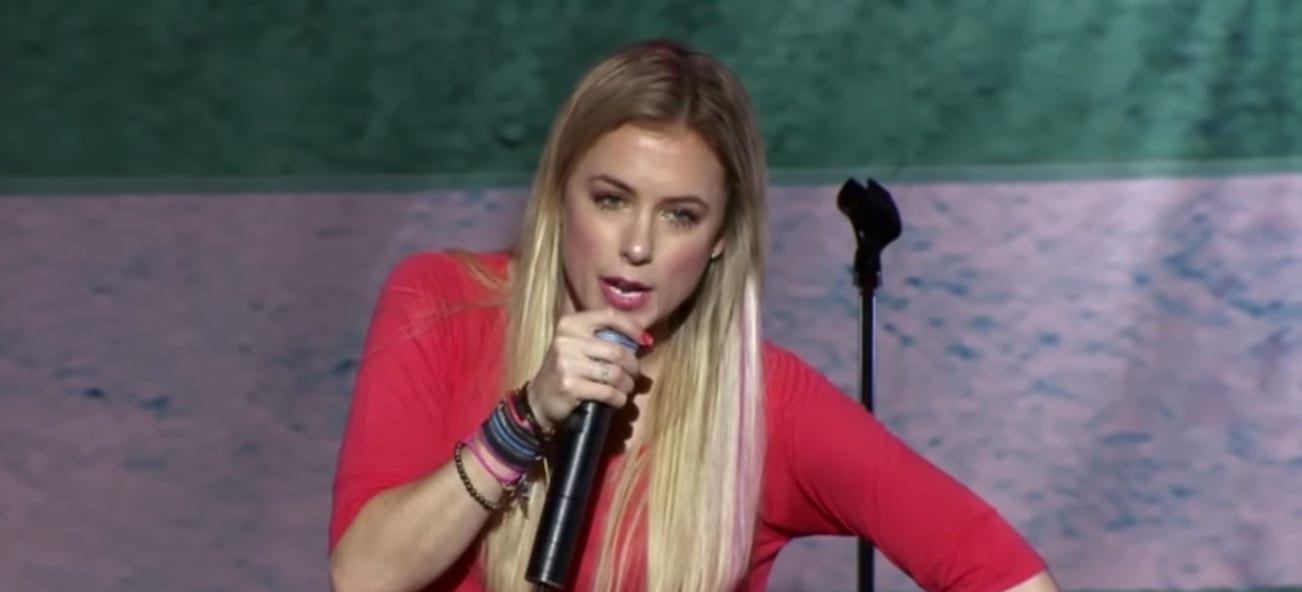
Iliza Schlesinger
The opening two jokes in this post, from Emo Philips and the Andy Gleeks undercutting joke, are stand-alone one-liners. Writing these is widely explored – including in my viral blog here! (Approaching 19,000 views!)
The rest of the jokes in this post are gags that are part of something bigger. These kinds of lines are important to building laughs as you develop an idea or tell a story.
In my previous post, I quoted Iliza Schlesinger talking about the TV channel TLC. As she opens up the topic, she asks the audience what it stands for and gets the answer, The Learning Channel. Then she says,
“But if you watch its programming, you know that it really should stand for…”
At this point we assume she’s going to give us an alternative for the acronym TLC. “The Lame Channel” for example. But in fact she gives us this BIG alternative:
“The Remember That Fourteen-Year-Old Girl That Had A Baby When You Guys Were In Middle School? Yeah, Well, Now That Kid Kind Of Tries To Do Pageants Even Though She’s Awful Looking And Doesn’t Have A Command Of The English Language. They Live In A Double Y, But They Make Like Seventy Grand An Episode, And You Still Have A Shitty Job... Channel.”
This is misdirection. She creates an expectation (that she is going to give an alternative three letter acronym that fits TLC). She spectacularly explodes that assumption. It goes from the small TLC to the massive:TRTFYGTHABWYGWIMSYWNTKKOTTDPETSALADHACOTELTLIADYBTMLSGEAYSHASJ.
This took a while to type up and it would certainly tax the continuity announcers every time they had to say the channel’s name… Watch the clip here.
───────────────
WHY THIS WORKS
Coming up with a different meaning for an acronym is a familiar game. For example, the very old joke about the defunct early twentieth century airline BOAC standing for Better On A Camel. So, this helps the misdirection as for TLC we expect something like “Totally Ludicrous Content”.
It’s also of course a comical summation of their content so gets laughs of recognition - and for audience members who don’t know the channel, it’s a funny way of bringing them up to speed.
───────────────
TRY IT!
Make the audience assume you are about to say something small in size or quantity...
...then go the other way and say something enormous
One way to achieve this is to start with something that has a familiar size or quantity… then flip to a vastly expanded version of that. (I’m suddenly put in mind of the Stay Puffed Marshmallow Man in Ghostbusters).
───────────────
Big to small: Sam Jay & Bill Burr
Finally, here are a couple of examples that are around marriages (but could be applied to any relationship). Sam Jay talks about her marriage, beginning by sweetly saying of her wife:
“She’s beautiful and I love her…”
Then she adds:
...but marriage sucks.”
We’re back to undercutting, but we’ll shortly come to our small-to-big. She then goes on to discuss the baggage that people bring into marriages (unless, she explains, they get married off aged 16 when they haven’t had time to accumulate much.) This leads to her wife asking a question about a small domestic issue:
“Why don’t you load the dishwasher?”
In response to which, she abruptly leaps to a massive emotional scale, replying:
“You don’t know my childhood”.
Bill Burr meanwhile, talking about his rather more long standing marriage, says he is considering a return to therapy. Going over what his wife has to criticise him about, he says:“I take out the trash… I pick up after myself. I like to think I’m a good dad. I work my ass off and make a great fucking living. Crush all of that! All she has on me is….”
He is about to jump from these commendable but quite routine achievements, to a total takedown of his entire existence:
“...who I am as a person”.
It’s a dramatic small-to-big! Here’s the line in context.
───────────────
WHY THIS WORKS
Both these examples begin with relatable relationship situations (stacking the dishwasher, taking the bins out, being a good dad and working hard) and then leap to massive intractable issues (a complex childhood and the total failure of who one is as a person!)
───────────────
TRY IT!
Start with an everyday situation or friction in a relationship...
...then jump to a totally intractable issue or existential failing
───────────────
If you can use a change of scale to create a one-liner that stands alone, great. But finding these laugh moments as you develop a bigger idea is an important part of your stand-up building momentum. An abrupt jump of scale can give you that.
───────────────
💡 TIP
Sudden changes are always the best. Don’t change from one state to another gradually. Do it abruptly!
The larger the change...
...the bigger the laugh.
───────────────
Can you think of other small to big examples?
And I’d love to hear what you come up with in response to this post.
See you next week!
— Chris
─────────────────
PLUG
You can do small-to-big in your dialogue in TV and movie scripts. I write about this in my Complete Comedy Script Toolkit book.
─────────────────
RELATED POSTS
More stand-up writing inspiration:
• You Animal! (Human and Animal Behaviour)
• Puppies Are Evil! (Contrarian Thinking)
• A Little Cash Bribe (Turning TV viewing into Stand-up Material)
─────────────────
Comments
Nothing yet. Say the first thing.
Sign in to join the conversation.