
Hello stand-up comedian (and anyone else who wants to write funny).
In my last post, I did a profound plunge (my preferred alternative phrase for a ‘deep dive’) on one great example of stand-up storytelling from Kevin Hart. I’ll return to this focus on one bit in future, but this time I’m writing a post where we take a subject and look at a bunch of different approaches to it.
The topic is driving. By the end of this post you’ll have clear ideas for how to funny up material about driving. Plus you’ll have some great angles to take on other topics too.
----------
💡 COMEDY TIP
Driving is a great subject for comedy because:
* it’s pretty much universal (as a driver or passenger),
* there are stakes (it’s inherently dangerous)
* and it brings out extremes of behaviour.
If the topic you want to explore ticks all 3 boxes (universality, stakes, extreme behaviour) you’re onto a winner. What other topics can you think of that tick all 3?
----------
Finding the funny in driving
I’m going to give you three angles to take on driving.
Taking a contrary stance
Absurd justifications
Absurd solutions
Let’s go through them in turn (and of course you can apply these to other topics – even better if the subject ticks all of the above 3 boxes.)
----------
Taking a contrary stance
In my second post, I looked at taking a contrarian stance. Here I’m inviting you to take some aspect of driving that people are disapproving of, and take a positive stance towards it.
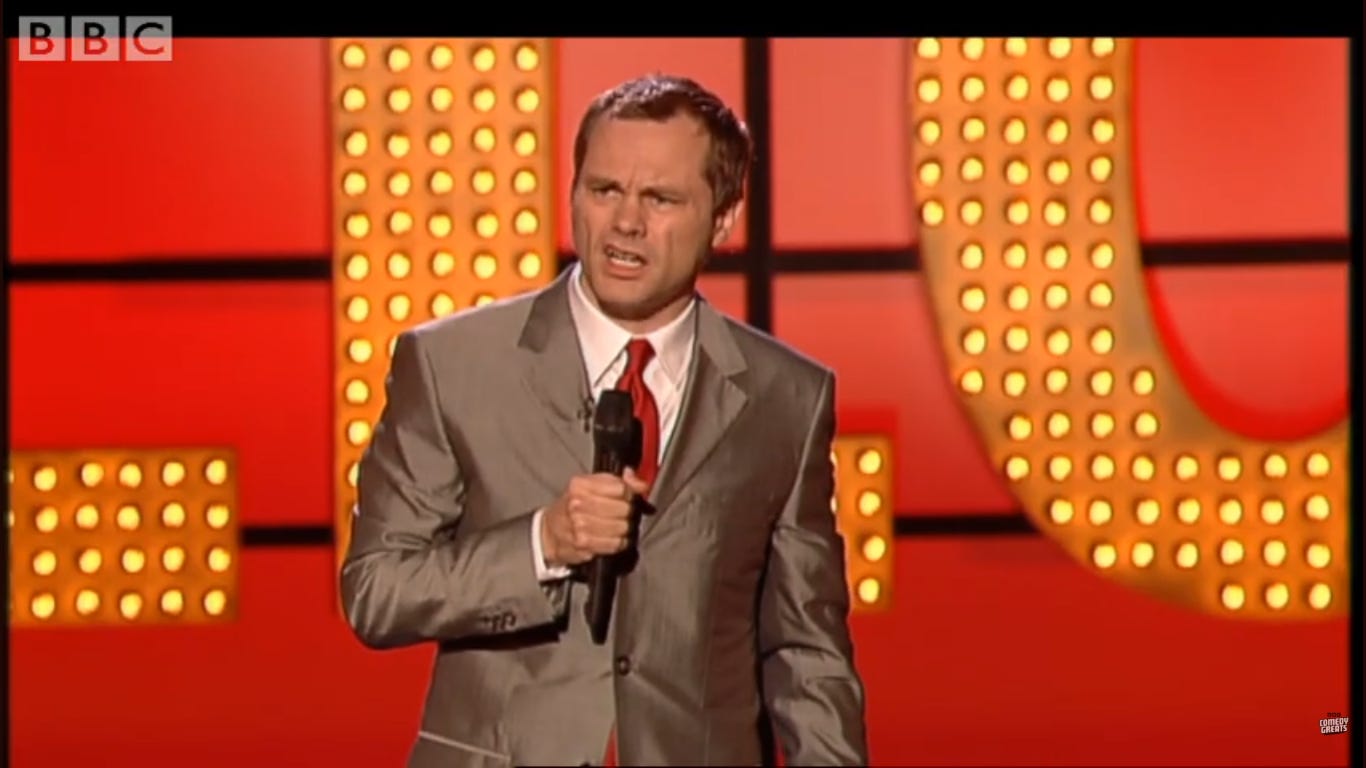
Before that, let’s return to misdirection. Here’s a great Jack Dee car related joke (from his shortlived sideburns era) that’s an example of misdirection.
Now, here’s Jack Dee on his kids learning to drive. First of all he talks about giving his daughter driving lessons and we get another example of misdirection:
“We went to Tesco car park and did the first half an hour of kangaroo starts and wrong gear and reversing instead of going forward and scratching one or two cars. And then she had a go.”
It’s the classic kind of misdirection where we make an assumption (his daughter is behind the wheel) which is then subverted (he, the father, was behind the wheel). Next we have what I think of as attitude misdirection and it’s here that we get our contrary stance:
“Last September, went to a family wedding in Cornwall. And I saw my 14 year old son with a pint of beer in his hand. Now, call me old-fashioned that for me that’s too young to be carrying on like that… It’s a bit embarrassing. I had to go up and have a quiet word with him. I said, ‘What are you doing? You’re meant to be driving us back’.”
And he adds:
“You can have 3 pints max. I’m watching you okay?”
Why it works
In both cases, we are led down one path and then it flips. Firstly, with the terrible driving in the car park, the set-up doesn’t say who is driving, so it could be either person, but we naturally assume the daughter is. Then we discover Dee himself is behind the terrible wheel. The art of this kind of misdirection is crafting a statement that is ambiguous. The audience only see the obvious interpretation then you reveal the surprise.
I didn’t learn to drive until we were planning to move out of London and into the Cotswolds in my late thirties. I started my lessons in London and at the time while compering a student stand-up gig, I said:
“You get a lot of road rage as a learner driver in London. The other day, I was in a lesson and I stalled and suddenly I hear: ‘You f**king muppet! Get off the road until you can drive properly’. And I went, ‘steady on, you’re mean to be teaching me.”
It does the exact same kind of situational misdirection as the Jack Dee joke. The attitude misdirection is more straightforward. You make it appear you hold a typical attitude to the topic – then reveal the opposite. So, initially Dee seems unhappy with underage drinking. Then we discover his contrarian attitude. He’s actually okay with underage drinking - and drink-driving at that.
----------
Absurd justifications & absurd solutions (plus more contrarian attitudes!)
Here’s another example of a contrarian attitude, where Camilla Cleese (great comedy family genes!) is positive about mobile phone usage while driving. She also employs our next two comedy techniques, absurd justifications and absurd solutions.
Here she is discussing Los Angeles traffic. She also starts out with a bit of attitude misdirection:
“I’m excited to be here. Pretty excited anytime I’m not in my car in traffic these days, right? It’s gotten so bad because everyone’s on their phone. I mean, I am too.”
So she seems disapproving then reveals she does it too. She goes on:
“But I use FaceTime. It’s much safer. You can have whoever you’re talking to watch your blind spots.”
This is a great example of an ‘absurd justification’ for your own bad behaviour. More on that below. She goes on to discuss the problem of drivers not noticing traffic lights have changed and holding up cars behind:
“Someone needs to invent an app that sends drivers a text message to let them know that the light turned green. Maybe call it a Green Alert because I hate having to wait for someone to honk.”
Finally, she finds an unexpected positive in a negative situation:
“I saw something amazing today, though, you guys. I saw a girl taking a selfie while she was driving. Like, not at a stoplight, while the car was moving, right? And normally I hate selfies, but that is a great selfie. I feel like it’s good for natural selection. Hashtag Darwinism.”
Why it works
She employs all three of the classic stand-up techniques I’m exploring in this post in this driving bit. Firstly, she takes a contrarian positive attitude to dangerous phone usage while driving.
Then there’s the absurd rationalisation of her own bad behaviour. She justifies her own phone while driving on the absurd basis that FaceTime is actually safer because the person on the video call can watch her blind spots.
Then, a classic and a favourite technique of mine to get comics working with: absurd solutions. The problem is drivers not noticing the traffic lights have changed because they’re on their phones. A rational solution: don’t use your phone while driving. Cleese’s absurd solution is creating the Green Alert app that texts you when the lights change.
----------
Take a contrary stance
Take something people don’t like about driving and be all in favour of it. In Jack Dee’s case, it’s a quick gag, but you can also go on to argue your case. So, take something people are disapproving about with driving and (after misdirecting that you are too) reveal that you are fine with it. And potentially go on to argue why.
Give an absurd justification
Give us an example of your own bad behaviour while driving (or your own bad driving) and give an absurd justification for it.
Offer an absurd solution
Take a problem that people commonly face when driving and suggest an absurd solution.
In next week’s post, I’m going to explore changing the context to create comedy and I’ll start with another couple of examples of stand-up about driving.
----------
Leave a comment below and tell us about bad behaviour or bad driving. (Your own or other people’s). Or share a favourite example of stand-up about driving.
----------
If you’d like a free 15 mins consultation on your stand-up, you can book here.
My next Stand-up Comedy Generation Course on Zoom starts in September.
Here’s my acclaimed book on stand-up.
And here’s my latest book The Complete Comedy Script Toolkit
----------
For more on contrarian stances:
Comments
Nothing yet. Say the first thing.
Sign in to join the conversation.