
Over the last few years, I have collected an unusual set of screenshots. One by one, a small who’s who of climate deniers has blocked me on X, and I saved each notification as it arrived.




I did not block any of them; they blocked me, and they did it after I showed up beneath their posts with a citation and a genuine question about where their numbers came from. Every one of them has insisted, at one point or another, that the science is not settled, which has always struck me as a strange thing to say right before refusing to let a meteorologist reply. For a long time I treated the whole collection as a running joke, telling audiences that the fastest way to get blocked online was not to hurl an insult but to politely ask a contrarian to source his claim. I am not telling it as a joke this week.
This week, Politico and E&E News reported that one of those accounts belongs to a man who now runs the U.S. Global Change Research Program. Matthew Wielicki, a former University of Alabama geochemist who calls himself a “professor in exile” and who has spent years describing mainstream climate science as alarmism, is its new director, and his own bio on X confirms it in plain text: “Director - United States Global Change Research Program.” I want to walk through what that job actually entails, because the title alone does not begin to capture the stakes.
Congress created the U.S. Global Change Research Program through the Global Change Research Act of 1990, signed into law by President George H.W. Bush, and gave it the job of coordinating climate research across roughly fifteen federal agencies, among them NASA, NOAA, the EPA, and the Departments of Defense, Energy, and State. Its flagship product is the National Climate Assessment, a congressionally mandated report released every four to five years that draws on hundreds of peer-reviewed studies to lay out, region by region, how a warming planet is reshaping American infrastructure, health, water, agriculture, and the economy.
It is worth understanding how a person comes to run that program, because the mechanism is part of the story. USGCRP sits inside the White House Office of Science and Technology Policy, under the umbrella of the National Science and Technology Council, which means the job of directing it is not a Senate-confirmed position. There is no nomination sent to Capitol Hill, no confirmation hearing, no vote, and no public vetting that the rest of us get to watch. The only Senate-confirmed official anywhere in that chain is the OSTP director, Michael Kratsios, who was confirmed in March of 2025; everything beneath that line, including the person who now steers the National Climate Assessment, is filled at the administration’s discretion. That is how someone who has spent years arguing the assessment should be scrapped can be installed to write it without ever answering a single question under oath.
That report is far more than a pamphlet gathering dust on a shelf. It is the document a town engineer reaches for when sizing a culvert, the reference a coastal planner leans on when deciding how high to build a road, and the justification an emergency manager points to when applying for the mitigation grant that keeps a neighborhood dry. I have relied on it in my own work more times than I can count, and so has nearly every serious planner, insurer, and public official who has to make a decision about a coastline or a floodplain. Now the person in charge of it has argued, publicly and repeatedly, that it should not exist.
When the Fifth National Climate Assessment was published in 2023, Wielicki reviewed it and landed on two words: good riddance. In his own newsletter, under his own name, he has described USGCRP, NASA’s climate office, and Climate.gov as institutions that manufacture fear in order to keep taxpayer grant money flowing. That is not my caricature of his views; it is his stated position, argued at length. So this is not a case of a skeptic being handed a seat at the table. It is a case of a skeptic being handed the pen that writes the record the table produces.
I did not come to this story because of a headline; I have been tangling with this particular person for well over a year. In March of 2025, a paper began circulating in denier circles claiming to be the first climate study ever written by an artificial intelligence, Elon Musk’s Grok, as its lead author. It carried the “peer-reviewed” label and appeared in a fringe outlet called Science of Climate Change, and among its co-authors was Willie Soon, a contrarian who has taken more than a million dollars in fossil fuel industry funding over the years. It leaned on a solar reconstruction that NASA’s Gavin Schmidt pointed out had been reexamined and found to be fabricated, AFP and France24 both ran debunks, and a microbiologist who tracks research fraud noted that the paper did not even disclose how the AI had been prompted, which meant no one could check its work at all. That was the caliber of “science” making the rounds, and it was being shared as though it settled something.
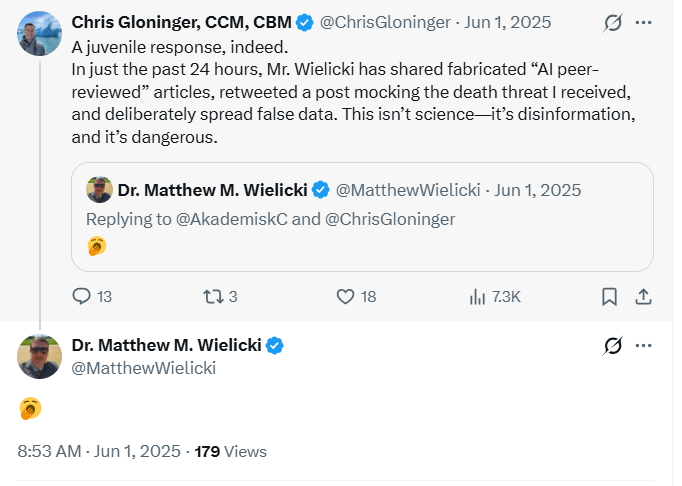
On the first of June, 2025, I said so publicly, writing that Wielicki had shared fabricated “AI peer-reviewed” articles, deliberately spread false data, and retweeted a post mocking the death threat I received in Iowa, the one that helped drive my family out of a state we had come to love. His entire reply was a single smirk/yawn emoji, and he did not deny a word of it. I raise all of this now not to relitigate a year-old exchange, but because it is the résumé, the demonstrated judgment and relationship to evidence that a person carries into the office that now writes the nation’s official climate record.
What the headlines are underselling is that the National Climate Assessment is no longer just a summary of the weather. Over the last decade it has quietly become a load-bearing legal citation, turning up in lawsuits against fossil fuel companies, anchoring the defense of federal climate regulation, and sitting underneath the 2009 Endangerment Finding, the EPA determination that greenhouse gases threaten public health and the legal keystone that allows the federal government to regulate carbon at all. Once you see that, the fight over who runs USGCRP stops looking like a dispute over temperature readings and starts looking like a fight over a legal instrument.
We have already watched the dress rehearsal. In 2025, Energy Secretary Chris Wright, a former oil and gas executive, quietly assembled five hand-picked climate contrarians into what he called a Climate Working Group, and they produced a report, titled A Critical Review of Impacts of Greenhouse Gas Emissions on the U.S. Climate, that broke from the scientific consensus and downplayed the severity of warming. The EPA then cited that report twenty-two times in its effort to rescind the Endangerment Finding. In February of 2026, U.S. District Judge William Young ruled that the group had been assembled illegally, in violation of the transparency requirements of the Federal Advisory Committee Act, and scientists whose research the report cited said their findings had been misrepresented, with one fact-check counting more than a hundred false or misleading claims. The judge declined to strike the report from the record, so federal agencies can keep using it anyway.
That is the template: a small, hand-picked group, a conclusion largely settled in advance, and a document engineered to be cited in court. Install that same logic inside the office that writes the official National Climate Assessment, and it becomes clear why this appointment matters far more than any block ever did. Michael Kuperberg, who ran USGCRP under two prior administrations, made the quiet point to Politico that an assessment written by a small, hand-picked group will not represent the wider field, and that is the whole strategy in a sentence: not to win the argument in the open, where it tends to lose, but to rewrite the reference itself so the open argument never has to happen.
As of tonight, this appointment has been reported by Politico and E&E News, confirmed through Wielicki’s own public posts and a second person familiar with the program. The White House did not make him available for an interview, though it did send a statement, and it has not yet issued a formal announcement naming him. I want to be careful about that distinction rather than paper over it, because careful is the entire point of the work I do. If you would rather not take my word for any of this, his own bio on X remains the simplest source imaginable. It says “Director.” I am not asking you to trust me; I am asking you to read him.
For years a handful of accounts told me the science was not settled and then blocked me so they would not have to watch it settle, and I wore the whole thing as a joke, saving the screenshots the way some people save ticket stubs. I am not laughing this week. The argument did not change simply because they stopped letting me make it. The carbon in our atmosphere still carries the isotopic fingerprint of coal, oil, and gas rather than volcanoes or the sun, the oceans are still absorbing roughly ninety percent of the excess heat we have trapped, and the last time this planet recorded a cooler-than-average year was 1976. None of that shifted when Wielicki updated his bio.
I am proud to be part of this group - help support our work:
No posts
Comments
Nothing yet. Say the first thing.
Sign in to join the conversation.