
(This will always be free, but paid support is always appreciated. Please share & repost to get the word out!)
Thursday night in Los Angeles, the 2026 FIFA World Cup kicked off in front of eighty thousand people and a global television audience somewhere north of a billion. By most accounts it was spectacular. What it wasn't, at least in any of the pre-match coverage I watched, was honest about where this tournament is being played and what the climate data says about those places.
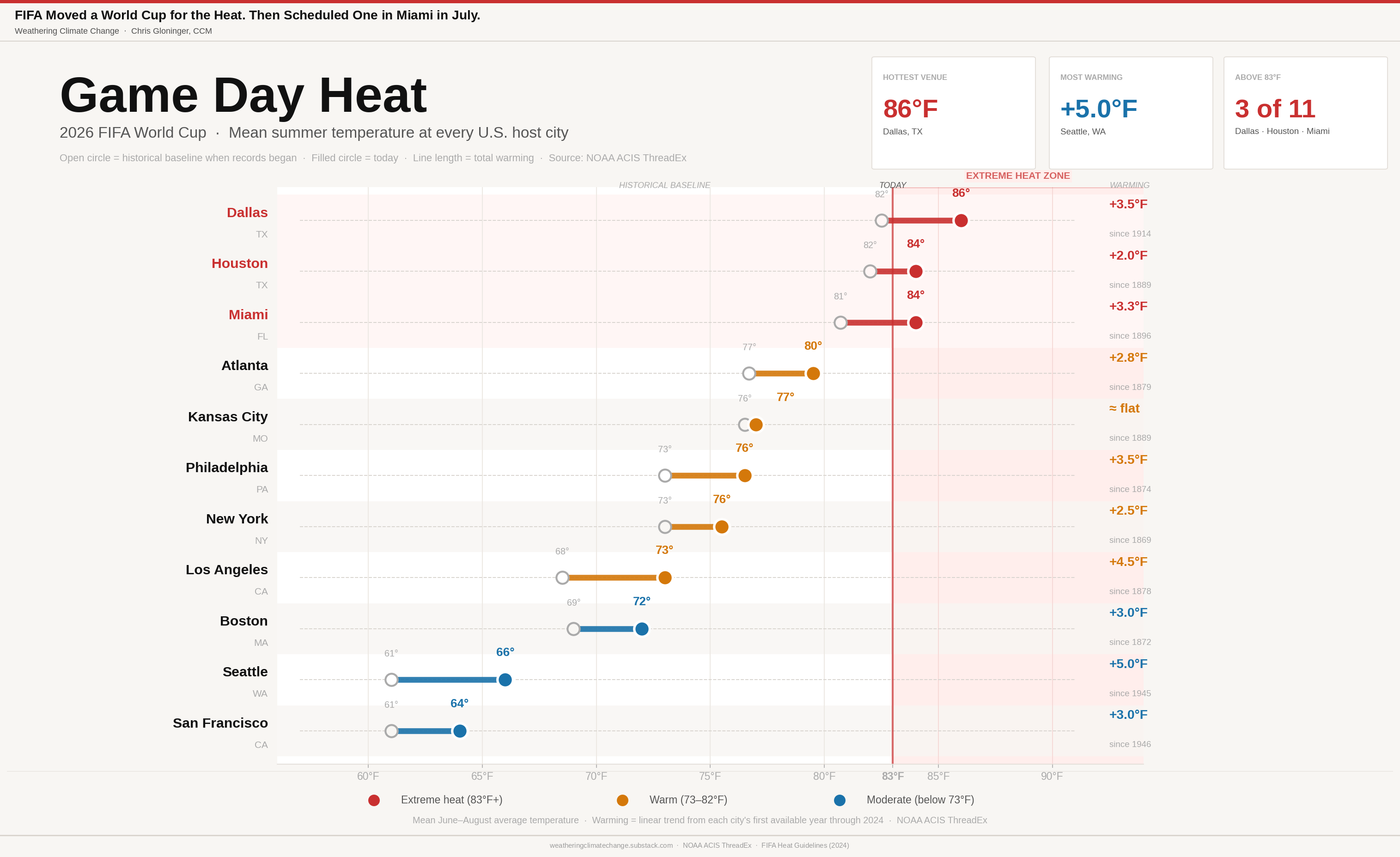
I've been pulling historical temperature records for the eleven U.S. host cities for a few weeks now, working from NOAA's ACIS ThreadEx database, which has station records going back to 1869 in some cases. The story those records tell is consistent across every city on the list, which is that every single one of them is measurably warmer than it was when weather observations began. Seattle has warmed four and a half degrees Fahrenheit since 1945. Los Angeles is up four and a half degrees since 1878. Philadelphia has warmed three and a half degrees since 1874. These aren't model projections or future scenarios. These are what the thermometers recorded, year after year, at the same stations over generations of observations.
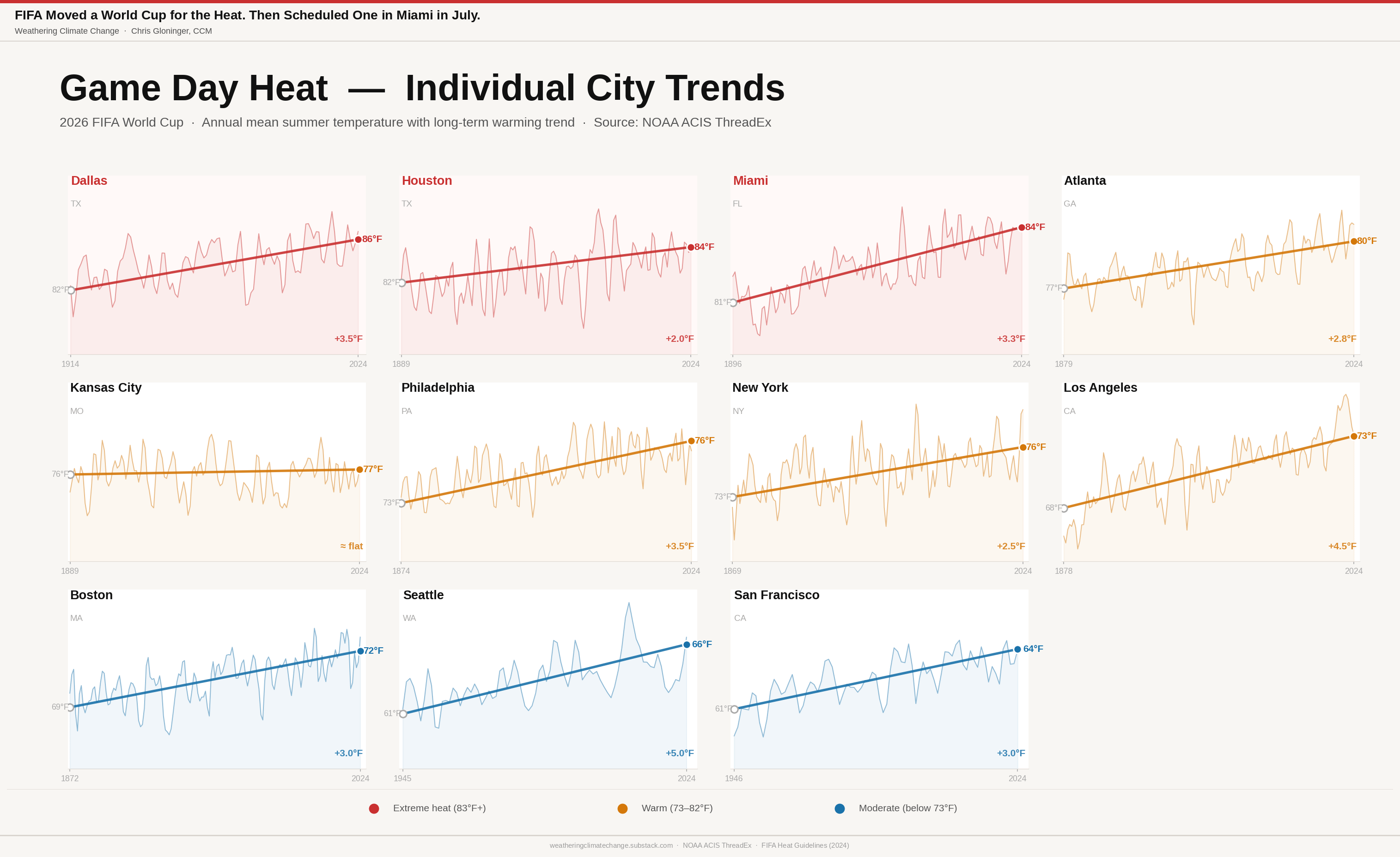
The cities I keep coming back to are Miami, Houston, and Dallas, because those are the ones already operating at temperatures that sports medicine professionals classify as genuinely dangerous for outdoor athletic exertion. Dallas averages 86 degrees Fahrenheit in the summer months and has warmed three and a half degrees since records there began in 1914. Houston averages 84 degrees and has warmed two degrees since 1889. Miami averages 84 degrees and has warmed more than three degrees since 1896. Those are the averages, meaning that's what you expect on a typical summer day in those cities, not the worst-case scenario.
Four years ago FIFA moved the Qatar World Cup to November and December because Doha summers regularly exceed 104 degrees and the organization concluded that staging a football tournament in those conditions would pose serious health risks. They have internal guidelines covering exactly this, specifying the thresholds at which cooling breaks become mandatory and the conditions under which matches should be postponed. So the institutional knowledge is there. The science is understood at the highest levels of the organization. And yet here we are, with matches scheduled in Miami in July.
Part of what gets lost in conversations about heat is that the temperature reading alone doesn't capture the danger, particularly for people engaged in strenuous physical activity. Your body has one primary tool for cooling itself in extreme heat, which is sweat evaporation, and whether that tool works efficiently depends almost entirely on how much moisture is already in the air around you. On a 95-degree afternoon in a dry climate, sweat evaporates quickly and does its job. In Miami in July, the air is already carrying close to as much moisture as it can hold, which means sweat evaporates slowly or not at all, and your core temperature keeps climbing without much to stop it.
The metric that accounts for all of this together is wet-bulb globe temperature, which incorporates air temperature, humidity, wind speed, and solar radiation into a single number, and it's the standard used by the IOC, the U.S. military, and sports medicine organizations when they're making decisions about safe conditions for physical exertion. Working from NOAA climate normals for the 1991 to 2020 period, my estimates put Miami at around 31 degrees Celsius WBGT during peak afternoon conditions, Houston at roughly 30.5, and Dallas at about 28.4, which is right at the threshold where FIFA's own guidelines say cooling breaks become mandatory. Those are averages on typical summer days. There's a threshold in heat physiology at 35 degrees Celsius wet-bulb where the physics of evaporative cooling essentially fail completely, meaning the human body cannot cool itself even lying still in the shade, and on the worst summer days in South Florida we're not particularly far from it.
Elite footballers generate internal heat at roughly fifteen to twenty times their resting rate during intense play, and their core temperatures during a match routinely reach 102 to 104 degrees Fahrenheit. Efficient sweating in low-humidity conditions keeps that manageable. In Miami or Houston in late June or July, the body is working against a much steeper gradient, and the margin shrinks considerably. This isn't theoretical. Heat exhaustion and heat stroke are documented outcomes from sporting events held in comparable environmental conditions.
The evening scheduling argument is worth engaging with because it's the one that comes up most often when I discuss this with people. Yes, a 7 PM kickoff is meaningfully cooler than a 3 PM match, and that matters. But players are warming up in the late afternoon when conditions are still dangerous, fans are arriving hours earlier and sitting in serious heat, and the thing that has changed about cities like Miami over the past few decades is that overnight temperatures don't recover the way they once did. The lows in July in South Florida now regularly stay above 80 degrees. The relief that used to come after dark is less reliable than it was. And the tournament runs through July 19th, so the later rounds, the semifinals and the final, are being played when summer heat across the southeastern United States has fully arrived.
Kansas City is the interesting outlier in the data. Its long-term trend line is essentially flat, which is a documented phenomenon in the central United States that researchers attribute to a combination of agricultural irrigation, aerosol effects, and atmospheric circulation patterns that have dampened the warming signal there relative to other regions. Even so, Kansas City's baseline summer temperatures still place outdoor athletic exertion in what WBGT standards classify as high risk. There isn't a city on this tournament's U.S. roster where climate is simply not a factor.
None of this means the World Cup should be canceled or that FIFA made a straightforwardly indefensible decision. What it does mean is that the climate context for this tournament is being almost entirely absent from mainstream coverage, and that absence has consequences. Real-time WBGT monitoring at every venue, transparent public disclosure of those readings on match days rather than just the air temperature, and pre-announced protocols for cooling interventions aren't radical asks. They're achievable with existing technology and organizational will. They just require treating the science as seriously as FIFA's own guidelines say it should be treated.
The broader question, the one that extends well beyond this particular tournament, is about where we're headed. Summer outdoor sporting events at this scale are going to require increasingly difficult decisions about which cities can safely host them and under what conditions as warming continues. The World Cup, the Olympics, grand slam tennis, marathon majors, all of it is going to come up against these questions more frequently and more urgently. The physics of evaporative cooling don't negotiate, and the atmospheric warming that has already occurred in every one of these eleven American cities isn't going to reverse itself between now and July 19th.
The games started Thursday. It was already hot. It's going to keep getting hotter.
I’m proud to be part of the Iowa Writers Collaborative. Please support our work.
No posts
Comments
Nothing yet. Say the first thing.
Sign in to join the conversation.