
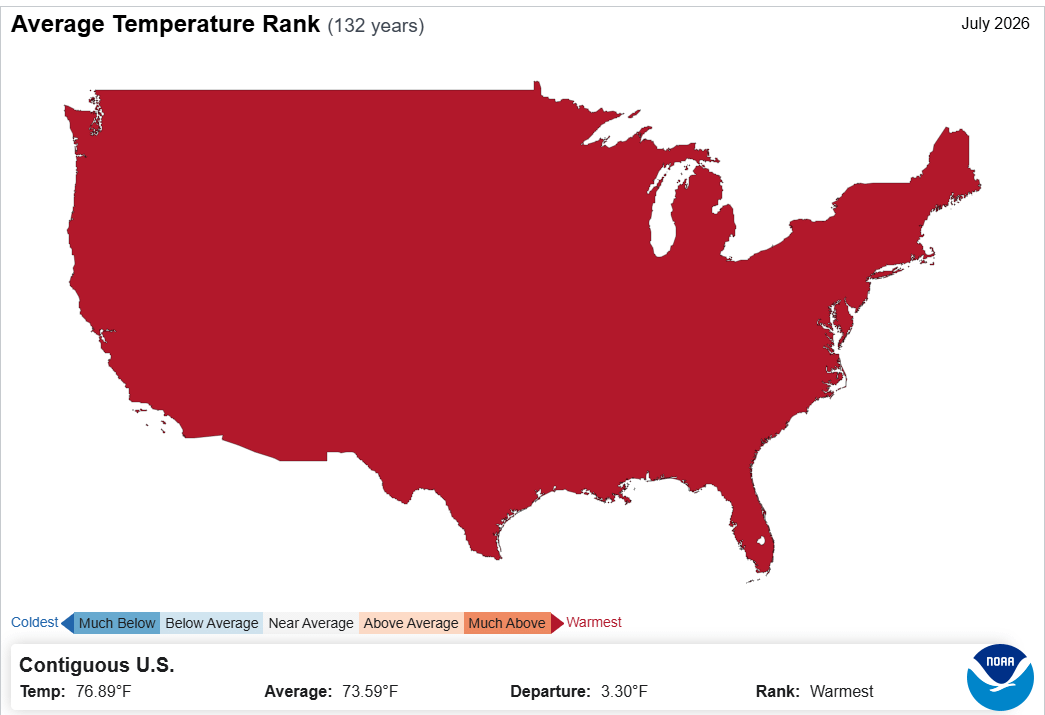
July 2026 was the hottest month ever recorded in the contiguous United States, according to NOAA’s records dating back to 1895. Analyzing 1,579 months of data, July did not just set a record for that month, it became the hottest month overall. While skeptics note that daytime highs were not record-breaking, the average temperature was driven largely by unusually warm overnight lows. Those nights averaged 64.2°F, breaking the previous record set in July 2022 by 0.7 degrees, while the month edged past July 1936 and July 2012 by a tenth to two-tenths of a degree.
Let’s rewind to the 1930s, because those same skeptics point to that particluar period of heat. The Dust Bowl ( in the Great Plains still helps account for some of the highest temperatures ever recorded throughout the contiguous United States. When soil moisture is gone, incoming solar energy goes into heating the air instead of evaporating water. During the 1930s, equatorial Pacific waters were cool and North Atlantic waters were warm, a combination that weakened the Great Plains low-level jet, the conveyor belt that carries Gulf moisture north into the central part of the country. The drought came in four rounds: the first between 1930 and 1931, the second in 1934, the third in 1936, and the fourth between 1939 and 1940.
The way the United States managed its agricultural practices helped compound the dry conditions. During the 1920s, the WWI wheat boom, a sharp inflation spike, mechanization, and the one-way disc plow led farmers to break up millions of acres of native shortgrass sod across the southern Plains. Fine, poorly aggregated soil, exposed ground, and Plains winds were enough to produce widespread saltation and suspension.
During my climate talks, I show a map of global temperature anomalies compared with the 20th century baseline. The blue shades indicate below average temperatures and red shades indicate above. As the animation progresses, blue colors fill more space than red. By the end of the animation, it’s mostly red, with some exceptions (one being the land ice melt in Greenland dropping the temperature – which is a bad thing, not a good thing). The 1930s were a deep red over the contiguous United States, but the rest of the world was largely shaded in blue. The U.S. was the exception. Temperatures were warmer than average because the day time highs were so hot.
Today it’s the overnights that are warm. Record-warm overnight lows also help disprove claims that recent warming is driven by the solar cycle. We can see the greenhouse signal clearest at night, when the earth’s surface tries to release heat but that heat gets trapped by those gases. Globally, the spread between daytime highs and nighttime lows has been shrinking for decades. This is because greenhouse gases trap the heat at night, which helps warm our average temperature.
I am proud to be part of this taleted group of writers and journalists. Please support our work.
No posts
Comments
Nothing yet. Say the first thing.
Sign in to join the conversation.