
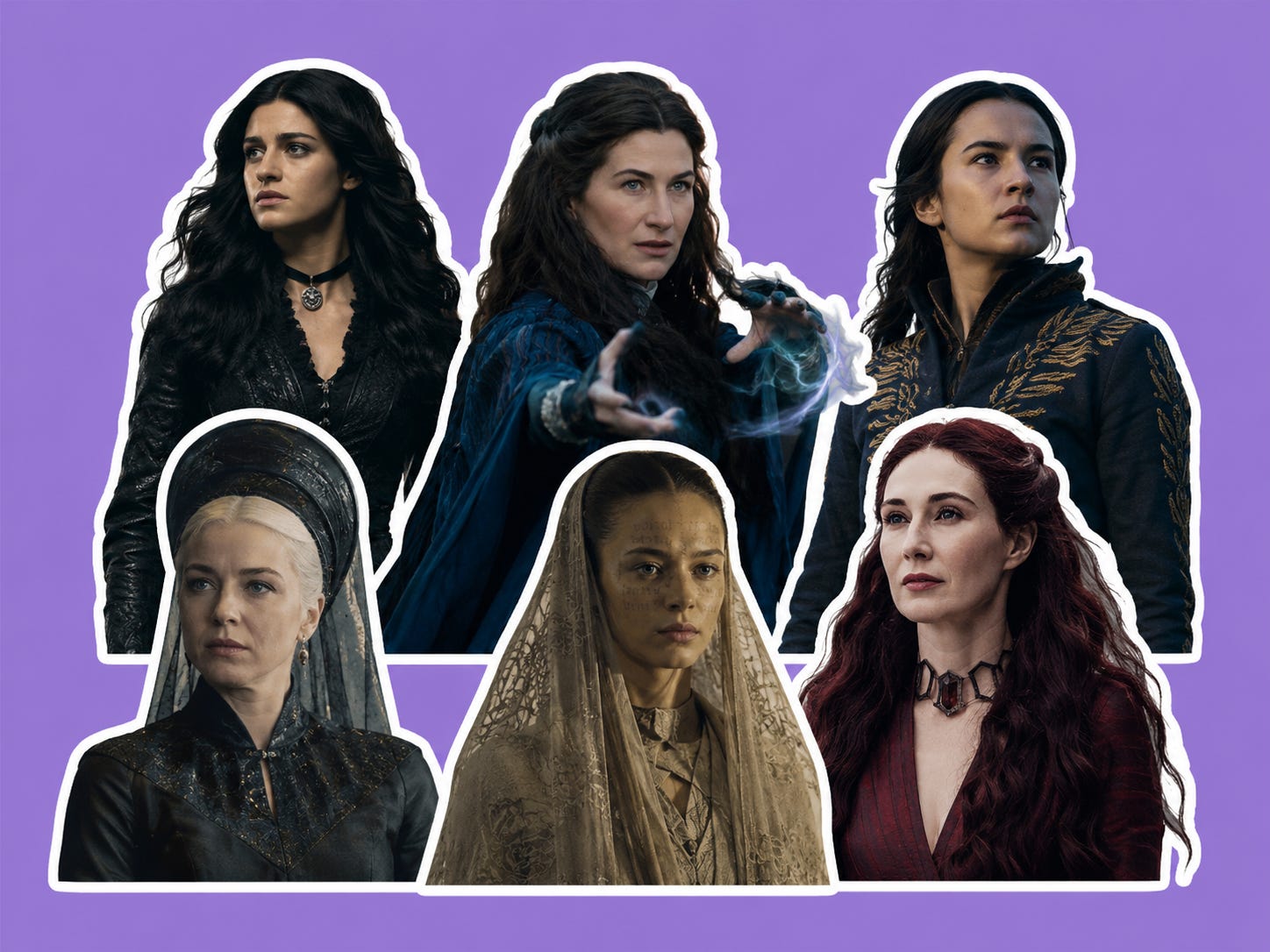
I was watching The Witcher (2019) the other evening, one of the earliest entries in our current cycle of prestige fantasy obsessed with female manipulation, domination, and control. Starring Henry Cavill's wig, the show is an ambitious dynastic tale following three different timelines across multiple decades: though mystified viewers could only discover this with a Google search.
Maybe children who grew up watching Lord of the Rings now want more of the same but with nudes. And less God please. A ten- to fifteen-year-old who watched Frodo destroy the One Ring would have been in their early twenties when Game of Thrones aired. The biggest demographic of viewer for that first season was 18 to 49 year old men: geeking out on Middle Earth style pre-industrial kingdoms but with more breasts and genitals. The show drew in a broadened cross-gender audience as seasons went on. Witcher follows on in the tradition, but post-COVID shows such as Shadow and Bone (2021), Wheel of Time (2021), and Dune: Prophecy (2024), have been increasingly preoccupied with lesbian witches. This is a far cry from the world presented by Legolas, Gandalf, Boromir and Tolkien.
Wheel of Time moved beyond the novel to insert throuples—dominant female witches married to gay men—and lesbian bonds formed from adolescent schooling norms creating lifelong sexual attachments. Shadow and Bone also significantly turns up the volume on “queer identities” incuding homosexual relationships that aren’t necessarily found in the novels. Meanwhile, Dune: Prophecy is as dull as you imagine a coven trying to control intra-galactic events would be. Visually striking, the series reminded me a little of the arts boarding school my sister briefly attended, with her tales of girls storming into the dorm room to declare they’d broken up with their best friend, asking another girl if she could call her mom, while another threatened to end her life by jumping out of the window. The Lodge of Sorceresses, The Aes Sedai, the Grisha, and the Bene Gesserit show what a nightmare a manipulative matriarchy ruling the fantasy world is like: overwrought females, drunk on power and control, murdering each other with bloodied daggers.
It is hard to see how any of this is progressive. Powerful women are presented as independent through being unable to bear children, using sex as a tool of manipulation, and forcing the exercise of supernatural power through incantation and spells to control others’ wills. These shows are not progressive but rather recycle ancient tropes about women as cunning, manipulative schemers. The portrayal of women is reduced to a choice between—as my wife put it so succinctly—“witches or bitches.”
That is why these shows, based on novels written in the 1980s, 1990s, and 2010s, lean into queer identity so much and why casting directors are at pains to present an ethnically diverse cast: an attempt at a progressive diversity packaging to cover up the works’ misogynistic and regressive contents.
But I think these fantasy series are bumping into a truth that they cannot get away from. Having survived the millennium bug, post-millennial cultural output moved on from stories about the end-of-the-world (America) through meteors, disease, or alien invasion, and instead now signals the West’s story-telling-elite’s preoccupation with origin stories.
Religion isn’t absent in these shows. Game of Thrones’ assessment of the old gods and the new, and the rise to political power of a zealot, are an interesting exploration of institutional power developed by those who establish a society’s moral code. Yet, the huge outpouring of fantasy genre is a groping around attempt at reimagining a European past, without the influence of Christianity.
These parallel universe stories are odd because they draw on imagery of a Christian Europe—kings, trade, legal rights and norms, and the existence and competition of religious forces—but clearly with an absence of the near eastern monotheism that shaped the moral architecture of Europe for centuries around the example and worship of Jesus Christ.
The portrayal is a visually ambitious attempt by prestige fantasy to show how positive an a-Christian society would be: plural sexual possibilities and the benefits of female domination. It is, in that sense, an attempt to rewrite history as one that would have bent toward the arc of today’s contemporary “woke” nirvana without the need for a DEI corrective. Rather these series invite the viewer to enjoy what might have been had the Church never existed.
The Christian faith is often parodied in other multi-million dollar drama, and by “woke” advocates, as a predictable smorgasbord of sexual perversion, domineering political power, or sacrificing children to the appetites of priests. And yet these are the very virtues celebrated by our contemporary streaming output. Yennifer in Witcher sacrifices her natural ability to have children in exchange for supernatural and political power. The Red Woman in Game of Thrones burns King Baratheon’s child in a failed attempt to secure victory in battle. Queen Cersei and Daenerys Targaryen both use their positions of royal power to mass-murder their own subjects while enjoying incest. Sister Valya Harkonnen rises to the head of her order by learning “The Voice” and using mind-control to murder her superior, Mother Dorotea. None of this is “giving vibes.”
Rather, these are deeply regressive portrayals of women, absent of motherhood, nurture, friendship, life-giving community, the ability to enter into relationships with men, where being boring, menopausal, or having an appetite for anything other than control, isn’t considered.
Now, admittedly, these shows are about the ruling class—the nobility—so of course there is a focus on power and politics. But other presentation of women could be offered here drawing from real-life experience. The community of Huguenot noble women who through reading groups and influence were able to change the course of French history without resorting to murdering babies, each other, casting spells, or scissoring. Temperance movements, possibly Suffragettes, Catholic and Protestant monarchs offer counter weight story guides that could make for more interesting and nuanced portrayals of female power.
But alas, script writers have forgotten the words of Éowyn as she kills the Witch King of Angmar, “I am no man.” Too often, unsure how to write powerful women, writers fashion them in these stories as men: power-obsessed, independent, serial shaggers who don’t raise children. Tolkien is often criticized for not including enough female characters in his novels, but unlike our contemporary output—influenced by his faith—he does at least include some.
The fully realized worlds of our prestige fantasy series cannot escape the fact that a cosmos absent of the dazzling concepts of grace, forgiveness, and mercy oriented around the person of Jesus Christ are, indeed, worlds absent of grace, forgiveness, and mercy. No amount of wardrobe, witchcraft, or women’s rise to power can overcome these constraints. In fact, the exploration of origin stories shaped in the absence of Christ does actually serve to point to His presence in real life. Without, the results are portrayals of women that are regressive.

No posts
Comments
Nothing yet. Say the first thing.
Sign in to join the conversation.