
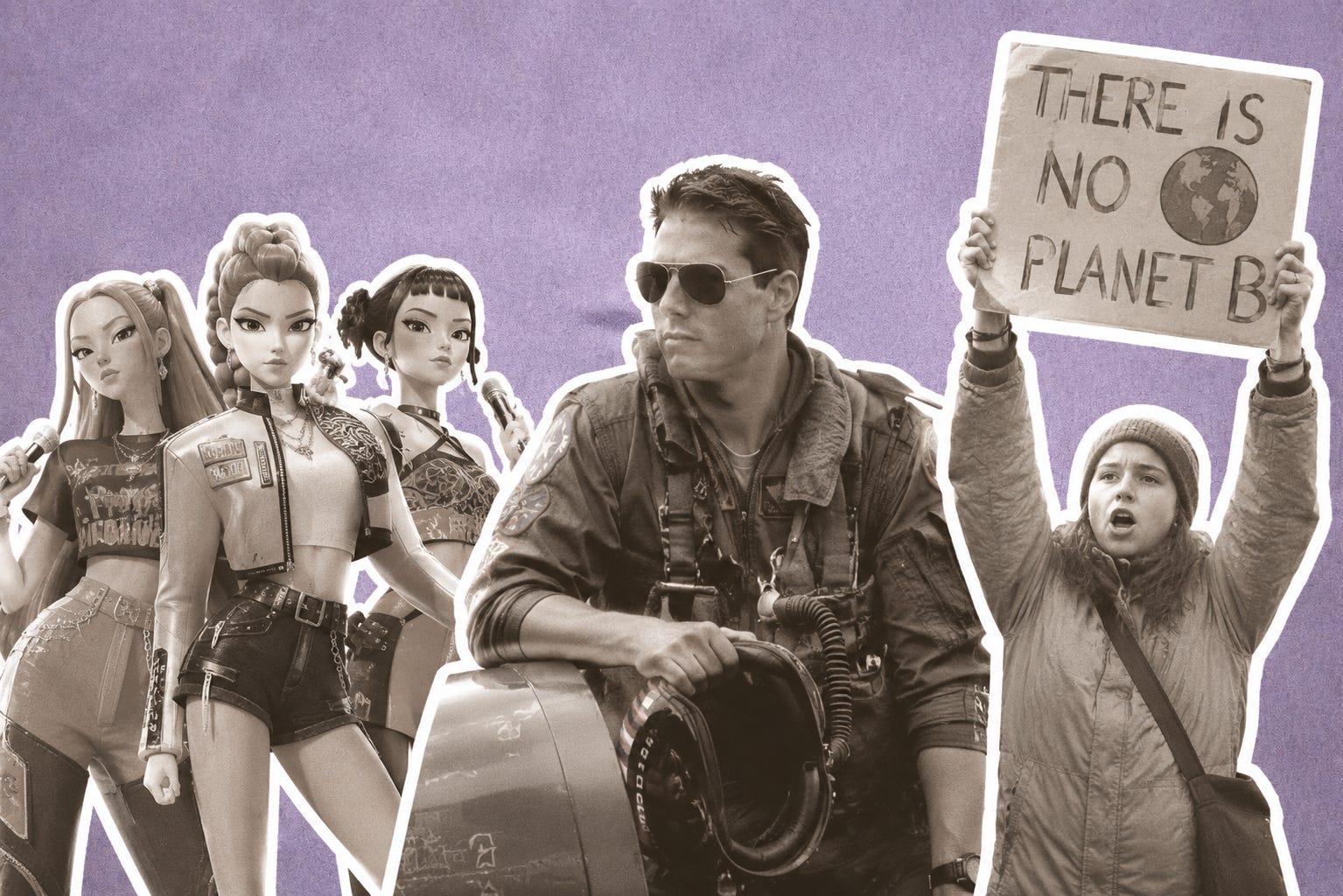
Plants fearing a survival threat are known to produce stress-induced flowering mechanisms in what is known as distress cropping. I’ve wondered if this is what is happening in Korea: with its population death spiral, it is churning out incredible artistic and cultural production in a last-bid attempt to seed the world.
K-Pop Demon Hunters has been a year long obsession for my six year old daughter who loves their music. She was excited when I bought back a Huntrix themed $2.99 just-add-hot-water noodles pot back home the other afternoon.
It’s not just her, her parents have been binge watching Korean content on Netflix too. Hellbound is startling in its originality as ‘demons’ appear at appointed hours to take people to hell. The damned are beaten violently and then burnt to ash in front of a quickly assembled audience from Korea’s top 1%. I gleaned from the show that in Korea, Barbour jackets, Chevrolets, and thermal coffee cups are considered extremely aspirational elite fashion.
The Great Flood is a film about a young mother and her six year old son having to escape a deluge created by an asteroid impact. A scene of the two climbing 30 stories of block housing in Seoul to outpace the rising flood continues on for the duration of the entire film. We see a lot of samey IKEA-styled interiors. I note how cluttered the kitchens are, and wonder how people are able to live in such close quarters in such large blocks. The film seems excited about the obliteration of the human race. Korea’s low fertility rate maybe something to do with the fact that there are next-to-no fathers in the film, the mothers heckle their kids, and men have guns and rob. In the end, something like a 3D-printed husbandless Madonna and Child emerge from a space rocket to reseed the human race.
I sense that, in Korea, society is quite preoccupied with the apocalypse, of a divine retributive nature—of a damned if you do, damned if you don’t variety. A lot of smiting seems to go on in the national psyche. I’m not sure what missionaries mingled their theologies with what preexisting cultural predilections for religious hysteria, but I did grow up hearing about the virtues of Korean prayer, which involved a lot of screaming.
But it’s not just Korea is it? Having recently subscribed to Netflix I see that the apocalyptic is in everything. I started something called IO (Jupiter’s moon) this weekend. A sort of female Tyler Durden from Fight Club narrates with a whiny accent about toxic pollution everywhere.
What I’ve noticed about science fiction in the last decade is that the threat is no longer the alien, it is us—humans. No more are we concerned with fleshy blood covered fetal erections bursting out of our stomachs and fending spaceship and Earth from their contagion. Now the human species is the contagion that deserves to be wiped off the face of the planet and in every simulation run—no matter what combination of DEI casting is thrown at it—we are doomed. The planet is made rotten, the only hope is somehow spending a decade to fly impossible distances to another goldilocks zone, where the human species is the bloody fetal erection colonizing other planets.
An alien erupts, a form of gastroentiritis, from Alien (1979)
So could someone at Netflix please just cheer up.
They might not be alone. One in three Americans think the world will end in their lifetime, a widely reported UC Irvine study notes. It appears to be corroborated by other findings, such as a PEW survey where “end times” thinking is recorded as most prevalent among evangelical Protestants (63%), but also nearly a quarter of those with no religious affiliation (23%). YouGov found too that 43% of Americans are actively "concerned about the possibility of the end of the human race on Earth", whether caused by climate catastrophe, God, nukes, or AI.
The UC Irvine report finds that those who think God will smote Earth’s ruin in our lifetime are more relaxed about policy solutions than those who think the danger anthropomorphic. While the reports finds that end-of-the-worldism is more popular among Protestants and Muslims, it too confirms it as entrenched in the wider American culture.
In as much as science fiction channels contemporary societal anxieties, it strikes me that people fear being at the apex of human technological, economic and social development and can only see “down” as the way ahead.
Science fiction nowadays is also less about interplanetary exploration (unless it’s about some sort of weird decolonizing colonization in the Star Trek franchise), and more about total societal collapse: zombies feature heavily. The Walking Dead, my god, even Game of Thrones turned out to be a zombie series. My hunch is this plays into fears of our fellow Americans as being untrustworthy. Last decade’s concern with oppressive political regimes (Hunger Games) has given way to the “what if” all government and society is wiped away concern.
A Pew survey in March indicates that climate change pessimism has grown substantially over the last four years. 62% of US adults don’t think countries will do enough to avoid the worst effects of climate change, up from 53% in 2022. This is a distinctly partisan pessimism. For example, “90% of Democrats with a postgraduate degree say the Earth is warming mostly because of human activity” compared to just 20% of Republican voters with a postgraduate degree. The partisan difference expresses a different role of humanity on the planet and a different role for government. Democrats see humans as the problem and government as the solution.
Obama, Netflix’s Influencer-in-Chief, and the country’s perpetual President Emeritus, railed against a recent Trump announcement to relax a 2009 ruling that gas emissions cause climate change. Governor Newsom, remaining calm, said the decision would cause “deadly wildfires, more extreme heat deaths, more climate-driven floods and droughts,” though I remain convinced that Newsom could manage all of the above with or without the EPA’s help.
But I don’t think the pessimism is just about beliefs in climate change.
Bin Laden’s main triumph in his 9/11 attack in 2001 was to fracture the windshield of American optimism. “What do you mean people would hate us?” a culture full of brim and confidence, Americans without passports, not watching themselves, asked themselves. A University of Texas Austin report suggests 9/11 was confidence shattering.
The demise in confidence is something that precedes a civilization’s decay. Hitting 250 the country perhaps seems old, rather than young, and it’s hard for people to see what another 250 years could look like. Civil society collapse and faltering confidence in public institutions are markers for a civilization in decline. Historian Sir John Glubb (who wrote on the 250 year life cycles of empires) observed that when nations forget their founding purpose, civic trust collapses, societies transition from an age of "intellect" directly into "decadence" and apathy.
While this is cute for America’s 250th birthday, it doesn’t explain similar faltering confidence across the West, or even in Korea. (On the West, I would note that leaders who break social contract are more prone to run their countries into the ground.)
Left leaning academia has exploited this 9/11 wound with a rash of rehashing the American story. America seems consumed with growing self-doubt and self-loathing. Though I would again note that the anxiety about a settler colonial past seems detached from the reality that everyone on the planet is the inheritor of some sort of settler colonization.
The internalized American self-hatred applies to the climate too: the secular tendency to feel that America deserves climate catastrophe. The Day After Tomorrow, even as far back as 2004, relished the idea of a United States so humbled by climate catastrophe that a Dick Cheney-lookalike president had to seek humble pie and grovel for Americans to receive refugee status in Mexico.
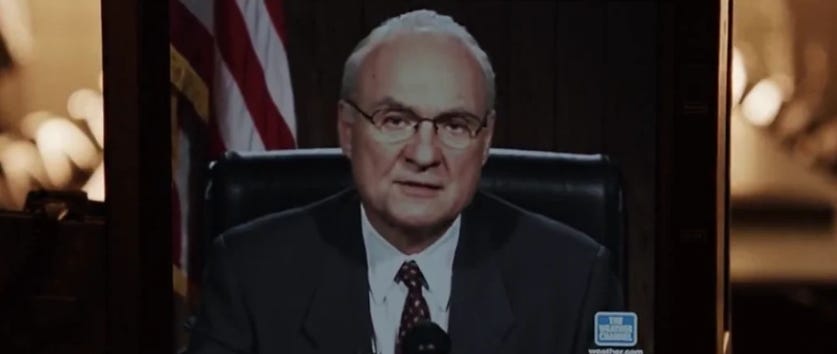
President-Cheney-lookalike begs the global south for refugee status for Americans in The Day After Tomorrow (2004)
As I’ve written elsewhere before, it is hard to tell whether those making predictions of climate doom with such urgent conviction are trying to avoid catastrophe or to achieve it. I think it is more the latter. The policy prescriptions appear determined to cause catastrophe. Net Zero policies and UN approaches to agriculture are attempts to return us to a pre-industrial age which supported billions fewer humans than are on the planet now. Current streaming-service science fiction isn’t so much a warning of catastrophes to avoid. They are a vivid, attractive brochure of what life will be like in a post-human Earth where only the Democratic voting remnant survive—usually the liberal or scientist now living in a collective.
Environmental doomism is impacting fertility choices. People say they want fewer to no children because they either want to not contribute to climate change or they fear the hostility of the planet their child would have to navigate. A 2024 Lancet study said over half of young adults aged 16-25 years-old were reluctant to have children because of climate change, and that 56% of young people globally believe that “humanity is doomed“ due to environmental breakdown.
When environmental pessimism is so partisan, could it be a factor feeding into partisan divide among high schoolers and their intention to have children as noted by Grant Bailey.

Grant Bailey@grantjbailey
The fertility divide along partisan lines is going to keep growing

5:24 PM · Jun 3, 2026 · 34.2K Views
11 Replies · 21 Reposts · 142 Likes
It’s sad because much of the climate catastrophizing has been debunked. Even its architects are trying to quietly dismantle the alarmist claims, such as Bill Gates now claiming climate change is not an existential threat to humanity. Climate policy skeptic Bjorn Lomborg explains that climate changed related deaths have fallen by 97% over the last century, and that many of the Al Gore predictions were needlessly alarmist.

Bjorn Lomborg@BjornLomborg
An Inconvenient Truth for climate alarmists: Al Gore’s dramatic climate warnings shaped a generation — but 20 years later, the data tell a very different story. Climate-related deaths are down 97% over the past century, polar bears more than doubled since the 1960s, and global
11:20 AM · May 26, 2026 · 308K Views
181 Replies · 2.02K Reposts · 5.95K Likes
Another symptom of wider end-of-the-worldism is the rise in nostalgia, in particular among GenZ. Ostensibly this is mostly about FOMO, aware they’re the first generation to be fully immersed in online technology from birth, with 60% of GenZ’ers wishing they had been born in a previous, analog time, harkening back to the 1990s, as Clay Routledge writes. I’ve been skeptical of this nostalgia because in the 2000s we had The Wonder Years, aired in the early 90s, set in the 70s; Young Sheldon which recently finished airing is set in the 90s. Stranger Things captured the GenX imagination with its relived 1980s recap, though as it drew in GenZ interest morphed to become GenZ-preoccupied teens caught in the 1980s. In other words, it seems normal to have a nostalgia for twenty year ago. But nostalgia linked to societal despair or a lack of confidence in life outcomes seems more persuasive a context to than just smartphones to suggest something serious may be happening.
I think it is right to think of this sort of doomerism as religious, whether based in an actual faith or a secular, ideological one. I think they end up acting the same. Korea, for example, is apparently uniquely disposed to end-of-the-worldism, fatalism, high levels of performance and social status anxiety. With a 0.7 fertility rate, the population of South Korea will halve in size over the next 50 years. No doubt this feeds into a cycle of despair.
Two hundred and fifty years on, it’s safe to say that—in contrast to Korea—America’s cultural outputs are certainly not distress cropping. Netflix is, in this regard, one of the sole sources of originality willing to risk new titles, directors, writers and actors. All the big studios are just photocopying previous success, “I know, let’s have another Batman movie”.
As America hits 250 I think the fatalism in Sir John Glubb’s analysis can be held off a little. The territorial attack of 9/11 was a loss of innocence that all empires have experienced. I think ancient faith stories and the communities they inspire, founding father narratives, and polishing up monuments and fountains may be part of the answer. However, I suspect the brightest horizon for the United States and the wider planet is science fact. Elon Musk’s mission to colonize Mars is an enormously hopeful and ambitious one. NASA’s Artemis project, which has spanned administrations, shows that America still has an appetite for discovery and to end up on the moon. The sorts of start ups and new technologies identified by the Rational Optimist Society are on the new frontier that markets and cultures always need in order to expand.
It is always the lack of horizon that deadens hope the most. As such, it would be good to see more of the “right stuff” return to the stories we tell ourselves: something of the stunning visual and beautiful score of Ad Astra but with the national self-confidence and camaraderie of Top Gun Maverick (2022). The latter landed a 99% popcornmeter score on Rotten Tomatoes, and 96% from professional critics. There’s still huge appetite for good simple optimistic story telling.
No posts
Comments
Nothing yet. Say the first thing.
Sign in to join the conversation.