

The economy is a complex set of evolved patterns for production and exchange.1 Like all technological shocks, artificial intelligence is forcing us to evolve new patterns.
This is true at the macro level of industries and cities and trade networks but it is also true at the micro level - the level of individual employees, managers and teams.
There are evolved patterns of activity that determine how companies operate internally, how employees relate to and communicate with each other, how we view each other’s contribution to team production, even what we expect to do when we clock on each day.
Play with AI enough and you can see how these micro patterns are about to profoundly change.
In 2009 Paul Graham wrote about patterns of activity in the workplace by focusing on the difference between how makers schedule their time, and how managers schedule their time.
A manager’s calendar is full, divided into hourly or half-hourly blocks of meetings. They bounce between projects and teams and appointments. When you ask to meet, they say “my calendar is up to date”.
This is fine for some sort of work - manager work - but it is terrible for what Graham calls makers. Makers are those who perform work that benefits from achieving a flow state. Think writing or programming. They need large blocks of time to hit that state. Deep work is hard to slice into 30 minute blocks.
Graham’s observation is that these maker and manager schedules clash. Managers think little of booking time with makers - half an hour here, half an hour there - but this breaks flow. Just a couple of short meetings spread arbitrarily across a day can have do outsized harm to maker productivity. Formally, makers and managers face very different switching costs.2
I’ve been thinking about Graham’s quite profound observations while using ChatGPT Codex over the last few days. I’ve been using Codex to make some toy applications - for example, little digital tools to illustrate concepts for an ‘economics of AI’ course I’m developing. I’m no programmer. I have tried many, many times to learn to code but for my goals the juice has not been worth the squeeze. Codex is a programming agent that sits beside your code. You ask it to do things and it does those things.
Like I say, I’m no programmer. I’ve figured out how to set up VS Code, install Python, fumble through PATH variables, load the necessary VS Code extensions, and connect everything to GitHub. There is a base level of technical knowledge required to make these AI platforms really sing. You need to know just enough to imagine what your robot can do.
For me, GPT-5 Codex feels like another one of these step changes in AI capability, like deep research was or the image editing by instruction that gave us Ghiblimania. Codex is so good at vibecoding that I don’t look at the code at all. The code window is wasted monitor space. Since starting with Codex I’ve manually edited code once, just to change some display text in an HTML file.
But for basically everything the workflow is the simple: first you prompt, and then you test. Then prompt, then test. etc.
Well, that’s not quite right. The workflow is actually: prompt, wait …….. test; prompt, wait …….. test. Codex takes time. You prompt it and then you wait while it does its business. In the back it is pumping out hundreds of thousands of tokens at the speed of light. It does tasks in minutes that would take me literally years.3 But we are humans and we are impatient.

Nobody warned us how much thinking time the machine god would need. And waiting is a weird feeling, for a maker. Until now, waiting has been a symptom of personal failure - we called that writers block. Now waiting is a signal of effective delegation.
I’ve mentioned previously the experience of setting deep research off on a task, then leaving the computer alone to do its thing while I make coffee or annoy colleagues. As recently as last week I was describing that with a sense of joyful amusement. But you tend to use deep research once per work task. Vibecoding is different. Vibecoding involves a constant stream of prompts, particularly as you get the robot to debug its last piece of work. You prompt, you wait …….
So what should you do while you wait?
One option is to vibecode something else at the same time, so you can bounce back and forth between them. I’ve been doing a bit of that. Double productivity overnight!
Another option is to write a Substack post complaining about how slow vibecoding is. But it’s hard to hit writing flow state when you’re tabbing back and forth to see how Codex is doing.
You could take the time as leisure, denying your employer the benefits of your increased productivity. I could never do that.
Or, you could take meetings. This amazing little quote is from OpenAI’s own guide to how they use ChatGPT Codex internally:
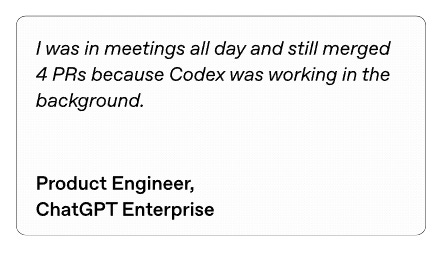
That is no less than an engineer - the prototypical maker, deep worker, hunter of flow state - outsourcing their deep work to AI while they conform to the managers’ calendar. And it seems to work! I’m sure the OpenAI engineer was surreptitiously checking in on Codex to see where it was at during those meetings, to make sure it kept moving along.
And they would have had to, because Codex has its own preferred patterns of activity. It gets into its own flow state - you do not talk to the robot while it is working - and when it is finished you have to attend to it. It is like an employee who finishes a task and then immediately demands you check its work. Nothing happens until you do.
Codex collapses the distinction between Graham’s two classes. Makers are now managers of very capable, but very needy, employees. What an opportunity to align our calendars! The singularity gives us so much more time to touch base, catch up, drill down, check in, sync up, double click on our near term horizon priorities, and share strategic planning updates.
I have a few hesitations with this argument. First, if all that is left are meetings while we supervise robots doing our work at arms length, then eventually someone, somewhere is going to realise that the managerial system is ripe for disruption too. Maybe we don’t need to circle back on the roadmap?
Supervising Codex is a lot like supervising a person. So why do we need supervisors to supervise supervisors? If makers are turning into managers then what should the current crop of managers do? In the medium term, businesses might get a lot flatter; less hierarchical.
Second, the usual caveat applies: this is the worst AI is ever going to be. Codex will get faster, and maybe I’m overfitting on current technology.
Remember when computers were so slow you could make a coffee while you waited for them to boot up? If I had a Substack then I probably would have written something about how mornings in the workplace were changing forever and that this revolutionises the fundamental economics of the coffee industry. But booting became nearly instantaneous.
Then again, our expectations keep increasing. The more compute we have the more we’ll ask of it. I expect each prompt will become more demanding, more ambitious, and we’ll push Codex - or whatever comes after Codex - further. This is the point of Ethan Ding’s essay tokens are getting more expensive. That I can’t imagine how I’ll prompt the next generation of models is a failure of imagination rather than a prediction of the future.
Third, and let me reiterate this, I am not a programmer. This prompt, wait …. pattern may not be the experience of those who understand what they’re doing.
But the pattern is very similar for research and writing. I have been a dedicated partisan of thinking models since o3 was released in April. The 5 Thinking and 5 Pro models are better again but even slower again. This makes research very stop-start as well. Might as well do something while you wait. And managers, now released of any lingering guilt that their meetings are interrupting deep work, might think that could well be more meetings.
My final hesitation here is that this total manager victory might not be a bad thing. In academia is it hard to imagine that meetings can be productive, but, dear colleagues, they can be. In businesses where the cost of time is viewed as a resource to be conserved, meetings are still a necessary mechanism for coordinating teamwork.
It is coordination - the joining up of the patterns of activity - that matters in an economy. Makers do not create value by making, they create value by knowing what to make.
Obviously there’s a Coasian solution we could work out here but nonetheless.
Because I would have to learn to code.
No posts
Comments
Nothing yet. Say the first thing.
Sign in to join the conversation.