
It’s easy to feel like the problems facing the ocean are too big to touch. Plastic, pollution, overfishing, bleaching coral, and warming water. You hear about it, you understand it, but it’s hard to see where you fit into any of it. Most of it feels far away, both in scale and in distance.
When something feels that big, it’s natural to think in big solutions. Big changes. Big commitments. We have to try to change the world, right? We need the kind of things that sound really meaningful and impactful.
In reality, these things are hard to sustain once life settles back into its normal pace. It’s the word “big” that causes things to break down. Not because these things are impossible or that people don’t care, but because the version of caring they’re aiming for simply doesn’t fit into their life.
What tends to last isn’t big gestures. These things show up in the things you already do every day. The things you do that don’t feel important and impactful on their own, but repeat often enough to make a difference.
That’s where impact can really start to become real. Not in doing everything. Not in doing it perfectly. Just in shifting a few things that are already part of your day and life.
I have a good example that I’d like to mention that a friend pointed out to me recently. It’s mildly embarrassing. I started selling apparel on my website, and some of the shirts aren’t 100% cotton.
You see, most synthetic shirts (polyester, nylon, blends) shed tiny plastic fibers every time they’re washed, and those microfibers often pass through wastewater systems and end up in rivers and the ocean, where they persist and are ingested by marine life. Cotton, on the other hand, is a natural fiber that biodegrades rather than accumulating as long-term pollution. Choosing 100% cotton doesn’t eliminate impact, but it reduces the steady flow of microplastics entering the water system from something as routine as doing laundry.
There are so many little things like this that, once we realize them, we can change the world in our own small way. I still have a lot of work to do and a lot to learn. But I’m proud to say, the next shirt that I added to my website is 100% ring-spun cotton. It’s also a finer, softer, and more durable fabric compared to regular (open-end) cotton. Win-Win!
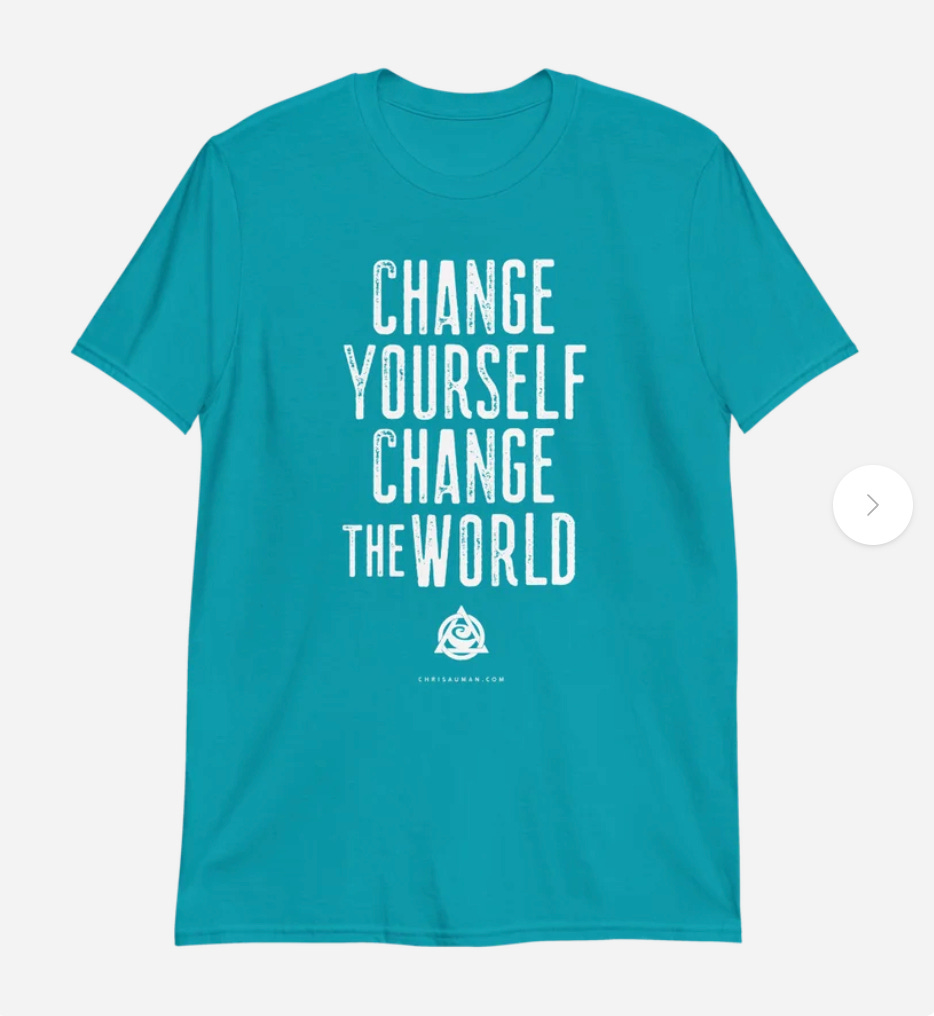
Change The World T-Shirt - ChrisAuman.com (10% will go to ocean charities)
When you begin start to notice how often you reach for something that’s designed to be used once and thrown away. You begin to see packaging more clearly. Not as something neutral, but as something that can stick around long after whatever it held is gone. You pay a little more attention to seafood when it comes up. Not every time, not perfectly, but enough to recognize that some choices are better than others and lean in that direction when you can.
Even waste, in general, starts to look a little different. What you throw away, what you reuse, what you recycle. These are just a few things that you can gradually get better at noticing.
None of these things is extreme. That’s the point. I’m very concerned with trying to make an impact whenever I can, but I have a very hard time. I am far from perfect. In fact, I’m not even “good” because life is a challenge every day. But the point is that I’m slowly getting better. One step at a time.
These small changes don’t require a complete shift in how we live. They don’t depend on motivation. They can be small enough to repeat without much effort (like paying attention to the material of the next t-shirt you purchase), and that’s what gives them weight.
Here’s what I keep reminding myself of. A single decision doesn’t do much. But a decision you repeat every day does. I have the same mindset for my art. If you engage with your practice, just a little every day, you’ll be incredibly surprised at what you produce at the end of the year.
Sidenote: I’ve been working on a few blocky collage portraits recently, and putting each piece together is a good example of what I’m saying. Each small piece isn’t much by itself. But when they all come together, it can be pretty impactful.

Surrender (Acrylic painted paper collage on illustration board - 18×24)
Over time, these small shifts start to feel normal and frictionless. You don’t think about them as “doing something for the ocean.” They just become part of who you are and how you move through your day.
Most of what we do each day isn’t a decision. It’s a pattern we’ve repeated enough times that it runs automatically. That’s what makes change possible. A single action doesn’t carry much weight, but something you do every day quietly compounds. Over time, those small, repeated behaviors start to define outcomes in a way that feels almost invisible while it’s happening.
And that’s really where the impact comes from. Not from intensity, but from consistency.
These kinds of small choices can make a big difference. They don’t need to be loud to matter. They just need to happen again tomorrow.
And the day after that.
No posts
Comments
Nothing yet. Say the first thing.
Sign in to join the conversation.