
I am not a software engineer.
Let’s get that out of the way first.
I run a technology recruiting company. I’ve spent more than 25 years around engineers, CTOs, technology companies and people building some incredibly complicated shit.
But I don’t write production software for a living.
And lately, I’ve been building some crazy stuff!
I’ve used both Claude Code and Codex to work through automation, APIs, integrations, financial systems, data, workflows and actual business problems inside Averity.
That experience has completely changed the way I think about these tools.
The interesting question isn’t really:
Is Claude Code better than Codex?
The better question is:
What can somebody accomplish now that they couldn’t accomplish before?
That’s where this gets interesting.
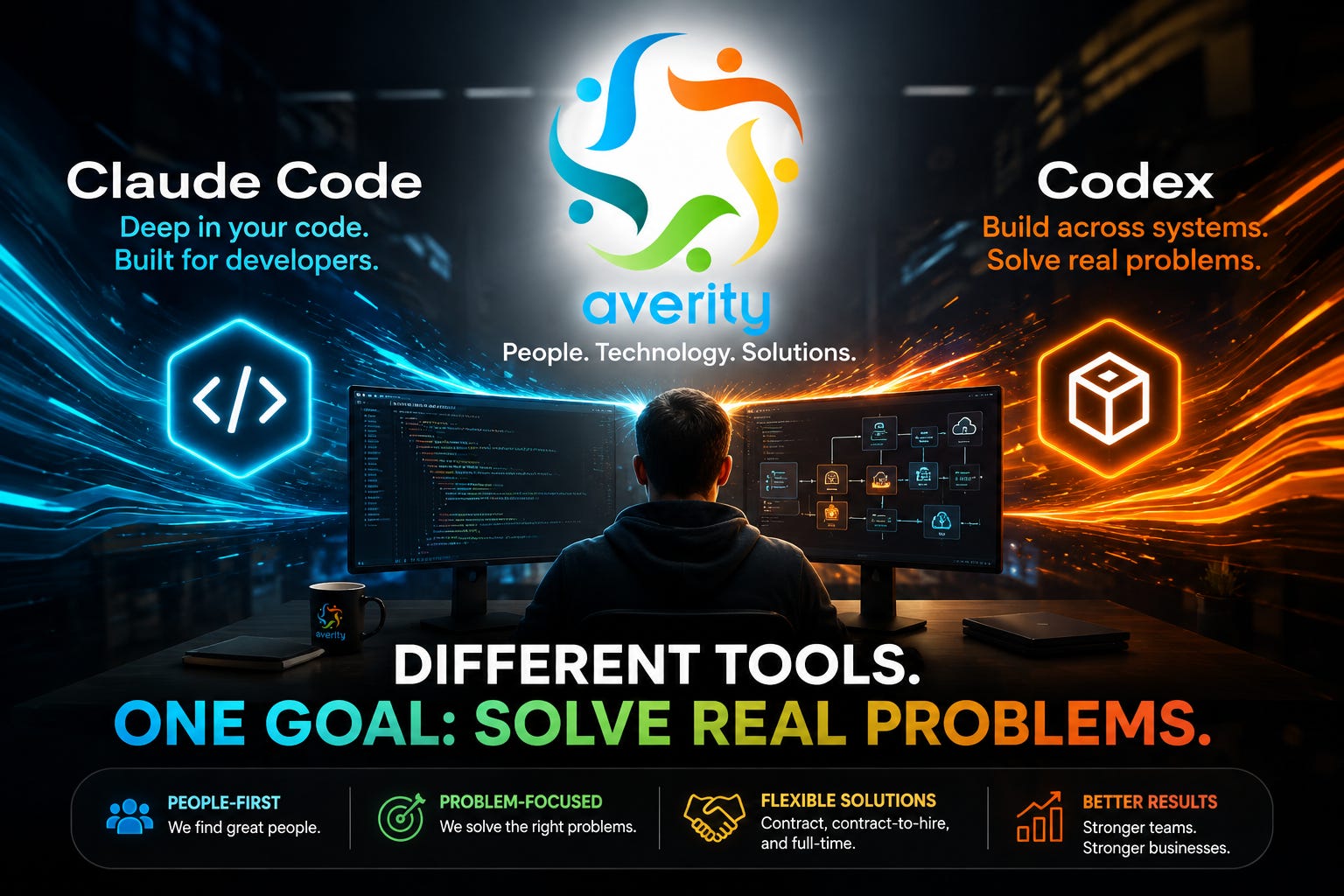
Both Claude Code and Codex can understand codebases, write and modify code, debug problems, work with repositories and help execute complicated engineering tasks.
But they don’t feel the same.
Claude Code has become extremely popular with developers working directly inside their existing development workflow.
Codex feels broader to me.
I’ve been able to use Codex not simply to write code, but to point at an actual business problem—automation, data, integrations, broken workflows—and start attacking it.
That’s important because I’m not trying to become a software engineer.
I’m trying to solve business problems.
Wrong question.
What are you trying to accomplish?
If you’re an experienced engineer working deeply inside a codebase all day, Claude Code might be your answer.
If you’re coordinating agents, automating workflows, connecting systems and turning business requirements into working technology, Codex may feel more natural.
You might use both.
These things are changing too quickly to pick a team.
This is where my recruiting brain kicks in.
If two engineers are equally capable technically, but one knows how to use AI to investigate problems, build faster, test ideas and automate repetitive work, are they really equally capable anymore?
Probably not.
But knowing how to prompt Claude Code or Codex does not suddenly make somebody a great engineer.
AI can accelerate ability.
It can also accelerate stupidity.
If you don’t understand architecture, security, databases, APIs, infrastructure or the business problem you’re solving, producing code faster doesn’t necessarily help anybody.
You can simply create bad software faster.
The engineers who become incredibly valuable will combine three things:
Technical fundamentals. Curiosity and adaptability. The ability to use AI as leverage.
That’s a very different hiring profile than “five years of experience using X.”
We’re already seeing job descriptions asking for AI, agents, MCP, LLM experience and whatever technology became popular three weeks ago.
We’ve seen this movie before.
Companies stuff every new technology into a job description and then wonder why they can’t find anybody who checks every box.
Start somewhere else:
What problem does this person need to solve?
That’s the hire.
Technology is moving so fast that businesses aren’t always going to need a skill permanently.
Sometimes you need it right now.
An AI Engineer for nine months.
A cybersecurity specialist for six.
A senior backend engineer to get a product over the line.
A machine learning engineer to prove an idea before you build an entire team around it.
That’s where contract staffing becomes incredibly powerful.
Bring in the specialized capability around the problem without pretending you already know what your organization will need three years from now.
Because right now, pretending you know exactly what your technology stack will look like three years from now is a pretty dangerous assumption.
The more AI enters recruiting and engineering, the more valuable I think the human part becomes.
Anybody can generate a resume. Anybody can stuff keywords into a profile. Anybody can send 5,000 automated recruiting emails. Anybody can claim AI experience.
Can they solve your problem?
That’s why Averity remains intentionally people-first.
We’re a boutique technology recruiting and staffing firm working across software engineering, AI and machine learning, data, cybersecurity, product, hardware, robotics and technology leadership.
We actually talk to people.
We understand what they’ve built.
We understand what companies need.
And increasingly, we want to understand something even more important:
How does this person think?
Claude Code will change. Codex will change. Six months from now there will be another tool everybody suddenly needs experience using.
Curiosity doesn’t become obsolete.
Problem solving doesn’t become obsolete.
Technical judgment doesn’t become obsolete.
Great people don’t become obsolete.
Use both.
Seriously. Don’t test them by building another calculator. Give them your real shit.
Give them a messy repo. A bug nobody has fixed. A workflow wasting five hours a week. Something you’ve wanted to build but haven’t had the time.
Then see which one actually helps you.
Which understands your code faster? Which needs less babysitting? Which catches something you missed? Which actually saves you time?
That’s how I’ve been learning.
And it’s changed the way I look at what’s possible inside my own company.
AI isn’t removing the need for talented technology people.
It’s changing what talented technology people are capable of doing.
And that’s going to change hiring.
Not necessarily. They solve many of the same problems differently. Give both a real problem and see which one works better for how you build. That’s a much better test than somebody else’s benchmark.
Both can understand codebases, write code, debug and handle multi-step engineering work. Claude Code has become incredibly popular for developer-focused coding workflows. Codex is pushing further into agents, automation and broader workflows. Depending on what you’re building, there’s a good argument for using both.
Absolutely. I’m doing it.
But building something with AI doesn’t suddenly make you a software engineer. Architecture, security, infrastructure and technical judgment still matter. These tools give people leverage. They don’t magically give people experience.
They’re going to replace parts of the work software engineers do.
That’s different.
Great engineers who learn how to use these tools may become significantly more productive. That’s why I think AI changes the definition of a great engineer more than it eliminates the need for one.
Stop obsessing over whether somebody has three years of experience with the AI tool that’s been popular for six months.
Look for technical fundamentals, curiosity, adaptability, judgment and problem-solving.
Then ask how they’re actually using AI to become better at what they already do.
Ask how long you actually need the capability.
If it’s core to the company, hire permanently. If you’re proving an idea, building something specific or need expertise immediately, contract technology talent can make a lot more sense.
Don’t make a three-year hiring decision for a nine-month problem.
Start with the problem, not the job title.
Averity helps companies hire full-time and contract professionals across AI, machine learning, software engineering, data, cybersecurity, product, hardware, robotics and technology leadership.
We’re a boutique, people-first technology recruiting firm. We talk to the people we’re representing, understand what they’ve actually built and focus on whether they can solve the problem you’re hiring them to solve.
Because a keyword match isn’t a hire.
The harder technology becomes to evaluate—and the easier AI makes it to create convincing resumes and profiles—the more important it becomes to actually know who you’re talking to.
That’s what a good specialized technology recruiting firm should bring to the table.
No posts
Comments
Nothing yet. Say the first thing.
Sign in to join the conversation.