

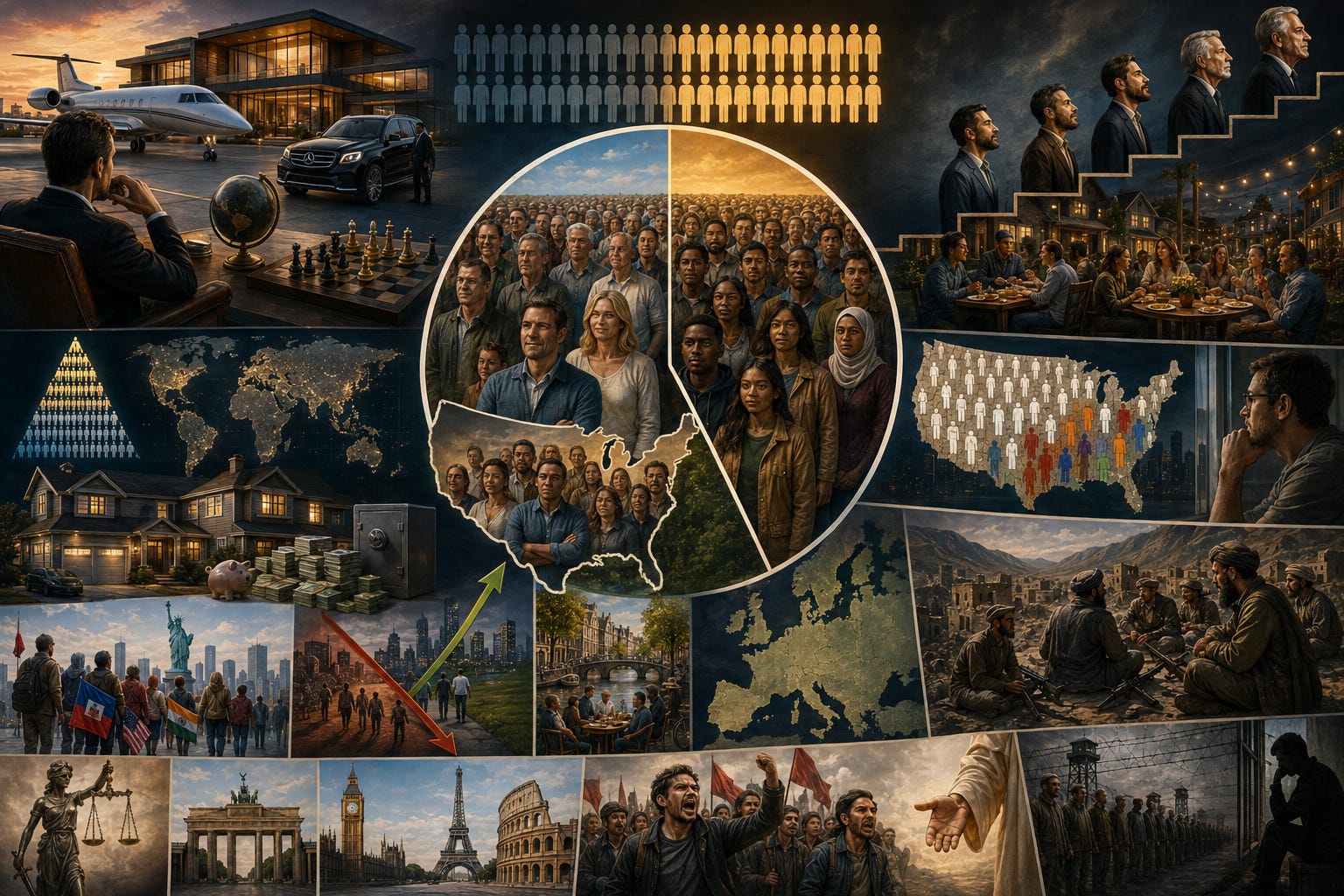
Even though America was founded more on an idea than on an ethnicity, unlike most countries around the world, and remains one of the most pluralistic societies in world history, it is still 60 percent white, despite what you may have heard. Sixty percent of America is also financially comfortable. Sixty percent is the share that would need to be defeated, whether the contest is racial, economic, or electoral, and a 60 percent majority cannot be beaten by treating it as a fragile minority elite. That is the argument, in full. What follows is the case for it, addressed to the reader convinced it's wrong, that America is still a poor country, that only ten percent of the population is genuinely rich, and that the conditions for a race war or a class revolution are finally in place. The scales-off-the-eyes phrase is old enough to have a name attached, Saul on the road to Damascus, unable to see what was already in front of him until something fell away. What follows is what's already in front of everyone.
Every successful revolution in the modern era, France in 1789, Russia in 1917, China in 1949, ran on the same ratio: a small, isolatable wealthy class sitting atop a vast, genuinely desperate majority. That ratio does not exist in the United States. Roughly 24 million Americans are millionaires by net worth, close to 40 percent of the world's total, on four percent of the world's population. Somewhere between 800 and 900 Americans are billionaires, more than China, Germany, and India combined. Close to 60 percent of Americans either earn more than $100,000 a year or hold assets worth that much. Median household income sits near $87,000. Median household net worth crosses roughly $190,000 to $200,000 for half the country, meaning half of America already holds that much in assets before the ultra-wealthy are even counted.
The "only ten percent are rich" objection usually rests on income data alone, often individual rather than household income, which understates the real base considerably. Net worth captures home equity, retirement accounts, and appreciated assets that never appear on a pay stub. A homeowner with a modest paycheck and a paid-off house can still be sitting on genuine, liquidatable wealth, the kind of runway history's actually desperate classes never had. The real picture is a far broader base with something concrete to protect, not a narrow elite.
The rhetoric itself gives this away. A century ago, millionaires and billionaires were roughly the same small population, easy to treat as one class. Today, activist and political language has narrowed almost entirely to billionaires, a few hundred people, while stepping carefully around millionaires. That is not compassion for the merely comfortable. It's arithmetic. Millionaires now number in the tens of millions, many of them Democratic voters and donors, too large and too politically load-bearing a group to cast as a villain. The target shrank to the only population still small enough to serve as one. That shrinkage is evidence of how large the comfortable class has become, not of how small it remains.
What is actually driving the appetite for upheaval is rarely hunger. It is envy. A friend, call him Mark, started in the academic middle class, missionary background, a family that owned its home but little more. He and his wife are now worth well over ten million dollars, married into venture money, moving in circles that fly private. He has said plainly that no amount of money will ever get them into the actual billionaire class, which runs largely on multigenerational wealth rather than the newer Silicon Valley kind, and which remains a tight world with real internal tiers most new money never fully clears. When he and his wife were earning a few hundred thousand a year, they envied millionaires. Having become millionaires, they envy the centi-millionaires. The centi-millionaires envy the billionaires. The billionaires envy the ones above twenty billion. There is no rung on this ladder without a resented rung above it.
The same pattern runs downward. Someone earning $87,000 in a city like Arlington can feel a paycheck from eviction. Someone earning three or four hundred thousand a year can quietly envy a colleague who simply owns a home outright. Almost nobody, at any income, discusses their actual burn rate, what is truly coming in against what is truly going out, because burn rate is a term borrowed from venture finance, and the borrowed term supplies distance that the plain description does not. Nobody wants to say they are overspending on takeout. Everyone is willing to say they are managing their burn rate. Very little of this ladder, at any rung, is driven by material lack. It is driven by envy, occasionally dressed as pride, corroding people who already have plenty rather than motivating people who have nothing. Revolutions require the second kind of grievance. America is thick with the first, at every income level simultaneously, which is a fundamentally less flammable condition.
Race is the second half of the wall, and the one most consistently misjudged. A race revolt only works against a small, isolatable ruling minority, the way apartheid South Africa or Rhodesia's white population, roughly 10 to 15 percent, sat on top of a vast disenfranchised majority. Self-identified white Americans are close to 60 percent of the population. That is not a fenced-off ruling class you can surround and overthrow. It is most of the country. Run the apartheid playbook against a group that size instead of one a sixth as large, and the arithmetic fails before the argument even starts.
An acquaintance of mine, a serious journalist with multiple New York Times bestsellers and a senior post at the paper itself, believed for years that Black Americans made up 40 percent of the population. He grew up in Berkeley, Oakland, and New York, environments where 40 percent felt like an undercount. The actual figure is 13 percent. He was off by a factor of three, not through carelessness, but because his own geography had misrepresented the country to him for decades. That is not a failure of intelligence. It is what happens when a personally representative sample is mistaken for a national one, and it is precisely the error that makes an American apartheid comparison feel plausible to well-informed people who have simply never checked the census.
The wealth data cuts against the racial version of the narrative as well. There are more Black, Hispanic, Asian, and Muslim American millionaires and high-net-worth households today than at any point in the country's history. This is not white America against a uniformly desperate everyone else. It is a comfortable population cutting across every group, set against a shrinking population of genuinely desperate people cutting across every group. That is not the architecture of a race war. It is the K-shaped economy running through racial lines rather than along them.
Open borders would not destabilize this arrangement. They would reinforce it. The people with the personal drive to uproot their lives and migrate to the United States, even under a fully open border, are disproportionately the kind of people already oriented toward the comfortable side of the economy, not a desperate mass positioned to destabilize it. Immigration into America has functioned this way for decades: it imports ambition, and ambition aimed at America tends to be absorbed into its wealth-building machinery rather than turned against it. Each wave once treated as a threat to the country's prosperous class ends up, within a generation, enlarging it, more prosperous Black Americans, more prosperous Haitian, Dominican, Muslim, Hindu, and Buddhist Americans. That is not destabilization. It is inoculation.
The claim that the middle class was destroyed also has the direction backward. The American middle class of 1950 to 1980 was already, by global and historical standards, a condition of wealth and comfort. What happened since is that a large share of it moved up the K rather than down it. Nobody sent the middle class into poverty. The middle class of fifty years ago would recognize almost none of today's median American as poor.
The Denmark-and-Finland objection is worth answering directly, because it always arrives. Happiness surveys and contentment are not the same measurement. A culture that settled, decades ago, on a lower ceiling, a bicycle to the lake, a subsidized beer, a shared public pool, scores well on contentment precisely because it stopped pressing against that ceiling. That is a legitimate choice. It is not evidence that the society beneath it is wealthier, freer, or more stable than one that kept pressing. It reflects a different relationship to more, not a superior one.
Modern European nation-states were founded on ethnic and cultural homogeneity, a state for the French, a state for the Danes, a state for the Poles, not on the civic identity America was built around. Pluralism there is not merely difficult. It runs against the founding premise of the states attempting it. Sweden has reversed course on refugee policy after a decade of visible integration failure. Denmark has passed some of the most restrictive anti-ghettoization laws in the West. Eastern Europe has refused EU migrant quotas outright. This is not friction at the margins. Several European countries are actively retreating from pluralism because their institutions were never built to absorb it.
Ask what pluralism actually means, though, and the standard has a way of moving the moment America starts satisfying it. By raw composition, America wins outright, 40 to 50 percent non-white, built explicitly around civic identity rather than bloodline, more demographically plural than nearly anywhere on earth. The instant that comparison becomes inconvenient, the definition quietly shifts from composition to power-sharing structure, and countries that are almost entirely one ethnicity get to count as more genuinely pluralist because the arrangement is written into law. Switzerland, over ninety percent European by background, gets credited for dividing power formally among its French, German, Italian, and Romansh populations. Canada, which enshrined multiculturalism as official state doctrine back in 1971 and wears the branding more comfortably than any country on earth, is still, by its own 2021 census, roughly 70 percent European by ethnic origin, visible minorities at 26.5 percent. America, at closer to half non-white, gets waved off as tokenism for lacking the equivalent legal scaffolding. That is not a neutral analytical standard. It is a standard that relocates itself specifically whenever the prior one stops producing the desired answer, and followed to its logical end it would rank a country that is roughly seventy percent one ethnic origin above one that is nearly half people of color, as long as the smaller country wrote the right clause into its constitution.
The example used to make that case does not hold up on inspection either. Switzerland, despite having the highest foreign-born population in Europe at around thirty percent, pairs that number with some of the toughest naturalization law in the West, permits that evaporate the moment someone loses a job, a twenty percent single-year spike in reported racist incidents, and a formal United Nations finding of systemic anti-Black racism and inadequate police accountability. The country has the paperwork. It does not have the proximity.
That is the actual test, and it is not a legal one. It is not whether a country writes pluralism into its constitution, or wants its best friends to be a different race in the abstract while living somewhere it will never happen. It is whether the people involved are actually in the room together, at the dinner table, in the workplace, in the marriage, close enough that the relationship costs something real. Where's your skin. America, whatever else is broken about it, has sixty years of the unlegislated fact of roughly half the country being people of color, living beside, working with, and marrying into the other half, without a statute mandating any of it. Nobody had to pass a law to make that true. It just happened, unevenly, imperfectly, but at a scale and a proximity no amount of Swiss legal architecture has actually produced.
The commitment shows up as liturgy far more often than as policy. Constitutions get pluralism clauses. Government proceedings open with acknowledgments of whose land it originally was. None of that costs anything, and none of it has produced an actual transfer, a timeline, an acreage figure, a title changing hands. It is recited the way a Hail Mary is recited, words spoken aloud because the words are treated as doing the work, except performed for an audience that already understands it as theater rather than as an act of faith. The trend line underneath the liturgy is the real signal. Every major European country has spent the last decade tightening rather than loosening, National Rally surging in France, Brothers of Italy governing in Rome, Alternative for Germany posting record vote shares, harder borders, stricter asylum law, explicit remigration platforms gaining ground rather than losing it. A continent that actually intended to reach American-level pluralism would show it in the trend, not just the preamble. The trend runs the other way.
The clearest evidence isn't rhetorical at all. It's bodies in the street, and the street tells a very different story than the constitution does. The largest overtly anti-immigration mobilization in modern British history, the "Unite the Kingdom" rally, drew somewhere between 110,000 and 150,000 people by official Metropolitan Police crowd counts, drone-mapped and grid-verified. AfD-linked demonstrations in Germany routinely pull five to fifteen thousand, and even that gets outnumbered roughly three to one by counter-protest. America's ceiling for the same kind of explicit mobilization is Charlottesville in 2017, a few hundred people, followed by doxxing, lost jobs, lawsuits, and prison sentences so severe that nothing at that scale has been attempted again since. Ninety-seven percent of America's actual immigration-related street demonstrations, tracked by the Armed Conflict Location and Event Data Project, run in the pro-immigrant direction, the opposite ratio of what the more-racist accusation would predict. A country's constitution says what it wishes were true. A country's streets say what its people are actually willing to show up and do. On that measure, the comparison isn't close.
America is not in the position several European states now occupy. It has been genuinely, if unevenly, pluralistic for roughly sixty years, since the 1965 Hart-Celler Act replaced the explicit ethno-nationalist immigration quotas of 1924. Sixty years has not produced a smooth outcome, self-sorted neighborhoods, real gentrification, real inequality persist, but it has produced sixty years of practice at something Europe is only now attempting for the first time, and under considerably worse conditions. That head start is a large part of why the demographic arithmetic never assembles into the uprising so often predicted.
Americans also chronically underrate their own floor. Mississippi, the poorest American state, runs close to Germany in GDP per capita and outperforms the UK, France, Italy, and Spain outright. In one widely cited comparison, median American disposable income ranked second only to Luxembourg, a jurisdiction whose figures are inflated by its role as a tax haven. An $87,000 American income already clears the threshold for a comfortable salary in Berlin, matches London's benchmark for a genuinely good white-collar wage, and more than doubles a comfortable single income in France. Paris itself, held up as the picture of European sophistication, is internally split, 65 percent of its arrondissements affluent, the wealthiest averaging roughly $56,000 per person in disposable income, close to the American median rather than far above it. Americans book five-star hotels in Paris because the city's reputation for expense has never been reconciled with the underlying numbers. The instinct runs backward from the evidence.
One further pattern is worth naming for anyone still convinced they would be the exception, the vanguard who actually means it. Every wealthy or white person who has romanticized fomenting a revolution or a race war has, without exception in my experience, wanted to be the vanguard rather than the person doing the underlying work. Not to defeat that person, to become them: the factory floor, the family stacked into a block of a thousand identical apartments, the decade-long wait for a Trabant to arrive. Nobody volunteers to trade places. Everyone volunteers to march alongside.
This is the same posture as the mother of James and John, asking Jesus to seat her two sons at his right and left hand in the Kingdom, not asking for the cup that comes with those seats, only the seats themselves. The answer she receives is the whole matter in miniature: you do not know what you are asking, and the greatest among you will be a servant, not the one who lobbied hardest for the good chairs. The other ten apostles, notably, were indignant at the attempt, evidence that the impulse to angle for position while claiming solidarity is not rare even among people who had genuinely given up everything else.
History's judgment on this particular move is unambiguous. Privileged allies inside revolutionary movements are, overwhelmingly, not spared, elevated, or remembered as saviors. They are purged. Sympathetic aristocrats and bourgeois reformers who backed the early French Revolution went to the guillotine once the Terror required proof of ideological purity. Bourgeois defectors to communist revolutions were routinely reclassified as class enemies once the leadership needed someone to sacrifice. White allies within anti-colonial and civil rights movements were frequently sidelined or branded untrustworthy by the movements they had joined. The historical base rate for privileged allyship inside a successful uprising is not sainthood. It is betrayal, on a fairly reliable schedule.
Seizure without preserved incentive rarely produces the outcome it promises. When Zimbabwe redistributed roughly four thousand white-owned commercial farms in the early 2000s, the land changed hands but the credit lines, irrigation systems, export networks, and decades of accumulated management knowledge did not transfer with it. Maize and tobacco output each fell by about three-quarters. GDP contracted by roughly forty percent over the following years. The country that had once been the breadbasket of the region ended up with half its population food-insecure. Wanting to eat without wanting the farmer to keep wanting to farm does not produce food. It produces a fallow field with a new name on the deed. The same logic runs in the opposite direction too: enjoying the wealth, the companies, the jobs, the innovation that comes from a class of people building and investing at scale, while resenting the people doing the building, is not a stable position either. Ask honestly which side of that ledger actually weighs more, the benefit received or the resentment felt, because both cannot be maximized at once.
Even the appetite for this, measured honestly, doesn't hold up. Polling on political violence shows a wide gap between rhetorical sympathy and actual willingness. A 2023 PRRI survey found 23 percent of Americans supported political violence in the abstract to "save the country," and a more recent NPR/PBS/Marist poll put agreement that Americans "may have to resort to violence" at 30 percent. Those numbers sound like a country on the edge, until the question gets specific. The most rigorous ongoing tracker on this, a nationally representative longitudinal study out of UC Davis, found only about 8 percent would support a right-wing insurgency and 6.7 percent a left-wing one, and just 3.7 percent considered it very or extremely likely they would personally participate as a combatant if large-scale conflict actually broke out. Belief that civil war is both coming and necessary sits in the single digits, roughly 4 to 6 percent depending on the year. A fifth to a third of the country will agree with violence when a pollster offers it as a hypothetical. Fewer than one in twenty-five will say they'd actually pick up a gun for it. That gap between what people will claim in a survey and what they will actually do is the appetite problem sitting on top of the numbers problem. Even setting the arithmetic aside entirely, revolution fails a second time on simple willingness.
None of this argues that revolution is morally unjustifiable. It argues that it is arithmetically implausible in a country where most of the population, across every racial and ethnic line, has something real to lose. Sixty percent, twice, from two directions, race and class landing on the same number and disqualifying the same uprising. The belief that America remains a majority-poor, majority-desperate country, structurally comparable to apartheid South Africa or Rhodesia, rarely traces back to the census or the IRS. It traces back to a feed, a neighborhood, a friend group, the same mechanism that convinced a Times journalist for years that Black Americans were 40 percent of the country. The arithmetic has been available the entire time.
No posts
Comments
Nothing yet. Say the first thing.
Sign in to join the conversation.