
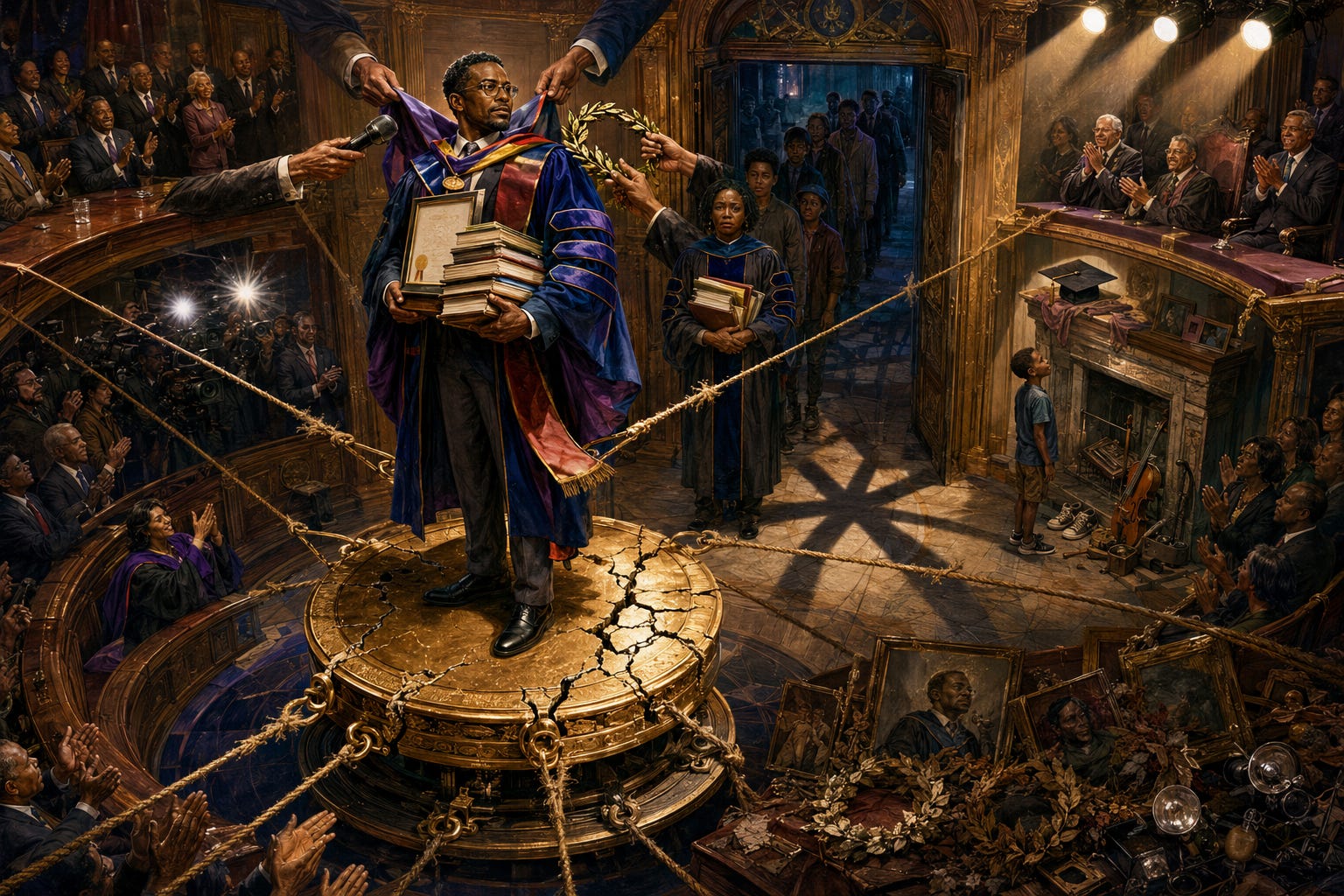
There are not enough people to go around, and every institution that wants a visible symbol of progress right now is drawing from the same thin, slow-growing pool.
Cambridge has seventy-five Black academics out of sixty-one hundred. The entire United Kingdom has roughly three hundred and fifty thousand Black residents out of sixty-eight million. America's Black population runs well over thirteen percent, but the specific credential most elite institutions are actually hiring for, the terminal degree, the endowed chair, the board-ready decade of executive experience, draws from a far smaller slice of that thirteen percent, for reasons that trace straight back to the historical resourcing gaps the entire push was supposed to close in the first place. Every university that wants a headline hire, every corporate board filling an ESG requirement, every media outlet that wants an expert to put on air, every awards committee assembling a program, is reaching into the same room. A PhD takes years to produce. A tenured chair takes longer. The demand for visible representation scaled up in a decade. The supply moves on a generational clock. That gap is not a scandal. It is arithmetic, and arithmetic does not care how good anyone's intentions are.
What arithmetic produces, reliably, is overexposure. The same handful of names get asked onto every board, into every keynote, onto every shortlist, because they are the names everyone already knows, and being known becomes its own qualification, detached from whatever earned the recognition in the first place. Corporate governance researchers have a term for this when it happens to directors: overboarding, the practice of asking the same small set of visible minority executives to sit on far more boards simultaneously than their white peers ever are. Nobody has to coordinate for this to happen. A hundred honest search committees, each reaching for the one list everybody already has memorized, will produce the identical outcome with zero conspiracy anywhere in the chain.
None of which makes the person selected a mark. A school mascot tries out. He knows exactly what costume he's putting on and what the job requires before he ever agrees to wear it. That's a real distinction, and it matters, but it isn't the only honest way to be chosen for a symbolic role and still come out ahead. Leonard Bernstein invited the Black Panthers into his Park Avenue apartment in 1970, and Tom Wolfe wrote the essay that gave the whole phenomenon its name: radical chic, the fashionable set displaying proximity to danger and cause the way they'd display a new sculpture. Nobody sitting in that room was naive about what kind of evening it was. They were there anyway, because a room full of money and press attention is still a room full of money and press attention, and a savvy operator takes the opportunity the fashionability provides and banks whatever it's worth before the fashion moves on, same as anyone would.
King Kalākaua ran the same calculation on a grander stage. His 1881 world tour made him the first reigning monarch in history to circle the globe, and heads of state treated him as exactly what he was: Japan, Austria-Hungary, Britain, the United States, all received him with full military honors and formal audiences, and he became the first foreign leader ever hosted at a White House state dinner. That was one track. The other track, running underneath it in the same newspapers covering the same visit, kept marveling that a Pacific monarch could behave with such sophistication, as though competence in a Hawaiian king were the anomaly requiring explanation rather than the baseline. Both tracks were true at once. The state banquet was real. So was the condescension in the morning edition. Kalākaua wasn't tricked into the tour, he arranged it himself, for his own explicit diplomatic purpose, and he almost certainly understood exactly which parts of his reception were respect and which parts were spectacle, and used both anyway to advance what he came for.
Claudine Gay's appointment as Harvard's first Black president in 2023 ran the identical two-track pattern in modern dress. The institution announced it as history, the press covered it as history, and the arrangement functioned, structurally, as a wager the moment the ink dried: an institution putting a human being's tenure on the line as proof of its own progress before that tenure had run long enough to prove anything at all. When plagiarism allegations surfaced within months and she resigned within weeks of the scrutiny going mainstream, the same press that had run the coronation ran the collapse, at the same volume, on the same front page. By now the entire episode has largely receded from conversation, crowded out by newer stories competing for the same finite attention the original hire was built to capture. That fading is not incidental. It's the mechanism completing itself: the announcement was never really about the person, it was about the institution's need for a headline, and once the headline stopped generating attention in either direction, the institution had already collected everything it needed from the arrangement.
Here is the part that outlasts the wager, win or lose: the credential itself does not care how loudly anyone announced it, and it does not un-happen when the announcement sours. A degree earned is a degree held, permanently, regardless of the press release that came with it or the backlash that followed it. The court that closed the door on race-conscious admissions in 2023 could not reach backward and revoke a single diploma already granted. The scrutiny that follows any high-profile collapse can chase a reputation, but it cannot touch the actual work sitting underneath a real credential, because the diploma never asks how the political weather felt the year it was issued.
What the asterisk actually costs isn't the person it lands on. Whoever the asterisk targets either has the credential or doesn't, and the asterisk changes neither fact. What it costs is everyone standing nearby who shares a surface trait with whoever cracked, the professor down the hall who built a career the slow, unglamorous way with no press release ever written about her, the colleague who never asked to be collateral in somebody else's institutional wager and now answers for it anyway, in the raised eyebrow, in the assumption that has to be argued down before the actual work even gets a hearing. That's the tax nobody voted to pay, charged to people who were never in the room when the bet got placed.
And there's a second cost, quieter, running for a generation instead of a news cycle. Every family that watches one of its own walk through a door like this starts reorganizing what winning looks like around it. The Boulé Railroad worked precisely because a Harvard degree, once inside a bloodline, changes what the next generation aims for without anyone having to say so out loud. That's a real gain. It's also a real narrowing, because a household that starts treating the acceptance letter as the family's new trophy has quietly demoted whatever used to sit in that chair before, the ball field, the stage, the workshop, to something lesser. Nobody announces the demotion. It just happens, one dinner-table story of pride at a time, until the kid who wanted to be a running back instead of a lawyer is fighting his own family's new hierarchy of what counts as making it, not just the world's.
The mascot fades. The wager gets forgotten within a news cycle or two, same as it always does. The credential and the family's new definition of a life worth having are the only two things left standing when the applause moves on to the next headline, and only one of them was ever actually about the person the applause was pointed at.
No posts
Comments
Nothing yet. Say the first thing.
Sign in to join the conversation.