
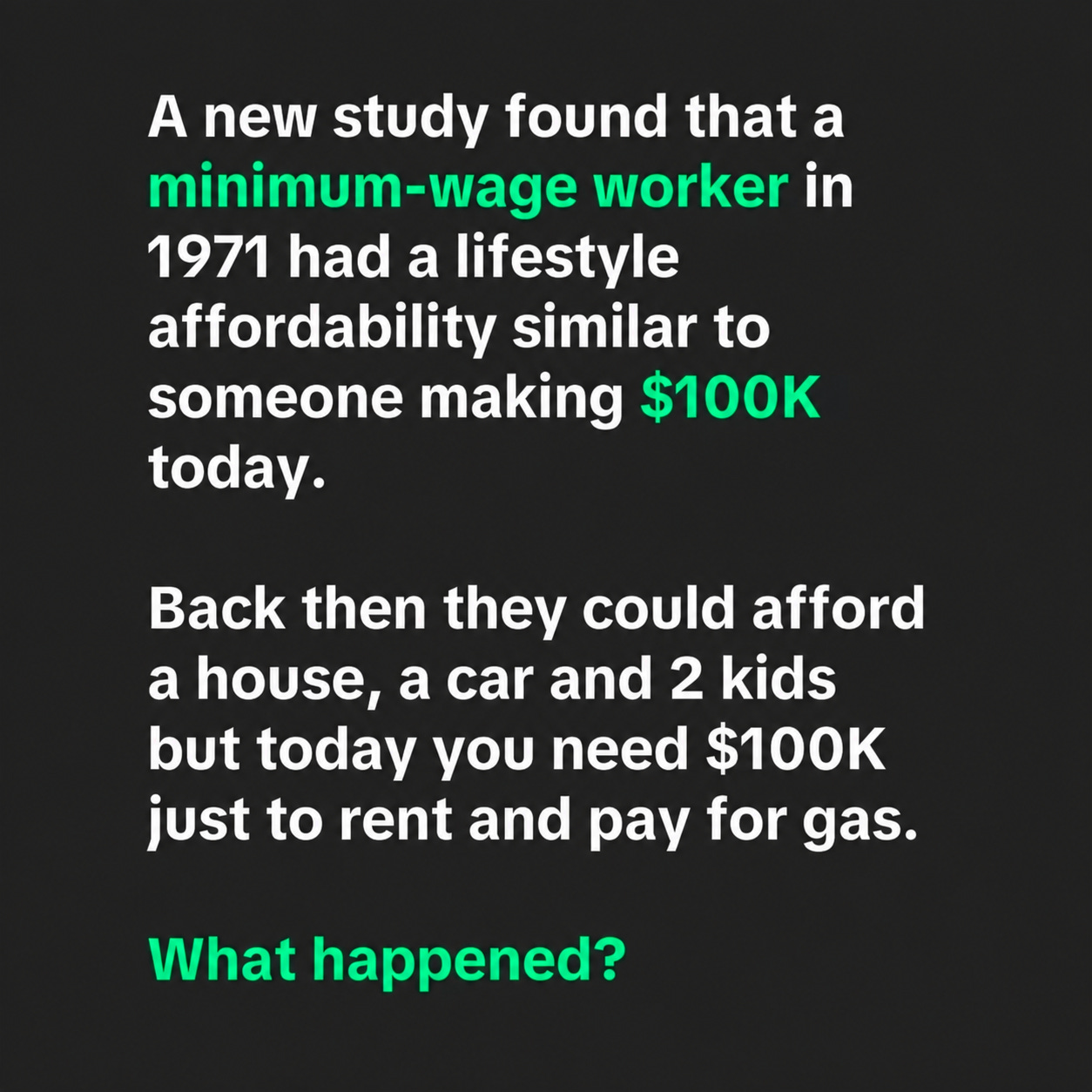
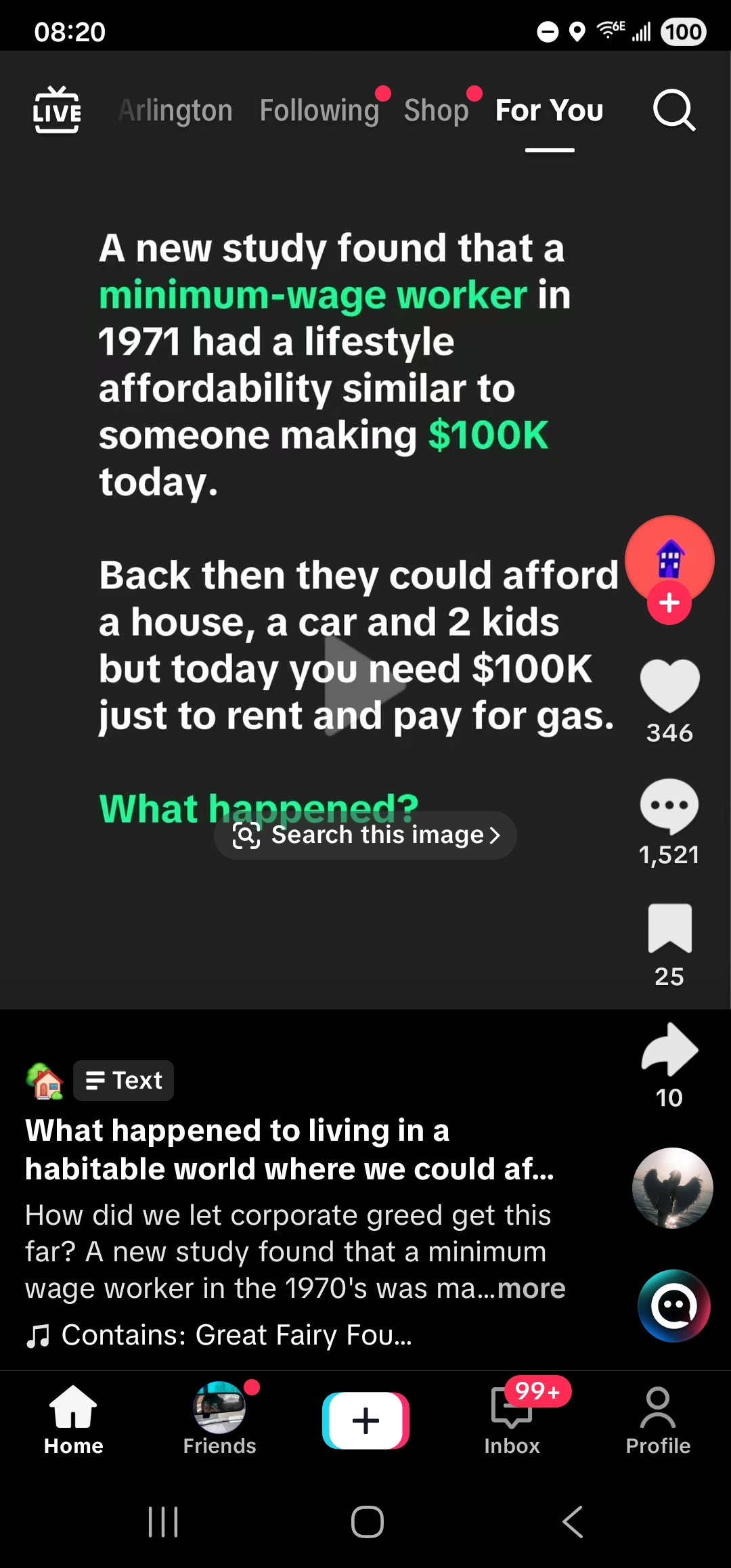
A TikTok making the rounds right now claims a minimum-wage worker in 1971 had the lifestyle affordability of someone making $100,000 today. Back then, the caption says, that worker could afford a house, a car, and two kids. Today $100K barely covers rent and gas. Then it asks the question it wants me to answer with "corporate greed": what happened?
I don't dispute the affordability gap. I dispute the explanation, and I think the real one is more interesting than a morality play about greed.
Start with the population. I'd guessed the US had around 150 million people in 1971. It didn't. It had roughly 207 million. Still, that's a real number worth sitting with against today's 340 million-plus. A country with 133 million fewer people is a country with dramatically less competition for the same finite stock of land, houses, and starter jobs. Every buyer bidding against you for a three-bedroom rancher in 1971 is one of a much smaller pool. Scarcity isn't just about supply, it's about how many hands are reaching for the same supply, and there were simply fewer hands.
Then there's the poverty baseline, which the viral version conveniently skips. Nobody in 1971 was benchmarking their life against Silicon Valley money or a Kardashian's house. The country was, on average, poorer in absolute terms, so the entire market, housing stock, car inventory, retail goods, was built and priced for a poorer population. A "starter home" in 1971 was 1,000 square feet with one bathroom and no air conditioning, because that's what an entire nation of comparably modest earners expected and could bid for. Prices don't float in a vacuum. They float against what the whole buying public can pay and is willing to accept, and in 1971 that ceiling was simply lower on both ends.
Regulation is the other half nobody wants to say out loud, because it indicts a system both parties like when it benefits them. Zoning, permitting, environmental review, historic preservation overlays, none of that existed in anything like its current form in most of the country in 1971. Building a house or an apartment building was faster, cheaper, and far less litigated. Every additional layer of review added since then adds cost, and that cost gets baked into the price of every unit built afterward, forever. A regulatory environment built for careful, incremental change is not free. Somebody pays for the caution, and it's the buyer.
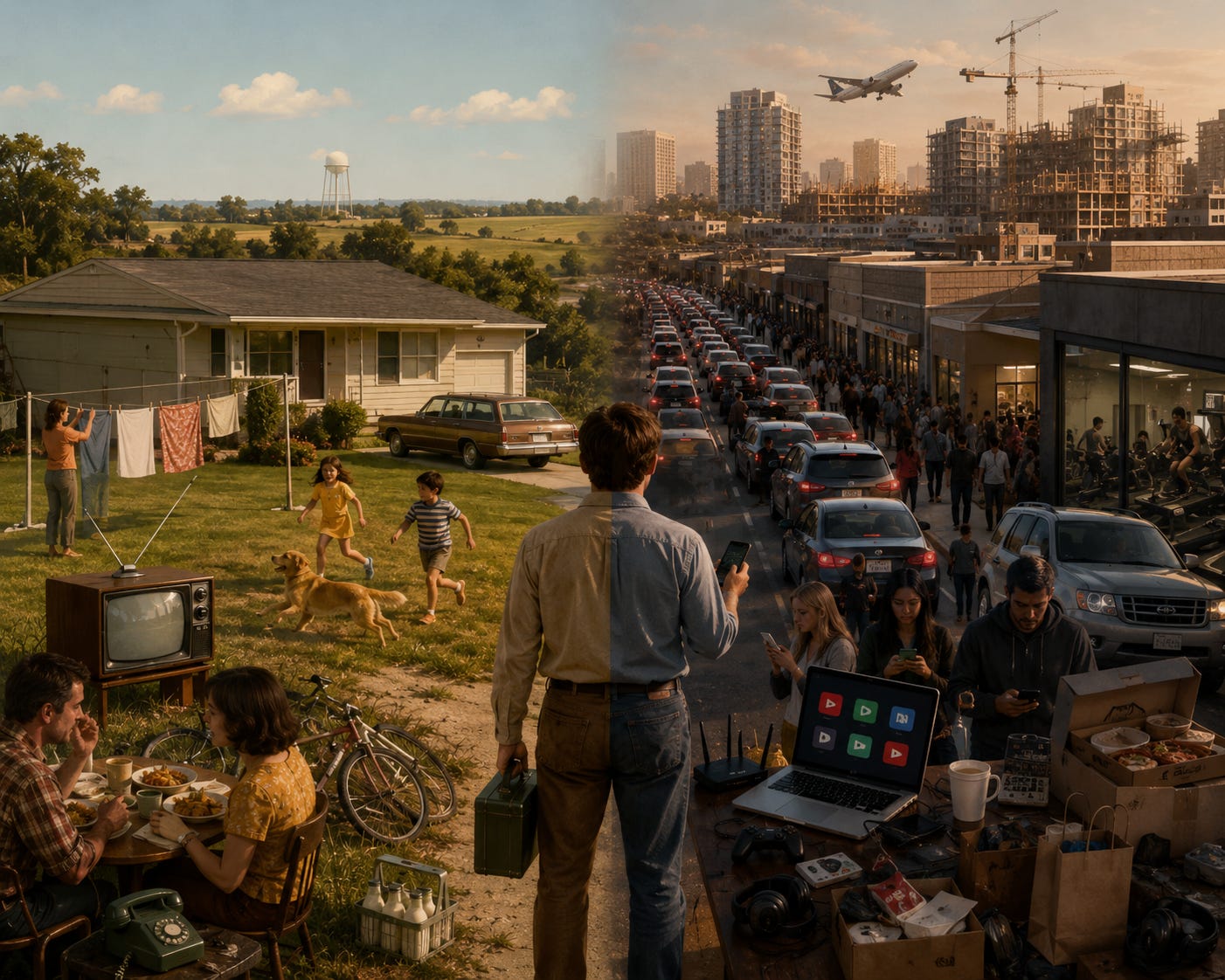
Then there's the piece that isn't economic at all, it's psychological, and I think it's the most underrated variable of the four. Nobody in 1971 was budgeting for cable, and there was no cable to budget for. Nobody had a phone bill, because there were no mobile phones, just one hardwired line the whole family shared. Nobody expected an annual flight to Cancún or Lisbon, international travel was rare and expensive and mostly for the genuinely rich. There was no Netflix, no Spotify, no Amazon Prime, no forty-dollar-a-month gym membership, no app subscriptions quietly draining a checking account one at a time. A dollar in 1971 wasn't just worth more in raw purchasing power, it had far fewer places it was expected to go. The paycheck went further partly because the culture hadn't yet invented two dozen new places to spend it.
The clearest way to see it is to just list the actual monthly burn rate of a household in 1971. Mortgage. Electric. Water. A phone bill for one line, shared by everyone in the house. Maybe a milkman, maybe a seasonal garbage fee. That's close to the whole list. Eating out was a once-a-week or once-a-month event, not a daily default, most people packed a lunch for work as a matter of course, not as a budgeting hack. Entertainment was three or four over-the-air channels and a radio, both free after the set was bought. A movie ticket was cheap enough to be a casual Friday-night decision. A newspaper ran a dime or a quarter, a magazine subscription was a small annual line item, not a stack of recurring charges. Compare that to a modern household's actual monthly burn rate, streaming services, a data plan, a car payment, a gym membership, food delivery apps, a dozen small subscriptions nobody remembers signing up for, and the difference isn't a lifestyle choice, it's a structurally larger number of things a paycheck is expected to cover before it even gets to rent. This isn't a scold aimed at anyone younger blaming avocado toast or a Starbucks habit, I'm Gen X, born in 1970, a year before the study's starting point, and my own personal burn rate today is exactly this bloated. The math is the same regardless of which generation is running it.
I'm not exempting myself from the bit either, for the record: between unlimited mobile on three devices, a gigabit router, and a streaming stack that runs Netflix, Hulu, Paramount Plus, Prime, AMC Plus, HBO Max, PBS, Acorn, an $89-a-year Rumble subscription, and an Audible plan I keep paying out of pure inertia even though I've mostly switched to the free Libby app, I am a fairly amusing case study in exactly the kind of bloated modern burn rate this piece is describing.
The oil piece is part of the same picture and rarely gets mentioned. Most of the world in 1971 didn't own a car. Vehicle ownership was still concentrated in the US, Western Europe, and Japan, so global demand for oil was a fraction of what it is now. Gas was cheap in large part because a huge share of the planet simply wasn't competing for it yet. That changed as the rest of the world motorized, and the price reflects a genuinely larger number of buyers, not just policy or greed on either end.
Put those five things together, a smaller population competing for the same land, a poorer national baseline setting lower prices across the board, a lighter regulatory load making construction cheap, a radically smaller menu of expected monthly expenses, and a world with far less competition for oil, and the $100K comparison stops looking like a story about corporate greed stealing the difference. It starts looking like a story about a country that was smaller, plainer, and ran on a monthly burn rate a fraction the size of what everyone, me included, treats as normal now.
None of that means today's affordability crisis isn't real. It means the cause isn't a villain who wasn't there in 1971 and mysteriously showed up later. It's arithmetic, more people, higher expectations, thicker regulation, a longer list of monthly bills, and a planet that now competes for the same barrel of oil, layered on top of each other for fifty years. Corporate greed is a simple, satisfying answer because it comes with someone to be angry at. The real answer doesn't give me anyone to blame, which might be exactly why it doesn't trend.
No posts
Comments
Nothing yet. Say the first thing.
Sign in to join the conversation.