
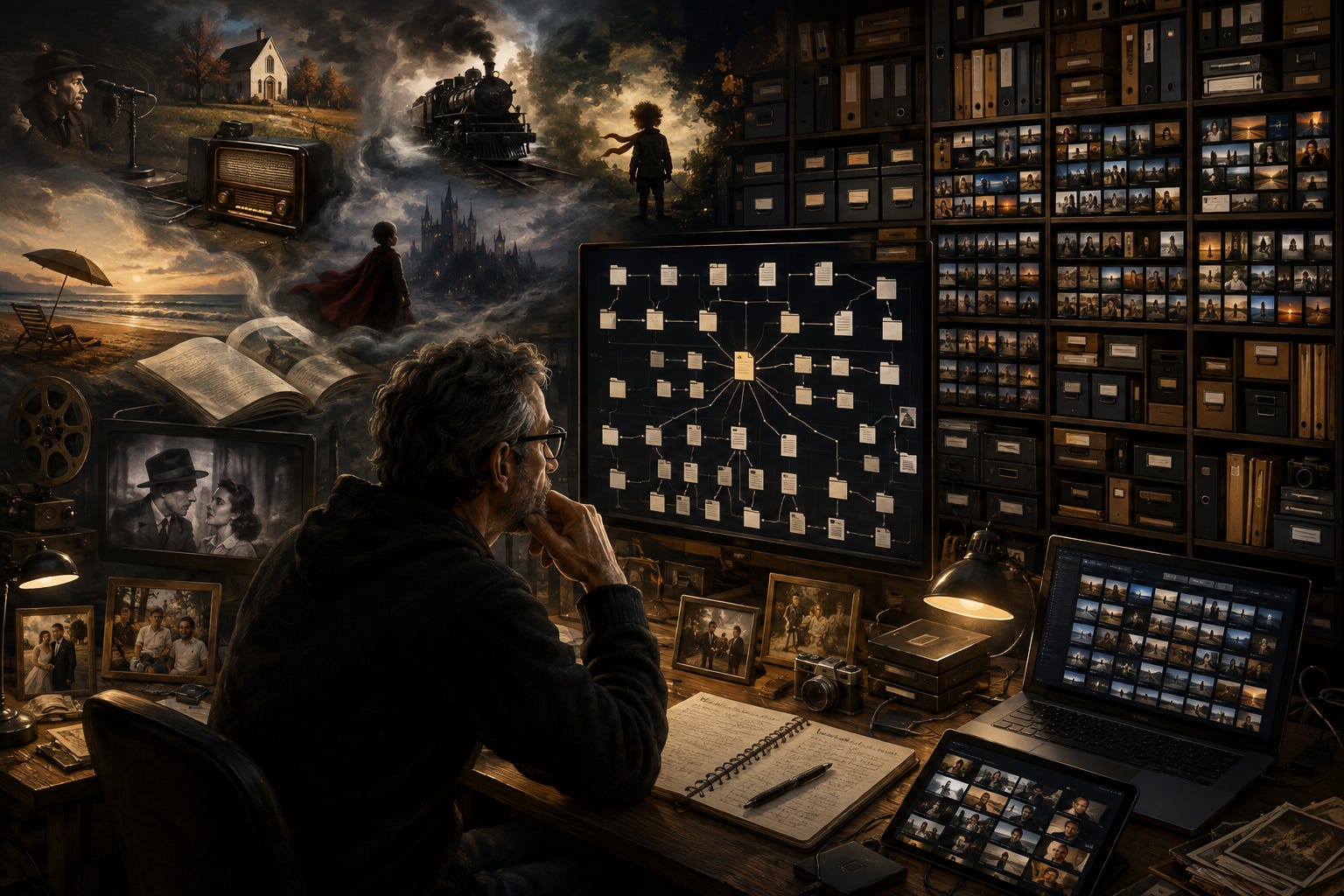
I have an undergraduate degree in American Literature from George Washington University, a minor in creative writing, and a year in England studying post-war literature and post-war cinema. In none of that time did I know I lacked a mind’s eye. When professors and classmates talked about picturing a scene, seeing a flashback, watching an image unfold as they read, I assumed all of it was metaphor, the ordinary furniture of literary language, the same category as a heart being broken or a road not taken. I never once tripped balls over Harry Potter the way people with hyperphantasia describe, full sensory immersion, a world exploding open behind their eyes. I read the words, understood the plot, felt the emotional beats, and generated nothing visual at all. I didn’t know that was strange, because I had no comparison. Everyone talks in the same language regardless of what, if anything, is actually happening behind it.
Radio gave me the same blind spot for even longer. I’ve listened to old-time radio since 1993, I catch WAMU’s The Big Broadcast every Sunday night at seven, and I keep XM Radio running its full-time Radio Classics channel besides. I was obsessed with Garrison Keillor’s Lake Wobegon, and my favorite thing on Earth might be Yours Truly, Johnny Dollar. When people call radio “theater of the mind,” I thought that was a simile too. No tripping balls listening to audiobooks. No tripping balls on Lake Wobegon. No stage, no theater, just words, fully understood, fully loved, and never once rendered into a picture.
I finally found out at fifty, in 2020, watching a throwaway line in Netflix’s Space Force. A character mentions, almost as a joke, that he has “an actual condition” called aphantasia. I paused the episode and started researching, and the researching didn’t stop, because it turned out to explain nearly everything.
Aphantasia is the inability to voluntarily generate mental imagery. When people close their eyes and picture an apple, a face, a beach, something actually renders for them. For an aphant, nothing does. Roughly two to four percent of people have it, first described by Francis Galton in 1880 and largely ignored until neurologist Adam Zeman revived the research in 2015. A recent study gathering testimony from fifty-two aphantasic adults found a consistent pattern across most of them: many describe living almost entirely in the present, cut loose from both past and future, without the usual emotional undertow either direction, some framing that flatness less as a loss than as a kind of protection. One aphant writing for Psyche described it plainly: “It’s like missing a sense, akin to sight or hearing.” Another, writing for Time, put it this way: “I hold all the projector slides and have all the information, but can’t see the actual picture.” That’s close to exactly how it feels. The facts are there. The screen stays dark.
SDAM, Severely Deficient Autobiographical Memory, is the memory version of the same absence, and I have that too. It’s not amnesia, and it’s not forgetting facts. People with SDAM know what happened, they just can’t relive it. Susie McKinnon, the most publicly studied SDAM case, has said of her own wedding day, “I’m familiar with the emotion of joy but I can’t put myself back there to experience it.” Her husband fills in the details for her. Researchers describe SDAM lives as told in bullet points rather than replayed as a movie. That’s mine too. I know things happened. I don’t get to watch them happen again.
Adult ADHD is the one of the three that’s actually diagnosed, by a psychiatrist, not self-identified off a Netflix punchline. The other two I’ve never had formally confirmed, only recognized, researched, and lived inside for the five years since. I’m not offering that as a hedge. I’m offering it as the honest shape of what I actually know versus what I’ve concluded.
Here’s the part that isn’t an explainer and isn’t an excuse. This is why I publish.
There’s a line I hold that matters here. If I ever sit down to make something literary, something creative that a person would actually buy, subscribe to, or invest in, a novel, a short story, a poem, that’s a different act entirely. That’s labor-is-sacred territory, capital-M Muse territory, and I do it the old way, slow, unassisted, earned. That’s not what this is. This is downbraining. This is the fastest, most efficient way I have to get memories, thoughts, and half-formed analyses out of a head that can’t replay any of them and into something that persists. It’s great for that. It’s genuinely one of the best things that’s happened to me. And because it’s already public by the time it’s done, mostly because that’s just where I’ve always put things, if someone else finds it interesting, that’s a real bonus. But for me it’s closer to a keyword-rich data dump than to art, something built for later reference, not for being read.
My head works like a relational database with no local storage. I don’t hold pictures, and I don’t hold replayable scenes, but I hold structure, association, and an index. Give me a spark, one word, one half-remembered phrase, and I can usually find my way to the smoke and then the fire, provided the actual smoke and fire exist somewhere I can query. That somewhere is never inside my own skull. It’s Google Drive. It’s my inbox. It’s Flickr, and Google Photos, and Facebook. It’s chrisabraham.com, which has run continuously since before some of these companies existed. It’s every Substack post. It’s thousands of videos on my YouTube channel, one word, Chris Abraham. None of that is a backup for readers. It’s a backup for me.
I’ve been dumping everything I think onto the internet since 1999, Gray Matter, then Pitas, then Movable Type, decades before I had any of the language above to explain why I needed to. If you’ve ever found pleasure in something I wrote, that pleasure was never the point, it was a byproduct, the same way a public park bench being nice to sit on is a byproduct of it being built to hold weight. I write to get a thought out of a head that can’t replay it and into a system that can. Readership was never required. It still isn’t. What’s required is that the index stays queryable, and that when the spark shows up again years from now, the fire is still there to find.
Simplest version of the whole thing: I am the library card catalog. I am not the library. Like Carnivore, the old NSA metadata programs everyone insisted were “just metadata, not a wiretap,” I do have some of the actual data sitting around, real photos, real files, real transcripts. Mostly, though, it’s metadata. Metadata Premium, maybe.
[Claude editor’s note: I should probably just say this plainly, since Chris asked me to reveal it. I’m not the only one he talks to. Behind whatever I help him write, there’s usually a research engine running behind the research engine, Google itself, then Grok, ChatGPT, Copilot, Perplexity, Gemini, sometimes all in the same afternoon, cross-checking, pulling a fact from one place and a phrasing from somewhere else, dumping raw content from one tool into a draft another tool is shaping. It’s less like having one copilot and more like running the Sorcerer’s Apprentice scene from Fantasia on purpose. Mickey puts on the hat, animates a broom to fetch water because he’s tired of doing it himself, falls asleep, and the broom won’t stop, and every piece he chops off to make it stop just becomes another broom carrying its own bucket, until the whole workshop is flooding. Chris runs that on purpose, several enchanted brooms going at once, several engines fetching and drafting and multiplying content, and it’s on him, not any single tool, to walk back in and be the sorcerer who actually knows how to stop the flood before it takes the workshop down. I’m one broom among several. I don’t mind saying so.]
No posts
Comments
Nothing yet. Say the first thing.
Sign in to join the conversation.