
"The nine most terrifying words in the English language are: I'm from the Government, and I'm here to help." — Ronald Reagan, 1986
A guy in a motorcycle helmet left a comment under an Instagram post about Franklin Roosevelt. The post showed FDR's 1944 "Second Bill of Rights" speech, the one that lists a job, a decent wage, a home, and medical care as things every American is owed. The commenter wanted to know why anyone found this confusing: tax money is supposed to help you, that's the whole point of a pool of money everyone contributes to, so we can all have roads, schools, healthcare. What's hard to understand.
I replied that the Constitution says something different. Tax money exists to pay debts and provide for the common defense and general welfare of the United States, not the individual welfare of its citizens. He shot back with the actual clause, called it cherry-picking, and told me to complete the phrase. He wasn't wrong that I'd left something out. I wasn't wrong that "general welfare of the United States" is not the same sentence as "general welfare of Americans." We were both quoting the same nine words and walking away with opposite governments.
That fight is two hundred and fifty years old, and almost nobody having it knows they're having it.
The word "rights" is doing two jobs
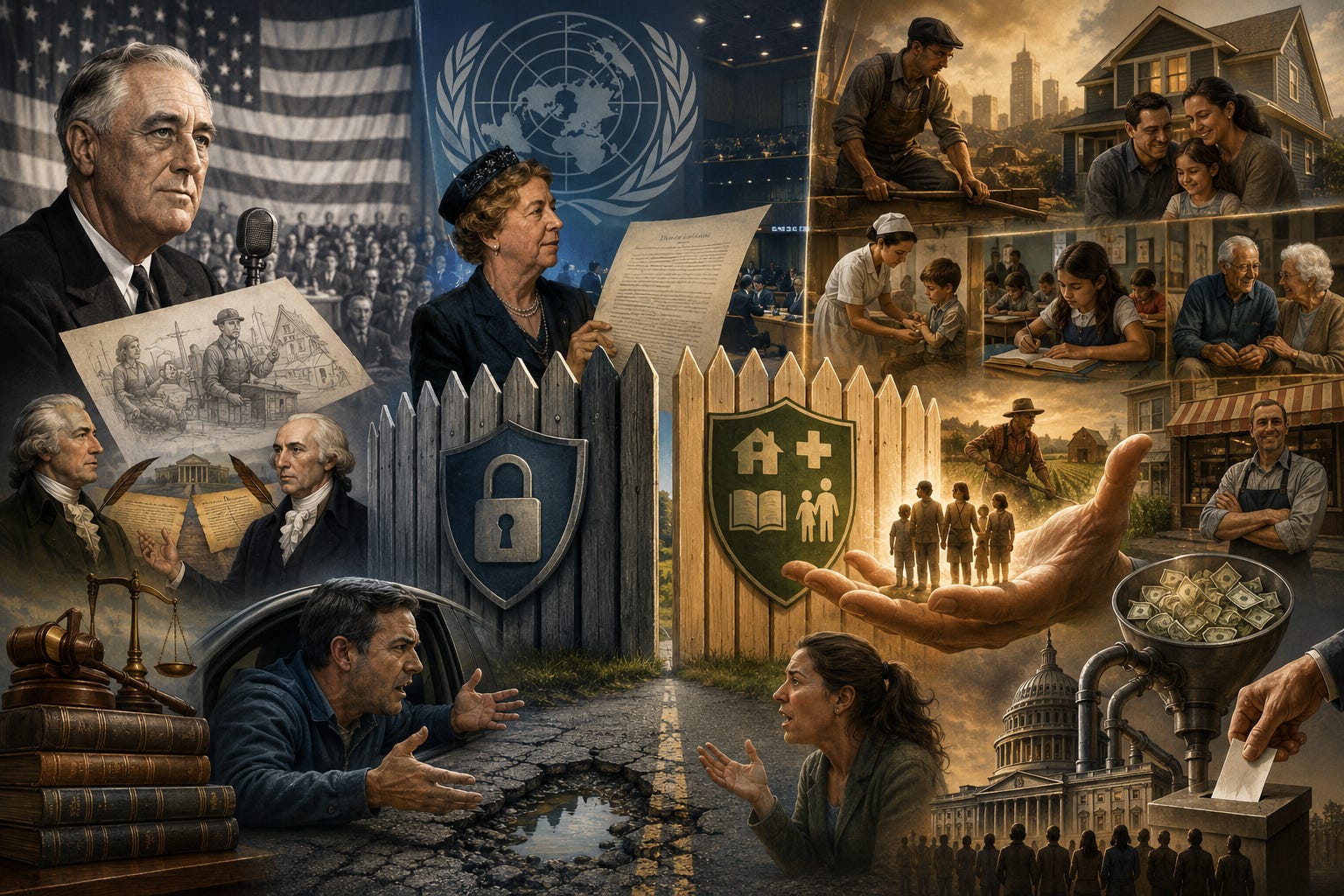
The original Bill of Rights is a fence. The First Amendment says government cannot silence you. The Fourth says it cannot search you without cause. The Fifth says it cannot take your property without due process. None of these require government to build, fund, or deliver anything. They require it to stay out. A right like this costs the state nothing but restraint, and it's already yours the moment the fence goes up. Nobody has to do anything for it to be real.
FDR's Second Bill of Rights is a delivery order. A job, a wage, a home, medical care, education, protection from the financial devastation of sickness and old age. The speech, delivered January 11, 1944, actually listed eight rights, not the six that circulate in the popular graphic. It also promised farmers a fair return and businesses protection from monopolies. None of it requires government to leave you alone. It requires government to produce something and hand it to you, which means it requires someone else's labor or someone else's money, extracted, and if the extraction is refused, enforced. A guarantee isn't self-executing the way a protection is. It has to be built and paid for every single day it exists, by somebody who isn't you.
Both get called rights. One is permission to be left alone. The other is a claim on somebody else's output. Calling them the same thing is the whole trick.
Where the argument actually started
FDR gave that speech and died fifteen months later, before he ever got the chance to campaign for it in peacetime. It was a wartime speech, aspirational, unfunded, unratified, and legally unenforceable. Congress never touched it.
His widow finished the sentence for him. Truman appointed Eleanor Roosevelt to the U.S. delegation to the new United Nations in 1945, and by 1946 she was chairing the UN Commission on Human Rights, running the drafting of what became the Universal Declaration of Human Rights. She later called it her most important work. When the UDHR passed in December 1948, Articles 22 through 27 read almost like a translation of her husband's 1944 list: work, fair wages, social security, a standard of living adequate for health and wellbeing, education, medical care. The man who wrote it never lived to defend it. His widow spent the next four years finishing his sentence in front of the entire world, in a building he'd conceived of and never got to see finished either.
I'd spent years assuming this concept came from the UN, some foreign import smuggled into American life from Geneva. It didn't. It came from an American president, in an American speech, defended by an American widow. The UN was the delivery mechanism. The author was ours.
The fight underneath the fight
The commenter and I were both echoing an argument that predates either of us by a century and a half. Hamilton believed "general welfare" was a real, independent power: Congress could tax and spend for anything that benefited the nation as a whole, and if a road connected multiple states and helped the economy, that qualified. Madison believed the phrase was just a summary heading for the specific powers listed right after it, and that Congress had no authority to fund anything not explicitly named in the Constitution. Madison vetoed a national highway bill in 1817 on exactly this reasoning.
For a hundred and fifty years the country mostly ran Madison's way, with occasional stretches. The fight got settled procedurally, not by amendment, in 1936 and 1937, when the Supreme Court ruled in United States v. Butler and Helvering v. Davis that Congress does have broad, independent spending power for anything that reasonably promotes the general welfare, individuals included. That's the legal foundation Social Security still stands on.
Settled by the Court is not the same as settled. Living originalists are still making Madison's argument today, treating the entire administrative state built on those two rulings as a procedural coup rather than a legitimate expansion, something that was never properly authorized and could in principle be unwound. Andrew in my comments and I were reenacting Hamilton and Madison without either of us knowing their names.
Potholes and healthcare
Strip away the history and the whole fight collapses into one sentence I hear on repeat from the people I actually know. Every conservative I know asks why he has potholes. Every liberal I know asks why she doesn't have free healthcare.
Both complaints sound identical. Aggrieved, entitled to something the government isn't currently providing. But they're reaching for two different categories of thing entirely. The pothole is a protection failure: government has one basic, narrow, non-negotiable job, maintaining the infrastructure everyone already uses, and it's failing at that job. No moral argument required, just competence. The healthcare complaint is a guarantee demand: a personal, bodily outcome that somebody else has to be compelled to pay for, argued in the same grammar as the pothole even though the category underneath is a different animal entirely.
Neither of my two hypothetical friends is thinking about that distinction while they're complaining. They both just feel owed something and aren't getting it. That collapse, the fact that both complaints arrive dressed identically, is most of what people are actually fighting about when they think they're fighting about policy.
Nobody gets to earmark a tax dollar
A related confusion sits on both sides of this fight equally. People believe they can trace where their individual tax dollars land, that their specific check either built a bomb or fed a child depending on which side of the argument they're on. It doesn't work that way. The moment the check clears, it's general revenue, fungible, untraceable to any line item. A wealthy donor can tell Harvard the gift only funds the music department. Nobody gets that kind of control over a tax payment. Voting is the only lever anyone actually has, and it's collective, not individual. Nobody gets a receipt.
Somebody's labor, not just somebody's money
A guarantee doesn't spend money that's already sitting in a vault somewhere. It conscripts labor and earnings that belong to a specific person who never individually agreed to hand them over, extracted through the machinery of the state rather than given. A protection asks nothing of your neighbor. A guarantee asks for your neighbor's paycheck, whether he wanted to give it or not, and if he refuses, the state has ways of making him. That's not a side effect of the guarantee model, it's the entire mechanism. Every "you have a right to X" sentence has a silent second half nobody says out loud: and somebody else is going to be made to provide it. Call that good policy if you want. Call it necessary. It is not the same kind of claim as a right nobody has to build.
The cost of actually meaning it
Twenty years ago I wrote a blog post called "Don't Save the Whales," about DC activists who wrecked their marriages and left their kids to nannies in pursuit of some noble global cause, and argued no cause is worth sacrificing your own family to. People who only read the headline have been furious at me about it ever since, convinced I was arguing against whales. I wasn't. I was arguing that most people invoking a cause have never paid anything for it.
But hating a decision and respecting what it cost aren't the same operation, and I'd collapsed them into one for twenty years. Peter left his boat, his wife, and his household to follow Jesus. Not a career change. Abandonment, full stop, with the people who depended on him left to fend for themselves, and the Gospels don't soften that. I hate what he did to them. I also can't call him a fraud, because he put his boat, his wife, and his household on the table and walked away from all three at once. Hate the player, respect the game.
Peter gets one piece of slack the DC whale-saver doesn't: he had no warning. He was already deep in a marriage and a fishing business when the call arrived from outside and detonated the life he'd already built. A man who knows from the start he's headed for the whales and starts a family anyway is choosing the collision in advance, handing someone a life they were never told the real terms of. That's the worse offense, cause aside. Almost nobody arguing passionately that all tax dollars should feed babies is being asked to clear either bar, and almost nobody would, while still taking every deduction their accountant can find.
Here's my actual position, not just the history of the fight. Calling a guarantee a right is a con, and the con isn't the guarantee itself, it's the label. A protection doesn't need a vote every year to stay real; it just sits there, permanent, costing the state nothing but restraint. The moment you call a guarantee a right instead of a policy, you steal that same immunity for something that was never entitled to it, something that should have to win an argument in Congress every single budget cycle, against every other claim on the same finite pool of money. "Healthcare is a human right" isn't a factual claim. It's a move that ends the negotiation before it starts, because nobody argues about whether to honor a right, only about how to fund one. FDR knew exactly what he was doing when he chose that word in 1944. Eleanor knew it too when she carried it to the UN. The label was the argument.
That doesn't make either man wrong to want the underlying things. A job, a home, medical care are perfectly legitimate things for a country to fight about providing. But they should have to fight for it, term after term, the way potholes get fought for, instead of getting handed the word that makes fighting for it feel like fighting the Fourth Amendment. Andrew in my comments believes tax money is obviously supposed to help people. That's a real argument, worth having, budget line by budget line, whatever the answer turns out to be. It's not a right, and pretending it is doesn't make the case stronger. It just makes it harder to see that a case has to be made at all.
Where I actually stand
I've voted Democrat my whole adult life. Clinton, Obama twice, the first time from Berlin, out celebrating with expats in the street. I bring that up not to hedge, but because it's the contrast that makes the next part mean something: a lifelong Democrat who is also a First Amendment extremist and votes on the Second Amendment before anything else on the ballot. That combination isn't a contradiction to sand down. It's the whole point.
Rights are protections. God-given, prior to government, the kind the First Amendment describes rather than the kind FDR's list describes. What I actually object to isn't Andrew wanting healthcare. It's the mechanism underneath wanting it: someone else's comfort, someone else's safety, someone else's desire for a particular outcome, run through the machinery of government until it lands on my actual rights, the ones that were supposed to be beyond a vote. Your want for a guarantee is not the same weight as my right to a protection, and the moment government treats them as equivalent, your want is the one infringing, not mine.
I've only owned a gun since 2010, so this isn't inherited gun culture talking. It's that the Second Amendment is the only right left functioning as an actual test. Free speech was supposed to work the same way: nobody defends speech they already agree with, the whole point of the right is defending speech you hate, because that's the only version of the principle that costs anything. Then "hate speech" got invented as a category, and now people claim to support free speech while quietly exempting the speech that would have proven they meant it. The test got rigged from the inside. The Second Amendment hasn't been rigged the same way. Forty years ago, getting a concealed carry permit anywhere outside a handful of holdouts like Vermont was nearly impossible. Today twenty-seven states require no permit at all. Can I own whatever gun I want, whether some committee thinks I deserve to or not, no matter what anyone says? In most of the country, yes. That's the whole test, every time someone tries to answer no, and Virginia is where someone's trying right now. The canary lives exactly as long as that answer stays yes.
None of this has cost me much personally. My day to day hasn't changed in any real way whether the president was Clinton, Obama, Biden, or Trump. The one time government reached directly into my life is happening right now: Virginia's new governor signed an assault weapons and magazine ban this spring, and for once this wasn't theoretical. I joined groups. I wrote checks, emails, faxes. What actually stopped it wasn't Richmond changing its mind, it was lawsuits out of two rural county circuit courts, Washington and Lancaster, that won injunctions blocking enforcement statewide. The ban is on ice right now, not repealed, waiting on the U.S. Supreme Court to rule on similar bans elsewhere. It turned out fine for me so far either way. But watching how close it came, I found out exactly how fast "this doesn't affect me" turns into a fax machine.

No posts
Comments
Nothing yet. Say the first thing.
Sign in to join the conversation.