
The piece is dedicated to and inspired by my old friend Mike “Doc” Doyle who opened me up to this experience. This trip was some years ago. I hope 7-Mile hasn’t lost its gritty charm, like so many other places.
Three days I've been here, camping on the seven mile beach, well down from the manicured and guarded domain of the all-inclusive resorts. Brochure perfection, just like the photos, poolside cabanas and a swim-up bar. A place to go and be fat, safe from the rapacious natives who wander the beach a few hundred yards closer to the river inlet.
Our tents are in a grove of breadfruit, palm and sago and the breeze is forever laden with the lugubrious bass lines that encroach from all sides, wisps of ganja, curry and clouds of Jamaican mosquitos that descend at day's end. Judging by my neighbors, this notion of traveling to the islands with only a tent is more European than New World it seems, and that suits me fine.
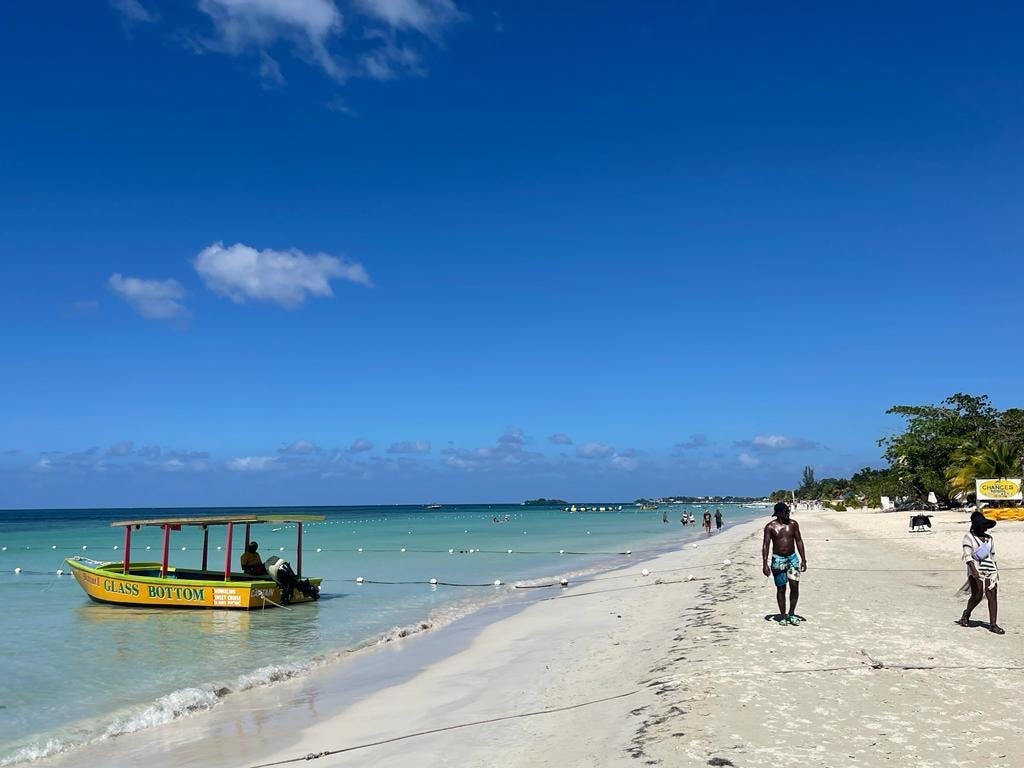
The beach is the stage of all activity and the initial hustler assault lasts all day and for several. Just today, things eased up and I walked more freely. The locals see things that we don't. When we first arrived, wide-eyed and hypnotized, our skins not yet sautéed by the Caribbean sun, we're all the same, seekers strolling and keeping our eyes open for the perfect afternoon. That could involve a spliff, water sports or scuba, maybe a snake oil that's "good for the bamboo" and so every few paces a local will slink in beside you in a chummy way and offer what he has to offer. They glom on, walking with you offering distractions from every page of the menu. They mark you right away, I was told, they know who's new to the beach. Your armor is eye-contact and a consistent no, I was told. Eventually the hawkers peel away and glom onto the next comber passing in the opposite direction like remoras in a school of lazy manta rays.
So unpleasant is this rite of passage that many people avoid this stretch of beach and the prowlers that never sleep, and the safety-seekers don't stay long enough to realize that it is a passage. These skins are the real Jamaica, they surmise, and they retreat back beyond the sentry post of Club Perfect, taking note to never again disregard the warnings of the concierge.
Always, the rolling beats of reggae, dancehall, rocksteady, opposite the waves that fall onto the sand with a hollow clap. Nothing crashes here. It's a throwback where people are not identified by codes or #tags or @nything of that sort. You get to know people because you see them where you walk, where you eat, where you dance. Strangers become familiars become acquaintances. The compulsion to share contact info becomes a comical token of the uninitiated. . . but how will I find you . . . just keep doing the things you enjoy doing and I will be there . . . . and after two days of persistent but polite no's and the emerging tan, the hustlers begin to regard you not as a mark, but someone with a will.
I met a man named Ariston at the Rasta Shack today. All of the Jamaicans are carved by the same sculptor and the craftsman has an eye for perfect musculature, sinew and the rippling forms that we whiteys associate with youth but that carry on well through the decades in Jamaica. His material is a creamy obsidian, the color of undiluted coffee and the polish he uses is some magic oil that somehow conveys both power and patience, ferocity and passion. Ariston led me back through a bamboo grove where a band of ragamuffins was sitting on felled logs and passing a joint. When he said it, my name had a regal tone, but more mountain king than courtly. "This is George," he said and then took a place on a log and I did the same, next to a woman named Barbara who had driven her ramshackle RV to the Yucatan and then had it barged across the Caribbean to Jamaica. Another woman, Mary Katherine, had crazed distrustful eyes that might have been split by the cannabis so I took note to hit it mildly when it came my way. John Baldwin had moved down from Chicago, a bedraggled looking Rasta ex-pat whose dog, Killer hated cops.
A local named Thunder who I recognized from the coffee stand where each morning we get a slice of papaya and a piece of toast to accompany the Blue Mountain brew, served with sweetened condensed milk. Lynette was quiet. I only heard her speak when we were introduced and she had pixie eyes and a glow about her, perhaps imparted by the panther of a man sitting next to her who smiled freely and rolled a finger-sized spliff to back up the one that was dwindling on its passage around the clearing. When he finished rolling, he tucked the spliff behind his ear and then grazed Lynette's back with graceful fingertips and she looked at him with the smile of one who's carrying a warm secret. Ynez joined us from the RV and she was carrying a mesh sack full of fruit the size of a child's fist that bore a sweet and grainy flesh when you tore it open. Ynez was Barbara's lover and I sensed that the lesbians held power with the Rastas, the kind of power gained through generosity, such as with a mesh bag of fruits. Given the air temperature, it seemed odd to me that a smoldering fire burned in the center of our seated ring, but there it was and the air was fragrant and cool in the shade of the bamboo grove.
I soon became high, very high, despite my cautious pulls on the spliff. Marijuana often leaves me tenuously pacing the brink of paranoia, but this was not that experience. As the ganja took over, the sense of difference between my self and Jamaica, the people and the customs, seemed to blur with the smoke hazing its way through the sky-high jungle grass. This high felt necessary, and just as reggae doesn't sound nearly as good beyond Jamaican shores, the effects of even the best of pot cannot touch that levied by true Jamaican ganja.
Before long, Peter Jackson showed up from a morning in the hill country, he called our attention to his new haircut that he'd paid for with a string of beads. I mention I'm thinking about food and Ariston demands that Peter Jackson (his name only ever said in full) show me their friend's curry shack, best curried conch on the beach, and Peter Jackson obliges. I follow him back out to the beach.
The air feels much warmer than it had in the bamboo grove, even in the alternating patches of cloud shade. I had stumbled into my cast of characters that afternoon, by happenstance that could have just as easily ended in a knifepoint robbery. I didn't choose the faces, but just the same they became the nucleus of my familiarity over the days I had remaining, and had those days been weeks, the nucleus would be the root of my molecular interactions with the denizens of the honest end of five mile beach.
I sat for an hour at an unshaded picnic table while Peter Jackson's friend prepared a plate of curry in the unhurried fashion that confounds many tourists. His kitchen was an open air cook surface with two gas burners and a brick fire pit covered by a heavy iron grill. The cook's name was Dean, and like any of the food vendors who operate lean-to restaurants along the beach, Dean never stopped moving, but he moved languidly with no concern for the expectation of his guests. At the time, I was his only customer. Nothing happened quickly in Negril. In fact, aside from the scooters that sputtered along the beach road, and the ripping taxis that threatened them with each hair-miss passing, nothing moved quickly in Negril and the best place to recalibrate the clock of your expectations was with the beach chefs. When he delivered my plate, Dean sat opposite me at the picnic table.
"How do you know Peter Jackson," he asked me.
"We met earlier in the bamboo grove, down the way."
I pointed down the beach and Dean didn't need to see where I pointed to know the grove I meant.
"Barbara's place." He said the name Barbara in distinct syllables, as if they were three separate words.
"Is he a friend of yours?"
Dean was looking at the sea and he continued looking at the sea when he said something that under different circumstances could seem threatening.
He said, "I have no place in my life for friends anymore."
And he didn't seem like he was testing me or trying to make me uncomfortable. He was a warm man, and he spoke as one grateful to have an audience.
"One week ago, my friend, my closest friend, drowned in the sea. He was a great swimmer, the best. It makes no sense so God could be the only one with a reason and when God is ready for someone to have that power over me again, I will know it."
While I ate, Dean drank a cup of coffee and looked at the sea, or beyond the sea, and long silences would pass. He shared snapshots of his history with Johnny, the boy they called 'Rascal' for how quickly he would steal things.
"But he wasn't really stealing, you know. He was borrowing it whether you were ready to lend it or not," he smiled. "Bicycles, boats. Just two weeks ago he took my folding knife from the kitchen here," and then Dean went silent again, wondering, I imagined, if he'd ever see that knife again.
I was happy to eat Dean's curried conch, and to be his ear, to listen without threatening friendship. When I left, he told me to "have a good day," and he really leaned on the word 'good'.
I made my way back up the beach to my tent, where I slept off the last heat of daylight before the timbre of beach sounds shifted from day to night.
It was dusk when I was awakened by the sound of a woman, stark raving mad with some discontent or another. I stood from my tent and watched her walking toward the beach, toward the music, with a rent-a-dred in tow. She sounded like a mynah bird trying to blame the world for her fledgling fallen from the nest. Her Dred followed her with two fingers hooked into hers, trailing her as if keeping a distance from her fury. She was not an unattractive woman, and I imagined he had a head full enough of ganja that he could regard her with the same fascination as I was. What a foreign creature she must be, practically dragging him in her haste. A haste for nothing, a haste for its own sake. I imagined her back home leading a reluctant five-year-old on his way to the barber shop, but the Dred was smiling, perhaps a mask for his friends watching nearby, marveling at what Rico would go through for a little Pum Pum. Later I saw them dancing at the reggae show, his hand still woven in hers. He danced on the sand and she on a table.
I crossed to the fringe of the beach where the sand was hardened by the slow clapping waves, and the sea was glassy, throwing back a perfect replica of the streaky rust and orange, the final smolder of daytime.
Up the beach the tiki torches were alight at the resorts where the regimented leisure held the vacationers in a comfortable state of routine. Days, and mornings, and breaks, and evenings. Clocks set by the timing of buffets, evening serenaded by kettle drums, never allowing for the unmooring of clock and calendar. The tailored staff were trained to keep disorientation to a minimum, "ah, no ma'am, the pool is in that direction," and none of these poor souls freed themselves from their temporal blocks and orientations, which were nothing more than a sand grain vortex, slowly sucking them toward death.
Down my way, gone were the twittering sounds of beach play and the seascape was silent. No paraglider-trailing motor boats, no jet skis with their howling rooster tails, and all of the fishing boats had puttered back into their river inlet slips. All that remained was the beats and the murmur of gathering crowds. Stepping closer to the water and taking in a full expanse of beach, you can see these crowds forming around the make-shift stages set just far enough apart that their concerts would only barely overlap, one show bids farewell as the next beckons.
The beach pushers seem more sinister after nightfall. Watching a fellow alter his meandering course so that he passes close enough to make a pitch unnerves a newbie. Back home the Safety-seekers might cross to the other side of the street if they saw such a panther approaching. The guy recognizes me, and he knows I'm not a buyer, so he smiles and lets me know what's in his pouch, just in case . . . ganja, ecstasy, cocai. . .
No posts
Comments
Nothing yet. Say the first thing.
Sign in to join the conversation.