
Good morning. We have 15 minutes of morning left. Saturday, November 23rd. I lost my pen.
Found it.
So: for this morning’s recording, I’m going to record my Hungarian homework as a timestamp of my progress. No one will ever need to listen to this but me. That’s how I give myself permission.
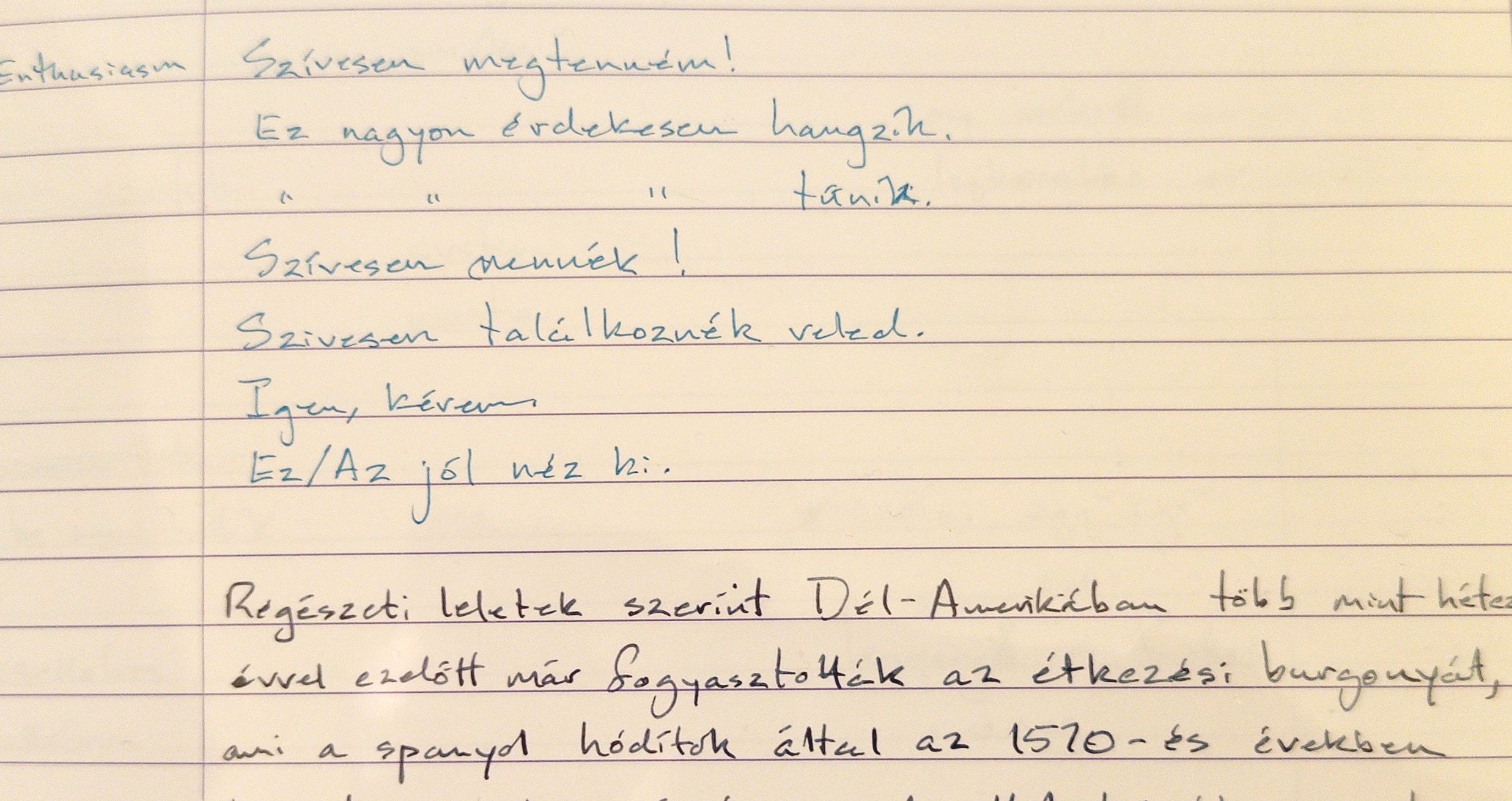
[What follows is a working session with the morning’s vocabulary and sentences. Each one read aloud in Hungarian, translated, new words noted.]
Hatékony — efficient. “Old Hungarian buses are slow and not efficient.”
Elnézést — excuse me.
“Elnézést, kéjekvájtok?” — Excuse me, are you locals? — helyek is the new word.
“Pozsonyban régi házak, keskeny utcák és drága üzletek vannak.” — There are old houses, narrow streets, and expensive stores in Bratislava. “I’ve only been once. I should go back.”
“Szállást kell foglalni.” — We have to reserve accommodations. — szállást = accommodations, kell = must, foglalni = to reserve.
“Ki vágja fel a tortát?” — Who cuts up the cake? — “felvágnál if it’s a statement; you reverse fel and vágja and separate them if it’s a question.”
“Előadást tart ma?” — Who is giving a lecture today? — előadást = lecture, accusative form.
“Nem hiszük, hogy ő francia.” — We don’t believe that he is French.
“Amikor esik az eső, magammal viszem az esernyőt.” — When it rains, I carry an umbrella with me. — magammal = with me.
“Fáj a védőoltás?” — Does a vaccination hurt?
“Egy belépőjegy.” — An admission ticket.
“Elárultál.” — You have betrayed me. “I don’t need that. No one’s gonna betray me.”
“Soha nem árulok el.” — I will never betray you. “That I might need.”
“A turisták elkéstek, mert eltévedtek a városban.” — The tourists were late because they got lost in the city.
“László mindig megeszi az ebédjet.” — László always eats his lunch. — “Interesting word, ebédjet.”
“Közel van ehhez az épülethez.” — It is close to this building.
“Nem lepődtem meg, mert tudtam, hogy jönnek.” — I wasn’t surprised because I knew they were coming.
“Nem hívtalak meg, mert nem akarok veled találkozni.” — I didn’t invite you because I don’t want to meet with you.
“Nem hívtam meg Josht a bulira, mert már nem vagyok szerelmes belé.” — I didn’t invite Josh to the party because I’m not in love with him anymore. “Sorry, Josh.”
“Megfelelt, vagy nem felelt meg?” — Was it suitable or not?
A note on pronunciation from my teacher: Hungarian has a lot of e sounds — there’s e, é, eh. She said if you want to speak eloquently, the poets find different words to break up the run of eh, eh, eh. Something to pay attention to.
To be continued.
No posts
Comments
Nothing yet. Say the first thing.
Sign in to join the conversation.