
Highlights
AI capex is larger than you think. WSJ has an excellent visual piece tracking Big Tech’s AI capex. They estimate that the spending is in fact US$3 trillion higher than publicly reported, with many financial commitments being securitised and held by financial institutions, or otherwise being ‘off the balance sheet’ of tech companies. This makes the stakes ever higher for the AI boom with so so much riding on the success of AI. But even if AI turns out to be as good as investors hope, won’t that be destructive to the labourforce and economy as we know it?
Nvidia and the AI boom. The FT considers that Nvidia, which has morphed from video game tech supplier to GPU chipmaker to AI imperial octopus, continues to be well positioned for the AI boom.
Consider the counterpoint: in the current age of inference, the AI chip market is a lot more competitive.
On Cerebras’ CS-4 chip. SemiAnalysis turn their technical analysis to Cerebras’ latest chip. The CS-4 has roughly 2x the performance of the CS-3 chip.
Thanks for reading.
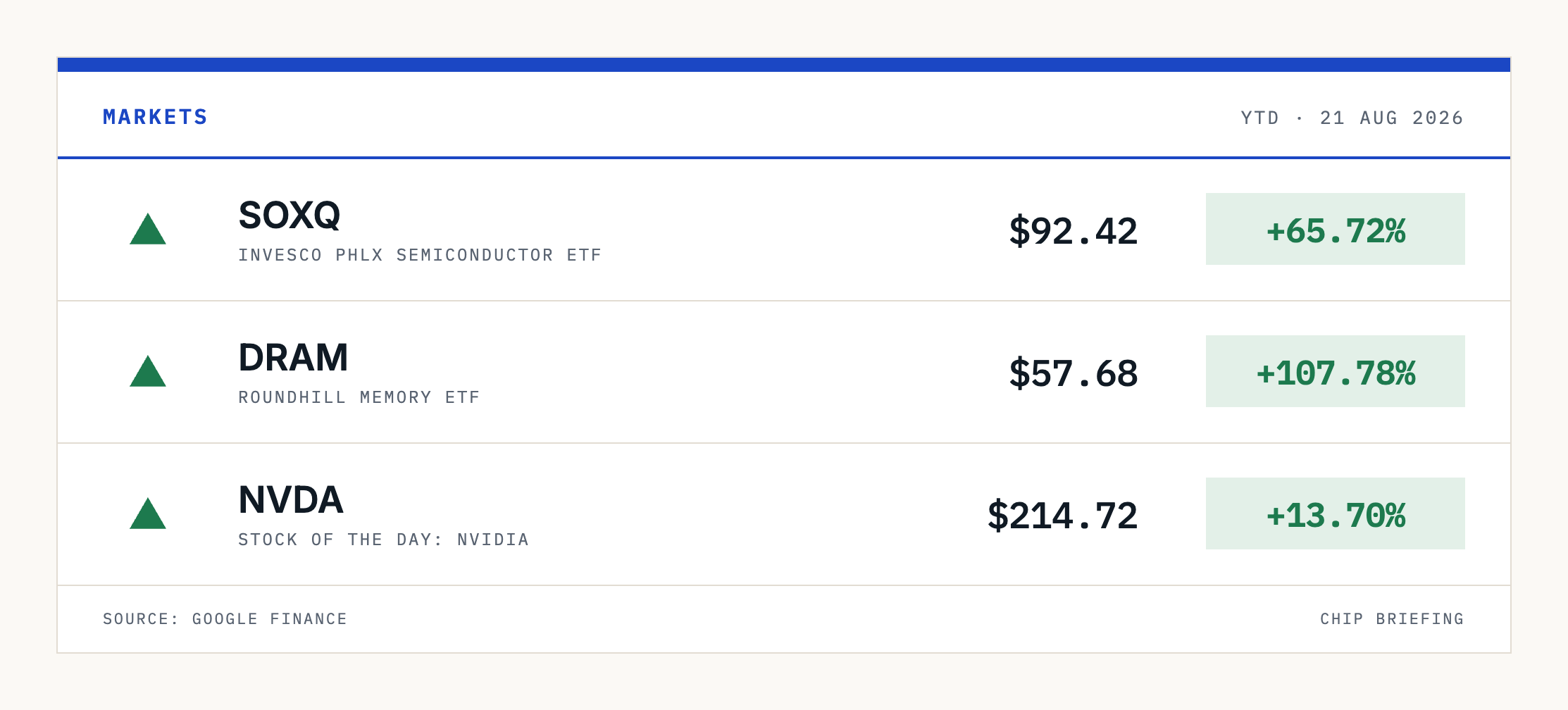
Table of Contents
Peter Rudegeair and Peter Santilli, “Why Big Tech’s AI Spending Is $3 Trillion Higher Than It Seems,” WSJ, 08/16/2026.
Richard Waters, “Nvidia looks well placed to benefit from the next stage of the AI boom,” FT, 08/20/2026.
Myron Xie, Bryan Shan, Wega Chu, et al., “Cerebras’s Next Generation CS-4: Fast Just Got Faster,” SemiAnalysis, 08/18/2026.
L. Lynne Kiesling, “The Grid’s Expanding Feasible Set, Part 1,” AEI, 08/20/2026.
1.
Peter Rudegeair and Peter Santilli, “Why Big Tech’s AI Spending Is $3 Trillion Higher Than It Seems,” WSJ, 08/16/2026.
Each quarter, big tech companies disclose their massive capital expenditures on artificial-intelligence infrastructure, from data centers to chips.
But those figures don’t come close to expressing the full extent of future spending to which Google parent Alphabet, Meta Platforms, Oracle and many others have committed. That is because a huge swath of their coming financial obligations aren’t reflected on their balance sheets.
Nine top tech companies had some $3 trillion of off-balance-sheet commitments mostly related to AI, according to a Wall Street Journal analysis of footnotes in their most recent securities filings. Those obligations are growing faster than traditional “capex,” which totaled about $600 billion over the past year they reported, and were about triple what the companies owe under their outstanding leases and long-term borrowings.
America’s blue-chip tech companies are placing these huge bets based on assumptions about what the demand for AI computing—and availability of AI hardware—will be in several years. Their hope is that they will easily meet all their obligations with future revenue as consumers and businesses adopt AI in every facet of American life.
If those assumptions about technology and demand prove wrong, these deals to clinch future capacity could become a monstrous burden for the tech companies and their investors.
Meta’s gigantic “Hyperion” data-center project in Louisiana, which is the size of about 1,700 football fields, helps explain how big obligations wind up off tech companies’ balance sheets.
A graphic showing the 80%-20% split between Blue Owl Capital and Meta Platforms in the special purpose vehicle that owns the Hyperion data center.
Though Meta is the builder, neither Hyperion nor the $27 billion in debt that’s financing its construction shows up on Meta’s balance sheet. Funds managed by the Wall Street firm Blue Owl Capital own the majority of a joint venture that, in turn, owns the campus.
2.
Richard Waters, “Nvidia looks well placed to benefit from the next stage of the AI boom,” FT, 08/20/2026.
When Nvidia first lent large amounts to some of its customers to finance sales of its chips, it fed worries that an AI bubble was being inflated by an orgy of “circular” financing.
A year on, something new is taking shape. These days, Nvidia has found ways to limit its own exposure, while co-opting a wider group of financiers. Equally significant, it is using its credit to seed new markets and a fresh business model.
This hasn’t silenced all the doubters. But for the world’s biggest chip company, it signals a sea change in the strategic use of its balance sheet and a new phase in the AI boom.
One sign of this was last week’s framework agreement for six Wall Street financiers to extend some $500bn to Nvidia’s customers, with Nvidia guaranteeing up to a quarter of some of the transactions. Another was this week’s news that it is providing an up to $105bn backstop for a new OpenAI data centre in Ohio.
Those guarantees could still leave it on the hook for large amounts, and it is unclear how much more exposure like this it will take on. But for now, the deals have done nothing to weaken Nvidia’s “excellent financial profile”, according to Moody’s, which has affirmed its credit rating.
Even if it has found a way to reduce its own risk, though, Nvidia has left tougher questions for credit markets to chew on. CEO Jensen Huang claims his company’s chips are in wide enough use that they amount to a new asset class against which financiers can comfortably lend. But it is an asset class without the extensive history that credit analysts rely on.
The direction has been clear for a while. Nvidia has been inching towards supplying all the technologies needed to create AI services. That includes last week’s release of its latest open-source AI model, at a time when US demand is growing for an alternative to open models from China. It has also been developing complete AI solutions for “vertical” markets like healthcare, potentially opening the door to new types of software revenue.
How far this will go is an open question. But with its balance sheet at its back, Nvidia is ready to lean further into the next phase of the AI boom.
3.
Myron Xie, Bryan Shan, Wega Chu, et al., “Cerebras’s Next Generation CS-4: Fast Just Got Faster,” SemiAnalysis, 08/18/2026.
Cerebras revealed CS-4 this week, with more details to come at Hot Chips. CS-4 is their fourth-generation rack built around the same third generation 5nm wafer-scale engine: WSE-3. CS-4 doubles the performance of CS-3 through increased power consumption and clock frequency per wafer, and better rack-scale density.
This all translates into CS-4 being able to double the tokens/s/user per wafer from CS-3, and at around the same cost as the previous generation. This is a no-brainer for customers who can enjoy double the token revenue with the same hardware spend. It’s not only the tokens that are getting faster, but so is time to market: the rack architecture itself is redesigned to be more modular, allowing improved manufacturability and deployment times. Last but not least, a new I/O module will enable open, heterogeneous and disaggregated inference architectures going forward. These disaggregated inference setups will go a long way to help overcome the memory capacity constraints of the CS-4 by pairing it with HBM-based systems.
The CS-4 uses the same 5nm WSE-3 as the CS-3, but Cerebras is extracting double the performance by doubling clock speeds. This comes from feeding dramatically more power to the wafer, and is enabled by the CS-4’s improvement in power delivery and cooling technology. While staying on the same 5nm silicon sounds underwhelming, Cerebras can still double the metric that matters most: memory bandwidth. The doubling in memory bandwidth should translate into a near doubling of tokens/sec/user all else equal, and this is what customers want from Cerebras. Clock speed doubling also drives double the peak theoretical FLOPs and the WSE’s parallel off-wafer I/O, allowing the CS-4 to upgrade to 2.4Tb/s of off-wafer I/O from 1.2Tb/s with CS-3. However, what remains the same is 44GB of SRAM capacity per wafer, as this is determined by the number of SRAM bit cells available on each wafer. so we’ll have to wait for the next generation silicon before we can see any improvement here. This is the main drawback of re-using the same WSE-3 as the low memory capacity per wafer is one of the key tradeoffs inherent with Cerebras’s architecture.
As we described in our previous article on Cerebras, the wafer has an incredibly unique architecture due to the use of SRAM that makes it well suited for running kernels with low Arithmetic Intensity, such as low-batch size decode.
4.
L. Lynne Kiesling, “The Grid’s Expanding Feasible Set, Part 1,” AEI, 08/20/2026.
I think about this industry as a five-layer stack (of course I do, I have a stack for everything, have you met me 😉 ?!?!).
At the bottom are semiconductor materials and devices: silicon, silicon carbide, gallium nitride, semiconductor switches like MOSFETs and IGBTs.
Above them are the modules and hardware that turn semiconductor switches into reliable equipment: gate drives, capacitors, magnetics, busbars, cooling, packaging.
The third layer contains converter architectures and controls: inverters, rectifiers, DC/DC converters, modular multilevel converters, and grid-forming algorithms.
The fourth layer is where those technologies become recognizable power-system equipment: battery storage, solar plants, HVDC systems, microgrids, data-center power systems, and perhaps increasingly solid-state transformers.
The fifth contains the institutions that govern their use: grid codes, interconnection requirements, protection practices, dispatch, markets, cybersecurity, and regulation. More on this next week.
Innovation can move upward through this stack; constraints, downward. A new semiconductor may enable a sophisticated grid-forming converter, while an interconnection rule written around yesterday’s equipment can prevent it from providing the very service that makes it valuable.
–
Cover Photo by Geoffrey Moffett on Unsplash
No posts
Comments
Nothing yet. Say the first thing.
Sign in to join the conversation.