
I am flying to the United States this weekend. Starting later this month, I will be based out of Stanford University in Palo Alto, CA. For the next two weeks, though, I am taking a trip around the east coast of the United States, visiting DC, New York City, and Boston. This newsletter may come out at a different time and/or at an irregular cadence until I settle in. Thanks for your understanding. I look forward to seeing friends and readers in the US.
Highlights
US polysilicon tariff. The US imposed 15% tariffs and a price floor on polysilicon, a pure form of silicon that forms the base for semiconductors and solar panels. Polysilicon is predominantly produced in China and this is an effort to move the chip supply chain to the US. Though, because there are no sufficient American substitutes, it’s more likely that the supply chains will stay as they are and everything downstream of polysilicon (chips, data centre buildout, consumer electronics) will get more expensive.
The tariffs are under Section 232 of the Trade Expansion Act of 1962, which is more legally sound than the IEEPA-based tariffs that the Supreme Court struck down earlier this year. The tariffs will take effect December 4. Xi Jinping of China is expected to meet with Trump in the US on September and I imagine this will come up. I wrote a little bit more on the latest US-China trade dispute yesterday.
AMD acquires AI chip startup. AMD acquires Canadian AI chip startup Taalas for an undisclosed sum of money. Taalas is an AI inference startup. This comes as inference takes up more compute and as competitor Nvidia ‘acquired’ Groq.
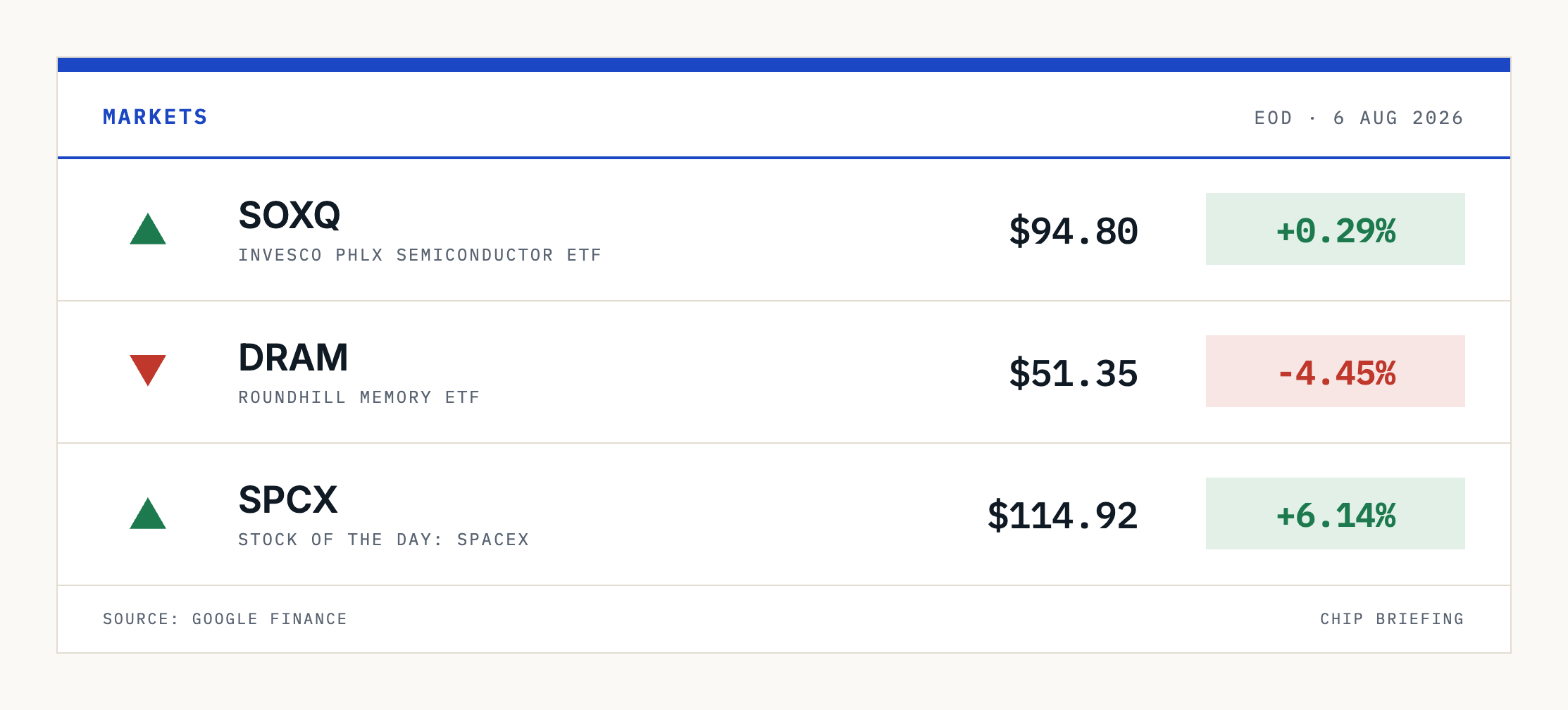
Terafab to invest $17B+. Terafab, Elon Musk’s effort to build a chip plant under his own firms SpaceX and Tesla, will reportedly spend at least US$16.8 billion to build the facility. To build something of the scale Musk envisions - massive output at the cutting edge - he will need to invest many more billions. There was no news about Intel, which was previously reported to be helping the Terafab project, though I can’t imagine why since they would be a direct competitor.
Thanks for reading.
1.1
Reuters (08/07): Trump unveils trade actions to protect key solar and semiconductor material
The White House on Thursday imposed a series of price floors and a 15% tariff on products made from polysilicon, the raw material used in semiconductors and solar panels.
The proclamation under Section 232 of the Trade Expansion Act of 1962 by U.S. President Donald Trump is aimed at protecting domestic polysilicon makers from Chinese competition.
Polysilicon, an ultra-pure form of silicon, sits at the start of the semiconductor and solar manufacturing supply chains. Manufacturers turn silicon wafers into solar cells and then assemble those into panels used in solar projects. The trade protections will take effect on December 4, the White House said.
1.2
Bloomberg (08/06): Chinese Renewable Energy Giant Envision Launches Data Center
Envision Group has commissioned the initial phase of a gigawatt-scale data center in China’s Inner Mongolia, an unusual foray by a renewable energy company into the booming artificial intelligence industry.
AI company DeepSeek is also planning a 1 gigawatt data center in Ulanqab, according to people familiar with the matter. The city’s cold climate, with an average annual temperature of 4C (39F), helps reduce the energy required to cool power-hungry AI servers. Z.AI, formerly Zhipu, is also working on a 1 gigawatt project that it plans to fill with only domestically made chips.
1.3
Bloomberg (08/06): UAE Fund Weighs $6.3 Billion for Japan AI Data Center
The United Arab Emirates is considering investing as much as ¥1 trillion ($6.3 billion) to build an artificial intelligence data center in Japan, according to a person familiar with the matter.
Abu Dhabi sovereign wealth fund Mubadala Investment Co. would lead the investment into a 500-megawatt project in the Akita prefecture in northern Japan, which may include other foreign and domestic investors, the person said, asking not to be identified because the information isn’t public.
Once completed, it could become the largest data center in Japan. The talks with the Gulf state underscore growing global interest in securing critical AI assets in countries viewed as relatively insulated from geopolitical tensions.
1.4
Chosun Ilbo (08/06): Sovereign AI Goals Undermined by NVIDIA Chip Dependence
As countries worldwide pursue “sovereign AI (AI sovereignty)” by independently building their own data and artificial intelligence (AI), they remain overwhelmingly dependent on U.S. NVIDIA in hardware such as AI chips. This undermines the stated goal of “not being dependent on any specific country’s AI technology.”
Market research firm Counterpoint Research released the “Sovereign AI LLM (Large Language Model) Research Report” on August 5 (local time), stating, “Over 55 countries are currently developing their own sovereign AI, which are LLM models.” Counterpoint Research analyzed more than 170 AI models developed by countries across 80 regions, including the Middle East, Europe, Asia-Pacific excluding China, Central Asia, Africa, Canada, and Latin America.
According to the report, while countries advance sovereign AI, the graphics processing units (GPUs) used to train these models are predominantly NVIDIA chips. NVIDIA’s chip market share reached 92.4%. AMD ranked second with 4.1%, and Cerebras third with 1.7%.
2.1
Bloomberg (08/07): Advanced Micro Devices to Buy Startup Taalas for New AI Chips
Advanced Micro Devices Inc. is buying Canadian startup Taalas, a move that will let it offer another type of artificial intelligence chip to the burgeoning data center industry.
AMD has reached a definitive agreement to acquire the Toronto-based company, according to a statement Thursday. Financial terms weren’t disclosed.
Taalas’ technology is used in chips that handle inference — the stage of AI where already-trained models are fielding queries from users and providing responses. The startup says that by hard-wiring AI models into chips, it can create more efficient machinery than today’s options.
2.2
Reuters (08/06): SpaceX, Tesla to initially spend $16.8 billion on Terafab chip plant in Texas
Elon Musk’s SpaceX Tesla will initially invest $16.8 billion to build Terafab, an advanced AI semiconductor complex in Grimes County, Texas, as the companies race to secure the chip capacity that the billionaire has called essential to their future.
The facility is intended at narrowing the gap between global chip supply and the more than 1 terawatt of computing power that SpaceX and Tesla expect to need in the coming years.
Future expansion phases could push total investment much higher, SpaceX said in a statement on its website on Thursday, adding that the facility would employ at least 3,000 people.
2.3
FT (0806): SoftBank’s $8bn gain on Intel stake helps Japanese group beat expectations
An $8bn gain on SoftBank’s stake in Intel helped Masayoshi Son’s tech group beat analysts’ expectations despite a decline in first-quarter profit.
The Japanese company said on Thursday that net profit was ¥347.3bn ($2.2bn) in the three months to June, ahead of the ¥148.4bn analysts had expected, according to LSEG data, but down 17.7 per cent on the same period last year.
SoftBank booked a ¥1.3tn ($8.2bn) gain on its investment in Intel, in which it agreed to invest $2bn last year at $23 a share.
2.4
Bloomberg (08/07): Nscale Touts $51 Billion in Contracts, Targets September US IPO
Nscale is telling prospective investors it has about $51 billion of total contracted revenue ahead of a US initial public offering that could take place as soon as in September, according to people familiar with the matter.
The London-based company’s executives briefed potential backers on its growth trajectory, with revenue rising to more than $100 million in the second quarter of 2026 versus around $37 million in the first and roughly $33 million in all of 2025, the people said, asking not to be identified.
Nscale is working to add 10 gigawatts of power for its AI computing centers, adding to an existing 831 megawatts of active and contracted power, some of the people said. A single gigawatt can power roughly 750,000 US homes at any given time. The company is developing data centers in sites including in Norway and West Virginia.
2.5
Chosun Ilbo (08/06): FuriosaAI Targets 100 Billion Won Sales with AI Chip Expansion
Domestic AI semiconductor (NPU) startup FuriosaAI is accelerating its commercialization efforts with the goal of achieving annual sales of 100 billion Korean won this year. FuriosaAI, a fabless (semiconductor design) company specializing in AI accelerators (NPU) optimized for inference operations in generative AI services, aims to connect its technological capabilities to actual business results by expanding mass production and overseas supply of its second-generation AI inference accelerator, ‘RNGD (Renegade).’
However, industry observers cautiously note that domestic AI semiconductor companies, including FuriosaAI, have entered the ‘Death Valley’ phase. Death Valley refers to a period when startups, having succeeded in technology development and product mass production, face difficulties in securing customers, securing repeat orders, and raising additional funds. There are criticisms that proving chip performance and consistently generating sales in the actual market are challenges of entirely different dimensions.
3.1
WSJ (08/06): Startup Raises $700 Million to Replace Data-Center Wires With Light
Lumilens, a two-year-old startup building optical-interconnection technology for data centers, has raised more than $700 million at a $5.5 billion valuation, as firms search for better ways to connect growing numbers of artificial-intelligence chips.
The financing was co-led by Atreides Management, Bain Capital Ventures, Meritech, Seligman Ventures and Spark Capital, the company said. The San Jose, Calif.-based company has raised more than $900 million since its founding and recently began shipping equipment into the data centers of a large hyperscale cloud provider it declined to name. The agreement is worth billions of dollars over the next several years, the company said.
The idea is to use optical connections—which transmit information using light—instead of electrical signals traveling over wires. Graphics processing units today are typically connected with copper wiring, which is cheap and reliable but becomes less effective when handling larger amounts of data over longer distances.
3.2
Korea Herald (08/06): China’s homegrown DUV jolts chip industry, but yield test looms
Recent reports that China has developed its own immersion deep-ultraviolet lithography system have jolted the global semiconductor industry, suggesting that Beijing may be closing one of the most formidable technology gaps maintained by US export controls.
Korean experts caution, however, that building the machine is only the first step. China could still need years to prove that the equipment can operate reliably, process wafers at competitive speeds and deliver commercially viable chip yields.
3.3
Chosun Ilbo (08/06): TSMC 3-Nanometer Production Jumps to 180,000 Monthly Wafers
TSMC, the world’s largest semiconductor foundry, is expected to increase its monthly production capacity for 3-nanometer (nm) processes to 180,000 wafers by the end of this year. This expansion, driven by rising orders for AI and high-performance computing (HPC) semiconductors, exceeds initial market expectations.
According to local Taiwanese media reports compiled on August 6, TSMC’s 3-nm factories in Taiwan are projected to reach a monthly production capacity of 180,000 wafers by year-end. This is 20% higher than the initially anticipated 150,000 wafers and represents over a 40% increase compared to the 120,000–130,000 wafers produced monthly at the end of last year.
–
Cover Photo by Tabrez Syed on Unsplash
No posts
Comments
Nothing yet. Say the first thing.
Sign in to join the conversation.