
Highlights
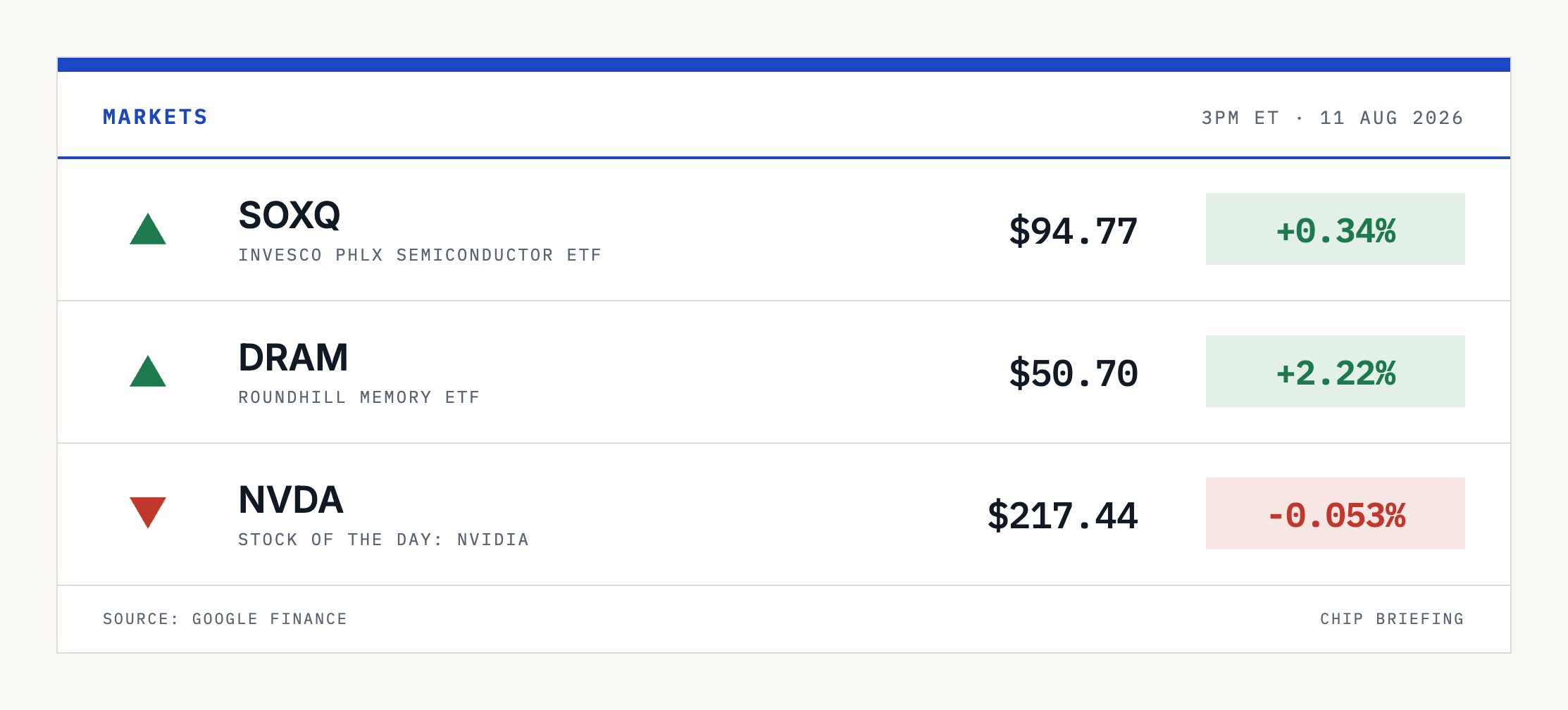
Nvidia-Wall St financing deal. Nvidia and several major financial institutions signed a deal to help the chipmaker’s customers finance the purchase of chips. It is estimated at over US$500 billion over the next few years. This latest meta-deal marks a significant expansion of the circular / vendor financing that has come to characterise many deals in the AI boom to the concern of some regulators and investors. The financial firms, which include Apollo, Blackstone, BlackRock, Brookfield, Goldman Sachs, and KKR, will offer financing at attractive rates for Nvidia customers.
Tighten export controls? Last month, Nvidia’s H200 chips finally made their way to China in limited quantities. At the same time, Chinese AI firms have demonstrated success and innovation; their models are much more compute efficient but nonetheless would still prefer to be trained on Nvidia chips. As a result, Commerce’s BIS is reviewing how Chinese AI firms access Nvidia chips, specifically by renting compute from data centres physically overseas. I’ve long said this was a well-known loophole to US export controls and Commerce may tighten this soon, if Congress doesn’t move on this first.
John Moolenaar, head of the House China Committee, called the administration to prevent China from accessing advanced US chips.
Apple tests CXMT chips. Apple is reportedly testing CXMT memory chips for its products, including for the iPhone and MacBook. CXMT is currently blacklisted by the Pentagon for alleged affiliation with the Chinese military.
I previously wrote of my skepticism that Apple will (be allowed to) use CXMT memory chips given congressional opposition and counter-lobbying by Micron. Plus, CXMT only just caught up to the cutting-edge of mobile memory, cannot produce at the quantities that Apple needs, and any price discounts will likely even out in the medium term.
Nonetheless, DC lobbying regarding the memory chip industry is heating up, per a NYT article that outlines the different suggestions companies have floated to ease the memory supply crunch.
Thanks for reading.
1.1
Bloomberg (08/07): US Reviews China’s Offshore Nvidia Chip Access After AI Gains
A key US agency is reviewing how Chinese AI firms acquire and access Nvidia Corp. chips overseas, following a spate of technological breakthroughs that highlighted their ability to use the cutting-edge hardware despite Washington’s restrictions on shipments to the Asian country.
The government division that typically investigates violations of chip export controls is now more systematically looking at legal avenues through which Chinese AI firms are accessing advanced processors, specifically by renting computing power located in other countries, according to people familiar with the matter, who asked not to be identified as the details aren’t public.
That post wasn’t coordinated with the Commerce Department, whose Bureau of Industry and Security oversees chip export curbs, despite alleging a violation of those rules, people familiar with the matter said. A few days later, though, the enforcement arm of BIS launched its review, said the people with knowledge of that process.
1.2
Reuters (08/10): Key Republican urges US to stop any advanced chips from reaching sanctioned Chinese firms
Republican Congressman John Moolenaar, who leads the House Select Committee on China, called on the Trump administration to make sure chip manufacturers don’t send advanced logic chips to untrusted Chinese firms.
In a letter dated Thursday, Moolenaar described the measure as “a critical step in preventing [China] from accessing high-end U.S. chips and preserving America’s technological edge,” urging the Commerce Department to enforce it.
1.3
NYT (08/10): A.I.-Driven Chip Crunch Leads to New Rush of Lobbying in Washington
The artificial intelligence boom has created a shortage of a critical commodity called memory chips, and a new front for corporate lobbying in Washington.
Now, a wide range of industries, including medical device makers, car manufacturers and consumer electronics companies like Apple, are asking for the government’s help to get the chips they need.
The companies and their lobbyists have suggested a mix of solutions, some conventional and others highly interventionist, like federal policy that would push memory chip makers to allocate more chips to their industries, according to interviews with 18 people, many of whom spoke on the condition of anonymity because they were not authorized to speak publicly about those discussions.
1.4
Bloomberg (08/09): China AI Chip Designer Moore Threads Plans Hong Kong Listing
Artificial intelligence chipmaker Moore Threads Technology Co. said it plans to list in Hong Kong at an “appropriate time” after its shares have surged more than 420% since their Shanghai debut last year.
The Beijing-based firm is planning a Hong Kong offering to deepen its internationalization strategy and attract outstanding research and development as well as management talent, according to a filing released Sunday. Moore Threads also reported a first-half net loss of 11.6 million yuan ($1.72 million), down from 270.9 million yuan in the same period last year, according to a separate filing. Revenue jumped 147% to 1.74 billion yuan in January-June.
1.5
Reuters (08/09): South Korea to launch $3.5 billion chip fund, speed development of semiconductor hubs
South Korea will launch a 5 trillion won ($3.52 billion) semiconductor fund targeting promising chip materials, parts, equipment and fabless companies, a presidential official said, as Seoul seeks to accelerate plans for new chip manufacturing hubs across the country.
The government will also provide a further 5 trillion won in trade finance for suppliers, Presidential Chief of Staff Kang Hoon-sik told a press briefing after a meeting chaired by President Lee Jae Myung on Monday.
1.6
Reuters (08/09): Former SK Hynix employee jailed for leaking information to a Chinese firm, Yonhap reports
A former employee at SK Hynix has been sentenced to 18 months in jail for leaking information on semiconductor manufacturing technology to a Chinese firm, the Yonhap news agency reported on Sunday.
2.1
WSJ (08/10): Nvidia, Wall Street Firms Strike AI Financing Deal Targeting $500 Billion
Nvidia reached deals with some of Wall Street’s largest firms aimed at raising massive amounts of capital to help the chip maker’s customers finance the cost of computing power.
The chip maker has signed agreements to partner with Apollo Global Management, Blackstone, BlackRock, Brookfield Asset Management, Goldman Sachs and KKR to establish “compute financing platforms,” the companies announced Monday. The firms aim to deploy over $500 billion of outside capital in the coming years.
The firms said the platforms will create pools of capital at “attractive rates” for Nvidia customers.
Apollo and Blackstone earlier this year struck a deal with Broadcom to set up a similar financing platform for the chip maker’s customers. The platform will offer financing to companies like Anthropic to pay for computing power from chips developed by Broadcom, including Google’s processing units.
2.2
WSJ (08/07): SK Hynix to Invest $38 Billion on Expansion of Chip Production Capacity
SK Hynix plans to invest about $38 billion to expand semiconductor production capacity in South Korea, as it seeks to ramp up output to meet growing demand fueled by the artificial-intelligence boom.
The world’s second-largest memory chip maker said Friday that its board approved 54.3 trillion won, equivalent to $38.15 billion, in investments—comprising 35.2 trillion won for new chip fabrication facilities in Yongin, south of Seoul, and 19.1 trillion won for new fabrication facilities in Cheongju, central South Korea.
2.3
Bloomberg (08/07): SK Hynix Said to Mull Options for $3 Billion Chongqing Plant
South Korea’s SK Hynix Inc. is considering options for its Chongqing, China-based facility, including bringing in an investor to help accelerate growth, according to people with knowledge of the matter.
The company, a key supplier of high‑bandwidth memory chips to Nvidia Corp., is speaking with prospective advisers to help review the business, the people said, asking not to be identified discussing private information. A potential stake sale may value the facility at about $3 billion, the people said.
2.4
Bloomberg (08/10): Anthropic Strikes $9 Billion Computing Deal With Riot Platforms
Anthropic PBC has struck a $9.1 billion deal with Riot Platforms Inc., a Bitcoin mining company that recently began selling AI data center capacity, people familiar with the matter said, underscoring the Claude maker’s efforts to secure enough computing power to meet its customers’ demand.
Riot disclosed earlier on Monday that it had secured a 20-year deal to supply 191 megawatts of capacity — enough to energize roughly 143,000 homes at any given moment — from its Rockdale, Texas, campus to a “leading frontier AI” company. That company is Anthropic, the people said, asking not to be identified discussing private information.
2.5
Bloomberg (08/10): Intel Raises $20 Billion in Upsized Share Sale for AI Plans
Intel Corp. raised $20 billion in an upsized share sale, a third more than it was targeting when it announced the deal Monday morning.
The chipmaker priced the offering at $95 per share, according to a company statement. That represents a discount of 6.5% to Friday’s closing price, according to Bloomberg calculations. The share sale drew more than $100 billion in demand, people familiar with the matter said.
Intel’s deal shows the resilience of investor demand for stocks along the artificial intelligence supply chain. The year’s biggest US equity offerings have been dominated by companies riding the boom in AI spending. Alphabet Inc. is in the process of raising as much as $85 billion through equity offerings, including so-called at-the-market share sales and equity-linked deals. And Oracle Corp.’s fundraising plans include a $20 billion at-the-market sale.
2.6
Bloomberg (08/09): TSMC Sales Rise 45% as Demand for AI Hardware Stays Strong
Taiwan Semiconductor Manufacturing Co. reported a 45% rise in its monthly sales, a sign of sustained demand for AI hardware in the face of market volatility.
Revenue at the go-to chipmaker for Nvidia Corp. and Apple Inc. reached NT$467.58 billion ($14.5 billion) in July. Analysts on average are estimating a 46.8% increase in sales for the current quarter.
2.7
Bloomberg (08/10): Amkor Is Said to Mull Stake Sale in $1.5 Billion China Unit
Amkor Technology Inc., a provider of outsourced semiconductor assembly and testing services, is considering options including selling a stake in its China business, according to people with knowledge of the matter.
The Tempe, Arizona-based company is working with an adviser to help prepare the carveout of the unit and gauge initial interest, the people said, asking not to be identified because the deliberations are private. Amkor may retain a minority stake in the business, which could be valued at $1 billion to $1.5 billion, the people said.
3.1
WSJ (08/09): Apple Tests Chinese Memory Chips as Supply Squeeze Bites
Apple has been testing memory chips from China’s CXMT across product lines including iPhones and MacBooks, according to people familiar with the matter, as the U.S. company addresses a memory crunch during the artificial-intelligence boom.
Apple has held early talks with CXMT about supplying components with the goal of using them in some devices sold in China, the people said. Apple hopes to win the White House’s blessing to do business with the Chinese company.
Apple is raising prices on its products globally, blaming the rising cost of memory chips because of high demand from AI companies. Getting access to Chinese supplies could help the iPhone maker ease its crunch.
Laptop makers HP and Acer have started using memory chips from CXMT in devices sold outside the U.S. to alleviate some of the memory supply strain, people familiar with the matter said. The Chinese company recently listed its shares in Shanghai and is the most valuable company listed in mainland China with a market capitalization equivalent to $520 billion as of Friday.
3.2
Bloomberg (08/10): Microsoft Plans Production Boost for AI Chips, Report Says
Microsoft Corp. is planning to “significantly” increase production of its next-generation AI chips, the Information reported.
The company has been in discussions with supplier Taiwan Semiconductor Manufacturing Co. to secure manufacturing capacity for over 300,000 of the chips for delivery in 2027, the technology news site reported on Monday, citing people familiar with the situation. Microsoft is preparing to unveil its new Maia 300 chip this fall, the Information said.
Microsoft’s chip push started years after Amazon.com Inc. and Alphabet Inc.’s Google began designing their own chips, and the Maia line is widely seen as less mature than its rivals, which are already widely used to power AI services. Anthropic PBC alone has deals to use 1 million Amazon Trainium chips and Google Tensor Processing Unit accelerators.
3.3
WSJ (08/07): Situational Awareness Bets $400 Million on Stealth Chip Startup After Crash
AI-battered hedge fund Situational Awareness made a big bet this week in Source Foundry, a private company aiming to reinvent the way chips are manufactured, according to people familiar with the matter.
The company has invested $500 million in the startup, including a fresh $400 million infusion this week, one of the people said. Founded last year by Stanford University researchers Abdulmalik Obaid and Joe Burg, Source Foundry has already raised at least several hundred million dollars to date, including a recent fundraising at a valuation of $5 billion, one of the people said. Sequoia Capital previously backed the startup.
–
Cover Photo by Sirisvisual on Unsplash
No posts
Comments
Nothing yet. Say the first thing.
Sign in to join the conversation.