
No Staff, New Words is an ongoing TypePinyin Lab series about the small, surprising moments of everyday life in China—and the Chinese that helps you take part in them.
Start with the first lesson → Episode 1: Robot Coffee Kiosk 🔽
Picture one ordinary day in China.
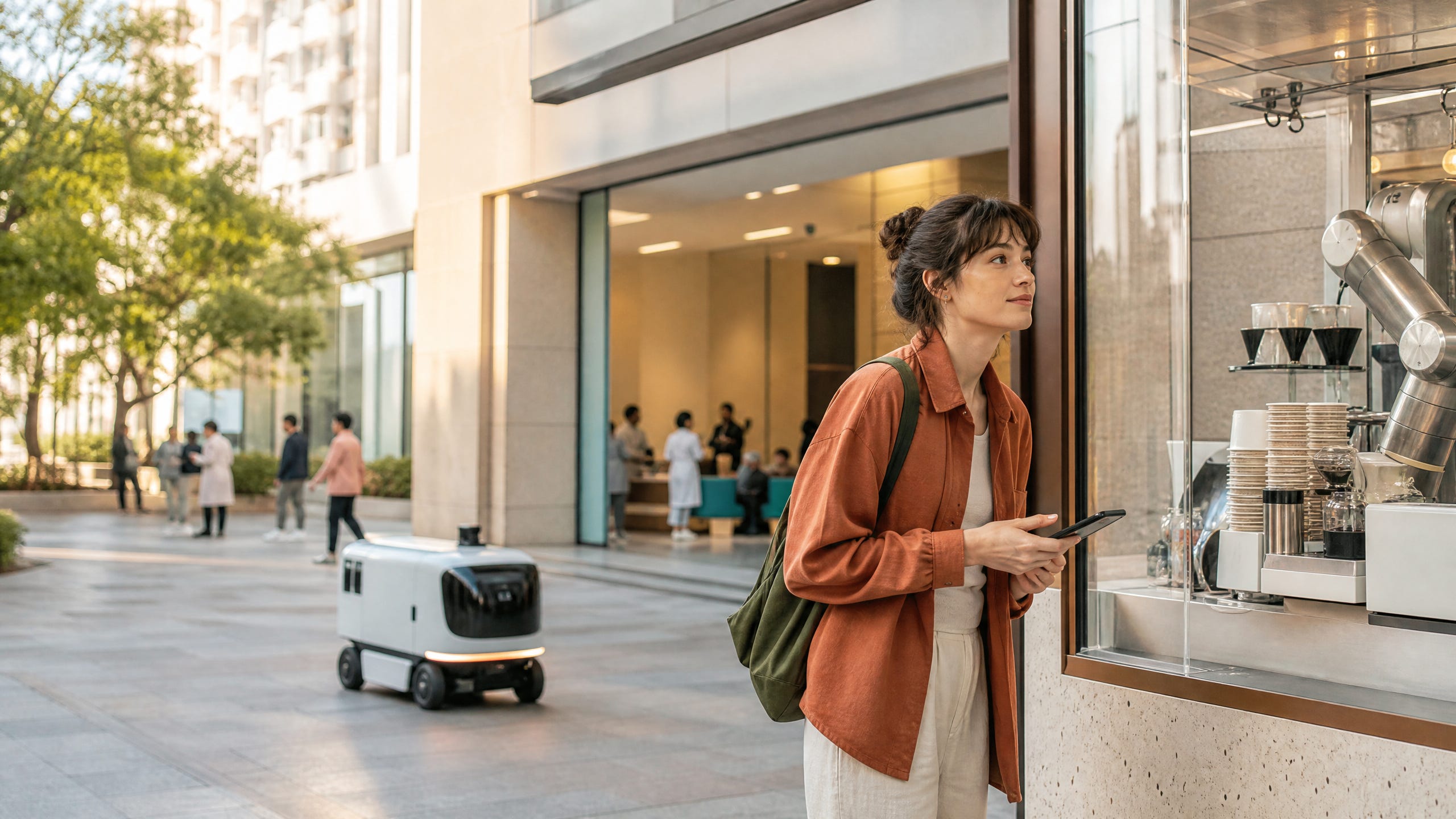
You stop for coffee and scan a QR code. A robotic arm prepares the drink. At lunchtime, a machine makes a hot jianbing while people watch from the side. Later, you receive a message: 你的外卖到了 (nǐ de wàimài dào le—your takeaway has arrived). In a hotel, it may be a small delivery robot at the door rather than a courier. At a shopping mall, a crowd gathers around a machine dog. And if you need help in a hospital, a self-service screen or a guide robot may be the first place you turn.
None of these moments needs a long technical explanation. What they give you is a reason to use Chinese: to scan, order, choose, wait, collect, ask a question, or say what you think.
That is where this series begins.
I created No Staff, New Words for learners who want more than a list of words from a textbook.
扫码 (sǎomǎ, scan a code).
下单 (xiàdān, place an order)
到了 (dào le, it has arrived)
试一试 (shì yi shì, try it)
请问,……在哪儿? (qǐngwèn, … zài nǎr?, excuse me, where is …?).
These are the kinds of phrases that make a new place feel a little less distant.
China’s everyday service scenes keep changing. Some services appear in a particular park, hospital, campus, hotel, mall, or fixed delivery route; others become more familiar over time.
The series follows those changes in a grounded way, one scene at a time. We have already explored coffee, breakfast, restaurant kitchens, delivery, drones, robot showrooms, shared massage chairs, and hospital navigation.
More episodes are on the way.
So you do not need to wait for a “complete course,” and you do not need to read every episode in order. Start with the moment that feels closest to your life—or the one that simply makes you curious. As the series grows, this page will grow with it.
Begin with one scene. Keep one useful sentence. Return when the next scene appears.
Every article starts with a short Chinese reading built around a real situation. You can read the scene first, get its rhythm, and see how much you understand from context.
The lesson then opens into a fuller study system: Pinyin and translation, practical vocabulary, sentence patterns, etc.
The point is not to memorise a word once and leave it on the page. It is to meet it again in another setting. A phrase from a robot coffee kiosk can help at a self-checkout machine. The language of a delivery message can reappear at a hotel or package locker. A question from the hospital episode can make a hard day easier in many kinds of public places.
Continue with the full lessons
You can start anywhere. These four routes are simply different doors into the same idea: everyday China is full of small chances to practise Chinese.
The first three episodes follow a very natural route—from a coffee kiosk to a jianbing machine to a restaurant kitchen.
Episode 1 — No Barista, New Chinese Words: Ordering Coffee from a Robot Kiosk
Episode 2 — Learn Chinese: Scan, Order, and Try a Jianbing Robot
Episode 3 — From Chefs to Smart Kitchens: Learn Chinese for Ordering Robot-Cooked Food
One phrase to keep:
我想要…… wǒ xiǎng yào…
I would like …
You can use it for coffee, breakfast, a meal, and much more.
Learn food-and-drink Chinese → Episode 1
Begin here if you are planning a visit to China—or if you love the tiny drama of watching an order move from a phone screen to your hands.
You may meet a delivery robot in a hotel corridor or on a campus. A drone service may send an order to a designated landing point.
The settings differ, but the useful language is beautifully ordinary:
门口 (ménkǒu, entrance or doorway),
取餐 (qǔ cān, collect food),
取件 (qǔ jiàn, collect a parcel),
and 到了 (dào le, has arrived).
Episode 4 — A Robot Brought My Order? Learn Chinese Through China’s 无人配送车
Episode 5 — From Takeout to Sky Photos: Mandarin Words for China’s Drone Services
Practise delivery Chinese → Episode 4
In a robot showroom, you may want to ask what something is or whether you can try it. In a cinema, mall, or railway station, a shared massage chair gives you another low-pressure scene: scan, choose a time, sit down, and talk about how you feel.
Episode 6 — Machine Dogs in the Mall: Learn Chinese for China’s Robot Showrooms
Episode 7 — Massage While You Wait: Learn Chinese for China’s Shared Massage Chairs
One phrase to keep:
我可以试一试吗? wǒ kěyǐ shì yi shì ma?
May I try it?
It is friendly, useful, and easy to carry into many situations.
A large hospital can make anyone feel lost. The hospital episode brings together the language of symptoms, departments, registration, payment, and directions—words that are practical because the situation is practical.
One phrase to keep:
请问,……在哪儿? qǐngwèn, … zài nǎr?
Excuse me, where is …?
One good question can change the whole experience of a new place.
Learn hospital Chinese → Start Episode 8
The existing episodes take you from buying a drink to finding your way in a hospital. The next ones will keep moving through the places where daily life change.
That is why this is a living guide. It is a place to return to—not because you have homework to finish, but because another small China moment has arrived and there is new language waiting inside it.
China changes quickly, but the language that helps you join in is often simple: a code to scan, an order that has arrived, a question to ask, a place to find.
Start with the scene that interests you most. Keep one sentence. Then come back for the next one.
[1] Episode 1: No Barista, New Chinese Words: Ordering Coffee from a Robot Kiosk
[2] Episode 2: Learn Chinese: Scan, Order, and Try a Jianbing Robot
[3] Episode 3: From Chefs to Smart Kitchens: Learn Chinese for Ordering Robot-Cooked Food
[4] Episode 4: A Robot Brought My Order? Learn Chinese Through China’s 无人配送车
[5] Episode 5: From Takeout to Sky Photos: Mandarin Words for China’s Drone Services
[6] Episode 6: Machine Dogs in the Mall: Learn Chinese for China’s Robot Showrooms
[7] Episode 7: Massage While You Wait: Learn Chinese for China’s Shared Massage Chairs
[8] Episode 8: No More Waiting in Line: How to Use China’s Hospital Robots
No posts
Comments
Nothing yet. Say the first thing.
Sign in to join the conversation.