
A Two-Part Series on the 2026 Midterms and the 2028 Presidential Election
— Chapter One · The Trembling Iron Throne — Chapter Two · Where the Old Map Ends — Chapter Three · The Great Divide — Chapter Four · Interregnum
— Chapter Five · The Many, the One — Chapter Six · The Nth Time / The Sinews of Power — Closing · Who Is That Damned Cowboy?
You are reading Part I.
The Iran War will be looked back upon, again and again. In March, America’s Operation Epic Fury swept Iran end to end; the Iranian air force and navy were almost entirely dismantled, the leadership decapitated more than once. By May the regime was still there, the uranium was still there, the IRGC was still there, and a newly minted PGSA had hung out its shingle on the Strait of Hormuz, issuing VISAs to decide who could pass — with tolls settled in renminbi and bitcoin.
American GDP is still first in the world. But every reading from the foundation is moving in the same direction. Consumer confidence has collapsed to 44.8, the lowest in University of Michigan records going back to 1952; it was 56.6 in February, three straight months of decline. One-year inflation expectations jumped from 3.4% pre-war in February to 4.8% — the moment the Iran War opened, the number bolted upward.
National debt has climbed to $39 trillion, and interest service has overtaken the defense budget. Manufacturing construction spending is more striking still — from its $240.1B peak in June 2024, falling month by month to $196.2B by January 2026; once reshoring topped out, it never recovered. Even Trump’s most ironclad base is loosening: his net approval among white voters over 65 has caved from -1 to -17. His overall net approval stands at -23.
The coming American midterms will be unprecedentedly chaotic — and unprecedentedly clarifying. Looked at in hindsight, you will also find them unprecedentedly clear.
The political stars of America’s future will begin to step onto the stage from this election forward.
Trump’s midterms are not going to look good — because his sixteen-month report card does not look good.
One thing has to be conceded first. In the past forty years, Trump is the first American president to publicly acknowledge that System Aᵀ is, at the physical level, sick. Not sick in the culture-war sense, not sick in the polarization sense — but hollowed out: industry gone, manufacturing offshored, labor swallowed up by services, dependence on China deep enough that critical minerals turn into chokeholds at critical moments.
He identified the battlefield. He set out to make A strong again. That judgment has not been overturned to this day.
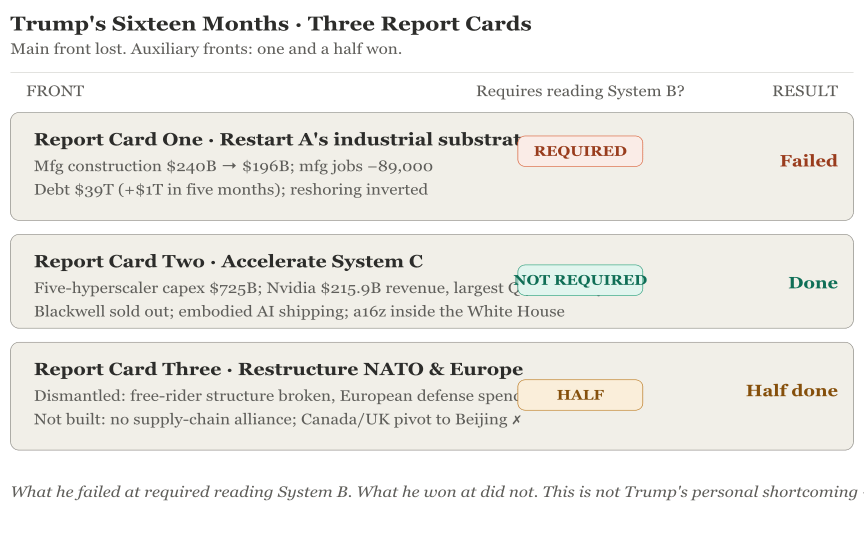
The problem is that this sixteen-month record splits into three report cards. The main battlefield was not saved. The auxiliary battlefields won one and a half.
Manufacturing construction spending slid from its $240.1B peak in June 2024 to $196.2B by January 2026, an unbroken downhill after reshoring peaked. Manufacturing employment fell, not rose, after Liberation Day; by February 2026 the cumulative loss was 89,000 jobs.
DOGE was supposed to cut $2T; the wall of receipts self-reported $215B in savings. The Partnership for Public Service, totaling layoffs, rehires, furloughs, and productivity losses for one year, put the cost at $135B. The Yale Budget Lab estimated IRS attrition alone would lose nearly $198B in tax revenue over ten years. The savings were padded. The spending was real. Musk has now left. National debt has climbed to $39 trillion — adding a trillion in five months. The deficit is 5.8% of GDP; interest service has overtaken defense. This report card did not lift the industrial substrate — and on the books, the page looks worse than before.
This should have been forgivable. A has been sick for twenty years; he had sixteen months. Rebuilding an industrial substrate hollowed out by forty years of financialization, offshoring, and cost-cutting was never a one-term task.
But the problem is not only time. Trump’s thinking and his methods remain inside System A’s old logic. Tariffs are a 19th-century instrument: they regulate the flow of goods, not the metabolism of industry. Seizing Greenland, seizing Venezuela — these are 20th-century instruments, premised on the assumption that securing the raw materials solves the problem. But A long ago lost the refining of rare earths, the production lines for lithium batteries, the capacity for polysilicon. Owning the mine is useless if no one knows how to refine the ore. DOGE is a tool of the financialization era — it cannot touch what actually loads America’s books, namely interest plus old-age benefits plus defense, three lines totaling more than 80%.
Nineteenth century, twentieth century, Cold War — three old toolkits, stacked on top of one another. With this set of tools, Trump tries to fight a 21st-century war.
The real weight of this report card lies not in the policy gestures, but in the machine roaring to life behind them.
Start with the substrate of compute. In 2026 the capex of the five hyperscalers vaulted to roughly $725 billion, up more than 60% year on year — not the expansion of one industry, but a civilization placing its largest single physical bet on a single direction.
Nvidia alone booked $215.9B of revenue in fiscal 2026, up 65%, with data center revenue of $193.7B making up nine-tenths of the total; Q4 alone delivered $68.1B, the largest single quarter in the history of the semiconductor industry. Blackwell sold out through mid-year. The next generation, Vera Rubin, shipped first samples in February — 336 billion transistors, with claimed inference performance five times that of Blackwell. Chips are no longer products. They are the electricity of this era; whoever holds them holds the output power of the next industrial round.
Then look at embodied intelligence — the step where C drives Bits back into Atoms. Venture investment in robotics tripled from 2023 to 2025, touching $40.7B in annual size.
Figure’s Helix 02 came online in January: a single 10-million-parameter neural network replaced roughly 109,000 lines of hand-written C++ balance-control code. This is not the trick of a demo video; it is a genuine capability leap. The first deployment at a BMW plant took twelve months. The second paying customer took thirty days. Tesla has turned the Fremont line toward humanoid robots; Optimus remains in what Musk himself calls the “data-gathering” phase, but the direction is not to be misread: the labor force of manufacturing is itself being redefined.
Stacked together, this is already a revolution underway — AI compute, top-end chips, embodied intelligence. What C completed in these sixteen months is the transformation of “using compute and protocol to drive the physical world” from a slogan into shipping capacity.
The Trump administration loosened the leash and supplied the current. Section 232 tariffs, grounded in national security, were cut cleanly and held. The IEEPA tariffs, though overturned by the federal Court of Appeals, made clear which categories of industrial policy his team knew would stand up in court. The a16z circle moved directly into the engine room of policy — Sacks, after 130 days as the AI and crypto “czar,” took the co-chair of the President’s Council of Advisors on Science and Technology; Andreessen entered the President’s Council on Science. Stargate’s $500 billion, the Genesis Mission, and Middle East AI diplomacy were unrolled in parallel — a tempo unlike that of an administration its critics had called technologically illiterate.
It is worth pausing here: why did he win precisely this report card? The full answer requires the three cards to be laid down together, but the clue is already buried: accelerating C, from beginning to end, does not require him to understand System Bᵀ.
The free-rider structure of NATO 1.0 was forcibly broken; European defense spending has risen to historic levels. German defense expenditure set a new record. France’s strategic autonomy has hardened from diplomatic phrase into real budgetary allocation. At the same time, Europe’s far-right and anti-establishment forces have risen across the continent — from AfD to Le Pen to Meloni, the political center of gravity is sliding from soft establishment toward hard national-industrial policy. In four years, Trump moved a board that Europe had failed to move in thirty.
But what should NATO 2.0 have been? It should have become the supply-chain security alliance of the 21st century — European, Japanese, Korean, Australian industrial capacity, critical minerals, semiconductor back-end, green technology, all wired into a supply-chain system led by A; the criterion of membership shifting from Article 5 (collective defense) toward a new article — call it Article Resource: are you willing to plug your lithium, cobalt, and rare earths into A’s supply chain? That is the form NATO would have needed to take to survive the 21st century.
That half did not get done. In January 2026, the Canadian government flew to Beijing for the first time in a decade. British officials visited China in the same window — the first since 2018. European political and business elites are voting with their feet: if Trump is using tariffs to hit them, they will reopen the door to B.
Trump took the old burden off NATO. He did not reassemble NATO into a supply-chain alliance. This report card delivered the dismantling. It did not deliver the reconstruction.
Lay the three cards down side by side, and a line emerges. The two he won — accelerating C, removing NATO’s old burden — neither required him to understand System B. C shares A’s capital markets, A’s legal system, A’s regulatory vocabulary; lifting the burden is no more than an internal reconfiguration of allies inside A. The two he lost — restarting A’s industrial substrate, building NATO into a supply-chain alliance — both required reading System B. And that is precisely the place he could not reach.
This is not Trump’s personal shortcoming. It is where the old map ends. Forty years of elite-pipeline selection inside System A trained no one to read System B.
And the structure was finally torn open, displayed for everyone to see, by a war that lasted only forty-two days.
The The Great Divide is the Iran War itself.
Forty-two days, from late February to early April — the window from the opening shot to the end of major combat operations on the Islamabad negotiating table. In this period, the American and Israeli forces lost not a single battle. Iran’s conventional military capability was reduced by 60 to 70 percent. Khamenei and Larijani were killed in succession; nearly the entire top leadership of Iran’s Supreme National Security Council was eliminated within 72 hours. Operation Epic Fury was more precise than 2003’s strike on Saddam, more thorough than 2011’s strike on Qaddafi, deeper than 2020’s strike on Soleimani — the high-water mark of American intelligence and precision-strike capability layered together since 1945.
A textbook of tactics.
Then, on May 5, Rubio’s White House briefing publicly narrowed the war’s objectives from four (denuclearization, destruction of the Iranian navy, severing of proxies, freedom of navigation in the strait) down to one: “an economic outcome focused on the Strait of Hormuz.” Epic Fury “is over.”
On May 18, the PGSA was inaugurated in Tehran as a body under Iran’s Supreme National Security Council. It turned Hormuz into a VISA gate — visas issued to nations Iran approves of, each transiting vessel paying a $2 million toll, settlement routed through renminbi and bitcoin. Annual revenue estimates range from the low billions to several hundred billion dollars, depending on which toll assumptions are used. But whichever number lands, the nature of the change is the same: the strait, once a global commons through which anyone could pass freely, has become a gate that requires approval and can extract a fee.
From Trafalgar in 1805 to this war, 221 years had passed without any non-Western military entity, at any point, exercising real control over a globally significant maritime chokepoint. And in this successful rewriting of the script, System B sent no warship and sank no American warship.
Do not read this war as a failed military operation. It is not. It is The Great Divide.
Since 1945, American power has rested on one implicit theorem: maximum military force necessarily produces maximum strategic return. The theorem was verified on Saddam, on Qaddafi, in the victory over the Soviet Union. It is the physical bedrock on which System A built the whole of its political selection machinery for eighty years — choose the military-hawkish; choose the financial-order custodians; choose the alliance-system coordinators; choose the national-security bureaucracy’s promotional ladder. Every one of these selection mechanisms rests on a single assumption: if A applies the right force, A will win.
In 42 days, that theorem was driven through. Maximum force was applied to its fullest — and the strategic return was zero, even negative. Because during these same 42 days of total tactical victory, the PGSA was inaugurated; the chokepoint-visa mechanism began to spill from Hormuz toward Malacca, Panama, and the Taiwan Strait; the settlement plumbing in renminbi and bitcoin was field-tested and proven to function under war pressure. At the same time, German inflation surged to its highest since 2008; Japan tapped its strategic oil reserve for the first time since Fukushima; South Korea’s SK Innovation paid the highest spot-market premium since 2022 to secure crude. Each physical cost was booked to the account of the side that won.
A struck. B collected. The two did not collide.
This has not happened in the past eighty years.
And it happened in 2026. Seven months before the midterms.
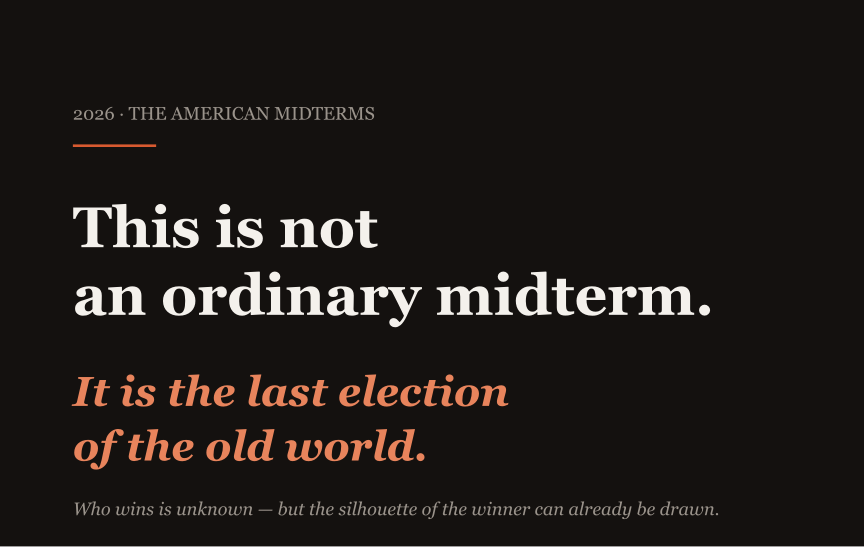
This is why the election on November 3, 2026 is not an ordinary midterm.
1946 was the postwar election of the victors, distributing the dividends of victory and laying down the postwar order. 1992 was the election of the unipolar moment, distributing the dividends of thirty years of unipolarity. 2026 is the first election since the Iran War — A is now selecting its next leader inside a new set of physical facts. The new fact is this: the entire physical foundation of A’s political selection machinery, in place since 1945, has been driven through by a 42-day war.
The old selection machinery is still running. It has not had time to recalibrate. Newsom is still running California by the playbook of 2016, preparing for his 2028 primary. Buttigieg is still touring nationally after his term as Transportation Secretary. Establishment think tanks are still writing reports on how to repair the transatlantic alliance.
For eighty years, System A has been running a machine that selects political leaders. The machine was never written into any document, but it has run continuously — selecting not only presidents, but Senators and Representatives, governors, think-tank heads, media principals, party nominations. It decides whose words are heard seriously, and whose words are treated as background music.
During the Cold War, its core selection rule was whether one’s anti-communist position was hard enough. After the Cold War, the rule shifted to whether one embraced free trade, the transatlantic alliance, and the financialization narrative. After 2008 there was a fine adjustment: could one keep globalization running under conditions of partial breakdown? Underneath, it was always the same set of rules being recalibrated — the same machine, the same type of person. The four “régime-form” elections of 1932, 1946, 1980, and 1992 were each course corrections inside this same machine. Roosevelt, Eisenhower, Reagan, Clinton were different products that this machine calibrated under different physical conditions, but every one of them was certified by the same mechanism.
And the whole operation of this machine rested on one physical axiom never written down — maximum military force necessarily produces maximum strategic return.
This is the physical bedrock of System A since Yalta in 1945. Without this axiom, the machine’s entire rulebook loses its fulcrum. You cannot keep selecting the military hawk — military hardness no longer produces strategic returns. You cannot keep selecting the custodian of the financial order — the physical foundation of that order is being replaced. You cannot keep selecting the coordinator of the alliance system — the logic of the alliance system has shifted. You cannot keep reading voters by the pollster — voter preferences are reordering themselves along a new principal axis.
The 42-day war drove this axiom through. Maximum force, applied to its fullest, returned zero — even negative. This is not a policy failure, not an intelligence failure, not an execution failure. It is the collapse of the physical bedrock. Once the bedrock fails, every selection rule built upon it fails simultaneously.
What is being recalibrated is not merely the qualification for presidential candidates. It is the entire political ecology of System A — the coordinate axes of partisan position have shifted; the rules of House and Senate selection have changed; the party primary mechanism is opening to a different kind of person and beginning to close to another; pollsters can no longer read voters; the briefing memos of establishment think tanks are losing their pull; the gatekeeping power of legacy media on the framing of issues is loosening; both Democratic and Republican machines are producing, unexpectedly, candidates “outside their own specification.”
In the state-level elections of NJ, VA, and MI, a new kind of figure has already begun to emerge: campaign language opposing Trump’s tariffs, message anchored in cost of living — but a legislative record running on supply-chain national security. On the Ohio Senate seat, a thirty-year labor-union veteran and a sitting Trump appointee are locked within a single point of each other — two politicians long assumed to be on opposite sides, pushed by the same force to the two ends of the same question. In the Republican national primary cycle, the traditional establishment legal-faction was forced out by Trump endorsements; a biotech-bred industrial faction took the primary by 85 percent.
These are not isolated events. They are the same new machine, in the first year of its operation, clumsily, discontinuously, and with frequent misreads — but already selecting.
Trump is the first product this new machine delivered, in 2024. The elite of System A spent eight years mocking him, dismissing him, indicting him, attempting to erase him from the political ecosystem — because he matched none of the rules of the old selection machinery. Anti-establishment, reckless, lawless, mouth unfiltered, breaking every protocol the party machine had programmed.
But he won 2016. He won 2024. He sits in the Oval Office. He cut the first opening in the wall that the old rules had built.
And very soon, you will see —
Trump is not one. He is a class.
Every fracture, every debate, every poll you see in the headlines from now on is no longer the kind of politics you have been familiar with for the last eighty years. It is a new machine, in the first year of its operation, learning how to run.
The old rules have failed. The new rules are still taking shape. The The Great Divide has been drawn.
Next
Part II · Who Is That Damned Cowboy? (Reading the 2028 Presidential Election)
— Chapter Five · The Many, the One — Chapter Six · The Nth Time / The Sinews of Power — Closing · Who Is That Damned Cowboy?
The terms below are foundational analytical units of the ChinArb three-system framework; this article uses them in their established sense. The full framework runs across all 47 ChinArb essays since late 2025.
System A — The old American system, centered on military hegemony and financialization. Trump has attempted to restart its industrial substrate, but using A’s own old tools.
System B — The Chinese system, centered on industrial metabolism and supply chains. The 21st-century adversary with which America must coexist, yet for which no elite pipeline trains anyone to read.
System C — The Silicon Valley accelerationist system, centered on compute, protocol, distributed energy, and embodied intelligence. It shares A’s capital, law, and regulatory language — which is why accelerating C does not require Trump to read System B.
R.I.C.E. — The four pillars of the Chinese manufacturing operating system: Redundancy, Integration, Compute, Evolution.
Comments
Nothing yet. Say the first thing.
Sign in to join the conversation.