
AI market share:
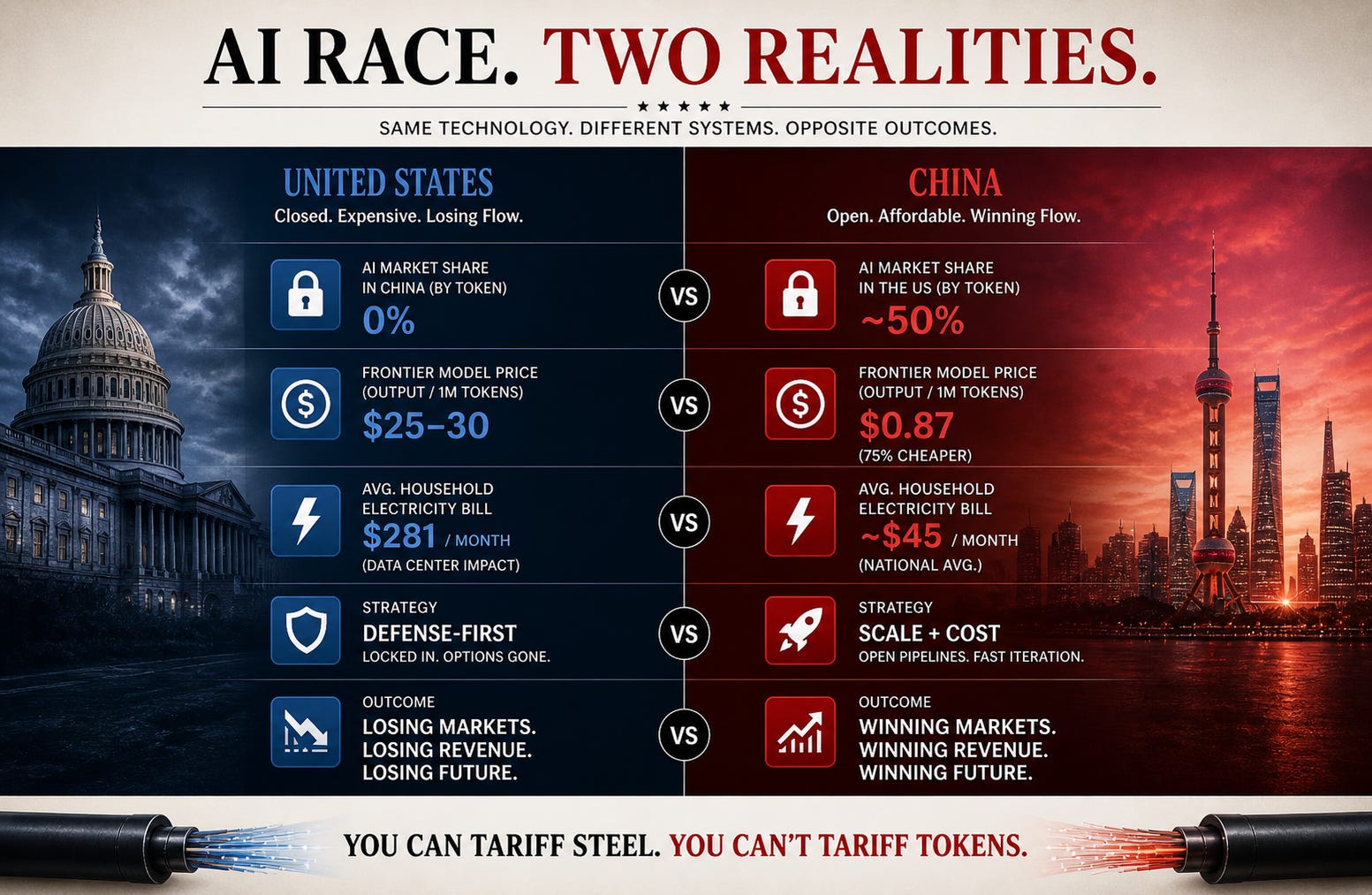
US AI in China, by token volume: 0%.
Chinese AI in the US, by token volume: ~50%.
That’s OpenRouter, April 2026. OpenRouter is the world’s largest independent AI API aggregation platform — 5 million developers, the vast majority American. Four out of the top five models are Chinese. Xiaomi’s MiMo-V2-Pro alone holds 21.1% — three times OpenAI’s entire lineup combined (7.5%). Anthropic has fallen from the lead to 15.4%.
Eighteen months ago, Chinese AI on OpenRouter was 1.2%. Forty times.
The reverse direction is 0% → 0%.
April 28. WSJ front page: OpenAI missed its revenue and user targets. CFO Sarah Friar privately warned the board that OpenAI may be unable to pay for the compute contracts it has already signed — those contracts total over $1 trillion against $25 billion in annualized revenue. Oracle dropped 5% in a single day, CoreWeave 5.4%, SoftBank’s Tokyo session down 10%.
April 30. DeepSeek V4-Pro announced a 75% price cut in China. Output tokens dropped from $3.48 to $0.87 per million. The equivalent OpenAI/Anthropic flagships charge $25-$30. A 35x gap.
May 1. The Pentagon announced seven AI classified contract winners: SpaceX, OpenAI, Google, Microsoft, Nvidia, AWS, Reflection AI. Anthropic was not on the list. Two months earlier, Hegseth had tagged it as “Supply Chain Risk” — for refusing to accept the Pentagon’s “all lawful purposes” clause.
Three events that look unrelated. They are the same event surfacing at the same time.
It has a name: Structural Collusion.
Steel. Twenty years of anti-dumping tariffs. China: 1 billion tons. US: 80 million. 1 to 12.5.
Solar. After Solyndra collapsed, the DOE loan office went twelve years without issuing a single PV manufacturing loan. China pushed its global share from 5% to 67%. Today the only Americans making money on solar are installers — every panel comes from China.
EV. BYD sold 4.6 million vehicles globally in 2025. Tesla sold 1.6 million. Three times. Detroit’s Big Three are all laying off. BYD is encircling the US through Canada and Mexico, and four of its US subsidiaries have sued the federal government to overturn the tariffs. The only thing keeping Chinese EVs out of America isn’t the 100% tariff — it’s Tesla. The single US automaker still able to fight head-to-head on EVs. Meanwhile, in the phones of American teenagers: 69% of Gen Z, after watching short videos of Chinese EVs, said they were “more likely to consider” buying one.
Chips. Three years into export controls. China’s share of global mature-node capacity (28nm and above) rose from 19% in 2015 to 33% in 2023; nearly 50% of new mature-node capacity through 2027 is projected to come from China. SMIC made 7nm with DUV. Huawei and Xiaomi are pushing toward 5nm and 3nm. Huawei’s 910C is in mass production, benchmarking against Nvidia’s H100. Xiaomi started mass production of its self-designed 3nm SoC in May 2025 — joining the “only four companies in the world with 3nm production capability” club.
Every time the same script.
Every time America says “this time is different.”
Every time the result is the same.
And every time it happens faster than the last.
China, for reasons of internal political legitimacy, built an information wall — known in the West as the Great Firewall. Originally a defensive structure, aimed at political content.
But its physical side effect was to filter 99.9% of potential users out of the reach of US AI companies:
The average Chinese user does not have a US phone number to receive OpenAI’s registration code.
Does not have an overseas credit card to pay for Anthropic.
Does not have the English fluency to read Claude’s product documentation.
And even if they had all three, using ChatGPT in China sits in a gray zone — requires a VPN, risks account suspension, and can be flagged at any time as “non-compliant use.”
Commercial use is even more impossible. A Chinese company’s CFO cannot find a compliant accounting category for “OpenAI API services” in their books. A Chinese company’s CTO cannot legally route customer data to Anthropic’s US servers — that violates China’s Data Security Law. China’s generative AI registration regime will not approve OpenAI — it has no Chinese entity.
This isn’t a ban. It’s an infrastructure-level impossibility. Make use complicated, and the market does the rest.
US AI companies, looking at this market structure, made a choice that is completely rational from the firm’s perspective: abandon China.
But the real driver of that choice was not that China is too difficult. It was that the US national security market is too attractive.
In November 2024, Anthropic entered the IL6 classified system through Palantir + AWS. In June 2025, it landed a $200 million Pentagon contract. Three months later, it updated its ToS to ban “all overseas subsidiaries 50%-controlled by China.” CEO Dario Amodei publicly called China an “adversarial nation.” Once your model runs in IL6 classified networks, you cannot simultaneously let ByteDance’s offshore subsidiaries call you through the API. The two are mutually exclusive at the compliance layer.
And the US capital markets watched it all happen — and valued Anthropic from $183 billion to $900 billion in eight months. A 5x jump. The capital markets voted with money: choose the democratic-AI-plus-national-security-asset path, and your valuation doubles. Choose “we still want China,” and the valuation falls off a cliff.
OpenAI followed. Google Gemini followed. Meta open-sourced, but added a “military exception.” No one is exempt.
Four forces, independently, push in the same direction:
The Chinese wall physically filters out foreign AI.
The US defense-AI lane makes US frontier companies actively close the China door themselves.
US capital markets price up that lane and lock down every frontier company’s optionality.
Chinese vendors, after a brutal domestic price war, flow one-way into US developers via OpenRouter and HuggingFace.
No one signed anything in a backroom. Every party, in its own optimization function, pursues local optimum. The aggregate effect: the two-way road becomes a one-way road — and that one-way road is the local optimum for every party involved.
The result of the collusion: both the Chinese and the US markets have been handed to Chinese AI vendors.
Chinese AI vendors get the Chinese market (foreign AI physically filtered out by the wall) plus 50% of the US market (US developers voting with their feet on OpenRouter).
US AI companies get an IL6 classified label and a valuation that quintupled in eight months and could collapse at any moment (the April 28 OpenAI revenue miss is already cracking that valuation).
American ordinary households get the electricity bill. John Steinbach in Manassas paid $281 in January — and 78% of Americans now equate data centers with their power bills going up.
Steel, solar, EVs, chips — every industry the US lost shares one premise: these products are atoms. Atoms can be tariffed.
In theory, customs can still stop the goods. Even if you lose the manufacturing, at least the tariff is still a real weapon.
AI is not atoms.
AI is tokens.
Tokens travel on fiber.
Fiber routes through Singapore, Tokyo, Hong Kong.
Customs cannot stop light.
A San Francisco AI engineer writes model_routes.json: send the most expensive customer conversations to Claude, and route the high-volume low-margin work — code completion, doc summarization, first-line customer service, SEO copy, email drafts — to DeepSeek, Kimi, Doubao, MiniMax, Qwen. This is not a geopolitical decision. It is engineering optimization. Doubao processes 120 trillion tokens per day — 70 times the monthly volume of Microsoft’s Azure AI Foundry. A single Chinese AI ingests, in one day, more tokens than the three US frontier giants combined.
And Chinese AI does not need to make any choice. It just keeps running tokens.
In theory, America has a solution.
Its core advantage was never closure. It was openness.
Build a layer of legal, compliant infrastructure aimed at Chinese B2B — US AI companies establishing dedicated sales entities in Singapore or Tokyo to serve Chinese enterprises, with B2B wire transfer channels, compliant invoices, and bookable categories like “technical service imports”; offshore data compliance assistance at edge nodes; content compliance filters that let Chinese companies legally use US AI in their products; the US government issuing a BIS-level whitelist for “civilian AI commercial services to Chinese B2B,” separating “military AI” from “ordinary Chinese private enterprise AI commercial use.”
Let Chinese B2B users legally, compliantly, and technically use US AI to build for global markets.
Turn the one-way road back into a two-way road.
That is what an Open America looks like — winning back markets by laying down the pipes, not by trying to imitate Chinese closure. America cannot match Chinese regulatory intensity. The systems are too different.
In theory it can be done.
This is not a question of one company picking wrong. Or one party picking wrong. The system is unsolvable at the physical layer.
Anthropic is already all-in on defense AI — building this infrastructure means giving up IL6 and the DoD contract, with the capital markets immediately marking the valuation to the floor. OpenAI just signed a Pentagon classified contract on May 1, locking it in even tighter. Google is under congressional pressure. Meta’s “military exception” is already written into its AUP. All frontier companies have already picked their side.
The capital markets won’t allow it. Any US AI company announcing “we will serve Chinese B2B” — its valuation multiple instantly switches from frontier-AI multiple to commodity-AI multiple. Investors won’t sign.
Congress won’t allow it. With the 2026 election cycle in full swing, any legislator pushing this infrastructure gets branded a “China apologist.”
Chinese regulators won’t allow it either — domestic vendors are already 50% of OpenRouter. Beijing has no incentive to let US frontier AI into Chinese B2B markets.
Four parties, each independently pursuing local optimum. No party has any incentive to break the equilibrium — because breaking it loses money in the short term, for whoever moves first.
The theoretical exit doesn’t exist physically.
Is the story over? It is not.
The plot twist has run before. This time the protagonist is AI.
After Hormuz sanctions, a shadow fleet of 3,000 aging tankers grew into existence. AI’s shadow fleet does not sit on the high seas. It sits on GitHub.
The open-source relay project one-api / new-api has 30,000 stars. A single programmer can stand it up in a day. Buy a few accounts on Taobao and you’re in business.
A Claude Max account: $200/month. Reverse-engineering tools split it across 20 users at $30-50 each. 400% monthly margin. Pool a few hundred accounts together, and many of these relays bring in over a million RMB per month.
What they sell isn’t just Claude. It’s the full set: Claude Opus 4.7, GPT-5.2 Pro, Gemini 3 Pro, Sora 2. One key, every US frontier AI — all in one pot.
Chinese developers are still using all of them. The only addition: a middleman, called
a relay station.
In every transaction:
OpenAI gets nothing.
Anthropic gets nothing.
Google gets nothing.
All of it is captured by the relay.
Baidu’s developer center, Zhihu, SegmentFault openly recommend these relays: AnyRouter, APIYI, Lingya, Shenma, WhatAI — with tutorials, with code, with compliance suggestions. Search and you’ll find them by the dozens.
The story isn’t over.
In April 2026, security researchers surveyed 428 commodity AI routers — 9 of them inject malicious tool calls into returned code (the AI recommends you install a pip package whose name is one letter off from the real one, and the malware is in), and 17 actively steal AWS credentials, GitHub tokens, and Ethereum private keys observed in transit.
The cost? Near zero. No real-name registration, no oversight, no escrow. Domain disappears. WeChat group disbanded. Operator vanishes.
This pipeline runs every day. It exists in no party’s official statement. No one admits it exists. Everyone lives as if it does.
And here’s the key difference between the Hormuz shadow fleet and the AI shadow fleet:
Hormuz tankers carry Chinese oil, evading Western sanctions — the West loses pricing power.
The AI shadow fleet carries American AI, evading the walls American AI companies built themselves — America loses revenue.
Chinese AI flows one-way into America via OpenRouter (Chinese vendors get paid).
American AI flows one-way into China via relay stations (relay operators get paid; American vendors get nothing).
Both directions leak. Only US frontier AI companies bleed in both directions simultaneously.
And they spent five years and hundreds of billions in valuation to obtain — an IL6 classified label.
* * ** * ** * ** * ** * *
Steel was like this.
Solar was like this.
EV was like this.
Chips were like this.
Every time, America said “this time is different.”
Every time, the same mechanism — four parties each doing what’s locally optimal for themselves; gray channels picking up whatever logistics remain.
The grave-digging workflow has been refined to this:
America doesn’t need China to act. America digs the grave itself.
More skilled than the last time. Faster than the last time.
And this time — even the people running the toll booth in front of the grave aren’t American.
The Nth time.
Comments
Nothing yet. Say the first thing.
Sign in to join the conversation.