
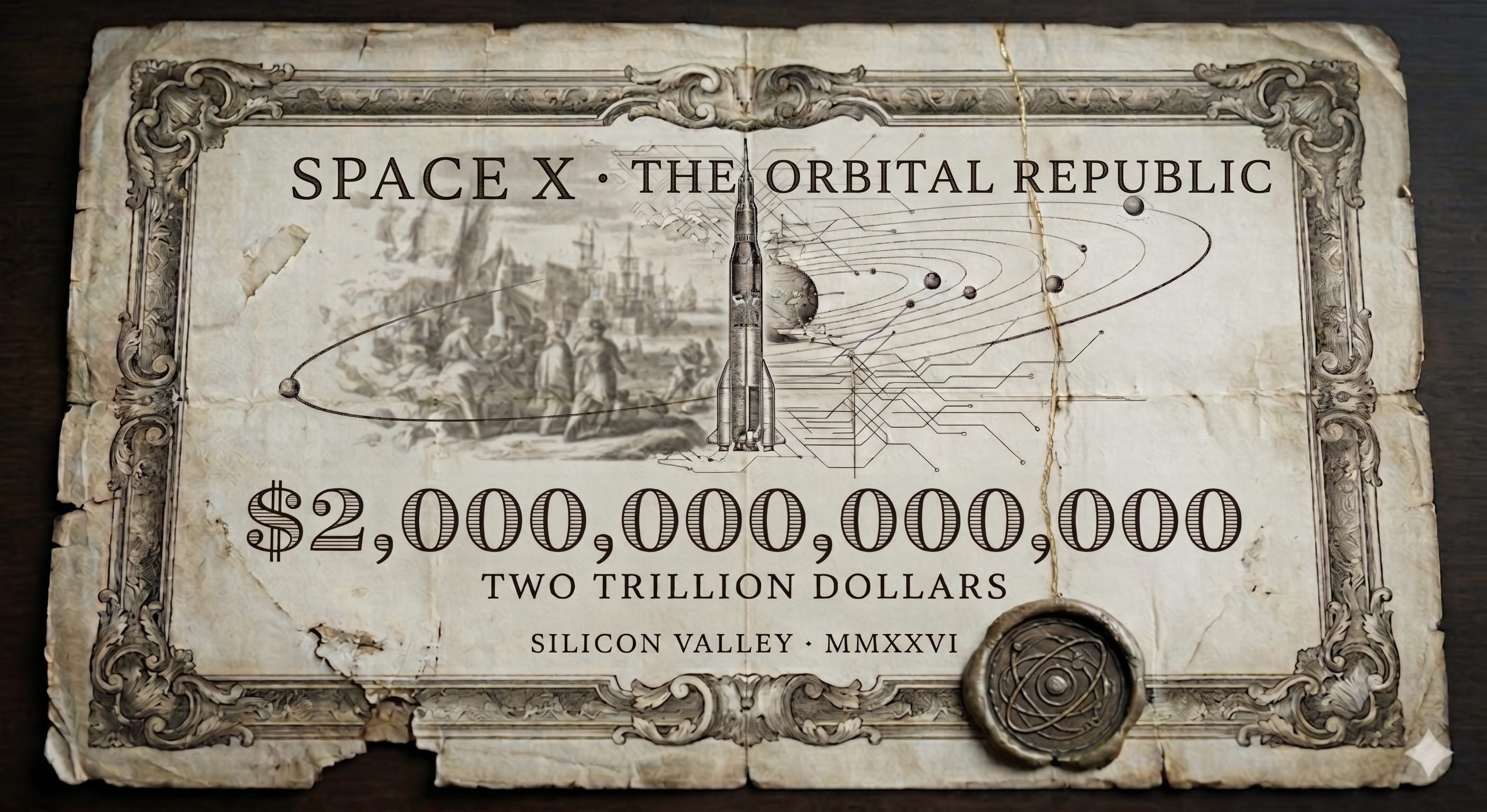
This isn’t another company’s IPO. It’s the coming-of-age of a new world.
On June 12, SpaceX priced at roughly $1.75 trillion, opened four-times oversubscribed, broke $2 trillion on the day, and made Musk the first trillionaire in human history — the highest-valued IPO ever. Wall Street split in two: one camp called it mania untethered from fundamentals, the other called it a bet on a company destined for greatness. Both were arguing the same question — does the valuation deserve it — and no amount of arguing will settle it, because the ruler in their hands was built to price companies.
And this time, the thing being priced is not a company.
The world’s first modern share was issued in Amsterdam in 1602: the stock of the Dutch East India Company (VOC). It had its own army; it could declare war, sign treaties, mint coin, found colonies. The people who bought it were never buying the profit on pepper — they were buying a share in an empire still taking shape.
Four hundred years later, look at SpaceX’s two-hundred-thousand-word prospectus: Martian colonies, electromagnetic lunar catapults, asteroid mining, orbital AI data centers, 8,285 bitcoin on the balance sheet. Is that the prospectus of a company that belongs to this planet?
SpaceX is not one — it’s a swarm, and merely the first to take the stage. Behind it, a queue: Nvidia is already the world’s most valuable company at $4.5 trillion; Anthropic filed on June 1, marked at $1 trillion on secondary markets, its annualized revenue leaping from $9 billion to $30 billion in a single quarter; a week later, OpenAI filed too. Trillions in new equity lining up for public markets inside eighteen months — a density financial history has never seen. These giants aren’t merely “richer than nations.” They are organs of a single system. That system is System C (the global C.O.D.E. system with Silicon Valley as its core node, whose purpose is to control atoms with bits).
Now look again at the number that broke Wall Street’s nerve: 94 times sales. Absurd, if this is a company. And if it’s a sovereign founding-bond?
The market isn’t valuing a spacecraft company. It’s pricing a share of System C — and that share corresponds not to earnings but to a nation not yet built. The nation has already shown its organs. C.O.D.E. — Compute, Open Protocol, Distributed Energy, Evolution — is its four-boned skeleton, and every name that took the stage this week grows on one of them: Nvidia is compute, from silicon to CUDA, the layer beneath everyone’s feet; Anthropic and OpenAI are protocol, turning intelligence itself into a callable interface; the seven giants building their own power plants are energy; SpaceX carried the whole thing into orbit. They aren’t running separate businesses — they are parts of one machine, and the parts have begun to feed one another: SpaceX rents 220,000 Nvidia GPUs and 300 megawatts of compute from its supercomputer to its rival Anthropic; two months ago it closed a $1.25 trillion merger with the loss-making xAI.
A founding-bond must swing violently. For an allocator, the meaning here isn’t “cheap or expensive” — it’s paradigm risk: anyone pricing System C by DCF will systematically underestimate its ceiling and misjudge its volatility. The real exposure sits in the “quasi-sovereign infrastructure” — compute, orbit, energy, the settlement layer — and its repricing doesn’t track the earnings cycle, it tracks the nation’s progress toward completion. Volatility isn’t a bug in this asset; it’s the birthmark. Whoever treats it as a growth stock and runs duration gets torn apart; whoever treats it as an early sovereign bond and trades the events can hold it.
What makes System C a nation rather than a company is that it is laying a physical foundation of its own — across ground, sky, and orbit at once. Every layer is pulling out of the old order’s jurisdiction.
The energy layer. System C wants its own power plants. Over the past year, the seven largest AI companies — Amazon, Google, Meta, Microsoft, xAI, Oracle, OpenAI — are all building their own electricity, with over 9.8 GW of nuclear capacity contracted, more than any single decade of American commitment to nuclear. Microsoft restarted Three Mile Island — the plant beside the 1979 meltdown — on a $16 billion, 20-year deal; Amazon spent $20 billion turning land beside a reactor into an AI campus. US data centers drew more than a tenth of the nation’s total electricity in the first quarter of this year — three years ago it was 4%. Whoever holds the inlet of energy holds the lowest switch in the physical world.
The compute layer. This week Nvidia built a deployment stack with Microsoft running from Windows devices straight to the cloud, embedded confidential computing into Apple’s Private Cloud Compute, and pushed physical AI and AI factories with LG and Doosan. A chip company is becoming the operating system beneath everyone’s feet.
The manufacturing layer. Compute is reaching into the factory. Nvidia made “physical AI” a product line, robots and assembly lines commanded directly by models; Tesla’s humanoid robots, everyone’s AI factories — the same motion: using bits to move atoms, letting manufacturing bypass human hands at scale for the first time.
The orbital layer. SpaceX laid its infrastructure where ground-bound states cannot reach: its own launch sites, Starship lines, the Starlink constellation, orbital data centers, a crypto treasury. Move the data center into orbit, and it slips the physical jurisdiction of every law on the ground.
Stack the four layers, and System C no longer depends on any single nation’s infrastructure. Nothing shows this better than this week’s announcement by both Britain and South Korea — building their respective “sovereign AI” with Nvidia’s technology at the core.
“Sovereign AI” sounds like a contradiction — how can sovereignty be built on a foreign company’s product? It’s a contradiction under the old frame; under System C’s logic it’s onboarding. This is not metropole and colony — it’s operating system and super-developer: System C supplies compute, protocol, security, and settlement; Britain and Korea are sovereign-grade developers on top of it. Their “sovereign AI” isn’t their own sovereignty — it’s their onboarding ritual into System C. Sovereign states queuing to plug into Nvidia are registering their nodes, at the very moment System C comes online.
That same week, the old order pressed back.
On June 9, Anthropic released its most powerful public model ever, Fable 5. Three days later, Commerce Secretary Lutnick, citing national security, issued an export-control order requiring Anthropic to cut off all foreign nationals’ access to it. Unable to sort foreign users from American ones in real time, Anthropic could only shut the model down for everyone on earth — paying enterprise clients and its own foreign staff included. A flagship billed three days earlier as the industry’s strongest vanished within hours.
Just before Fable, Washington had already played out the same rupture with Anthropic. Claude was the first — and once the only — frontier model running on US classified military networks, a $200 million defense contract; through Palantir, the Pentagon used it to help capture Maduro; even as the two sides fell out, the Defense Department was still using it to support US operations in the Iran war. Then, because Anthropic refused to hand Claude over “for all lawful purposes,” the Pentagon branded it a “supply-chain risk” — a label until then reserved for the likes of Huawei, companies seen as extensions of a foreign adversary, never pinned on an American firm; Trump ordered every agency to drop it. But it could be dropped and not replaced: analysts said Anthropic was “deeply embedded in the military and intelligence community,” Pentagon users couldn’t do without Claude, and even the Defense Department’s CTO could only say in public, “we can’t be reliant on any single supplier anymore” — a sentence that is itself a confession of reliance. Anthropic sued the Pentagon in turn, and a federal judge questioned from the bench whether the move “looks like an attempt to cripple the company.”
This is what the week truly exposed: the old order’s tools have come loose from the world they’re meant to govern. It can order a shutdown but can’t replace; it can pin on a risk label and get sued for it. Against Google, Meta, Amazon, Apple, it launched the largest antitrust assault in decades, four sued at once — but antitrust is the Sherman Act of 1890, the old blade that broke Standard Oil and dismembered AT&T, and swung at System C it barely draws blood: Google lost two antitrust cases and in the same year its stock rose 65%, its market cap broke $3.8 trillion, climbing to second in the world. Found a monopolist, valued higher than ever. A law written for the age of rail and steel cannot govern a species that controls atoms with bits. What still works for Washington, for now, is only export controls and Commerce orders — the hard national-security power. It can switch Fable off not through market regulation but through the logic of wartime control. This is the old order’s last working lever: it can no longer bind System C with rules, only cut its power in the name of national security.
But cutting power isn’t leaving. System A (the global financial-military hegemonic system with the United States as its core node) still wants to absorb the newborn System C into its body and live off it — losing ground in its supply-chain war with System B (the global manufacturing system with China as its core node), its eighty-year political axiom shattered by the 42-day Iran war, it needs System C’s new engine more than ever.
So it’s nailed to a position with no exit: it must suppress System C, and it can no longer do without it. Britain’s and Korea’s sovereign compute runs on Nvidia; defense algorithms run on Silicon Valley’s models; and still it presses the kill switch now and then, to prove the gravity is there. To suppress and to depend at once — that tension has no equilibrium point.
After World War II, the globalization America drove gave rise to System A — and, unintentionally, incubated System B. By the time America saw System B eroding its industrial and supply-chain capacity, it tried tariffs, sanctions, and resource seizure to claw the lead back, and lost ground, and decayed — because System B’s foundation is the very thing A had long since lost: the industrial metabolism of 800 million people, the world’s largest industrial workforce, the most complete supply chain on earth.
System C, for the first time, gave America another road. Its purpose is to control atoms with bits, which means it cuts the dependence on labor at the root. By 2026, AI-driven robots have replaced some 2 million manufacturing workers; Oxford projects 20 million by 2030. System B’s moat is its vast labor; what System C offers is precisely a path around labor — rebuilding manufacturing directly with compute and automation. With its old tools, A can never catch System B; System C hands it a card that skips labor altogether. A can’t beat System B on its own. System C maybe can.
The weight of that card lies in System B’s inability to copy it. Not technically — China has DeepSeek, has Doubao. Institutionally: the core of System C is that private capital can hold quasi-sovereign standing — sign sovereign-grade contracts, build its own orbital infrastructure, build its own power plants, negotiate with states as an equal. That can only grow in Silicon Valley’s soil. China’s institutional structure won’t let private capital climb to that position, so System B can produce world-class AI companies but cannot grow a System C. For the first time there is a card only the American side can hold, and System B cannot.
And once that card is played, something deeper happens: the attacker and defender switch. For forty years of A and B, System A was always the defender, walling and plugging with tariffs, sanctions, export controls, while System B advanced through industrial metabolism, around every wall. Now System C takes over the attack: it means to build an entire supply chain of its own — energy, chips, robots, manufacturing — and replace, one by one, everything System B holds. The attacker has changed from System B to System C; and System B, the machine no one could choke for forty years, is pushed for the first time onto the defense.
But System B won’t yield easily, because it still holds the fuel System C needs to fly. System C spends tens of billions to stand on its own in energy — seven giants building nuclear, Microsoft restarting Three Mile Island — yet the solar panels it needs: China makes 93% of the world’s polysilicon, 97% of its wafers; the storage batteries it needs: by 2029 China will have 88 gigafactories to America’s 3; the rare-earth magnets it needs, in everything from motors to turbines: China refines 90% of the world’s supply and manufactures 94% of the magnets. Peel the shell off those overseas nodes, and what flows inside is still Eastern blood.
So between C and B a second Hostile Symbiosis grows — only the attacker and defender are swapped: old board, A defends, B attacks; new board, B defends, C attacks. System C wants to replace System B, and the weapons it needs to attack must still, for now, be bought from System B; the harder it works to build a supply chain free of System B, the deeper the building makes it depend on System B. This is the deepest tension of the next decade’s game: whether a new species can build, on its rival’s fuel, the capacity to replace its rival.
This race won’t stop at the commercial layer. When the combined scale of top System C entities crosses some line — call it $10 trillion — their entry into the core of political power is no longer something granted, but a physical result. Past that scale, political influence is capital’s by-product.
And this isn’t the infiltration of one check or one man — it’s a whole cohort of System C’s people, taking seats inside System A’s own apparatus of power.
The capital end. In this midterm cycle, the Silicon Valley venture firm a16z became the single largest political donor in America, putting in over $115.5 million — a figure that was just $2 million in 2022. An industry PAC called “Leading the Future” raised over $100 million, including $25 million from OpenAI’s president, to strike down candidates who favor tighter AI oversight. A former White House official said a16z holds, in effect, veto power over nearly every AI-related proposal.
The power end. Early this year, Trump signed an executive order curbing states’ ability to regulate AI. Vice President Vance is himself a Silicon Valley venture capitalist by trade: after Yale Law he went to San Francisco, an investor at Mithril Capital, co-founded by Thiel; when he ran for the Senate in 2022, Thiel put in $15 million, the largest sum he’d ever given a single candidate; and it was Thiel who introduced Vance to Trump as his running mate. The monetary core is changing hands too: Fed chair Warsh, installed in May, argues for shrinking the balance sheet and against monetary policy backstopping the government — a Stanford classmate and decades-long friend of Thiel and Andreessen, himself a holder of SpaceX and Palantir stakes, the closest to Silicon Valley any Fed chair has ever been.
Silicon Valley and Washington are fusing into an axis. The three cores — executive, monetary, technology policy — are all staffed now by people of the System C lineage. Musk’s seat at the Department of Government Efficiency is merely the most visible node on that axis; behind him stand a venture-capitalist Vice President, an a16z holding veto power over AI policy, a $4.5 trillion Nvidia. The line between System A and System C is blurring, vanishing.
History offers precedent. A century ago, Standard Oil’s capital grew large enough to sway who sat in the Senate — a magazine drew the chamber of that era as “the Senate of the Trusts”; the bulk of the military-industrial complex forced a retiring general-turned-president to warn the nation against it in his farewell address. Once capital grows to sovereign scale, it seeps into the core of politics on its own. Now it’s System C’s turn — only far faster: oil took decades to buy the Senate; System C, in a single election, has placed its own people in the Vice President’s office, the Fed, and the final sign-off on AI policy.
This will make System A more turbulent for years, because it is forced to feed and to strangle the same thing at once. It needs System C to fight the System B it cannot beat, and fears System C will seize its core in return. So it signs SpaceX a defense contract and switches off Anthropic’s flagship; lets System C’s people run policy and sues, on antitrust, the giants it can no longer break. The way an empire treats the medicine keeping it alive is the most honest testimony to its fate.
A coming-of-age marks a child stepping, from now on, into the adult world of power as an independent being — with all its opportunity, and all its peril. This week, System C walked in.
What it will reprice is not only its own share price. It will reprice money — when settlement bypasses the dollar, when valuation comes loose from cash flow; reprice power — when a company’s kill switch and a nation’s export controls press on the same machine; reprice order — when sovereignty begins registering, like an app, on one company’s platform.
A hundred years ago, in the collapse of an old world, Yeats wrote: Things fall apart; the centre cannot hold. He was writing the moment an order departs and the new one has not yet formed — the falcon no longer hearing the falconer, the blood-dimmed tide loosed upon the shore. We stand at another such moment, only this time the center isn’t broken by war but hollowed from within by a new kind of creature. The decade ahead will be more turbulent than we can imagine, and stranger — from commerce to finance, from society and politics to the international order, not a single square will stay where it was.
This week, a rocket rose at Cape Canaveral. The same week, Mercury, Venus, and Jupiter aligned in the night sky — Musk insisted the IPO fall on the conjunction. And the same week, a hand signed a prospectus, issuing a $2 trillion founding-bond for a nation not yet arrived; and the hand that signed it, and the hand that switched off Fable, press on two ends of the same machine.
The falconer can no longer hear the falcon. And that rough beast strides, swift and certain, toward the place of its birth.
Comments
Nothing yet. Say the first thing.
Sign in to join the conversation.