
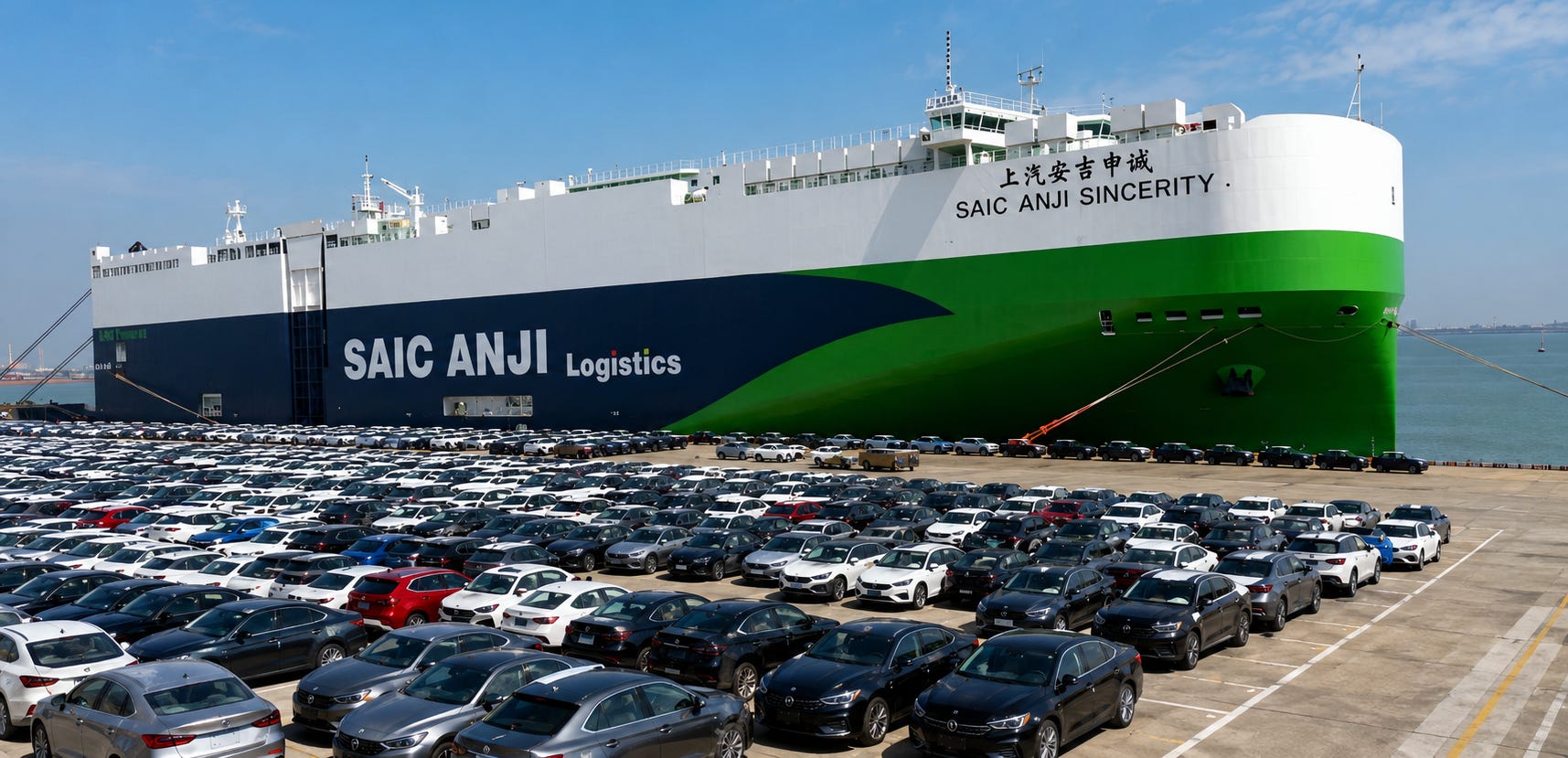
Weakening demand for NEVs (new energy vehicles), continued production growth and a prolonged price war have put sustained pressure on industry margins.
Premier Li Qiang 李强 warned about the risks of ‘involution’ in June 2024. The Politburo followed the next month, summoning automaker executives over below-cost pricing. Even so, the competition continued. In 2024 alone, 227 models cut prices, and CAAM (China Association of Automobile Manufacturers) was still publicly criticising carmakers for fresh rounds of price cuts as late as May 2025.
When Xi Jinping chaired a Central Financial and Economic Affairs Commission meeting on 1 July 2025, criticising ‘disorderly low-price competition’, anti-involution became an official policy priority. Measures specific to the NEV sector followed over the second half of the year.
But years of intense domestic competition had already forced weaker manufacturers to improve or lose ground. By the time Beijing moved PRC NEVs had iterated to a level of quality to sell profitably overseas, and at prices the domestic price war made impossible at home.
Local governments reinforced the dynamic. To protect investment, employment and tax revenue, they rarely let unprofitable carmakers fail, instead passing loss-making plants to state-owned enterprises or other local groups. Firms could keep competing on price without the usual threat of exit.
By mid-2025, the costs of that competition were outweighing the benefits: margins were being squeezed, suppliers and dealers were absorbing strain automakers could no longer carry themselves, and inefficient capacity kept changing hands rather than leaving the market.
The campaign that followed works in two stages. It first aims to restore competitive discipline by restraining unsustainable price cuts, shortening supplier payment terms, easing inventory pressure on dealers and raising market-entry thresholds through quality, energy-efficiency, and export standards. Beijing, thus, aims to ease inefficient companies out of the market through capacity monitoring, tighter controls on new projects, restrictions on local subsidies and stronger corporate exit mechanisms.
The goal is to shift competition away from discounting, inventory loading and reliance on local government support, towards technology, quality and cost efficiency. Mergers may follow, but are not yet the campaign’s main instrument: Beijing has set no targets for plant closures or the amount of capacity to be eliminated.
By mid-2026, the policy’s effects had diminished at each successive stage of this process. Measures governing corporate conduct and the use of working capital across the value chain had produced visible changes, while price competition had moderated. The effects became less apparent, however, as the policy approached the question of capacity exit.
anti-involution impact, January–June 2026
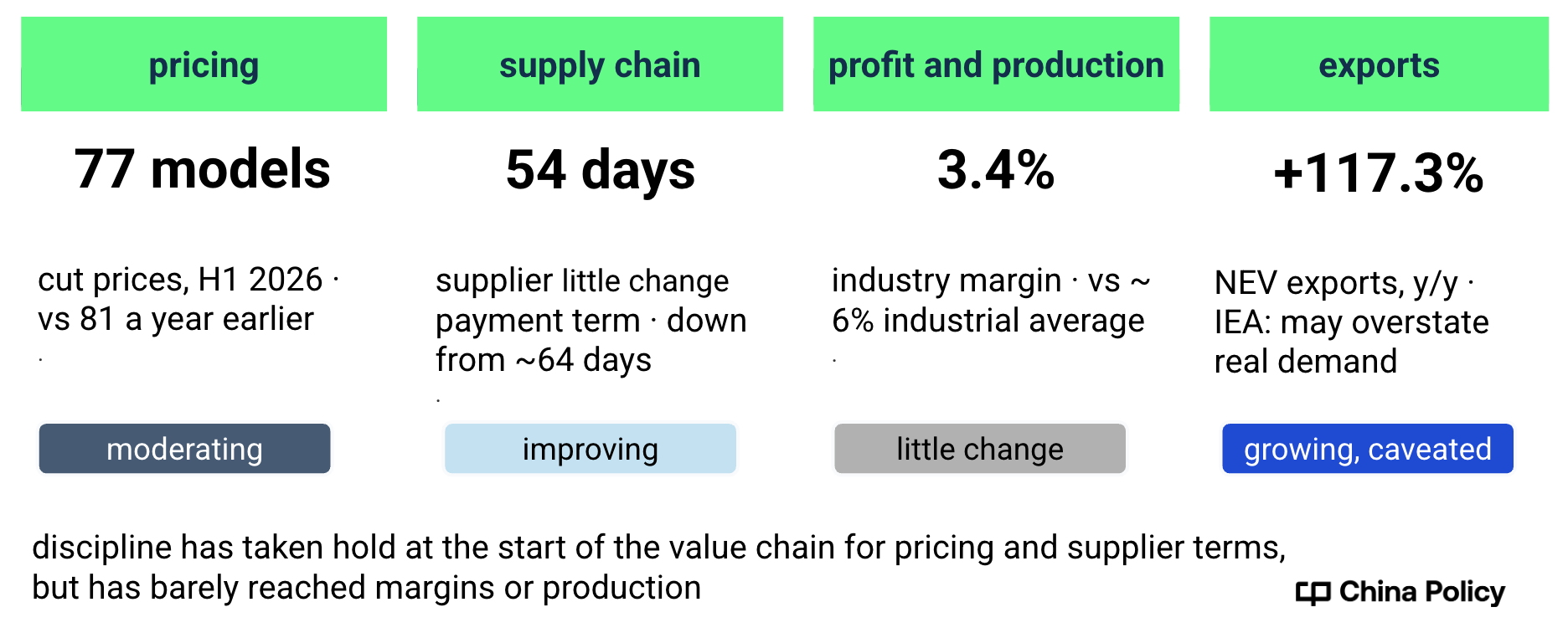
supply chain: here the effect is clearer. A survey by CAAM found that the average payment term offered by major carmakers to suppliers had fallen to approximately 54 days, around ten days shorter than a year earlier and broadly consistent with their commitment to pay within 60 days. Listed carmakers’ accounts-payable turnover also quickened, though periods remain long, especially among Hong Kong-listed firms. A similar pattern shows up in dealerships: passenger-vehicle inventories fell by approximately 350,000 units during the first five months of 2026, against an increase of around 10,000 units a year earlier, suggesting manufacturers have stopped pushing additional stock onto dealers. Even so, the dealer inventory warning index remained at 57.2 in June, and 76.9 percent of dealerships missed their first-half sales targets: the policy has slowed the build-up, not cleared the backlog.
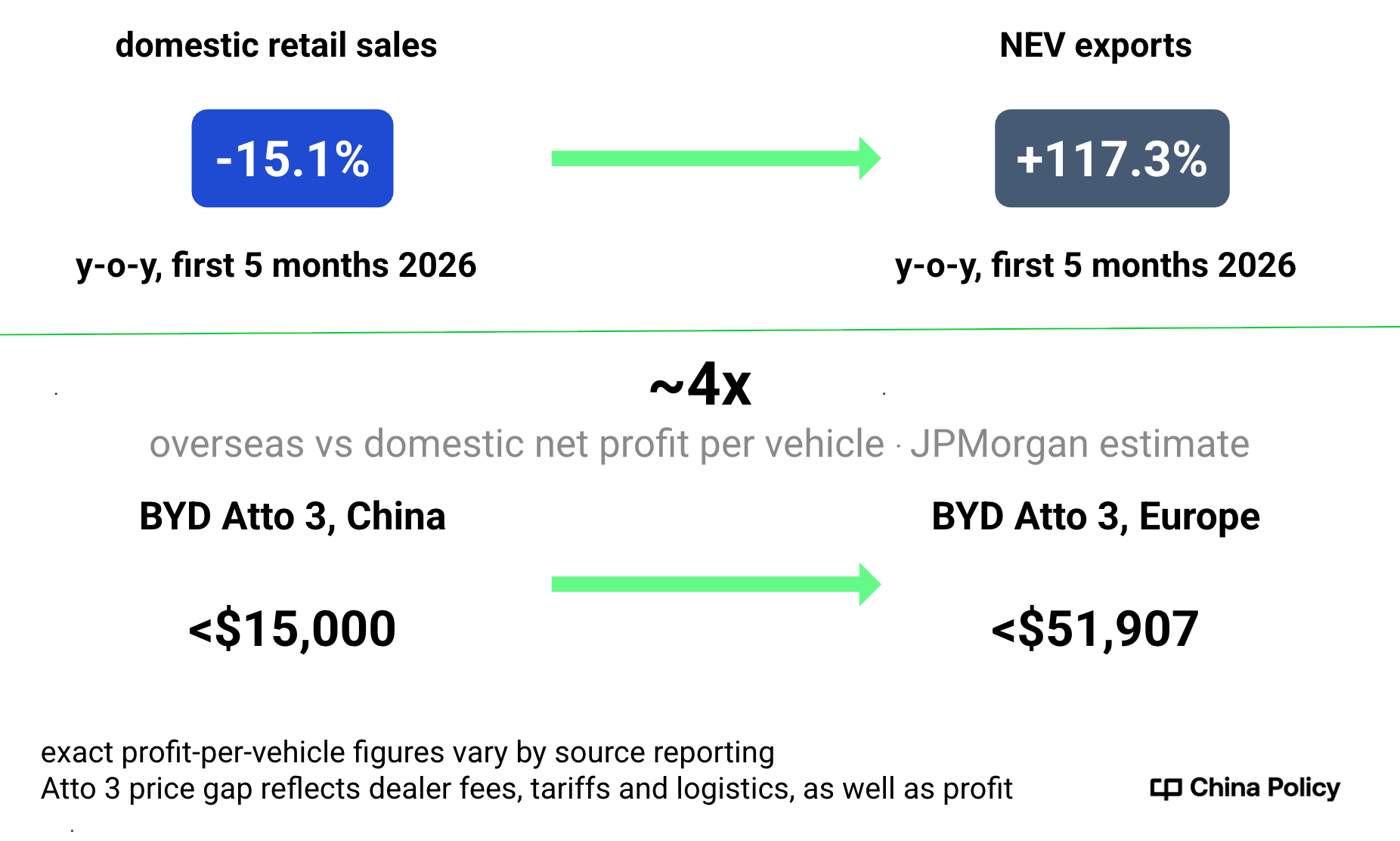
profits and production: these improvements in corporate conduct have not yet reached the industry’s underlying structure. The sector’s sales margin rose from 2.9 percent in January–February to 3.4 percent in January–April and held there through May, while profits were approximately 20 percent lower than a year earlier and margins remained well below the roughly 6 percent average for industrial companies generally. Production tells the same story: domestic retail sales of NEV passenger vehicles fell by 15.1 percent over the first five months of 2026, yet production rose by 0.9 percent and wholesale deliveries by 1.7 percent, and 20 manufacturers still recorded wholesale deliveries above 10,000 vehicles, two more than a year earlier. Weaker demand, in other words, has not yet forced either lower output or fewer manufacturers.
exports: the gap has been absorbed largely by overseas markets. CPCA’s (China Passenger Car Association) reporting shows NEV exports reached 1.732 million units during the first five months, up 117.3 percent year on year; customs data showed a smaller rise of around 61 percent but pointed in the same direction. The International Energy Agency, however, estimated that Chinese NEV exports exceeded actual overseas sales by more than 25 percent in 2025, attributing the gap to inventory accumulating outside the PRC. Domestic inventory pressure has eased, in part because some of the excess supply has simply moved further down the chain into overseas markets.
Short-term discipline. The anti-involution campaign has already produced identifiable results. Faster supplier payments, lower inventories in domestic distribution channels, and a moderation of direct price wars indicate that the policy has reduced carmakers’ ability to sustain expansion by tying up supply-chain funds and loading dealers with stock. Export licences, quality inspections and technical standards also help to curb zero-mileage used-car exports, fictitious sales and exports of cheap, low-quality vehicles. Even if these mea
sures do not immediately reduce production, they improve industry transparency and supply-chain stability.
Not yet restructuring. The campaign started rolling out only in mid-2025. Production has not contracted significantly, industry concentration has not increased and profit margins remain low. Failures are concentrated among smaller entrants: Neta, HiPhi and Ji Yue have all gone bankrupt, while the top tier of manufacturers has, if anything, grown. The policy has not yet moved from regulating corporate behaviour to eliminating capacity. Improvements in payment terms and inventories may, however, be preconditions for subsequent consolidation rather than its final result.
the export incentive
The risk. Destructive competition may also weaken legitimate competition. The cost of an NEV is difficult to determine because of platform sharing, software revenue and vertical integration, so regulators may not be able to distinguish accurately between low prices resulting from efficiency and low prices intended to exclude competitors. If rolled out too broadly, anti-involution could protect inefficient companies and raise consumer prices; if industry self-discipline develops into price coordination, it could instead strengthen the bargaining power of leading automakers over dealers and suppliers.
A case in point: from July 2025, the six largest PRC polysilicon producers coordinated under ‘industry self-discipline’ to curb the price war, eventually proposing a roughly C¥50bn (~US$7bn) fund to buy out and idle about a third of the country’s polysilicon capacity. In January 2026, the State Administration for Market Regulation halted the plan, ruling that the same coordination amounted to controlling output and allocating the market between firms. What the industry called self-discipline, the regulator called a cartel.
The upside case. The policy could raise the overall quality of the PRC automotive industry. Restrictions on expansion financed through delayed payments, inventory loading and fictitious sales will make it harder for companies without competitive products or adequate financing to survive, while quality, energy-efficiency and export standards should direct capital and orders towards companies with stronger technology and more stable supply chains. If this process eventually includes the closure of inefficient factories, the PRC automotive industry could move from loss-making competition among many companies to a smaller group of financially healthier manufacturers.
The local-government problem. The central government has folded rules on local investment promotion, fiscal subsidies and new projects into the anti-involution framework, addressing the institutional sources of duplicate investment. But Beijing’s own tools are more limited here than in other overcapacity campaigns: NEVs are built almost entirely by private firms, not the state-owned enterprises that dominate sectors such as steel or coal, where the centre can order capacity cuts directly. Local governments, however, still need to protect employment, tax revenue and local financial stability. If mergers and restructuring merely change company ownership without closing factories, they will reduce the number of brands but not the amount of capacity.
Anti-involution’s success will come down to three unglamorous tests: whether local governments let loss-making companies go bankrupt, whether banks recognise their losses, and whether the assets are actually removed from the market rather than simply recycled. For any of this to happen, there would need to be a marked shift in appetite for risk and in local governance. History suggests otherwise.

Chen Weiwei 陈伟伟 | NDRC Institute of Economic System and Management Urban–Rural and Regional Research Division deputy director
An economic-reform researcher within the National Development and Reform Commission (NDRC) system, Chen uses electric vehicles as one example of a broader ‘involution’ problem: low-price, low-quality, homogeneous competition detached from innovation, as he defined it in April 2026. Four causes drive it, in his account: a mismatch between supply and demand; weak technological differentiation; local fiscal incentives that conflict with a unified national market; and high exit barriers in asset-heavy industries. Firms may keep expanding despite weak demand, then cut prices to absorb the extra output, a cycle of expansion, falling prices and further expansion that local protection and selective subsidies only reinforce. His prescription: remove local barriers, strengthen antimonopoly and anti-unfair-competition enforcement, use standards and innovation to raise the level of competition, and coordinate regulators, industry associations and firms. Anti-involution, on this account, aims to stop low-level competition from distorting the market rather than end competition itself.
Deputy director of the Urban–Rural and Regional Research Division and an associate research fellow at the NDRC’s Institute of Economic System and Management, Chen researches the unified national market, market-system development, factor allocation, regional and urban–rural reform, local protection and the business environment. The institute is a bureau-level research body under the China Academy of Macroeconomic Research. Signed articles represent personal expert analysis rather than official NDRC policy.
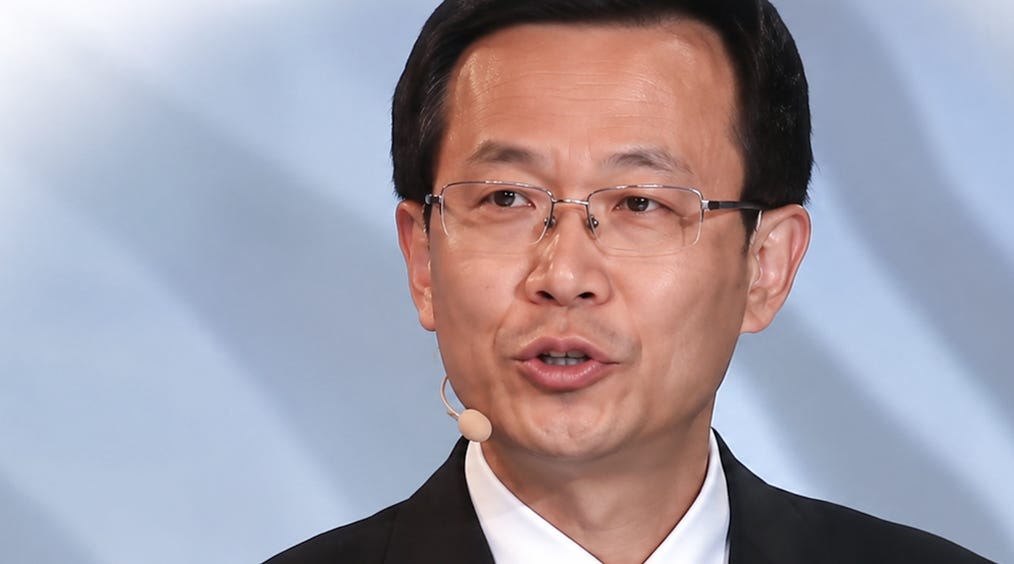
An Tiecheng 安铁成 | China Automotive Technology and Research Centre chairman
In An’s reading, involution is mainly a threat to quality, innovation and lifecycle support. Component procurement prices have been cut by 10–15 percent in repeated rounds in recent years, An noted in June 2025, making it hard to stop suppliers lowering quality requirements; intense short-term competition discourages research and development, and product homogeneity traps the industry in repeated low-level discounting. The risk continues after sale: suppliers do not normally inherit after-sales responsibility if an automaker exits the market, so software maintenance and updates for connected vehicles could simply stop. His September 2025 proposal paired new-investment discipline with revitalising existing assets through technological upgrading and supply-chain restructuring, alongside stronger standards and investment in core technologies. The preferred response, in short, is technology and standards, not price restraint alone.
An is party secretary and chairman of China Automotive Technology and Research Centre, a centrally administered state-owned group responsible for automotive testing, certification, standards and policy research. He spent decades at FAW in manufacturing and corporate planning, including as general manager of FAW–Volkswagen and FAW Car, before a stint as deputy general manager at Dongfeng Motor.
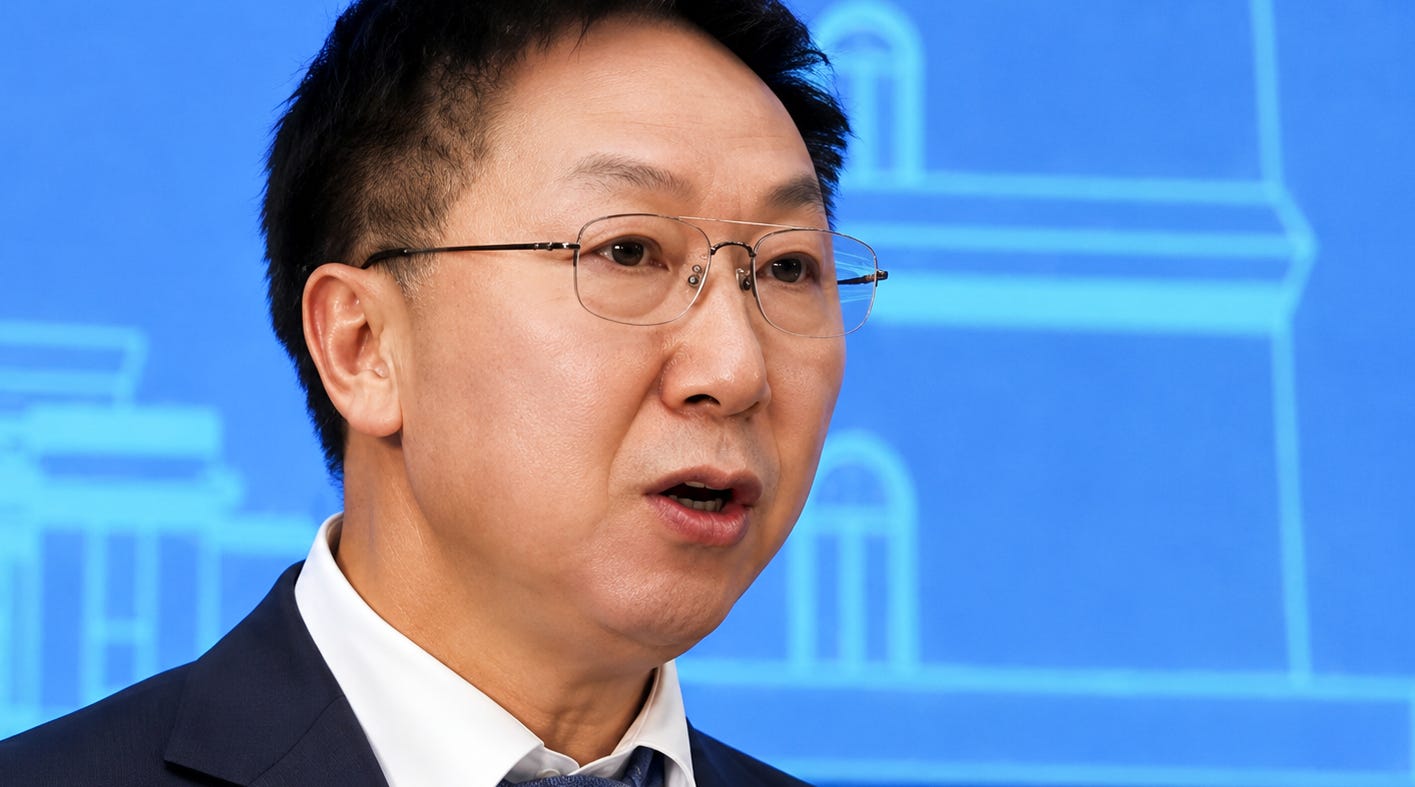
Fu Bingfeng 付炳锋 | China Association of Automobile Manufacturers executive vice-chairman and secretary-general
Anti-involution for Fu is a continuing industry-governance project, not a temporary pause in the price war. At the China Automotive Forum in July 2025, Fu called for a stronger long-term mechanism to shift the market from price-driven to value-driven competition, and linked domestic disorder directly to overseas expansion: firms should resolve problems at home, he argued, rather than let domestic ‘involution’ become ‘external involution’ abroad. CAAM has accordingly urged companies expanding overseas to respect local laws and culture and to develop in a more orderly manner. In October, Fu named group-based management of manufacturers and legislation on production admission as levers for improving the industrial structure, with tighter regulation alongside a gradual reform of market entry, though again with no numerical targets for production cuts or closures.
Fu has served as executive vice-chairman and secretary-general of CAAM since 2019, after decades at FAW in passenger-car research, product development and corporate planning, including as deputy general manager of FAW Car. He holds a master’s degree in engineering from Jilin University of Technology. CAAM is not a regulator, but coordinates between manufacturers and government agencies on matters including price competition, sales data and supplier payment terms.
Comments
Nothing yet. Say the first thing.
Sign in to join the conversation.