
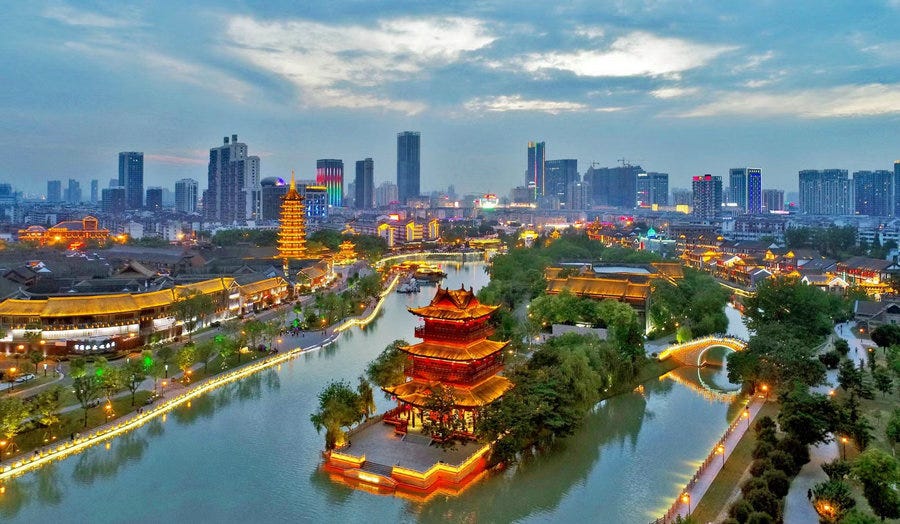
If you asked anyone in China right now about the city of Huai’an, they would most likely say the Grand Canal or Zhou Enlai. Those are the main descriptors of this city, both giving recognition in the past but no current value.
For centuries, this city was the Southbound Boat, Northbound Horse junction, the precise point where the Grand Canal met the Yellow River and Huai River. The Qing dynasty located both the Governor of Grain Transport and the Governor of Waterways here. Huai’an was not a destination. It was the valve controlling north-south movement.
Then the canal declined. The river shifted. The railway arrived elsewhere. Huai’an’s function was bypassed. The city faded.
On the other hand, China’s first Premier Zhou Enlai came from this city. Every schoolchild knows this. It is a point of pride, a source of identity, a draw for state visitors and tourists. But a hometown is not an economic engine. Memory does not generate sovereignty. Narrative does not make a city irreplaceable.
Underneath both; the canal’s memory and the premier’s legacy, something else was always there. Something the city extracted for decades and then left behind. Something that sat underground, ignored, while Huai’an searched for a new identity.
Salt. Billions of tons of it.
That salt is now making the regional grid dependent on this city.
Huai’an is not known for what makes it irreplaceable. It is known for what it used to be and who it produced. But underneath the city’s public identity lies a latent asset that the regional grid cannot function without.
This is a story about recognition. About a city that looked at its waste and saw infrastructure. About what happens when you stop extracting and start storing. About the moment you realize that what you left behind is worth more than what you took out.
And it poses a question for everyone reading this: What is buried in your territory that you have been treating as a commodity, a void, or a liability but could become your only buffer?
For centuries, Huai’an was not a destination. It was a passage.
The city sat at the precise intersection where the Grand Canal met the Yellow River and Huai River. This was not incidental geography. It was engineered inevitability. The Qingkou hydraulic complex,1 one of the most ambitious water management projects in pre-modern China, was built here to regulate the crossing of the canal over the Yellow River’s shifting bed. The Caoyun Governor’s Mansion; the administrative heart of the empire’s grain transport monopoly was located in Huai’an. The Qing dynasty did not merely acknowledge the city’s position. It institutionalized it.
Huai’an was the Southbound Boat, Northbound Horse junction. Grain from the Yangtze Delta moved north by water; tribute and goods moved south by land. The transfer happened here because it had to. There was no alternative.2
The constraint arrived in layers.
First, the Yellow River shifted course in 1855. The hydrological logic that had made the intersection functional was severed. The canal silted. The grain tax that had flowed through Huai’an for centuries rerouted to coastal shipping. The Qing dynasty’s grain transport system, which had relied on Huai’an as its administrative and logistical heart, began its long decay.
Second, the railway arrived in the early 20th century. The Tianjin-Pukou line, which connected north and south China, did not pass through Huai’an. It bypassed the city entirely. The new infrastructure moved the flow elsewhere. The valve was no longer necessary.3
The city did not collapse. It faded.
The administrative apparatus relocated. The granaries emptied. The hydraulic complex that had been the empire’s engineering marvel became a historical curiosity. The Britannica entry records the decline with clinical precision: its importance declined after the mid-19th century, when the Grand Canal gradually fell into decay.4
By the time the reform era arrived, Huai’an had been bypassed by every major economic transformation: coastal trade, industrial policy, foreign investment, high speed rail. What had been the administrative seat of the empire’s grain transport system became a county-level city, a regional agricultural center, a minor city in Jiangsu’s shadow.
The infrastructure that had made Huai’an indispensable still existed; the canal, the locks, the granary sites but the flow had moved elsewhere.
A city that had once been the administrative heart of the empire’s grain system, reduced to subsistence agriculture and administrative memory.
The premier is Huai’an’s most famous son. Born here in 1898, Zhou Enlai would become China’s first Premier, serving from 1949 until his death in 1976. Zhou Enlai spent the first 12 years of his life in the city, at No. 7 Fuma Lane in Huai'an District.5 His former residence opened to the public in 1979 and remains a site of pilgrimage for visitors from across China.
His memorial in Huai’an is the largest comprehensive memorial hall dedicated to Zhou Enlai in China. Construction began in 1986 and the hall opened in 1992, covering 400,000 square meters. It holds over 41,000 collections, including cultural relics, writings, paintings, and audiovisual materials documenting his life.6 The site is designated a national 5A level tourist attraction and a national first class museum.7
Every schoolchild knows his name. The city is identified with him in a way that few Chinese cities are identified with any single figure.
But a hometown is not an economic engine.
A hometown is a destination for pilgrimage, not for investment. It generates tourism revenue, but tourism is contestable. It generates narrative, but narrative does not make a city irreplaceable. The legacy of Zhou Enlai gives Huai’an visibility, but visibility is not sovereignty.
The city is known for the premier. It is not known for what makes it sovereign.
Together, Zhou Enlai and the Grand Canal give Huai’an a public identity. They make the city known. They give it recognition, pride, and a place in the national story.
But they do not give it sovereignty.
If the canal gave Huai’an its function, salt gave it its foundation.
For decades, Huai’an treated its salt reserves as exactly that, salt. A commodity. A mining product The salt was underground. Out of sight. Out of mind. The city’s identity remained fixed on the canal (memory) and Zhou Enlai (narrative) both powerful, but neither generating economic sovereignty. The salt caverns were not seen as infrastructure. They were seen as voids, empty space left behind after extraction
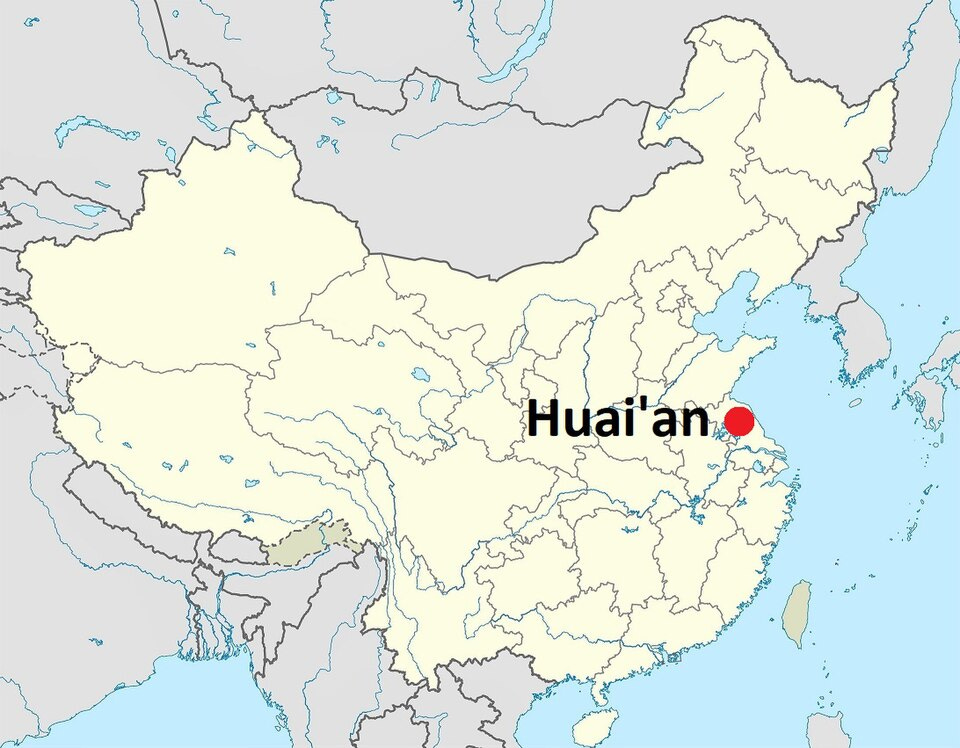
Beneath the city’s soil, buried between 1,000 and 2,500 meters underground across an area of nearly 200 square kilometers, sat one of China’s largest rock salt deposits.8 Discovered accidentally in the 1970s by geologists searching for oil, the Huai’an Salt Basin contains proven reserves of approximately 2 billion tons.9
The salt was not a secret. It had been extracted for decades; pumped out as brine through wells drilled into the deposit. In the late 1980s, Huai’an began systematic brine production, with companies like the Huai’an Salt Mine (established 1988) and the Zhugiao Salt Mine (established 1985) pumping brine for use in vacuum salt production, chemical manufacturing and even food processing. By the 1990s, brine was being transported via pipeline to alkali plants as far away as Lianyungang.10
The extraction method was simple: drill a well, pump in fresh water, dissolve the salt, and pump out the brine. The process left behind massive underground voids; smooth walled, impermeable, self sealing cavities where the salt had been.11
These caverns were not a product. They were a byproduct. The salt was the commodity; the caverns were the waste.
The local government treated the voids as a liability. A geological hazard to be managed. A problem to be monitored or filled. The 1987-2009 annual reports show the city’s brine production expanding year after year.12 The caverns grew. The waste accumulated. No one asked what the voids could become.
This is the blindness that defines the Latent Asset Principle. A city can hold an irreplaceable asset for decades and not recognize it, because it is looking at what it extracts, not what it leaves behind. It is looking at the commodity, not the container. It is looking at the salt, not the emptiness.
The buyers did not need Huai’an. They needed salt and salt could come from anywhere. The extraction generated revenue, but it generated no dependency.
The caverns were different. The caverns could not be moved. They could not be replicated. They were specific to Huai’an; the geology, the depth, the purity, the volume.
But the city did not see them. Not yet.
The caverns had always been there. The blindness was not in the geology. It was in the framing.
For decades, the voids beneath Huai’an were treated as a liability; a geological hazard that had to be monitored, stabilized, or filled. The mined out areas above which no residential, commercial, or public facilities could be approved sat as dead land, a constraint on development rather than an opportunity.13 The local government managed the risk. No one asked what the voids could become.
Then the frame shifted.
China’s energy transition demanded storage; massive, sealed, geological storage. The grid needed buffers: places to store compressed air, natural gas, hydrogen. Batteries were too expensive for long duration storage. Pumped hydro required specific topography and years to build. Salt caverns offered something else: pre-existing voids, impermeable and self healing, at the depth and scale the energy system required.
Huai’an’s caverns, created over decades of brine extraction, were suddenly not waste. They were infrastructure.
The recognition came in stages.
First, the research. Scientists at the Chinese Academy of Sciences’ Institute of Rock and Soil Mechanics and other institutions began studying Huai’an’s salt caverns systematically. The geology was specific: nearly 5 billion tons of salt reserves, distributed across the Huai’an and Hongze salt basins, with the largest rock salt deposit in China.14 The caverns were smooth-walled and airtight. Salt has a unique property: when cracks form, the pressure of surrounding rock causes the salt to recrystallize and seal itself.15 This self healing capability made the caverns ideal for long term storage.
Second, the technology. Over a decade of research, teams led by Jiangsu Soda & Salt Jingshen Co., Ltd. and the Chinese Academy of Sciences’ Institute of Rock and Soil Mechanics developed a China solution for salt cavern utilization: the connected well salt cavern gas storage construction technology. Traditional single well technology takes four to five years to dissolve 400,000 cubic meters of salt. The connected well technology; drilling two vertical wells that connect horizontally underground, forming a U shaped space reduces the construction cycle to approximately two years.16 This solved the problem that foreign experts once believed was insurmountable: that China’s thin salt layers, multiple interlayers, and high impurity content made efficient salt cavern storage impossible.17
Third, the mandate. In 2026, the Jiangsu Provincial Government formally embedded Huai'an in the 15th Five Year Plan with explicit language: support Huai'an in building a salt cavern comprehensive utilization demonstration base.18 The provincial People's Congress, during its February 2026 session, further emphasized the mandate during deliberations on the provincial government work report.⁷ The city was no longer asking for permission. It was being designated.
What Huai’an now holds is not abstract.
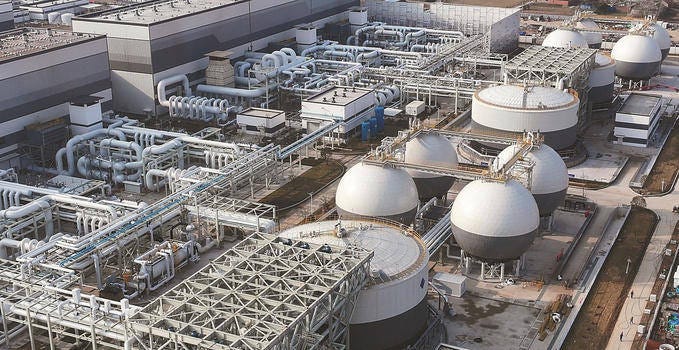
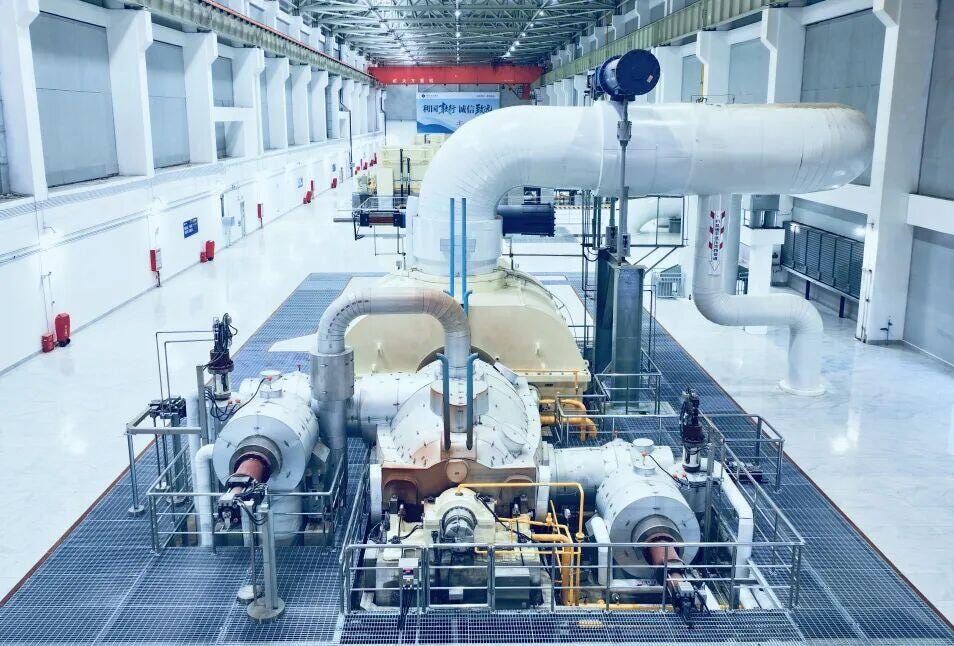
Compressed Air Energy Storage: In 2026, Huai’an commissioned the world’s largest compressed air energy storage facility: 600 MW installed capacity, 2,400 MWh storage, utilizing approximately 980,000 cubic meters of salt caverns located 1,150 to 1,500 meters underground.19
The project consists of two 300 MW non-supplementary combustion CAES units, achieving approximately 71% conversion efficiency without burning any fuel.20 With a total investment of $520 million, the station generates 792 million kWh annually; enough to power 600,000 households and saves approximately 250,000 tons of standard coal while cutting CO₂ emissions by 600,000 tons each year.21 The project is the largest of its kind globally, surpassing the previous record held by a 300 MW facility in Hubei.22
Natural Gas Storage: The Zhangxing Gas Storage Facility, built using the connected well technology, has formed 600 million cubic meters of storage capacity underground. Since beginning trial operations in October 2023, it has injected 160 million cubic meters of natural gas, with a daily injection capacity of 6 million cubic meters and a daily extraction capacity of 8 million cubic meters.23 The facility ranks second among salt cavern gas storage facilities nationally in terms of scale.24 The technology also utilizes sediment void space through low position brine discharge, increasing effective storage capacity by approximately 20% while reducing the base gas ratio from 40% to 20%.25
Hydrogen Storage: The future phase. Huai’an is researching four well interconnection models for salt cavern hydrogen storage, which would enable large scale, stable hydrogen reserves.26 The provincial government has explicitly mandated supporting Huai’an in this direction.27
The recognition was not that Huai’an had salt. The recognition was that Huai’an had emptiness and emptiness, properly framed, is infrastructure.
The commodity was salt. The sovereignty is the void.
Having established the asset, the question becomes: how does Huai’an convert emptiness into revenue?
The answer is not a single stream. It is a portfolio of mechanisms, each extracting value from the same geological endowment.
The 600 MW facility generates 792 million kWh annually, enough to power 600,000 homes.28 The revenue model is arbitrage: buy electricity during low demand periods (when wind and solar are abundant and prices are low), store it as compressed air, and sell it back during peak-demand periods (when prices are high).29 In Jiangsu’s electricity market, peak pricing can be up to 1.8 times the normal rate, creating a spread that makes the economics viable.30
The total investment in the facility was $520 million. Annual revenue projections are based on a levelized cost of storage model that factors in the 71% conversion efficiency, storage capacity of 2,400 MWh, and the projected spread between off peak and peak electricity prices.31
The Zhangxing Gas Storage Facility operates on a different principle: storage fees. Natural gas sellers pay to store gas during the low-demand summer months and withdraw it during winter. The facility has formed 600 million cubic meters of storage capacity underground, with a daily injection capacity of 6 million cubic meters and a daily extraction capacity of 8 million cubic meters.32
The revenue model includes Tolling fees where each cubic meter stored and withdrawn is charged. There is also Price arbitrage, where they buy gas when prices are low and sell when prices are high. They also have Strategic reserve contracts, where they get paid by the state for maintaining emergency gas reserves.
By utilizing sediment void space through low position brine discharge, the facility increased effective storage capacity by approximately 20% while reducing the base gas ratio from 40% to 20%; meaning less gas must be kept permanently in the cavern to maintain pressure, freeing more gas for market.33 This directly improves the economics of every unit stored.
Huai’an is researching models for salt cavern hydrogen storage, which would enable large scale, stable hydrogen reserves.34 Economic analysis of this model indicates the Levelized Cost of Hydrogen Storage (LCHS) reaches its lowest point at a roof depth of approximately 1,400 meters, suggesting optimal economic performance.35
The four well model achieves maximum gas storage capacity while minimizing cost, making it economically viable for the emerging hydrogen market.36 The provincial government has explicitly mandated support for Huai’an in this direction.
The revenue mechanisms share a common structure:
i. Capital Investment was secured through a combination of state owned enterprise equity (Jiangsu Soda & Salt Jingshen Co., Ltd.), joint ventures with national oil companies (China Petroleum, forming Jiangsu Guoneng), and central government infrastructure funding.37
ii. Operating Revenue comes from market mechanisms: electricity arbitrage, storage tolls, and strategic reserve contracts.38
iii. Economic Multipliers include the transformation of previously unusable land. The mined out areas above salt caverns were once development restricted; no residential, commercial, or public facilities could be approved on top of them.39 By converting the caverns to storage infrastructure, Huai’an has turned a constraint into an asset, unlocking land value that was previously inaccessible.40
Huai’an’s revenue model is not fashionable, it is structural.
Competitors cannot replicate the geology. Building new salt caverns elsewhere requires decades and billions of yuan in geological exploration and solution mining. The existing caverns gave Huai’an a five to ten year head start on any potential competitor.41
The provincial mandate is institutionalized. The city is not asking for permission. The system depends on its storage capacity.42
What Huai’an has activated is not a single revenue stream. It is a diversified asset base; compressed air, natural gas, hydrogen all drawing from the same geology. Each stream reinforces the others. Each stream makes the city harder to bypass. The city is not selling salt. It is selling storage capacity the grid’s only buffer
The commodity was salt. The revenue is storage. The sovereignty is the void.
The Sovereignty
Most entities; cities, companies, industries, even nations chase the wrong kind of power.
They pursue visibility; brand recognition, a famous founder, a landmark product. They pursue investment; capital, infrastructure, talent. They pursue policy favors; tax breaks, special status, regulatory exemptions.
These are not sovereignty. They are rent. They can be bid away. A competitor can offer a lower price, a faster delivery, a more aggressive incentive package. Visibility fades. Investment moves. Policy shifts.
Sovereignty is different. Sovereignty is structural dependency. It is the condition where the system cannot function without you.
Huai’an achieved sovereignty not by building something new, but by recognizing what was always there. The salt caverns were not created. They were left behind. The city did not invent storage. It discovered that the voids beneath its soil were already vessels.
Any entity that claims irreplaceability must pass three tests:
If the asset can be relocated, it is not sovereign.
Huai’an’s caverns cannot be moved. They are geology. They sit beneath 10,000 square kilometers of Jiangsu territory, at depths of 1,000 to 2,500 meters. The salt is specific to this location. No competitor can pick up the caverns and install them elsewhere.
If the asset can be replicated, it is not sovereign.
Building new salt caverns elsewhere requires geological exploration, solution mining, and years of construction. The Chinese Academy of Sciences’ connected well technology reduced the cycle to approximately two years; but that is two years Huai’an already has on any competitor. The thin salt layers, multiple interlayers and high impurity content that foreign experts once believed made efficient salt cavern storage impossible in China have become Huai’an’s expertise.
If the system can route around you, you are not sovereign.
Huai’an’s salt cavern storage is now embedded in Jiangsu’s 15th Five Year Plan as a salt cavern comprehensive utilization demonstration base. The provincial government has mandated the city’s role. The grid depends on the storage capacity for peak shaving, emergency reserves and renewable integration. Bypassing Huai’an would mean building equivalent storage elsewhere; a process that would take a decade and cost billions.
Huai’an’s sovereignty is not about salt. It is about the logic of recognition.
Any entity can audit its territory for latent assets:
What did you extract and leave behind?
What did you treat as waste?
What sits underground, ignored, while you search for a new identity?
The Latent Asset Principle transfers because the blindness is universal.
A manufacturing company has production lines it treats as a fixed cost; but the floor space, the power infrastructure, the logistics access, the trained workforce might be the real asset. A hospital has patient data it treats as records; but the epidemiological patterns might be the real asset. A logistics hub has warehouse capacity it treats as storage; but the location, the speed, the reliability might be the real asset.
The principle works at every scale:
A city can convert abandoned mines into energy storage.
A company can convert byproducts into revenue streams.
An industry can convert waste into feedstocks.
A nation can convert strategic liabilities into dependencies.
The question is not whether the asset exists. The question is whether the entity recognizes it before the system discovers it needs one.
Huai’an is not sovereign because it has salt. Huai’an is sovereign because it recognized that the emptiness left behind was more valuable than what was taken out.
The commodity was salt. The sovereignty is the void.
The principle is universal: What you left behind is worth more than what you took out.
What makes your position irreplicable? Is it structural or fashionable?
What if the most valuable thing you own is what you have been throwing away?
Not the product. Not the revenue. Not the headline. The byproduct. The waste. The emptiness left behind after extraction.
Huai’an sat on billions of tons of salt for decades. It pumped it out, sold it, moved on. The voids left behind were not a problem to solve. They were not a cost to manage. They were the asset, waiting to be recognized.
The canal is memory. Zhou Enlai is narrative. The salt caverns are sovereignty. Everything else; the extraction, the labor, the revenue was the cost of building the real asset. The city just didn’t know it yet.
How many of us are doing the same? Holding the asset. Treating it as waste. Looking everywhere else for value. Huai’an stopped looking. It looked down. And what it found made the grid dependent on it.
What is buried in your territory that you have been treating as waste?
Huai’an looked down and found sovereignty in emptiness. Its lesson is universal: the most valuable asset is often what you have been treating as waste. But not every city has salt caverns. Some have something else entirely.
Next week, we turn to a city that built its identity on what came from the ground and then had to reinvent itself when that ground stopped giving. But Pingxiang’s story is not just about transition. It raises a deeper question: What happens when the thing that built your identity disappears? How do you regenerate when the ground beneath you is hollow?
This is a city that refuses to be a ghost. And the question it poses is one every resource economy will eventually have to answer:
What do you do when what made you is gone?
Next week.
iahr.org.cn The Meeting Project Between the Grand Canal and the Yellow River and the Huaihe River During the Invasion of the Yellow River Into the Huaihe River (1128-1855)
Rock and Soil Mechanics (2014) JI Guo-dong, YANG Chun-he, XU Yu-long, et al., “Laboratory test study of sedimentation and consolidation behaviors of alkali waste backfill in salt caverns,”
Hao Zhang, Guimin Zhang, Kai Liu, et al., “Schemes comparison of layered and continuous solution mining in bedded salt formations by horizontal interconnected wells,” International Journal of Mining Science and Technology 35, no. 12 (2025): 2213-2229.
Sohu.com Zhang Shasha, Wang Yan, “Abandoned Salt Caverns Transformed into ‘Gas Banks’ Thousands of Meters Underground,”
Wuhan Institute of Rock and Soil Mechanics, Chinese Academy of Sciences This world’s first interconnected well salt cavern gas storage facility has transformed a salt mine goaf into an energy storage treasure trove. 2025-09-04.
Huai’an News Network, 2026-04-10 With sails unfurled, new industrialization is leading Huai’an’s “leap forward,”
PV magazine India, 2026-03-05. China's 600 MW/2.4 GWh storage plant becomes world's largest CAES site,"
Nasdaq, 2026-03-04. "Shanghai Electric Provides Core Equipment for World's Largest Compressed Air Energy Storage Station Now Fully Operational in Jiangsu, China,"
Interesting Engineering, 2026-03-05 "World-largest: China's 792 million kWh compressed air energy station now fully operational,"
Sohu Zhang Shasha, Wang Yan, “Abandoned Salt Caverns Transformed into ‘Gas Banks’ Thousands of Meters Underground,”
Sohu.com, 2026-05-22 Zhang Shasha, Wang Yan, “Abandoned Salt Caverns Transformed into ‘Gas Banks’ Thousands of Meters Underground,”
Geng Xiaoqian, 2022 Energy consumption and carbon dioxide emissions throughout the life cycle of advanced compressed air energy storage systems
Heise Onine 2026-03-05. 600 MW compressed air storage plant fully operational
IDEAS 2025 Stability evaluation and economic analysis of four-well interconnection salt cavern hydrogen storage-A case study of Huai’an, China
Stability evaluation and economic analysis of four-well interconnection salt cavern hydrogen storage," Renewable Energy 243, 2025-01-26.
SMEJS 2023 The preliminary evaluation of the general projects for the 2023 Jiangsu Provincial Science and Technology Award professional group has been passed
Sohu 2026-05-22 In-depth analysis | Thousands of meters underground, abandoned salt caverns transformed into “gas banks”
Science Direct Large-scale CAES in bedded rock salt: A case study in Jiangsu Province, China,
Comments
Nothing yet. Say the first thing.
Sign in to join the conversation.