
Dear Readers,
This week Beijing moved on every front and slipped on every seam. Chip exports hit $216 billion, state funds drove $8.4 billion into AI and semiconductor firms, Russia’s refinery output fell to a 21-year low while Beijing extracted better energy terms, factory margins compressed under weak consumer demand, and a ski resort database in Zhangjiakou put 12,000 surveillance files on the open internet. China is projecting outward with growing precision, even as the domestic economy cannot absorb what the industrial base produces and the surveillance state cannot secure what it collects. Follow me through the reports.

These reports demand hours of digging, cross-checking, and plain writing to reach you clear and sharp. If they sharpen your view, keep them coming strong. Subscribe now and go paid if you can.
Every dollar buys more depth and keeps the flow independent. Share this edition with someone who needs the unfiltered read. Drop a comment below with your take. Your moves keep the lights on and the conversation alive.
Start with the number that resets the baseline. China Doubled Chip Exports: $216B AI Trade Boom documents how semiconductor exports reached $216 billion in the first seven months of 2026. The value nearly doubled year-on-year, even as unit volumes rose only 6.2 percent. Vehicle exports tracked a parallel trajectory: 6.40 million units by July, a 53.7 percent increase over the same period last year. The divergence between value and volume is the key signal. China is not shipping more chips; it is shipping more expensive ones. Processing trade jumped 59.7 percent while general trade grew 14.5 percent. The figures indicate that China is not decoupling from global supply chains. It is ascending them.
China Doubled Chip Exports: $216B AI Trade Boom
·
Aug 10
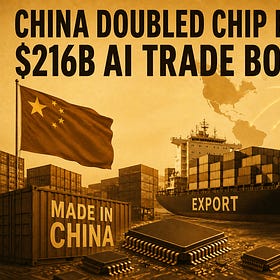
Compared to the exceptional previous month of June, Chinese exports cooled in July, though by less than forecast. The restructuring of the Chinese economy continues to advance, away from consumer goods and toward the processing of high-tech components needed for the AI boom. And the temporary freeze in the Hormuz crisis gave China the opportunity to res…
This export surge ties directly into the capital strategy Beijing is deploying at home to build the industrial base that drives it.
The export numbers do not emerge from markets alone. China Deploys Its ‘National Team’ to Win AI Race details how Beijing is using state-owned investment firms to channel capital into AI and semiconductor companies, turning the $28 trillion domestic stock market into an industrial policy tool. China Reform Holdings and China Chengtong Holdings deployed $8.4 billion to expand stakes in strategic tech firms. ChangXin Memory Technologies raised $9.8 billion in its IPO, the second-largest in mainland Chinese history, with its shares surging 466 percent on the first day. US private AI investment stands at $285.9 billion against China’s $12.4 billion, yet government guidance funds have invested an estimated $184 billion in AI since 2000. The strategy is deliberate: limited state outlays leverage larger flows of private capital into sectors Beijing cannot afford to lose.
China Deploys Its 'National Team' to Win AI Race
·
Aug 13

With a new strategy, Beijing is sending its National Team into the global AI race: The country is betting on the power of its domestic capital market to win the technological contest against the United States. State-owned investment companies are now deliberately using
This domestic investment logic has a direct geopolitical extension: Beijing applies the same leverage extraction to energy, where a weakened Russia has run out of alternatives.
The Kremlin’s fiscal position is deteriorating faster than its public statements suggest. Russia’s Oil Revenue Plummets 27 Percent reports that gross oil revenues collapsed from 968.5 billion rubles to 692.3 billion rubles in July, a 27 percent decline in a single month. Russian refinery throughput fell to a 21-year low of 3.8 million barrels per day, with 4.3 million barrels of daily processing capacity damaged or offline. India’s payments for Russian fossil fuels rose 59.7 percent year-on-year, providing partial relief. China increased its payments by 15.6 percent while stalling negotiations on the Power of Siberia 2 pipeline. The data suggest Beijing is operating as a monopsony buyer, securing discounted energy from a seller with nowhere else to turn.
Russia's Oil Revenue Plummets 27 Percent
·
Aug 11

A decline of more than a quarter has shaken Russia’s oil finances in July. The combination of targeted Ukrainian drone strikes on domestic refineries and the temporary easing of the Hormuz crisis is putting the Kremlin’s coffers under massive pressure. Shrinking export revenues and falling prices are carving a significant hole in the state’s ongoing inc…
These external gains occur against a domestic backdrop of margin compression that no policy instrument has yet resolved.
The industrial expansion visible in export figures does not reach China’s factory floors. China Factory Prices Drop as Domestic Demand Fails shows how manufacturers are trapped between rising upstream costs and falling consumer prices. Coal mining prices rose 27.1 percent year-on-year after a major mine accident cut raw coal output by 9.7 percent in June. The Consumer Price Index fell to 0.5 percent in July, well below the consensus of 0.8 percent; a government-mandated fuel price reduction pushed the transport index from 15.3 percent to 0.8 percent in a single month. Upstream production goods remain 4.8 percent above year-earlier levels. The margin squeeze is not cyclical. It reflects a structural deficiency: Chinese factories produce for export because domestic consumers cannot absorb the output at profitable prices.
China Factory Prices Drop as Domestic Demand Fails
·
Aug 12
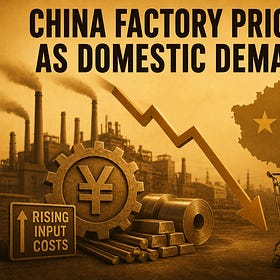
More clearly than in previous months, the easing price pressure in factories reveals how severely the country’s economic strength is suffering from insufficient domestic demand. After the Producer Price Index (PPI) reached its annual peak of 4.1 percent in June and slowed to 3.5 percent year-on-year in July
Such structural compression applies to the surveillance state too: the same gap between ambition and execution runs through the security architecture itself.
Finally, a story about what China’s ambitions look like up close. “Snow Ruyi.” China’s Ski Resort Leaks Secret Dossiers on Foreigners examines a database in Zhangjiakou containing 12,000 records on foreigners, including roughly 700 full profiles tracking bank transactions, medical histories, and smart TV viewing habits. Journalists accessed the system with the username and password already filled in on the public login page. Individuals like journalist Sophia Yan were profiled despite never having visited Zhangjiakou, indicating the reach of China’s Sharp-Eyes network extends far beyond local geography. The database categorized subjects by intelligence affiliation, flagging Five Eyes citizens separately. The exposure reveals a “Chabudwellian” system: surveillance unbridled in its collection and careless in its protection, an architecture that serves the state’s appetite for data without securing what it takes.
The week’s five stories share a single grammar: outward projection sustained by inward compression. China is advancing on every strategic front, with chip exports at $216 billion, state capital flowing into AI firms through the National Team mechanism, and energy terms tightening around a Russia with no alternatives. Yet the domestic economy contradicts this picture: factory margins are collapsing because consumers cannot carry the weight of industrial output, and the surveillance apparatus collects everything while securing nothing. Russia’s declining oil revenues add the fifth dimension: Beijing extracts leverage from external weakness even as it manages the same structural fragility at home. China is projecting outward with growing technical reach, yet the system that drives this projection is consuming itself from within.
Which shift stands out most to you? Share it in the replies. Your read steers the next course. Until next week.
No posts
Comments
Nothing yet. Say the first thing.
Sign in to join the conversation.