
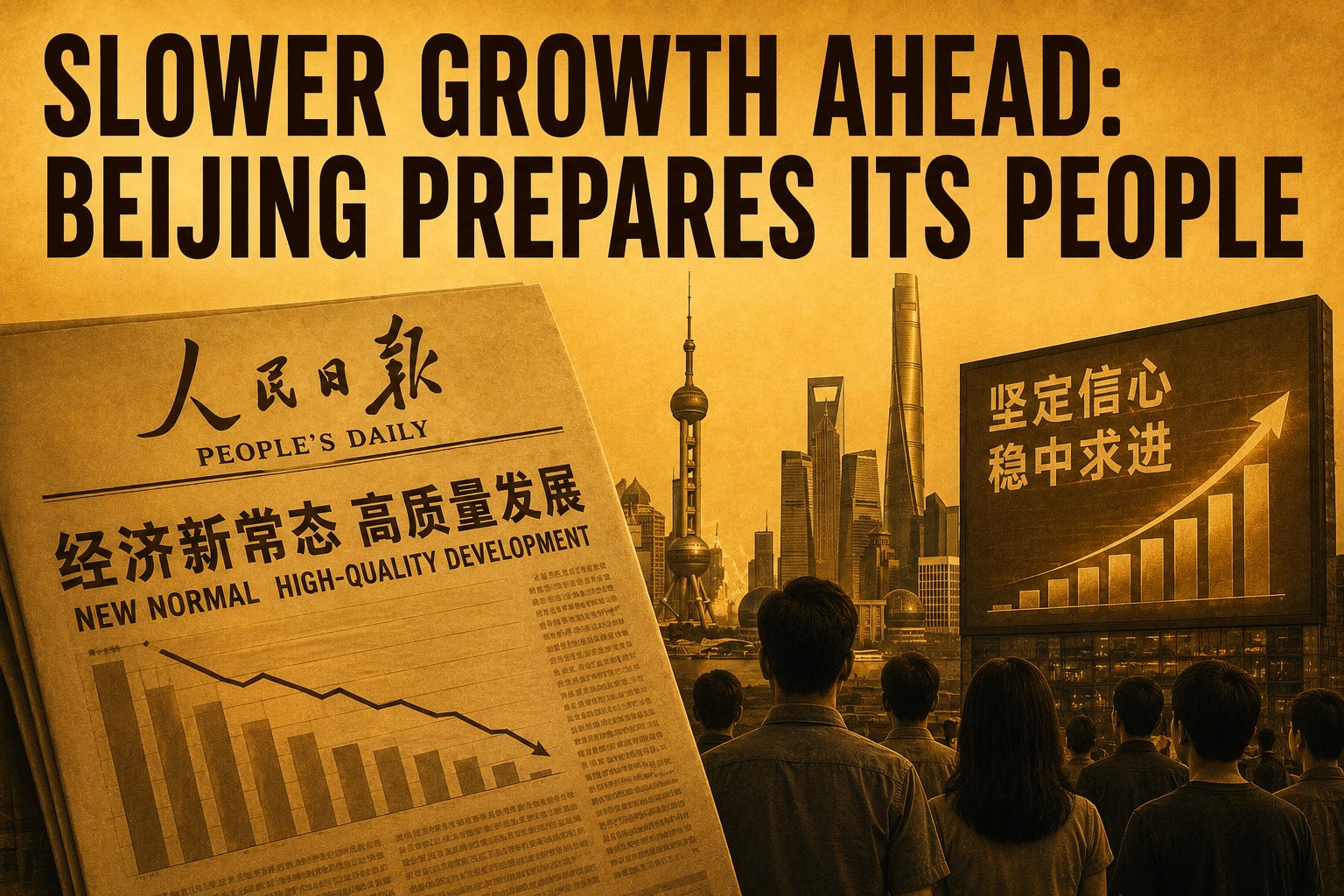
The Party leadership is preparing the population for permanently lower economic growth. A multi-part series of commentaries in a state medium makes clear that the high rates of increase of the past are history. To disguise this setback, the leadership is selling the slower pace as a qualitative restructuring of industry and continues to present its own economy as the main driver of global growth.
Generated by AI (DALE-E3)
In China’s leading medium, the People’s Daily, a collective of authors published a three-part series on the state and outlook of the Chinese economy following the State Council meeting last Friday. The commentaries are intended to convince the population, on the one hand, that the Chinese economy is strong and defies “wind and waves,” while at the same time lowering expectations for economic growth. GDP growth of 4.7 percent in the first half of the year is “essentially in line with current conditions” and “meets the potential economic growth rate,” the text states. In spring, the leadership had set a growth corridor of between 4.5 and 5 percent as its target. Michael Pettis of Peking University describes the text as a “warning.”
Traditionally, economic growth is less a reflection of the actual performance of the Chinese economy than it is proof of work by the political leadership, which is responsible for the prosperity of the population. The admission that GDP growth is moving toward the middle of the prescribed corridor is therefore already an admission that the leadership cannot prevent a weaker economic development.
To disguise this, the collective of authors argues that observers should focus less on the numbers and more on the “quality” of the economy. But “qualitative growth” has already been a fixed part of the political communication of the ruling elite for years. Against this backdrop, the renewed reference to successes in the high-tech and AI sector looks less like a new explanation for China’s economic strength than like an attempt to divert attention from the weaker overall economic development.
In doing so, the authors do not simply claim that growth of 4.7 percent is particularly high; instead, they describe the rate as an appropriate growth rate under current economic conditions. This shifts the benchmark. The focus should no longer be on whether China achieves its politically set growth target, but whether the growth achieved corresponds to what the economy can deliver under the given circumstances.
For the first time, the collective of authors explicitly acknowledges that the reduction of risks in local government debt, the property market, and among small financial institutions is weighing on economic growth. The cleanup has “objectively had a certain contractionary effect” and requires “the tribute of a certain amount of economic growth.” This short-term price, however, will be paid with long-term stability and sustainable development.
To properly assess this admission, it must be borne in mind that the authors are not simply the editorial staff of the People’s Daily. The author pseudonym “Zhong Caiwen” signals that the texts were produced in close coordination with higher-level authorities.
This simultaneously provides the leadership with a justification for weaker growth. Should the Chinese economy grow more slowly than originally expected, this can no longer be interpreted merely as cyclical weakness. Instead, the lower growth rate appears as the deliberate consequence of an economic cleanup necessary to clear the legacy burdens of past years.
At the same time, China’s role as a global growth engine, anchor of stability, and technological driver of innovation is described. Around 30 percent of global economic growth is attributable to China, one of the commentaries states. The 4.7 percent growth in the first half of the year is in line with the annual target and ranks among the highest growth rates among the major economies.
Here, however, the text exposes itself: to substantiate this claim, the authors point to a visit by a delegation of US business representatives who traveled to the People’s Republic on a trip organized by the China Council for the Promotion of International Trade (CCPIT) and spoke favorably about future sectors. This is a delegation from the second, if not third tier. Not heavyweights like Tim Cook, Stephen Schwarzman, Jane Fraser, Ray Dalio, or executives from Qualcomm, Pfizer, FedEx, and Boeing, who regularly attend the China Development Forum (CDF). Equally, the commentary does not reference the supposedly “still-high” foreign investments, since these are sharply declining — which is closer to a vote of no confidence.
The commentators’ goal is to relativize the significance of a particular growth figure. This is consistent with the explicit rejection of excessive reliance on debt-financed stimulus programs. The leadership does not want to pursue a path of high debt and high deficits to generate additional short-term growth. Instead, it is betting on structural measures intended to stabilize economic development over the long term. In doing so, the series simultaneously pushes back against the demands of senior Chinese economists such as Liu Shijin and Li Daokui, who are calling for stronger economic stimulus.
In this way, the leadership is attempting to prevent lower growth in the future from automatically appearing as an economic policy problem. What matters more, the argument goes, is whether the economy becomes technologically more capable, whether new industries emerge, and whether existing risks remain under control.
Here, however, a legitimacy problem arises for the Chinese leadership. The implicit Chinese social contract stipulates that the Party provides for prosperity and in return the people leave governance in the Party’s hands. But if the leadership now declares that it can no longer provide for prosperity to a sufficient degree, it is no longer fulfilling its side of the contract. Why, then, should the people continue to accept the Party’s claim to leadership?
The commentary also refrains from holding out the prospect of an overall economic recovery and instead points to the “quality” and rising competitiveness of individual industries. The message for the reader is that the country must brace itself for continued rising unemployment and loss of prosperity. The individual indicators of GDP show that while the new industrial sectors do generate high value added, they are not creating new jobs to replace those being lost in other areas.
The series is therefore not a tribute to the resilience and progress of the economic restructuring. Instead, it is preparing the population for weak growth and a continuing difficult environment for Chinese citizens. The property crisis will continue, which means a loss of prosperity; the growth sectors are not replacing the losses in traditional industries, which means jobs will disappear; and consumption will remain weak, which will further diminish entry-level opportunities for young workers. The commentary series is an adaptation to permanently lower growth dressed up in gestures of triumph, amounting to nothing less than the economic decline of large parts of the population.
No posts
Comments
Nothing yet. Say the first thing.
Sign in to join the conversation.