How do you know what token standards or blockchains to use in designing your tokens?
Shermin-Founder of Token Kitchen has unravelled that in her first session on Token Design Thinking Framework with Shermin Voshmgir.
Overlapping terms regarding tokens.
1. Cryptoeconomics:
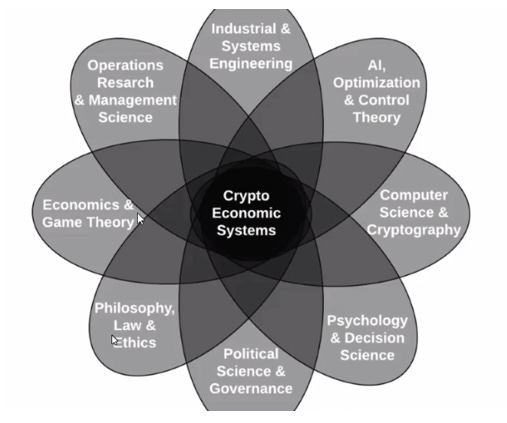
Is seen as an interdisplinary on the intersection of cryptography, economics P2P networks without a single institutional governance.
Fig. 1. Cryptoeconomics system flowers
This is used to describe the economic design patterns of different types of application tokens and depends on people's usage.
Simply referred to as the process of designing DAOs and their tokens where clear rules are hard-coded into the protocols with enough incentives to attract users.
Refers to theory, practice, and tools to analyze, design, and verify tokenized ecosystems popularized by Trent McConaghy.
Shermin considers all these terms except TE to be very reductionist as some focus only on the economic path of the tokens & leave out other relevant disciplines.
Shermin stressed that if we want to understand crypto economics and how to design these complex tokens, we need to study how Bitcoin and its payment systems operate.
She compared Decentralized Autonomous Organizations (Bitcoin as a use case) with Traditional Organizations. Unlike traditional organizations, proof of contributions to the network equals some distribution tokens which is the foundation of Bitcoin PoW. Here, anyone can participate according to the rules of the network.
Traditional organizations operate based on top-down structures. They generate trust and security through some form of registries and agreements where you can engage with anyone according to their level. Here there is no anonymisation.
Decentralized Organizations/DAO look like nation-states or internet tribes because of their social economic systems comprising of people and institutions with their respective economic interest. This system is a complex system.
She spoke about the Governance Feedback loop which involves an automated complex series of smart contracts. Where the protocol is the algorithmic administrator of the governance process, an automated policy of the blockchain network. This computational constitution is enforced by all the computers involved with the anticipation of AIs in the near future.
This loop involves Public Infrastructure, Human Agents & Bots, Social Governance, and the Algorithmic Administration of Governance.
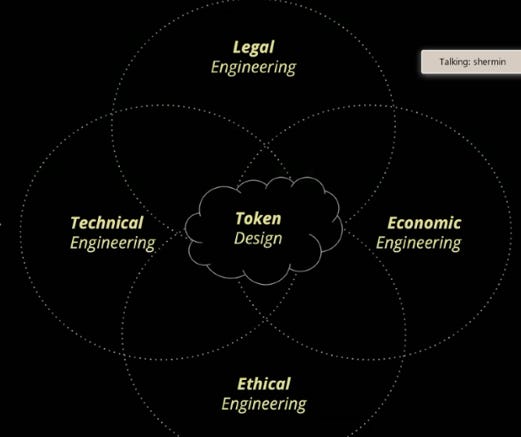
This involves 4 main areas as shown in Shermin’s Slide below:
Fig2. Token Design System
To design a token, you must ask what you want to do, and how you want to do it. Asking legal, technical, economic, and ethical questions to determine what token standards or blockchain infrastructure we would use.
You need to ask what is the purpose of the token that you want to design and not which infrastructure do you want to create it on or how do you technically do it.
These are one of the last questions to ask.
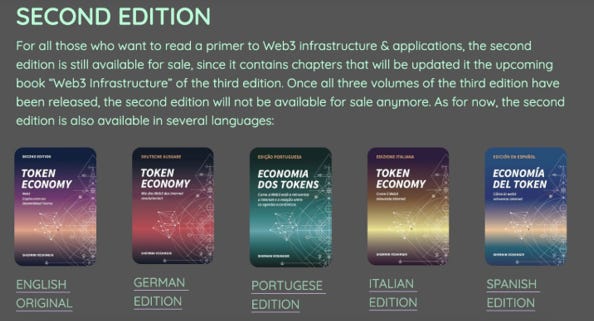
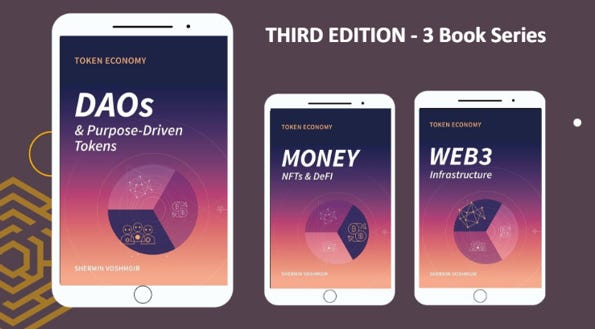
You can read more of Shermin Voshmgir's books listed below:
1. DAOs & Purpose-Driven Token
2. Money- NFTs & DeFi
3. Web3 Infrastructure
Until my next issue coming from our TE's next session, enjoy.

Comments
Nothing yet. Say the first thing.
Sign in to join the conversation.