
In this year’s great 250th July 4th celebrations of the founding of America’s Declaration of Independence, President Trump released the Domestic Policy Council’s report on the Smithsonian Institute’s National Museum of American History. Many of us may have missed it. The report began:
The Smithsonian Institution is one of the Nation’s greatest civic treasures: a place where parents bring their children and tourists from across the country and around the world come to learn about America. At the Smithsonian’s National Museum of American History (NMAH), visitors young and old should encounter the story of the United States told with honesty, seriousness, and pride. In particular, it should help the American people understand where America came from, what makes it distinctive, and why it is worth preserving.
In making their case to Congress in 1953, Smithsonian leadership argued that one of the “main reasons” NMAH should be created is “[t]o place before millions who visit the Nation’s Capital each year a stimulating permanent exposition that commemorates our heritage of freedom and highlights the basic elements of our way of life.”
The report found that this great effort to share our history to the world and to our own citizens has failed. According to the report, Museum leadership has been ideologically captured by “extreme political activism that seeks to transform our country.” This “shift from history to activism” sounds very familiar.
Because it is. The Smithsonian’s Director, Anthea M. Hartig, has repeatedly stated that Americans are illegitimate “occupiers” of the land called America. As evidence, this montage was played during a congressional hearing on July 21st before the House Oversight Subcommittee on Delivering on Government Efficiency.
Rep. Cloud showed a photograph of the first thing people see as they turn the corner for the “American Democracy, A Great Leap of Faith” exhibit. It’s a wall with the words SLAVERY and PRIVILEGE brightly lit up.
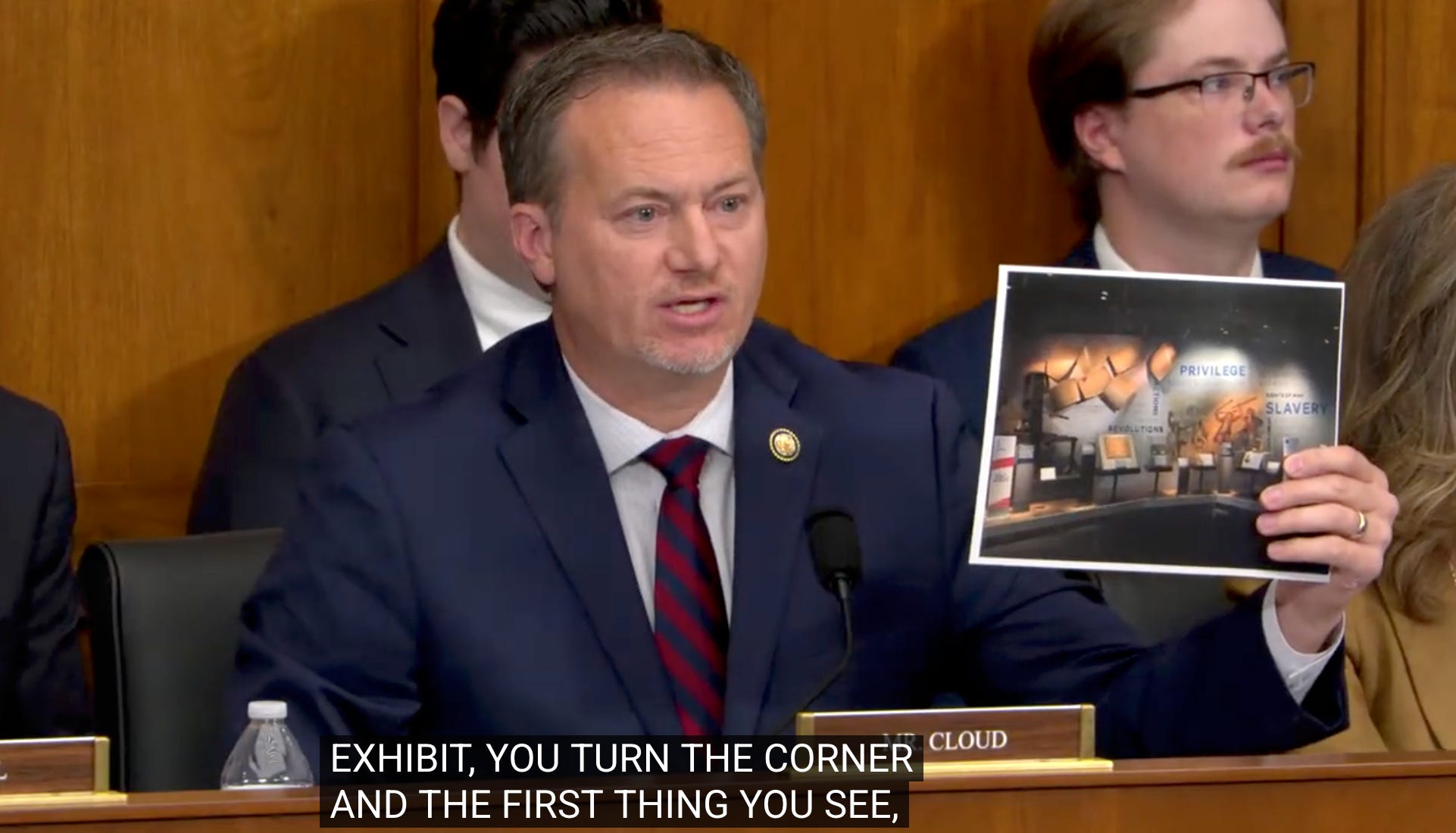
Rep. Cloud argued that what made America unique is that we worked to abolish slavery, but the exhibit doesn’t emphasize that. He also said he was quite surprised to find no prominent exhibit about the Declaration of Independence. He said you have to walk through a bunch of “junk” to get to it.
He was unable to find a display for the two most important books in America’s founding…the Bible and Thomas Paine’s Common Sense. He did however find George Takei’s children’s book about a young man lusting after another in the bookstore. Dr. Hartig defended that book as “beautiful” and justified its inclusion because Takei was “incarcerated during WWII.”
There is so much more. The entire hearing can be watched here.
This report echoes the very same transformation of education happening in America. The same twisting, rewriting and destruction of our history in the classroom is prominently on display at our U.S. Capitol. The report reads:
As this report shows, the Museum purposely presents America as a problematic country irredeemably conceived, founded by deeply flawed men, and still operating today as an instrument of systemic racism and oppression. In the Museum’s current telling, the country is, above all, defined by white supremacy, slavery, conquest, exclusion, hierarchy, racism, xenophobia, misogyny, and systemic injustice.
The report identifies a broad pattern: the Founders are minimized, if not entirely excluded; traditional patriotic narratives are treated with suspicion, if not outright contempt; and the basic symbols and stories that once helped unify Americans are presented not as reasons for gratitude and inspiration, but as objects to be inherently questioned, dismantled, “problematized,” and reinterpreted to achieve ideological ends.
To the extent that there is a story told at the Smithsonian’s National Museum of American History, it is not one of “the victory of freedom and genius of our country” but one of regret, tragedy, and shame.
Without a doubt this reflects the systematic dismantling of our nation’s founding principles.
Museum materials repeatedly suggest that Christianity functioned principally as an instrument of conquest, exclusion, or cultural erasure, while the constructive role of Christian belief and Christian institutions in shaping the Nation and its freedoms receives scant, if any, attention. White, male, and Christian Americans are regularly denigrated as the alleged embodiment of oppressive power structures. Exhibits frame the Pilgrims mainly as colonial oppressors, Thanksgiving as a “National Day of Mourning,” and the European settlement of the continent chiefly as a great “unsettling.”
The NMAH is filled with anti-white activism and “institutional anti-white transformation.” It features radical gender ideology, too. “Museum exhibits and educational materials present gender as fluid, treat biological males as girls or women, and fold contemporary advocacy for transgenderism into the Museum’s treatment of female childhood development, women’s history, and women’s sports.” When asked if she could describe a woman, Dr. Hartig obfuscated by saying they “strive not to categorize” Americans.
The Smithsonian is federally funded by over $1 billion annually. The Chief Justice of the United States Supreme Court leads its Board of Regents. Once again, our hard-earned tax dollars are being used to pay for the destruction of our nation’s true heritage. From the report:
In both theory and practice, NMAH is a clear and institutionalized example of intersectional critical theory—an intellectual framework rooted in Marxism that seeks to radically transform society by revealing and challenging alleged “overlapping systems of oppression”—applied to American history. It fails “to provide America’s young people access to what is genuinely inspiring and unifying in our history, as well as to the lessons imparted by the American experience of overcoming great national challenges”—stories and lessons that make “possible the informed and honest patriotism that is essential for a successful republic.”56 Its message does not seek to instill an “American education grounded in the principles of our founding that is accurate, honest, unifying, inspiring, and ennobling,” but rather seeks to teach disdain and inspire disgust of our great country.
“The 250th anniversary invites us to reconsider the Declaration’s relevance and its role in shaping American identity today,” stated Barbara Clark Smith, a member of the Committee that created the “Museums as A Site For Social Action Toolkit,” [pdf] a 200+ page, three-year roadmap (co-authored by half a dozen current/former Smithsonian employees).
The report explains:
[T]he Museum’s Interpretive Plan directs staff to, “whatever the topic,” tie exhibits back to a set of seven “core issues of our time”—specifically, race/identity, gender/sexuality, climate change, immigration/migrations, economic inequality, technological change, and nationalism/globalism—as part of its “commitment to relevance.”44 The result is that visitors encounter the same ideological storyline over and over again, whether the subject is democracy, entertainment, immigration, childhood, women’s labor, sports, or early American 3 settlement. The complaint is not that these subjects should never be discussed, but that they are increasingly presented through one dominant worldview—one that assumes America’s institutions are chiefly instruments of oppression and that the Museum’s duty is to provoke visitors into activist forms of political resistance to that alleged oppression.
We need to take to heart their Interpretive Plan, because it is the same plan everywhere, schools most of all. We don’t have to wonder why the same themes become part of every facet of our lives.
Clearly the Social Action Toolkit is working as they say, like a “roadmap” to use museums across the country to remove and replace our history.
Turning around the assault on America from within involves challenging this ideology wherever it is found. We are grateful that the Trump administration is confronting the Smithsonian.
Check out your own local museums. Have they also become part of the same ideological capture? Challenge it. Make it public. Insist on removing funding for any public institution that seeks to dismantle our great cultural heritage. Locally, it’s in our hands.
Comments
Nothing yet. Say the first thing.
Sign in to join the conversation.