
Tucked away among the busy streets and towering office buildings of the City of London lies a small park that many people walk past without ever realising the remarkable stories it holds.
At first glance, Postman’s Park appears to be just another peaceful green space, a welcome retreat from the pace of the capital. Shaded by mature trees and bordered by historic buildings, it offers a quiet place to pause, eat lunch or simply escape the noise for a few moments.
But step beneath a modest timber shelter at the edge of the park and you’ll discover one of Britain’s most moving memorials.
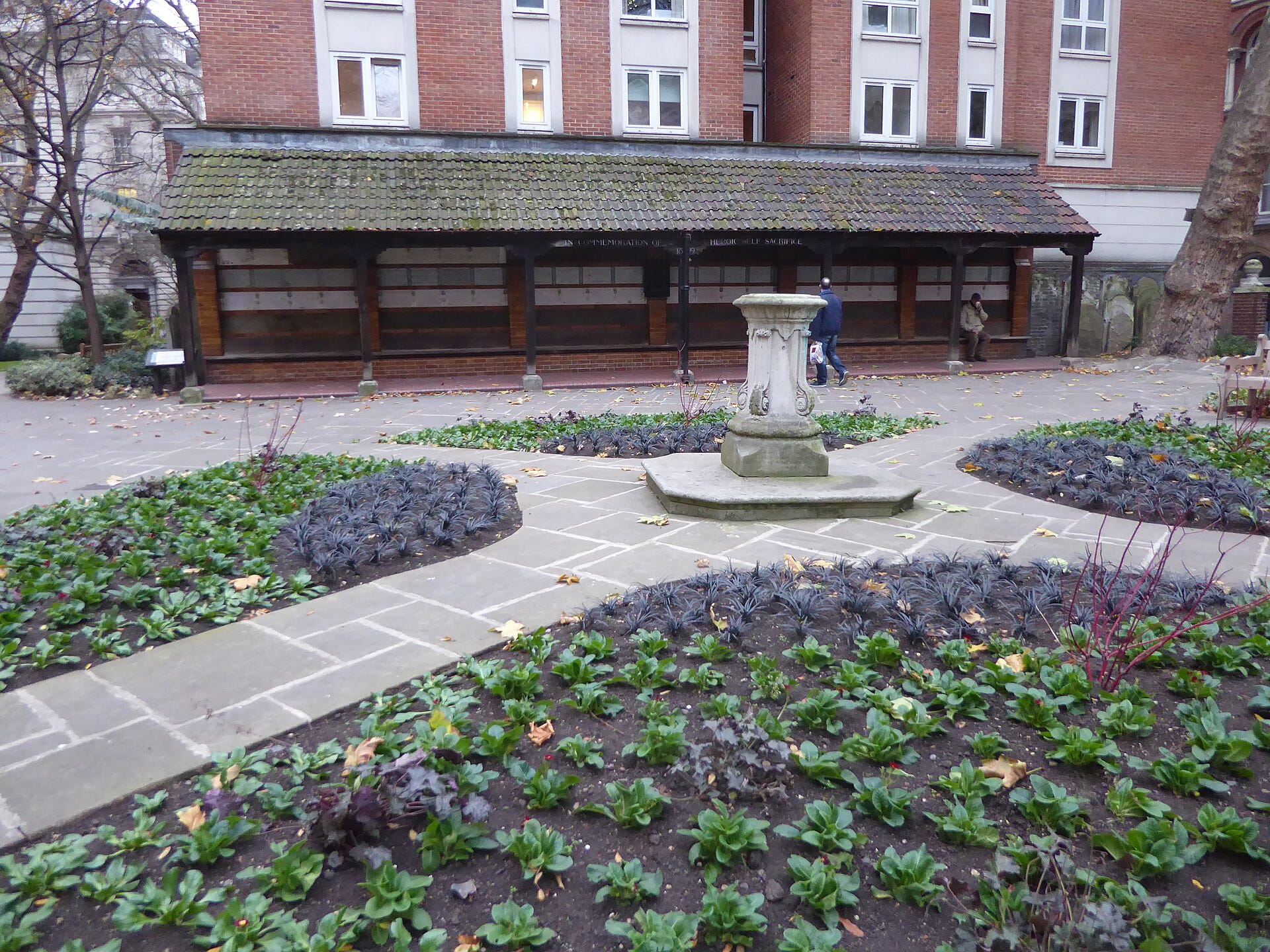
Lining a long brick wall are dozens of beautifully crafted ceramic plaques, each telling the story of an ordinary person who lost their life while trying to save someone else. There are no famous generals, monarchs or celebrated politicians remembered here. Instead, these simple tablets honour children, labourers, nurses, sailors, domestic servants and countless others whose final acts of courage might otherwise have been forgotten.
It is a place that asks us to slow down.
To read.
To reflect.
And perhaps to reconsider what it truly means to be a hero.
Unlike many of London’s great monuments, Postman’s Park does not celebrate victory or power. Instead, it quietly honours compassion, selflessness and the extraordinary bravery that can be found in the most ordinary of lives.
Behind every plaque is a story.
And together, those stories form one of London’s most touching and enduring tributes to everyday heroism.
The story of Postman’s Park begins not with the park itself, but with a remarkable Victorian artist who believed that history had overlooked a very different kind of hero.
George Frederic Watts (1817–1904) was one of Britain’s most celebrated painters and sculptors, renowned for his symbolic works and grand portraits of prominent figures. Yet despite his success, Watts believed that the greatest examples of human character were often found far from the spotlight.
Following the death of Princess Alice in 1878, Watts first proposed the idea of creating a national memorial to commemorate the countless ordinary men, women and children whose acts of courage went unnoticed. While society rightly honoured military victories and public figures with statues and monuments, he questioned why there was so little recognition for those who quietly sacrificed their own lives to save others.
To Watts, these were the true heroes of everyday life.
He imagined a memorial that would preserve their stories for future generations, not through grand sculptures or elaborate monuments, but through simple, honest inscriptions recording acts of selfless bravery.
That vision finally became reality in 1900, when the Memorial to Heroic Self-Sacrifice was unveiled in the newly created Postman’s Park.
The park itself has an interesting history. Rather than being designed as a memorial garden, it was formed during the late nineteenth century by combining the former burial grounds of several city churches, creating a peaceful public space in the densely built-up City of London. It soon became a popular place for employees from the nearby General Post Office to spend their lunch breaks, giving rise to the name by which it is still known today ‘Postman’s Park’.
The memorial found a fitting home here.
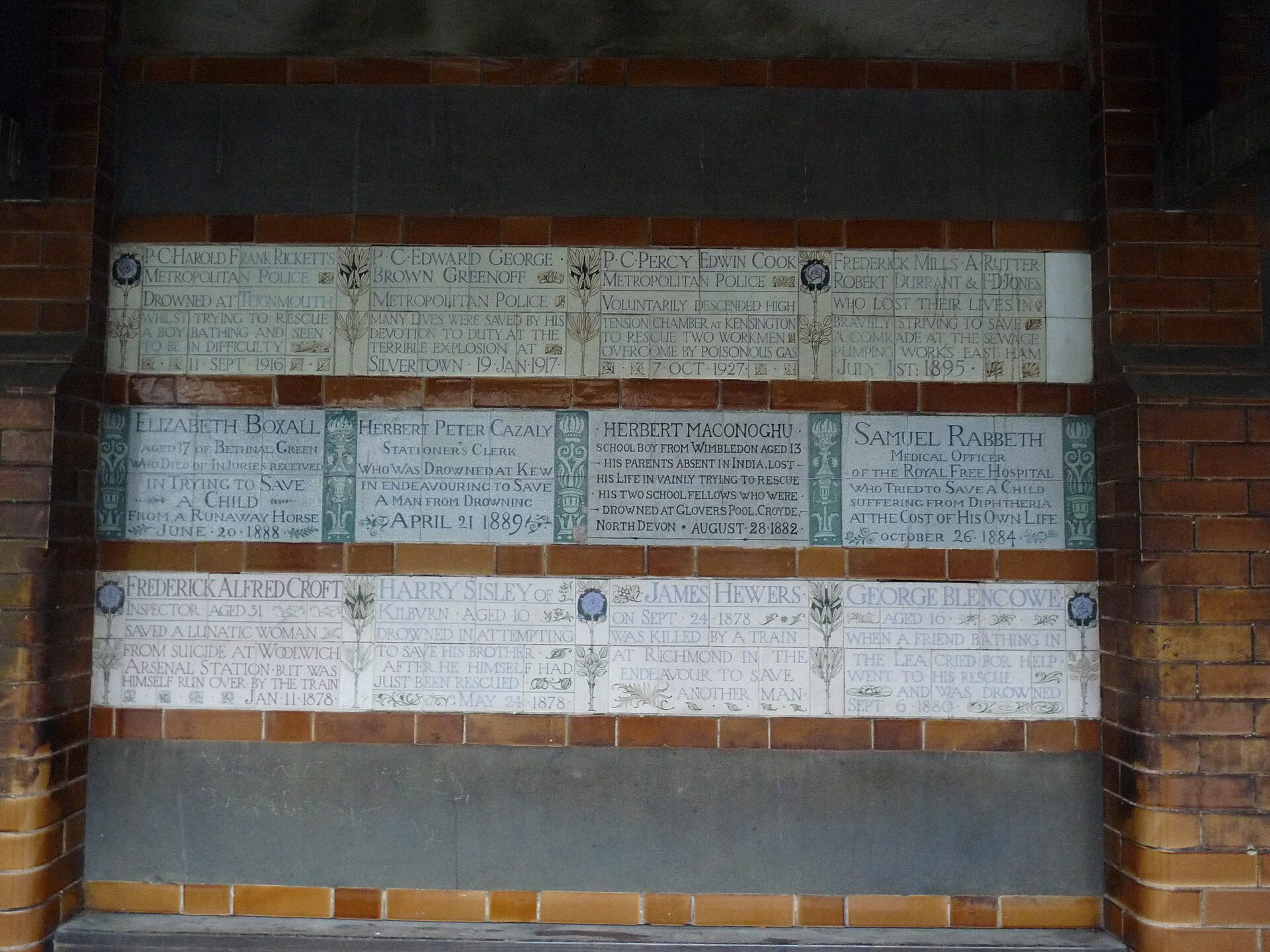
Away from London’s grand ceremonial avenues and famous landmarks, the quiet surroundings reflected the very people it sought to honour: ordinary individuals whose courage had changed lives without expectation of recognition or reward.
When the memorial was officially opened, only four ceramic tablets had been installed. Watts had imagined a much larger wall capable of holding around 120 plaques, each recording another story of remarkable self-sacrifice.
Although he died just four years later, his vision did not end with him. His wife, Mary Watts, continued championing the project, overseeing the installation of many additional plaques and ensuring that her husband’s belief, that ordinary heroism deserved an extraordinary memorial, would endure.
Today, while the memorial remains unfinished in the way Watts originally imagined, that very incompleteness adds to its quiet power. Each ceramic tablet serves as a reminder that history is shaped not only by famous names and great events, but also by countless acts of compassion that might otherwise have been forgotten.
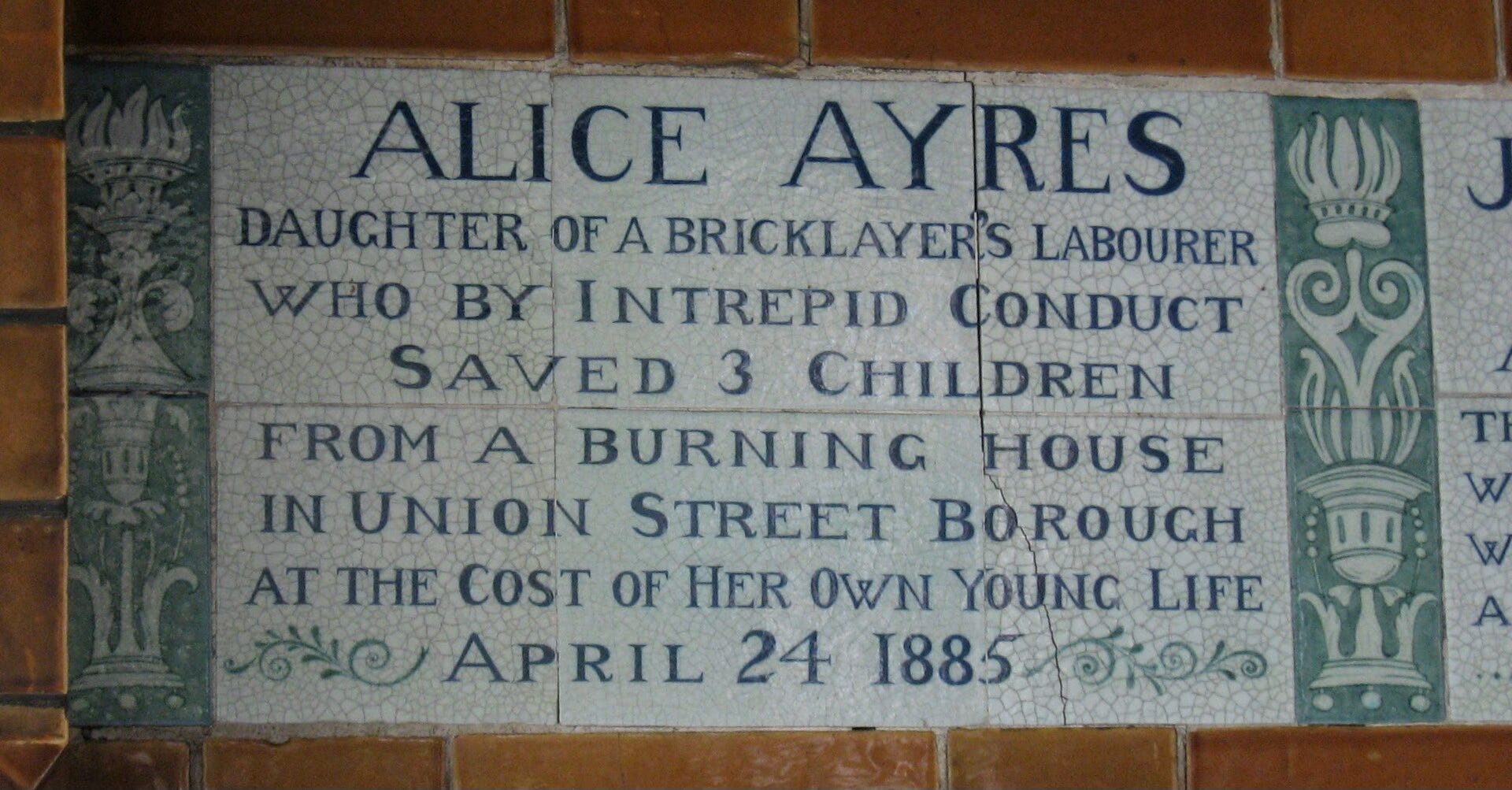
One of the memorial’s best-known names is Alice Ayres, a 26-year-old domestic servant whose courage captured the imagination of Victorian Britain.
On 24 April 1885, a fire broke out at a timber merchant’s shop and home in Union Street, Borough. As flames spread rapidly through the building, Alice found herself trapped on an upper floor with the three young daughters of her employer.
With escape cut off, she carried the children to an upstairs window and, one by one, helped each of them to safety, trusting they would be caught by the crowd gathering below. Having given the children a chance to live, Alice herself attempted to escape. She fell from the window and died from her injuries two days later.
Her story was widely reported in newspapers across the country and became one of the defining examples of Victorian self-sacrifice. In the years since, historians have questioned some of the dramatic details that appeared in contemporary newspaper accounts, but one fact has never been disputed: Alice remained with the children until they were safe, placing their lives before her own.
Her plaque in Postman’s Park preserves not just the memory of her final moments, but the timeless truth that genuine heroism is often found in the quiet decisions made when no one expects recognition.
Not every act of heroism takes place on dry land.
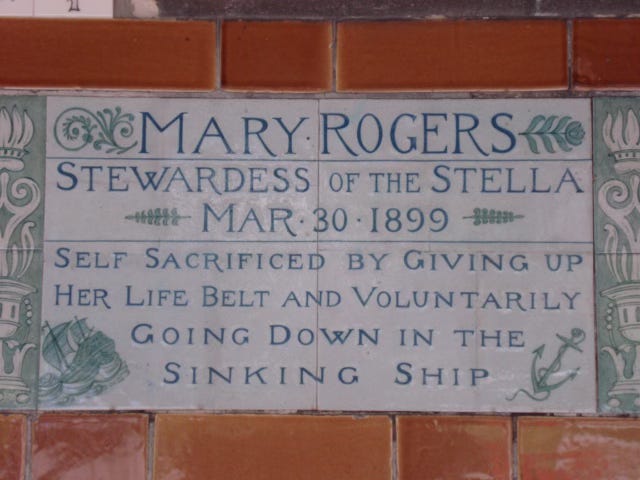
On 30 March 1899, the passenger steamer SS Stella struck the Casquets Rocks near Alderney in the English Channel. The vessel began to sink rapidly, and as panic spread among passengers and crew, lifeboats were launched into increasingly desperate conditions.
Among the crew was Mary Rogers, a stewardess whose first instinct was not to think of her own survival, but of the passengers in her care.
When the opportunity came for her to take a place in one of the lifeboats, she refused, believing it was already dangerously overcrowded. According to eyewitness accounts, she gave her life belt to another passenger and remained aboard as the Stella slipped beneath the waves.
Mary’s final moments were widely reported in newspapers across Britain. One witness recalled hearing her cry, “Lord, save me,” before she disappeared beneath the water.
The loss of the Stella claimed more than one hundred lives, yet Mary Rogers’ quiet courage became one of the tragedy’s enduring stories. Her plaque in Postman’s Park honours not simply the way she died, but the compassion she showed in choosing another person’s chance of survival above her own.
In the midst of confusion and fear, her final act reminds us that true courage is often measured not by the certainty of success, but by the willingness to put others first.
Some acts of courage are born not from experience or training, but from instinct.
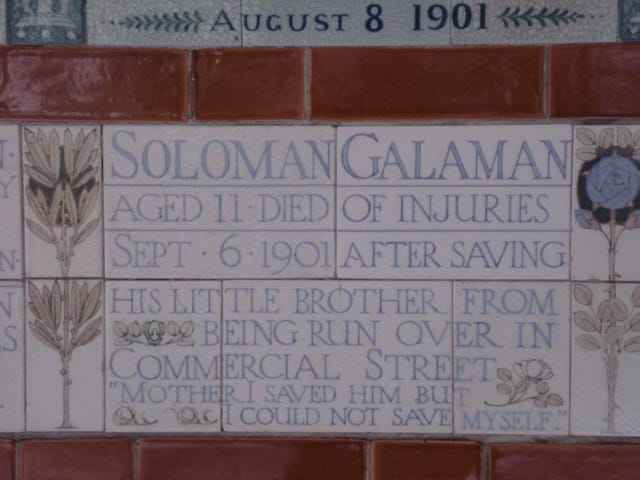
Solomon Galaman was just eleven years old when tragedy struck on a London street in 1894. As he and his younger brother crossed the road, an approaching horse-drawn carriage placed the younger child directly in its path.
Without hesitation, Solomon pushed his brother clear of the danger.
In doing so, he was struck himself.
His younger brother survived, but Solomon’s injuries proved fatal.
The few words recorded on his memorial plaque are among the most moving in Postman’s Park. They simply read:
“Mother, I saved him, but I could not save myself.”
Whether spoken in his final moments or remembered by those who loved him, those words have become inseparable from his story. They capture not only the tragedy of a life cut painfully short, but the instinctive love of an older brother whose only thought was to protect someone else.
Standing before Solomon’s plaque, it is difficult not to pause a little longer. His story reminds us that courage does not belong to age or experience. Sometimes it is found in the simplest of human instincts, the desire to protect those we love, whatever the cost.
Not every act of courage takes place beyond the stage.
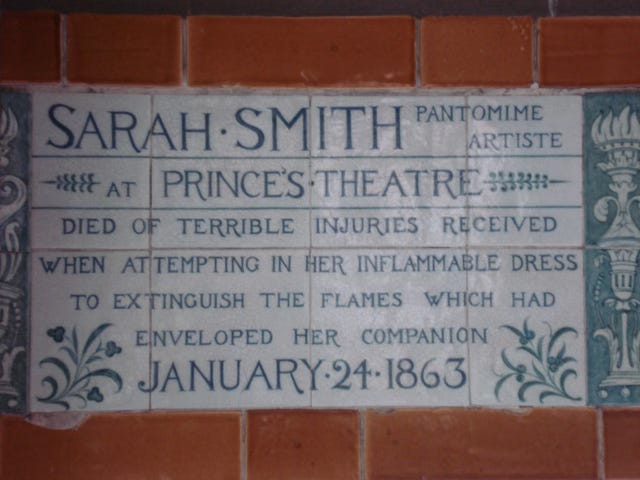
Performing under the stage name Sarah Smith, seventeen-year-old Sarah Gibson was a pantomime artiste appearing in Riquet With the Tuft at London’s Princess’s Theatre in January 1863. During one performance, the elaborate costumes and stage lighting that dazzled Victorian audiences became the setting for tragedy.
As one of her fellow performers, Anne Hunt, became engulfed in flames after her costume caught fire, Sarah instinctively tried to help extinguish the blaze. In doing so, her own highly flammable dress also caught fire.
Both women suffered terrible burns.
Anne Hunt eventually recovered from her injuries, but Sarah lingered in hospital for several days before dying on 28 January 1863, just seventeen years old.
Her memorial plaque in Postman’s Park records only the bare facts of that terrible evening. Yet behind those few words lies the story of a young woman whose first instinct, in a moment of sudden danger, was to help another performer rather than think of her own safety.
There was no audience applause for that final act of courage.
Only a ceramic plaque that continues to tell her story more than a century later.
The final story in this collection is also its newest.
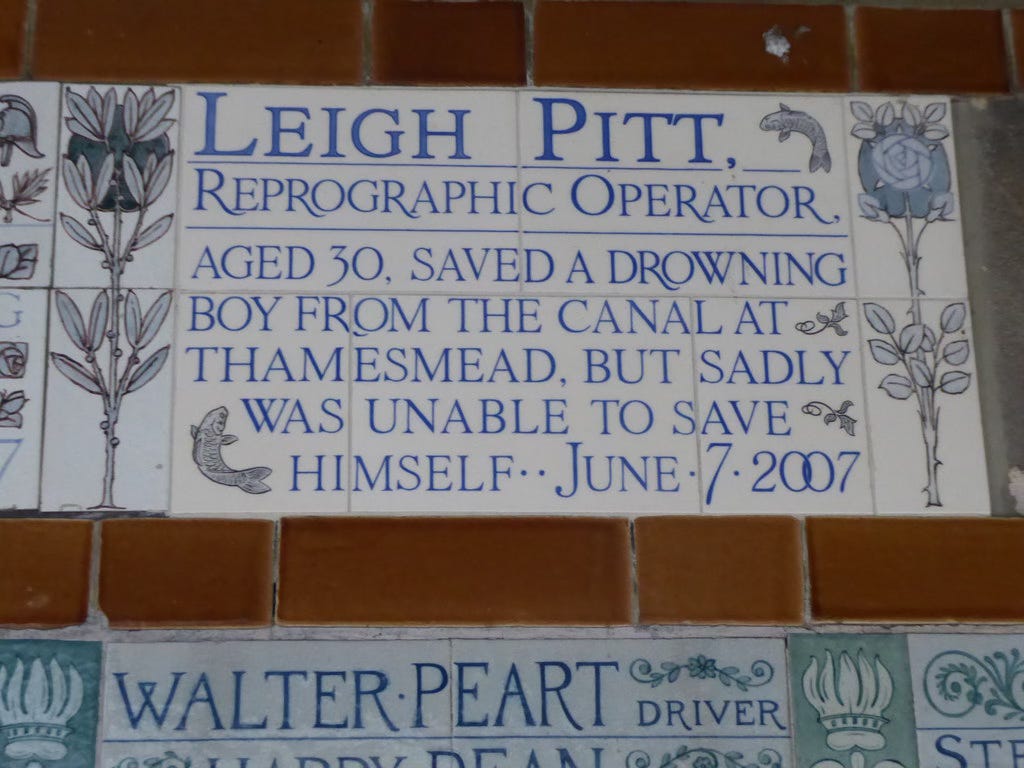
More than a century after George Frederic Watts first imagined a memorial to ordinary heroism, Leigh Pitt became the first person to be commemorated with a new plaque in seventy-eight years, reminding us that acts of selfless courage are not confined to history.
On 7 August 2007, Leigh was walking beside Thames Lock Canal in Essex when he saw a young boy struggling in the water. Without hesitation, he entered the canal and succeeded in rescuing the child.
Leigh, however, was unable to save himself.
He drowned before help could reach him.
In 2009, his name became the first to be added to the Memorial to Heroic Self-Sacrifice since 1931, ensuring that George Frederic Watts’ vision continued into the twenty-first century.
His plaque reminds us that compassion belongs to no single era. The circumstances may change, but the instinct to place another person’s life before our own remains timeless.
Standing before Leigh Pitt’s memorial, visitors are reminded that the wall is more than a record of Victorian courage. It is a living tribute to the enduring capacity for ordinary people to perform extraordinary acts of humanity.
The memorial remains unfinished because courage itself is unfinished.
Walking slowly along the memorial, it becomes impossible to see the plaques simply as works of ceramic craftsmanship. Each tablet represents a single moment when an ordinary life became part of someone else’s story.
Some of the people remembered here saved strangers. Others died protecting family members, friends or those placed in their care. Their backgrounds were different, their ages varied, and the circumstances surrounding each tragedy were unique. Yet they are united by one simple truth: when faced with a moment of extraordinary consequence, they chose compassion over self-preservation.
The memorial does not ask us to compare their courage or measure their sacrifice. Instead, it invites us to pause, to read their names, and to remember that history is shaped not only by those who changed the world, but also by those who changed a single life.
The memorial’s ceramic plaques have become almost as recognisable as the stories they preserve. Their rich colours, hand-painted lettering and beautifully crafted borders catch the eye of almost every visitor, yet few realise that the tiles have a remarkable history of their own.
Many people assume that every plaque was created by the celebrated Arts and Crafts designer William De Morgan, whose distinctive ceramics are admired around the world. While this is partly true, the story is a little more complex.
When the first tablets were installed in 1900, they were produced by William De Morgan’s pottery, whose craftsmanship perfectly complemented George Frederic Watts’ vision of a memorial that was both beautiful and understated. De Morgan’s ceramics were renowned for their rich glazes, elegant lettering and exceptional quality, giving each plaque a quiet dignity that reflected the lives they commemorated.
However, after De Morgan’s pottery closed in 1907, work on the memorial continued using Royal Doulton of Lambeth, whose craftsmen carefully produced later tablets in a style that respected the originals. If you look closely, subtle differences can still be seen between the two makers, though together they form a remarkably harmonious whole.
The memorial itself also remains unfinished.
George Frederic Watts had imagined a much longer wall, capable of recording around 120 acts of heroic self-sacrifice. In reality, only 54 ceramic tablets, commemorating 62 individuals, were ever installed. Following Watts’ death in 1904, his wife, Mary Watts, worked tirelessly to continue the project, but changing priorities and the practical realities of maintaining the memorial meant that the original vision was never fully realised.
Yet perhaps there is something quietly fitting about that.
The unfinished wall serves as a gentle reminder that stories of courage can never truly be completed. Every generation produces its own acts of compassion, sacrifice and quiet heroism. The addition of Leigh Pitt’s plaque in 2009, after a gap of seventy-eight years, showed that George Frederic Watts’ idea was never confined to the Victorian age.
Today, visitors may first notice the craftsmanship of the ceramic plaques, but they rarely leave remembering the tiles themselves.
They leave remembering the people whose stories those tiles were created to preserve.
It would be easy to think of Postman’s Park as simply a Victorian curiosity, a peaceful garden containing a memorial from another age.
Yet spending even a few minutes beside the wall of ceramic plaques quickly changes that impression.
The stories remembered here are not remarkable because they belong to history. They are remarkable because they show us that ordinary people are capable of extraordinary things.
Heroism is often imagined as something extraordinary, reserved for battlefields or moments that alter the course of history. Yet the people commemorated at Postman’s Park did not set out to become heroes.
They were domestic servants.
Children.
Stewardesses.
Performers.
Working men and women.
Ordinary people living ordinary lives.
Then, in a single unforeseen moment, they were faced with a choice.
Again and again, they chose someone else.
That is what makes this memorial so quietly powerful.
It reminds us that courage rarely announces itself in advance. It appears unexpectedly, in a burning house, on the deck of a sinking ship, beside a canal, or in the middle of a busy street. It asks for no recognition and offers no certainty of success. It simply demands a decision.
Perhaps that is why George Frederic Watts’ vision continues to resonate more than a century after the memorial was unveiled.
The names recorded here may never appear in history books, yet the values they represent remain as relevant today as they were in Victorian Britain.
Compassion.
Selflessness.
Kindness.
The willingness to place another person’s life before our own.
In a city filled with monuments celebrating kings, generals and great achievements, Postman’s Park quietly reminds us that history is also shaped by ordinary people whose greatest legacy was a single act of humanity.
Tomorrow, thousands of people will once again walk through the park.
Some will pause.
Some will read a plaque or two.
Many will continue on their way.
But for those who stop long enough to listen, the memorial offers something increasingly rare: a reminder that the measure of a life is not found in fame or fortune, but in the difference we make to others.
It asks us not to remember how these people died, but how they chose to live.
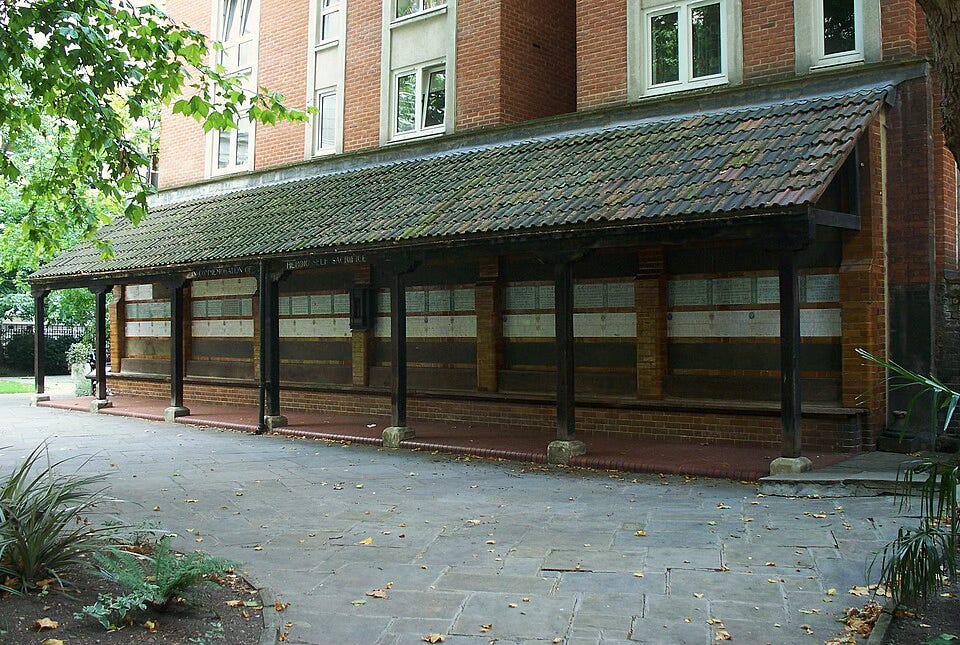
Postman’s Park is tucked away in the heart of the City of London, just a short walk from St Paul’s Cathedral. Surrounded by busy streets and modern office buildings, it remains one of the capital’s most peaceful and contemplative spaces.
The park is free to visit and makes an easy addition to any walk through London’s historic centre. Whether you spend five minutes reading a single plaque or an hour exploring every story along the memorial wall, it is a place that rewards those willing to slow down.
If you do visit, resist the temptation to read every plaque in one visit.
Instead, choose a handful.
Read them slowly.
Pause between each one.
Allow yourself a moment to think about the lives behind the names.
You may arrive expecting to see a memorial.
You’ll leave remembering people.
Have you visited Postman’s Park, or is it somewhere you’d now like to discover?
I’d love to hear your thoughts and reflections in the comments below.
History is all around us—sometimes we just need to slow down long enough to hear it.
I spend a lot of time researching and sharing these family connections, so if this post helped you uncover part of your family story, you can support my ongoing research here:

If you’d like to follow more of my research and stories, you can explore more here:
No posts
Comments
Nothing yet. Say the first thing.
Sign in to join the conversation.