
Sometimes, the smallest details in a record can leave the biggest questions behind.
A single sentence. A name scribbled in the margin. A tiny detail that, at first glance, seems almost insignificant.
And sometimes, more than a century later, that tiny detail refuses to let you go.
In my case, it was a tattoo.
“I Love F. Bevens.”
Those words were written on the military medical examination record of a young man called John Edwin Barnes, when he enlisted in the British Army in 1906.
John wasn’t just another name in my family tree.
He was my great-grandfather.
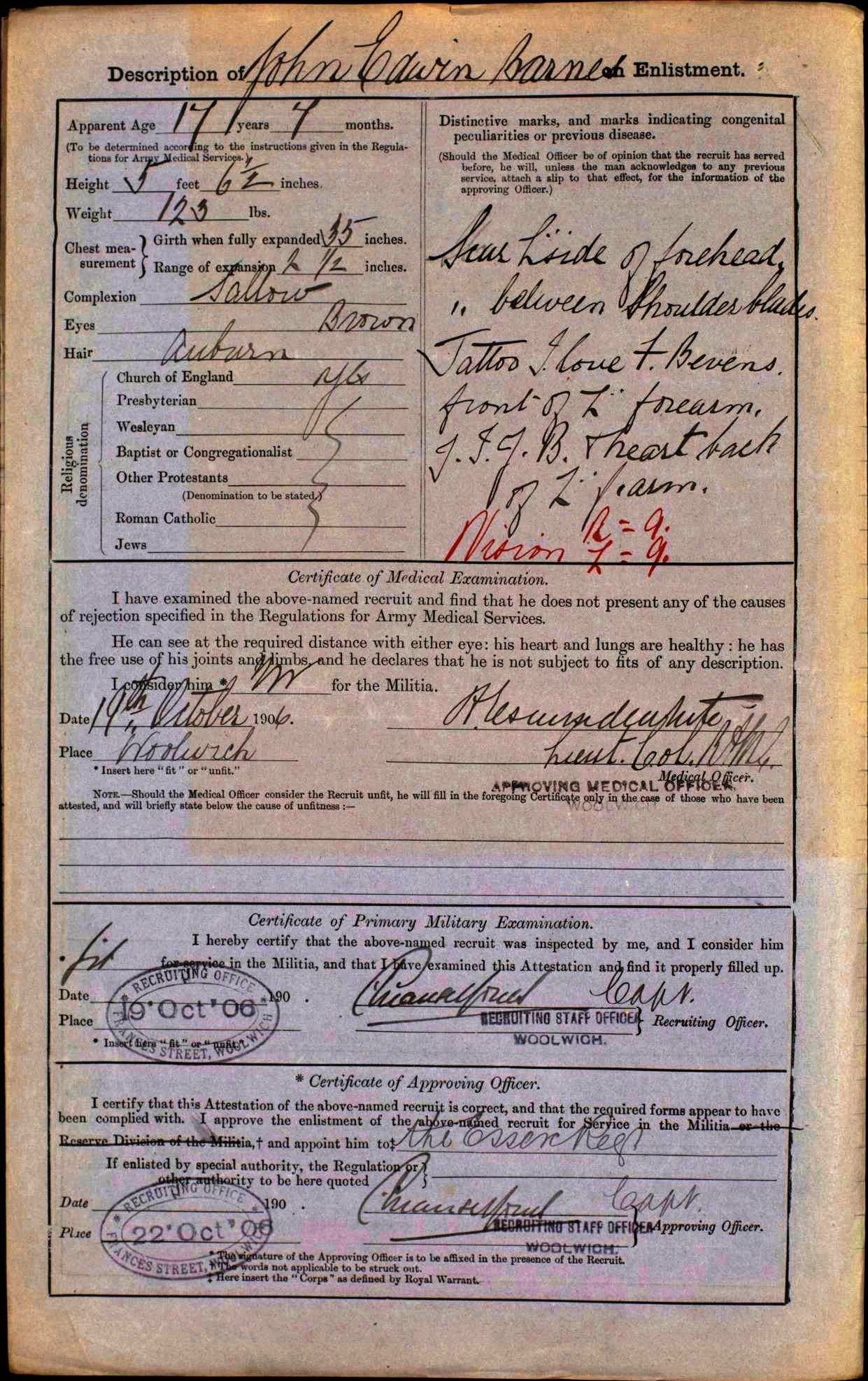
I’ve known about the tattoo for years. In fact, I wrote about John back in 2019, tracing his military career, his family, his service and, as best I could, the life he left behind.
But there was one question I couldn’t answer.
Who was F. Bevens?
Was she a sweetheart? A girlfriend? Someone he hoped to marry? A childhood friend? Or was the tattoo the romantic declaration that it appears to be?
For years, F. Bevens remained just that: an initial and a surname attached to a mystery. Recently, I decided to have another look. I wasn’t expecting to solve it. In fact, I’m still not sure that I have.
But somewhere along the way, a woman began to emerge from the records who fits the clues rather better than anyone I’ve found before.
Her name was Florence Ann Bevans.
And what followed was one of those genealogy journeys that reminds me exactly why I love doing this in the first place.
The starting point for all of this is a rather unremarkable looking Army attestation paper.
John enlisted into the Essex Regiment on 19 October 1906. He was recorded as 17 years and 4 months old, although we now know he was actually a little younger than that. He gave his occupation as a carman, and his address was 66 Hansworth Street, Canning Town.
And then, among the scars and other distinguishing marks recorded during his medical examination, there it was.
“I Love F. Bevens.”
The examiner added:
“front of L. forearm.”
That’s it.
Those words have survived for more than a century and, for years, left me completely stumped. There was no explanation. No surname I recognised. No accompanying letter or photograph. No family story handed down through the generations to tell me who F. Bevens was.
Just those words, permanently written into my great-grandfather’s skin.
I’ve often wondered what possessed a young man to have such a declaration tattooed on his arm. At seventeen, perhaps it seemed like a perfectly sensible thing to do. Anyone who has ever been young, hopelessly smitten and convinced that a particular person will be part of their life forever will understand the sentiment.
Of course, life has a habit of making fools of our certainty.
But was this even a woman?
That was one of the first questions I had to ask.
F. Bevens.
One initial, one surname.
And absolutely no idea who they belonged to.
The obvious interpretation of “I Love F. Bevens” is that F. was a woman John was romantically involved with. But I didn’t want to make that assumption. After all, tattoos don’t always tell the story we think they do.
Could F. Bevens have been a close friend? Someone John had known since childhood? A family member? Perhaps even a nickname or an inside joke between friends? And then there was another possibility.
What if F. wasn’t a woman at all?
John was a young man on the brink of military service, and the tattoo was already on his arm when he enlisted. Could it have been connected to a friend, a fellow soldier or some sort of military association? I considered the possibility of a bet or dare, too. Young men and questionable decisions have been going hand in hand for rather longer than tattoos have existed. Perhaps John and a friend had challenged one another to do something foolish, and “I Love F. Bevens” was the result.
It was possible.
But there was nothing in John’s military records to support it. So I looked elsewhere.
If F. Bevens was somebody locally well known, perhaps he or she was a sporting personality, performer or theatrical figure. Canning Town and the surrounding East End had no shortage of entertainers, sporting clubs and local personalities, and John was living right in the middle of it.
I explored those possibilities too. Again, nothing convincing emerged. There were plenty of people with an initial F. Plenty of Bevens, Bevans and similarly spelled surnames. But finding a name is easy.
Finding a connection is the difficult part.
And that became my guiding principle.
I wasn’t looking for somebody who merely could have been F. Bevens. I was looking for somebody who had a credible reason to have known John Barnes in Canning Town in 1906.
The more possibilities I tested, the more the same problem kept appearing. There was no evidence. No connection to John. No shared address. No family relationship. No military link. Nothing that could take a name from possible to plausible.
So, gradually, those avenues were put to one side.
I was beginning to realise that if I was ever going to solve this mystery, I needed to stop asking:
“Who could F. Bevens have been?”
and start asking:
“Who was actually around John?”
That brought me back to Canning Town. And eventually, back to the census.
The first thing I discovered was that John’s address mattered. As it turned out, it would prove to be crucial.
When he enlisted in October 1906, John Edwin Barnes was living at 66 Hansworth Street, Canning Town. His attestation also tells us that he had been living in the Canning Town area during the preceding year.
So I had my first real clue.
Canning Town. Perhaps F. Bevens was local.
Perhaps he or she was somebody John had known before he joined the Army. Perhaps their paths had crossed through work, family, friends or simply the everyday life of a busy East London neighbourhood.
I started searching.
And, as so often happens with genealogy, the first useful clue didn’t come from the person I was looking for at all. It came from a 1911 census return.
I’d found the Bevans household while searching the area and began looking closely at the names recorded on the page. The census was anything but straightforward. There were names crossed out, additions, amendments and notes written across the entries.
And there, among them, was a name crossed out that caught my eye.
Florrie Bevans
The handwriting wasn’t entirely clear.
My first thought was obvious.
Could this be her?
Was this the mysterious F. Bevens?
At that point, I had no idea.
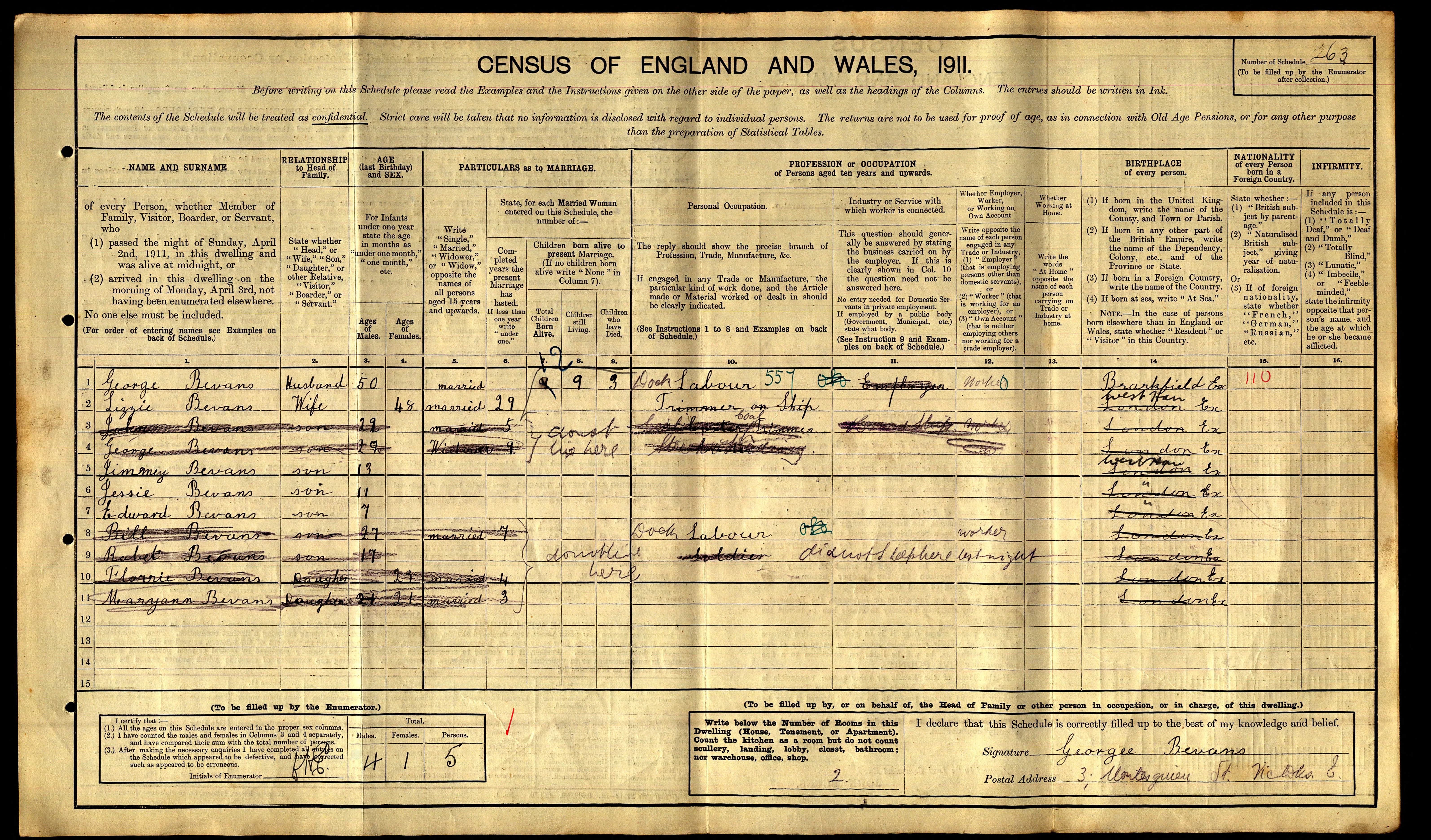
I didn’t know who she was, where she had come from, whether she belonged to the family or even whether I was reading the name correctly. But I had something I hadn’t had before.
A possible person.
So I started pulling at the thread. The more closely I examined the census, the more complicated it became. George Bevans had initially included several people on the return, but some entries had subsequently been crossed out, with “does not live here” written across them.
That was important.
Florrie wasn’t actually living in the household. But if George had thought she should be included, there had to be a reason.
Who was she? And why was she connected to this family?
I could have left it there.
Instead, I did what genealogists do when presented with a problem, I began reconstructing the family on the census.
Who was George Bevans?
Who was his wife?
Who were the children?
Where had they come from?
And that was when the investigation took its first unexpected turn. Because the further I went back, the more I began to realise that Florrie/Florence wasn’t simply a name on a census page. She was part of a much bigger family story.
And somewhere within that story, I hoped, was the answer to the question that had been sitting unanswered on my great-grandfather’s arm for more than a century.
Who was F. Bevens?
The first task was to establish exactly who this George Bevans was. That sounds simple enough. It wasn’t.
The surname immediately began causing problems.
Depending on the record, I found Bevans, Bevins, Bevin, Bavins and, on one particularly creative occasion, something that looked remarkably like Bebins.
This is one of those moments when you have to remind yourself that your ancestors weren’t responsible for how their names were recorded. They didn’t create the indexes we now rely upon.
Someone else did.
And sometimes, someone else’s handwriting can keep a family historian busy for hours. So I stopped searching for one perfect spelling and started following the people instead.
The first important piece fell into place when I found the marriage of George Bevans and Elizabeth Wilson in 1882. That was significant.
I now had a family name, a wife, a place and, crucially, a maiden name.
Wilson.
From there, the children began to emerge from the records.
George Robert.
Robert James.
James Robert.
Jessie.
Edward John.
The spellings continued to change, but the underlying family remained remarkably consistent. And then I came across something that made me look twice.
There was a Florence.
Not simply a Florence with the right surname, but a Florence who appeared to belong to this same family.
The date wasn’t quite what I had expected. Earlier research had contained a tantalising reference to “Flossie? 1888”, while the records I was now finding pointed towards a birth around 1886.
Close enough to be interesting.
Not close enough to be conclusive.
But genealogy is often about recognising when a clue deserves another look. So I followed Florence. Her records began to give me something I hadn’t had when I first saw that crossed-out name on the 1911 census.
A full name.
Florence Ann Bevans. And then came another piece of the puzzle. Her birth record gave her mother’s maiden name as Wilson.
That connected her directly back to the family I had just reconstructed.
George Bevans.
Elizabeth Wilson.
Florence Ann.
The pieces were beginning to fit. But I was still deliberately resisting the temptation to declare that I had found my answer. After all, Florence was a common enough first name, and Bevans was only one of several spellings I had encountered.
I needed more.
I needed to know what happened to this Florence. Was she really the same young woman who had appeared, albeit crossed out, on the 1911 census? And, more importantly, could she possibly have been the F. Bevens whose name had been permanently written onto my great-grandfather’s arm?
The trail had brought me this far. Now it was time to follow Florence’s life and see where it led.
With Florence now firmly attached to the Bevans family, the next step was to see what happened to her. This was where the trail became much more interesting.
The first significant record was her 1907 marriage.
On 8 September 1907, Florence Ann Bevans married Charles James Rayment in Canning Town. She was recorded as 21, and her father was named as George Bevans.
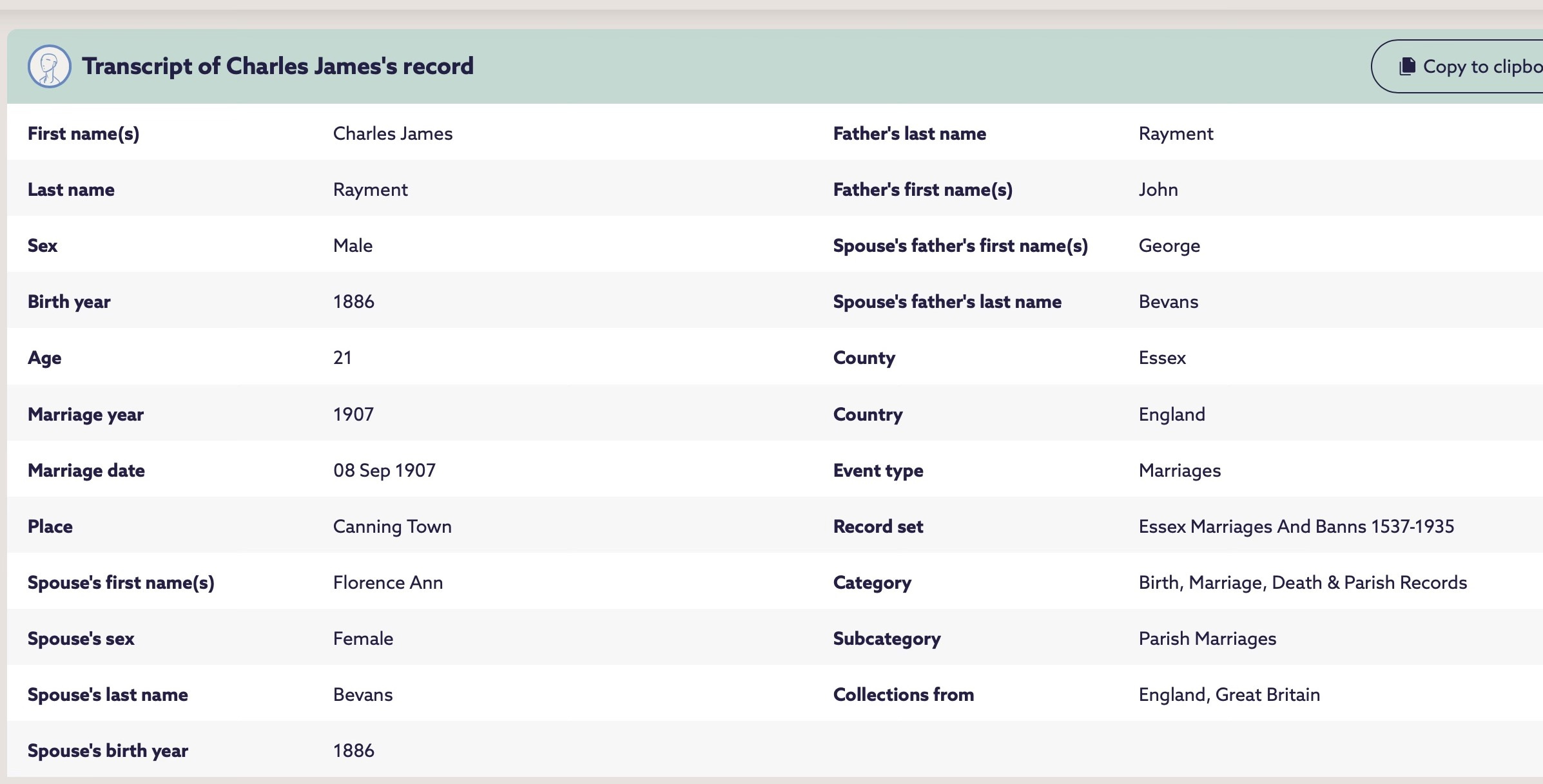
I remember looking at the date and immediately doing the arithmetic. John’s tattoo had been recorded on 19 October 1906. Less than eleven months separated the two events.
That was certainly interesting. But it was still only circumstantial.
A marriage record doesn’t tell us who somebody loved before they married. It certainly doesn’t tell us who might have had their name tattooed on an arm. So I resisted the temptation to jump to conclusions and carried on following Florence.
The 1911 census provided another useful piece of the puzzle. Florence was now living as Florence Rayment, with her husband James, at 28 Scott Street, Canning Town.
That was important for another reason.
It confirmed that the Florence we’d been following hadn’t simply disappeared after her marriage. She was still there, still in the same general part of East London, and now living under the surname Rayment. The 1921 census took us a little further. Florence was still living with James and their children, and her birthplace was recorded as Canning Town.
Then came the 1939 Register. This gave me a precise date of birth. 5 May 1886. And finally, the death index. In 1973, Florence Ann Rayment died in Essex at the age of 87. Her recorded date of birth was once again:
5 May 1886.
By this point, I was no longer dealing with a name that merely happened to fit. I had a woman whose life I could follow. Born Florence Ann Bevans. Daughter of George Bevans and Elizabeth Wilson. Born in the right part of East London. Unmarried at the time John enlisted. Married in Canning Town less than a year afterwards. And then traceable through the records for more than six decades under her married name.
The evidence was beginning to look remarkably persuasive. But there was still a problem. None of those records actually mentioned John Barnes. And that mattered. Because I wasn’t trying to prove that Florence Ann Bevans existed. I’d already done that.
I was trying to answer a much more personal question. Was she the woman John meant when he had those words tattooed on his arm?
That was where the evidence became much thinner. And it was time to stop looking at Florence for a moment and go back to John.
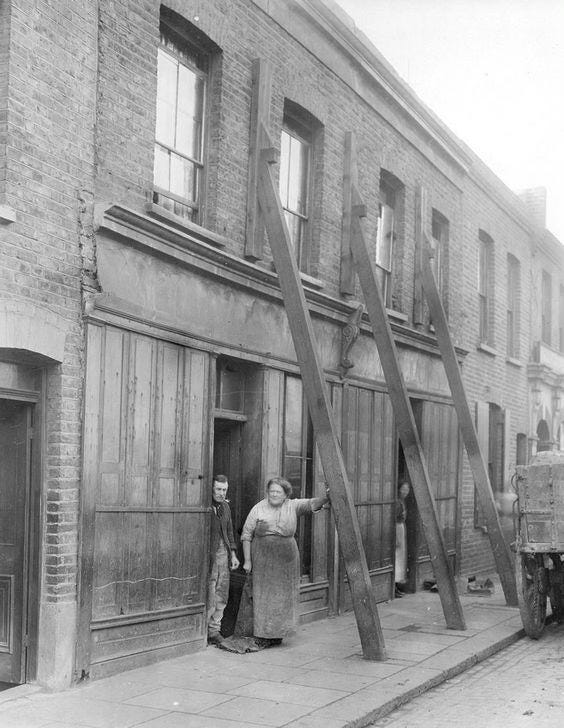
I now had a very plausible candidate for F. Bevens.
But genealogy isn’t about collecting pieces that fit and ignoring the ones that don’t. So I went back to John.
The first thing I kept coming back to was that address:
66 Hansworth Street, Canning Town.
John wasn’t simply recruited in the area. His attestation tells us that he had been living in Canning Town during the preceding year. That was important. Because Florence was from the same part of East London.
John was living at 66 Hansworth Street, while Florence would later be found living with her husband at 28 Scott Street, both addresses in Canning Town, within the same tightly packed docklands community. And John wasn’t living there as a soldier. He was a young civilian, working as a carman, before he enlisted.
So, for at least part of 1905 and 1906, we have two young people living in the same East London neighbourhood.
John was about seventeen.
Florence was about twenty.
And somewhere during that period, the words “I Love F. Bevens” found their way onto John’s left forearm. Could that be a coincidence? Of course it could.
Canning Town was a busy, densely populated place. Thousands of people lived and worked there. Simply being in the same neighbourhood doesn’t prove that two people ever met.
But the pieces were starting to form a pattern. There was another detail I found particularly intriguing. When John enlisted, Florence was still Florence Ann Bevans. Her marriage to Charles James Rayment came less than a year later.
If the tattoo really was a declaration of love, the timing suddenly seemed rather poignant.
Perhaps John had fallen for a young woman who eventually chose somebody else.
Perhaps Florence had never felt the same way.
Perhaps the relationship had ended before it ever had the chance to become anything more.
Or perhaps the tattoo meant something completely different. That’s the frustrating thing about historical records. They are very good at telling us what happened.
I could establish where John lived.
I could establish where Florence came from.
I could establish when she married.
I could establish that the tattoo existed before that marriage.
What I couldn’t establish was whether John and Florence had ever actually met. And that was the point at which I had to make a decision. I could keep searching indefinitely, hoping that somewhere in some obscure archive there might be a letter, a photograph, a newspaper report or a family connection that finally gave me the answer.
Or I could step back and ask a more difficult question.
How much evidence is enough?
Because sometimes, in family history, the answer isn’t hiding in another record. Sometimes we’ve simply reached the edge of what the records can tell us.
I don’t think I have solved the mystery of F. Bevens. And I’m comfortable saying that.
There is no document that says “Florence Ann Bevans was the woman John Barnes loved.” No letter, no photograph, no diary entry and no family story has appeared to give us that final piece of certainty.
What we do have is something rather more interesting than a simple name match.
We have a young man called John Edwin Barnes, living in Canning Town, who had the words “I Love F. Bevens”tattooed on his arm before enlisting in 1906.
We have Florence Ann Bevans, born in the same East London world, the daughter of George Bevans and Elizabeth Wilson.
We have the right initial.
We have the right surname, allowing for the spelling variations so common in historical records.
We have the right period.
We have the same Canning Town connection.
We have Florence unmarried when John’s tattoo was recorded, followed by her marriage less than a year later.
None of those things, individually, proves anything. Together, however, they form a compelling circumstantial case. Is it enough to say that Florence was F. Bevens?
No.
Is it enough to say that she could have been?
Absolutely.
And, after all these years of wondering who that mysterious initial belonged to, Florence Ann Bevans is by far the strongest candidate I have found.
Perhaps that is as close as I’m ever going to get.
Maybe somewhere, buried in an archive I’ve never found, there is a letter that would settle the matter in an instant. Perhaps there is a family photograph with John and Florence standing somewhere together. Perhaps a descendant has a story that has been passed down through the generations.
Or perhaps none of those things ever existed.
Maybe John simply carried the memory of Florence with him into the Army, along with a tattoo that seemed like a good idea when he was seventeen.
We will probably never know for certain.
But there is something rather wonderful about that. Because when I first looked at those words, F. Bevens was nothing more than an initial and a surname.
Now she is Florence Ann Bevans.
She has a family.
A birthplace.
A marriage.
Children.
A long life.
And a story that has survived more than a century. Perhaps Florence really was the woman John loved. Perhaps she wasn’t.
But for the first time, F. Bevens has become a person rather than a mystery. And perhaps that is what family history does best.
We don’t always find all the answers. Sometimes, we simply bring the people behind the records back into view. And sometimes, that’s enough.
I spend a lot of time researching and sharing these family connections, so if this post helped you uncover part of your family story, you can support my ongoing research here:

If you’d like to follow more of my research and stories, you can explore more here:
No posts
Comments
Nothing yet. Say the first thing.
Sign in to join the conversation.