
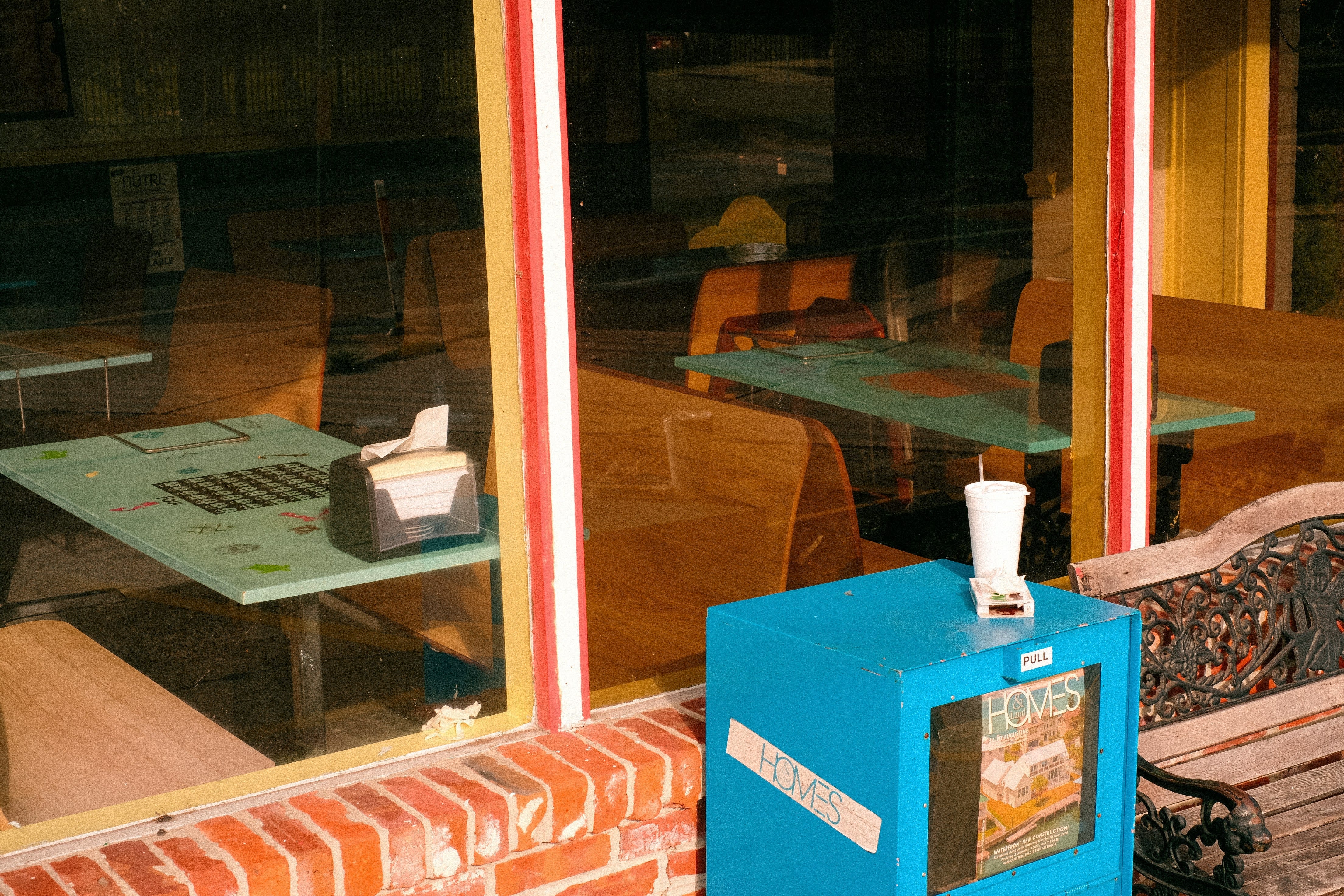
Photo Courtesy of Jackson Conner on UnSplash
“It’s so bright in here,” the woman said. “Doesn’t it hurt your eyes?”
The counterman, adjusting dirty dishes in a tub below the counter, looked up and around as if just noticing that it was indeed bright in the diner.
“You get used to it,” he said.
“But why does it have to be so bright?” she asked.
“I guess it’s supposed to be inviting,” the counterman said, standing up and putting his hands on his hips. “Let’s folks know we’re open.” He gazed out the large plate glass windows overlooking the deserted city corner.
The woman’s companion blew smoke from his cigarette towards the ceiling. “Ruthie, you worry about the queerest things,” he said with some derision wrapped in a chuckle.
She hunched her shoulders slightly and tucked a rope of orange hair behind her ear.
The counterman, satisfied the issue had been settled, shrugged, flipped a small white towel over his shoulder and turned to the only other patron, a man a few seats down from the couple. “You want some more coffee?”
The man smiled and nodded, pushing his mug towards the counterman who scooped it up and strode to the two large samovars in the corner, a bounce in his step.
“It’s for public safety,” the man said.
“How’s that?” the woman’s companion asked, pushing his hat back on his head a bit.
“All this,” the man said, looking up at the lighting fixtures. “It throws light out onto the sidewalk. Makes the neighborhood safer.”
The woman shifted on her stool to see out the window behind the man. The wide sidewalk was bathed in light.
Her companion turned around and surveyed the empty scene behind him. The furniture store on the other side of the street was closed up and dark. The same was true for the windows of the apartments on the second floor, but the narrow sidewalk beside the diner was well illuminated.
“I never really thought about that,” the counterman said, giving the spot in front of the man a cursory wipe as he set the full coffee mug down.
“I guess you’re right, mister,” the woman said.
The man raised his mug towards them and took a sip as the counterman disappeared into the kitchen. The buzz of the lights, now with an extra purpose, washed over the three customers.
The counterman returned placing ketchup bottles at intervals below the counter.
“Were you folks at the pictures?” he asked, directing the question to the woman.
“Theater,” her companion said.
The woman perked up.
“My little sister is in ‘By Jupiter,’” she offered.
“Is that right?” the counterman said.
“At the Schubert Theater?” the man asked.
“That’s right,” the woman said, sitting up even straighter. “It’s not a big part or anything, but she makes the most of it.”
“I bet she does,” the counterman said, wagging his head.
The companion exhaled more smoke towards the ceiling. “As talented as she is, Ruth here has more talent in her pinky,” he said.
“Is that right?” the counterman repeated.
“Oh no,” she said. “I can sing some, but Syd, my sister, she sings and dances.”
“Nonsense,” her companion said. “Remember what the paper said about you in ‘Anything Goes.’”
“You were in ‘Anything Goes?’” the man asked.
“You were in the paper?” the counterman added.
“Not here. Back in Indiana,” she explained, her cheeks turning the color of her dress.
The two men exchanged a quick glance.
“Don’t let that fool you, fellas,” the companion said. “‘A mesmerizing performance by newcomer Ruth Kovitz. Remember you saw her here, because it won’t be long before Miss Kovitz is known around the world.’ That’s what they wrote,” he said, punctuating the sentence in the air with his cigarette. “In the Indianapolis Star!”
The counterman let out a long whistle.
“They didn’t say ‘around the world,’” she said.
“What did they say?” her companion challenged, angling his square jaw at her.
“I don’t remember.”
“Yes you do. What was it?”
“A household name,” she whispered.
“A household name!” her companion thundered, banging the counter hard enough to make the napkin dispensers wobble.
“What’s your name again?” the man asked.
“I’m not a household name,” she said sheepishly.
“Not yet, doll. But someday,” her companion said.
“Sounds very nice,” the man said to just her.
“You can say that again, mister,” her companion said. “Ruthie’s gonna be a star. Brightest one in the night sky! With so much talent she’ll make everyone’s head spin.”
“Stop, you’re embarrassing me,” she said.
“Ruthie, you gotta get used to people looking at you. You aren’t in Owensville anymore, this is New York City. Next stop, Hollywood, and your face is going to be plastered all over magazine stands and outside theaters. People will ask for your autograph, and you’ll be on the radio programs—“
“Well, we’ll deal with that when the time comes,” she said, tucking her hair behind her ear.
“In fact, I’m gonna go call Mr. Silvestri right now,” he said, rapping the counter again.
“It’s so late, don’t.”
“It’s only eleven there, doll,” he said, patting her arm. Turning to the other two he added, “Her agent in Hollywood. You got a public telephone?”
“Back there,” the counterman said, pointing to a yellow door with a small square window at the far end of the diner.
“I’ll be right back. You want anything else, doll?”
She shook her head and he kissed her hard on the cheek. He jangled the change in his pocket, then softly said to her, “Settle up this bill, will ya, doll?”
She blushed and he headed back to the phone.
The woman didn’t know what to do with her hands now and she moved them from the counter to her lap and back again.
“He’s not my agent,” she said. “He just said when I get to California he’d introduce me around.”
“Is that right?” the counterman said.
She nodded, but the counterman didn’t see, he had already moved on to his next chore. She took a small compact out and looked at her cheek where her companion had kissed her, smudging her makeup.
“Ruth Kovitz,” the man said, trying her name out.
She smiled at him as she put the compact back and pulled out a five dollar bill.
“I could change it,” she said. “If it would make a difference.”
The man shrugged, took a sip of coffee, and eyed the cash she had placed on the counter to pay for her coffee and pie and her companion’s meatloaf plate.
“It may be too ethnic, you know?” she explained.
“Who told you that, a guy named Silvestri?”
“I guess it’s different for actresses,” she said quietly.
The man scoffed. “Well, I’m off,” he said, rising and putting three quarters and a dime on the counter.
“Good luck, Miss Kovitz,” he said, tipping his hat.
“Thanks, mister,” she said.
He nodded and headed for the front door, stopping to look through the small window leading to the phone. Her companion was leaning against the wall, hat pushed back on his head, taking a long pull from a small flask. He wiped his lips with the back of his hand.
The man looked back at the woman. She was staring at a spot on the counter next to her coffee mug, waiting for her change.
“Hey, Ruth Kovitz,” he called.
She looked up at him.
“You be careful, okay?”
She smiled, then looked at the door leading to the public telephone and her face fell a little. A small sigh escaped her. She looked back at the man and nodded. “I will.”
He tipped his hat again and stepped out of the diner onto the brightly lit sidewalk.
Ruth watched him cross the street and recede into the darkness of the city.

A native New Yorker, Michael has lived in Northern Virginia since the turn of the century. His fiction has appeared in The Whisky Blot and After Dinner Conversations. Since 2006, he has run a local writers group that meets weekly and he co-hosts a monthly writing podcast, “Work in Progress,” with two group members.
No posts
Comments
Nothing yet. Say the first thing.
Sign in to join the conversation.