
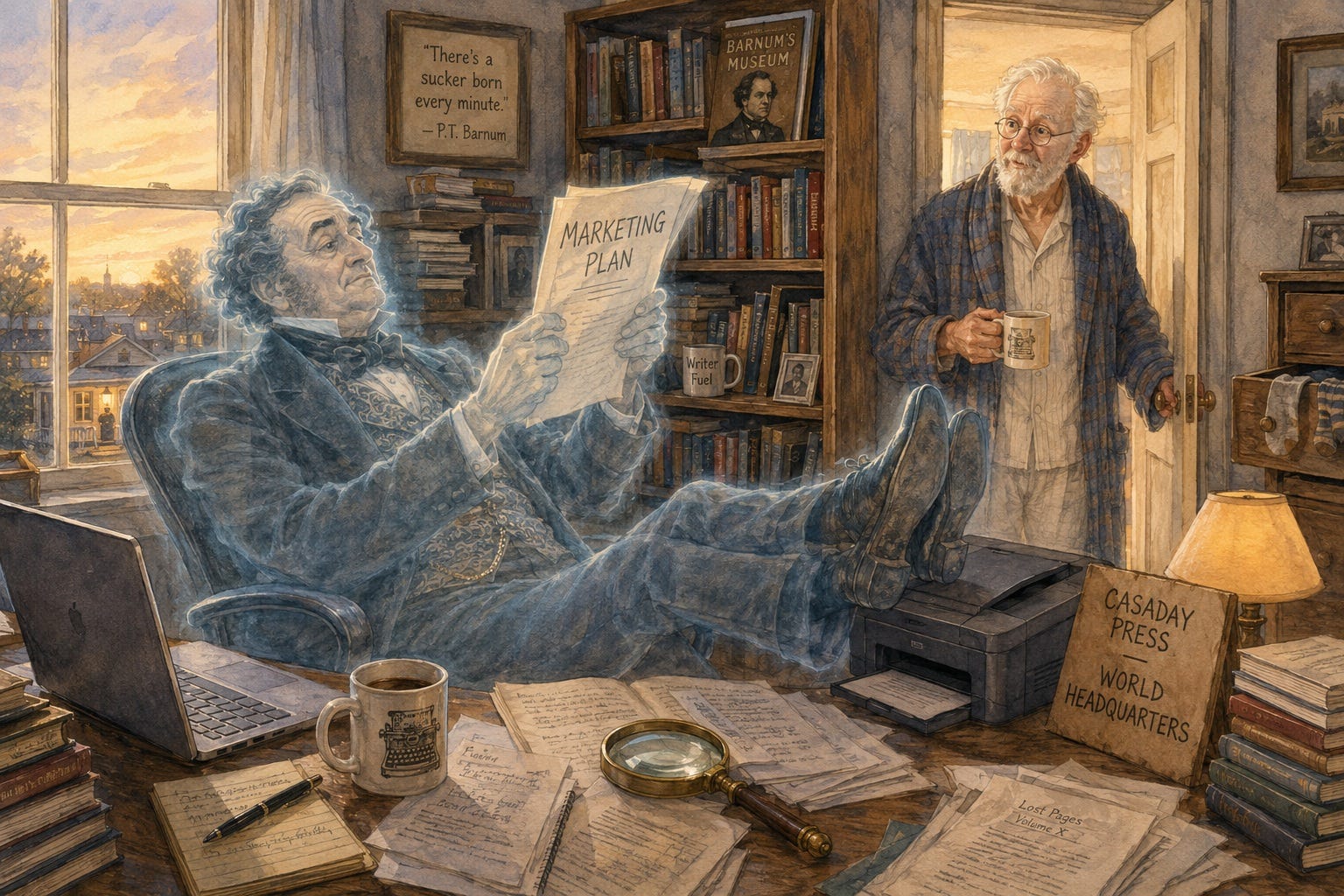
Last Friday, around six in the morning, I shuffled into the back bedroom with my coffee and found P.T. Barnum sitting in my desk chair, reading my marketing plan.
He had his boots up on my printer. He was spinning slowly in the chair, a dead man discovering ball bearings is a sight I won’t soon forget, and he held all nine pages of the plan at arm’s length, the way you’d hold a fish that had gone bad a week ago.
“Seventy-three subscribers,” he said, by way of good morning.
“Seventy-four,” I said. “Roger signed up Thursday.”
He looked at me over the top of the pages the way my seventh-grade teacher Sister Mary Amata used to look at boys who’d forgotten their homework, which is to say with sorrow refined into a weapon.
Now, before we go further: yes, I know P.T.’s dead. Died in 1891, in Bridgeport, Connecticut, reportedly after asking about the day’s ticket receipts at his own circus, which tells you most of what you need to know about the man. I’ve reached the age where the dead drop by without calling first, and I’ve stopped apologizing for it. If that’s not the way it happened, that’s the way it should have happened.
Anyway. He’d found the plan. And he’d found my book.
“Fifty-seven dead witnesses,” he said, tapping the pages. “You wrote a book, sir, in which fifty-seven deceased persons of distinction are invited to sit in judgment of your life. Poets. Psychoanalysts. A Kennedy. That woman who informs you your chapter was homework.”
“Nora Ephron.”
“And in this vast assembly of the departed, this museum of the dead, this greatest gathering of posthumous opinion ever assembled under one spine, you did not think to invite the one man in American history who could have SOLD it?”
The chair had stopped spinning. His voice had the volume of a brass band with five too many horns.
“It wasn’t that kind of book,” I said.
“There is no other kind of book!” He stood up. Dead men stand up faster than you’d think. “A book unsold is a letter unmailed! I moved five hundred thousand copies of my own life story. I priced it cheap on purpose, sir, a dollar and a half, because I understood what you apparently do not, which is that a book is not furniture. It does not appreciate in a drawer.”
I sat down on my spare office chair because it was six in the morning and I was being lectured on publishing economics by a man who once exhibited a mummified monkey sewn to a fish tail and called it a mermaid.
I mentioned the mermaid.
“The Feejee Mermaid,” he said, with dignity, “was a question. I posed it to the public and let them pay a quarter to argue about the answer. They got a full morning’s entertainment and a story to tell at supper. Name me one purchase you’ve made lately that performed as well.” He pointed at my $19.95 flip phone on the desk, and I confess I had no rebuttal.
“Besides,” he went on, “I never said it.”
“Said what?”
He pointed at the framed quote over my bookshelf, the one I bought at a flea market in New Orleans back in 1977 for three dollars because it made me laugh.
"That," he said. "You have it on your wall, sir. Attributed. Framed. I've been staring at it since five-forty." Then he said the words themselves — "There's a sucker born every minute" — and he pronounced them the way you'd handle somebody else's used handkerchief.
“A rival pinned that on me, and the press ran with it, because the press could no more resist a good line than a moth can resist a porch light. I never held my audiences in contempt, sir. Contempt is the one economy that always goes broke. My entire method, write this down, was to give the people more than they paid for, so they’d forgive me the humbug and come back with their cousins.”
And here’s the part I have to admit because this newsletter has a strict honesty policy that I occasionally regret instituting: the advice was good.
It kept being good. He went through my marketing plan page by page like a favorite uncle scrutinizing a nephew’s report card. The parts I was proudest of — the dignity, the restraint, the no-hype rule — he read aloud in a voice a doctor would use to announce a herpes diagnosis.
“You’ve written here,” he said, “and I quote: no manufactured urgency. Sir, your book about mortality was written by a seventy-eight-year-old. The urgency is not manufactured. It’s the one piece of inventory you’ve got that I never did.”
“That’s ghoulish.”
“That’s arithmetic. I died asking about ticket receipts. I know the difference.”
I tried my best marketing objections on him. I told him self-promotion is undignified. He said dignity is a fine suit, but the only occasion it’s truly required for is the one where they close the lid. I told him I’m a writer, not a salesman. He said, “So was I. The autobiography, sir. Also two newspapers and a lecture called The Art of Money Getting, which I delivered roughly one thousand times, mostly to pay off a clock company.” I told him the book would find its readers.
He got quiet for the first time.
“No,” he said. “It won’t. That’s the one lie in this room, and I’ve kept professional company with lies my whole career, so I’d know. Books don’t find readers. Readers get told.“
***
Phineas straightened in my desk chair, and all the brass went out of him, and for a minute he was just an old man in a home office with another old man, at the hour of the morning when truth walked around in its bathrobe.
“Why does a man write the best book of his life,” he said, “and then whisper?”
I gave him my answer. It’s the same answer I’d give you, so you might as well have it too: because asking feels like begging. Because I spent twenty-four years in a classroom telling teenagers their work was good enough for others to read, and sixty years at a keyboard declining to believe it about my own. Because if you never ask, nobody ever tells you no, and a man can live a long time, seventy-eight years, as it turns out, on the strength of an unasked question.
Barnum heard all that out with his hands folded, patient as a pallbearer.
“I went bankrupt in 1856,” he mused. “A clock company took everything: the museum, the house, the name. And I climbed out of that hole one lecture at a time, standing on stages asking. So attend me closely, because I paid full price for this and you’re getting it free, which is fitting: Begging is asking for something in exchange for nothing. You are offering the best book you ever wrote for the price of a review and a forwarded letter. That’s not begging, sir. That’s commerce. And honest commerce is just a conversation where both parties leave richer.”
The window was going gray with morning. Somewhere down the street a dog was making its opinions known. The rooster herding his hens in the backyard of the house next door crowed.
“You won’t say it,” he said. “I can see that. Very well.” He stood, buttoned his coat, and turned to face the room the way I imagine he used to face a full house in Bridgeport. “So I’ll say it.”
And then Phineas Taylor Barnum, the Prince of Humbugs, dead one hundred and thirty-five years, cleared his throat and said:
“Ladies and gentlemen. The man behind me has written a book called Wicked Imagination, in which fifty-seven dead souls examine his life and do not spare him. I’ve read it. The dead read fast, it’s the one perk. It is the strangest and truest thing he’s ever done, and TODAY and TOMORROW ONLY, it costs nothing. Free. A price, I’ll say plainly, that offends me to my professional core, but there it is. Take ruthless advantage of the old fool. Download it this morning. And when you’ve read it, leave an honest review at Amazon. Mark me, I said honest; flattery is humbug and the man needs evidence that living people read it, not applause. And if this letter gave you more than you paid for it, and you paid nothing, so the bar is on the floor, forward it to one cousin. One. I built an empire on cousins.”
He left the way he came, which is to say I looked down at my coffee and when I looked up the chair was spinning slowly and the room smelled faintly of cigars and ambition.
The story of my life is free today and tomorrow. The link’s right below.
Lord love a duck. I just asked.
— Chet
P.S. — P.T. says he’s coming back Thursday to review the download numbers, whatever they turn out to be. I’ve decided to let him. Pray for me.
No posts
Comments
Nothing yet. Say the first thing.
Sign in to join the conversation.