
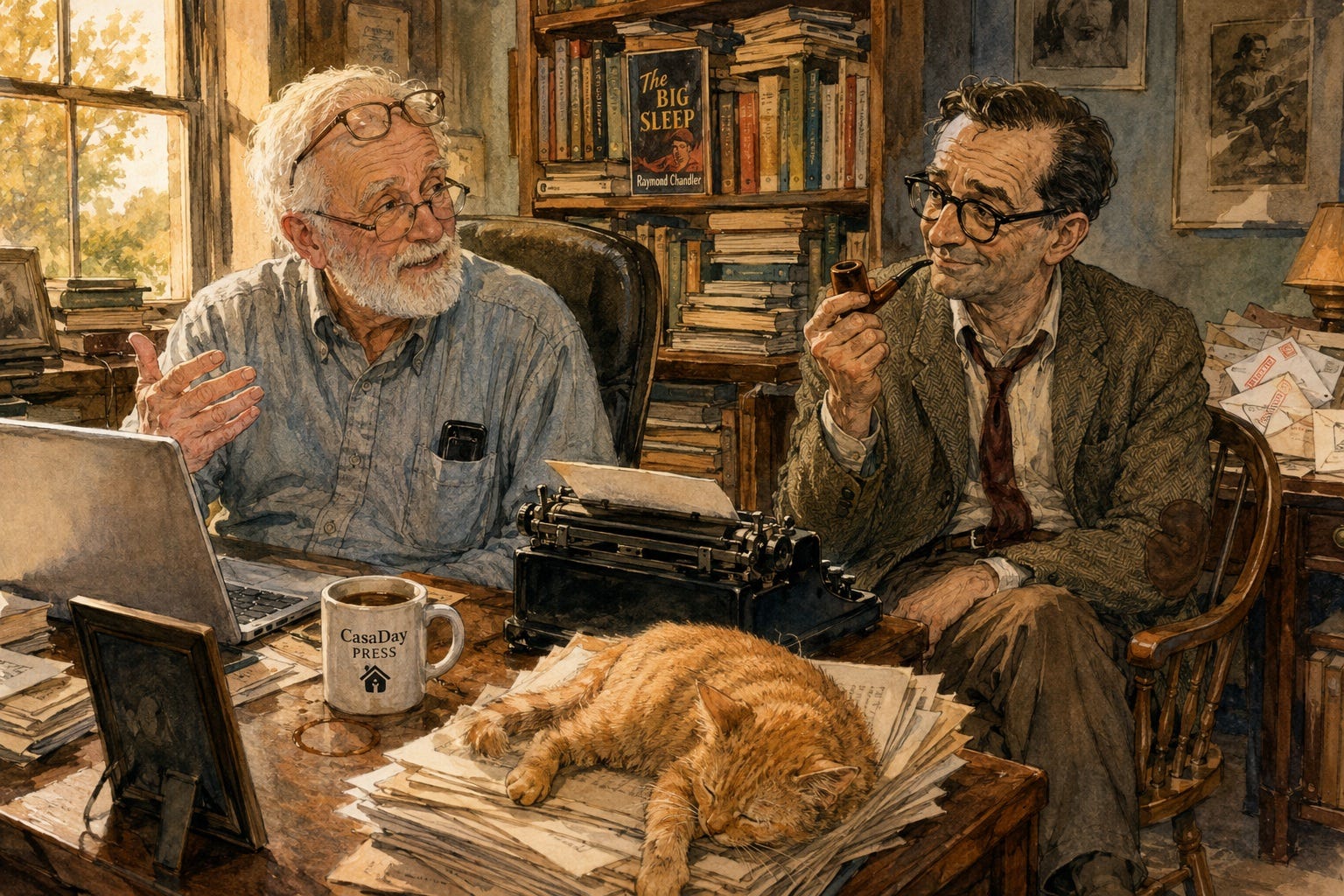
I’ll confess something that’s been nagging at me lately: I sometimes catch myself thinking I’ve missed the boat. That if I was going to make a real go of resurrecting my writing career—really pursue it, not just dabble—I should have started decades ago when I was younger and hungrier and didn’t need reading glasses to find my reading glasses.
Then I got to thinking about famous authors who started writing after 60.
And I recalled Laura Ingalls Wilder.
She was 65 when she published her first book, Little House in the Big Woods. Sixty-five. An age when conventional wisdom says you should be winding down, not firing up a literary career that would produce eight beloved books and outlast everybody who ever told her to sit down.
Wilder isn’t alone, either.
Bonnie Garmus published her first novel, Lessons in Chemistry, at 64. Here’s the kicker: that book got rejected 98 times before it found a publisher.
Ninety-eight rejections.
Most of us would’ve quit after a dozen. Two dozen if we’re particularly stubborn. Garmus kept going, and the book became a monster bestseller and then a Netflix series. In an interview she said something that stuck with me: age never matters for a writer, because nobody ever sees you and nobody really cares how old you are.
Her advice to older writers is to quit saying it’s too late and start saying, “It’s time.”
It’s time. What a shift in perspective that is.
Raymond Chandler took a different path to writing. He was an oil company executive who lost his job during the Great Depression, three years into that economic catastrophe, at age 44. His response? He decided to write detective fiction. His first short story was published a year later, and his first novel, The Big Sleep, came out when he was 51. He would go on to become one of the most celebrated crime writers in literary history.
Only Raymond Chandler would respond to unemployment during the Depression by launching a literary career. But it worked, didn’t it?
***
Here’s what I’ve been pondering. Why do some writers get better as they get older?
Experience, obviously. By the time you hit 60 or 70 you’ve lived through marriages and divorces, births and deaths, successes and failures, moments of grace and long stretches of grinding difficulty. Your characters feel real because you’ve known real people, hundreds of them, and your conflicts ring true because you’ve navigated actual conflicts.
But it’s more than mileage. When you’re 25, everything is urgent and absolute. Every heartbreak ends the world. Every triumph proves your exceptional destiny. There’s an intensity to that, sure, but there’s also a narrowness. By 60 or 70 you’ve figured out that most catastrophes pass, that people contain multitudes, and that life rarely arranges itself into a neat narrative.
***
And here’s what might be the greatest advantage of starting a writing career late: you don’t need it to work out.
Sounds backwards, I know. But think about it. When you’re 22 and launching a writing career, the stakes feel enormous. You need to make a living. You need to prove to your parents, and to yourself, that the English degree wasn’t a waste. You need success to validate your talent and your worth.
That desperation warps the writing. You chase trends instead of following your own voice. You make compromises that chip away at whatever made you distinctive in the first place.
But when you start writing seriously at 65 or, in my case, start over at 72 right after your wife of 47 years dies? You’ve already had a career or two. You’ve already been proven and disproven in other arenas. You don’t need writing to save you or validate you or cover the mortgage. Which means you get to write exactly what you want, exactly the way you want to write it.
You’ve also got less time to waste on things that don’t matter. You’re not going to spend five years on a novel that doesn’t excite you just because somebody says it’s commercially viable. You’re not going to tolerate feedback that doesn’t ring true. You’ve earned the right to be picky about where you spend your diminishing supply of days.
***
The other good thing about starting after 60 is that you get to define success yourself.
Maybe success means getting traditionally published and seeing your book on a shelf in a store. Maybe it means finishing and self publishing a memoir about the love of your life. Maybe it’s a weekly newsletter that lands with people going through the same stuff you’re going through. Maybe it’s just the satisfaction of wrestling language into shape and saying what you came here to say.
Being older makes you a lot less susceptible to other people’s definitions. You’ve seen enough to know that external validation evaporates like spit on a stove lid, and that the real satisfaction comes from doing work that matters to you.
***
So if you’re reading this and you’re north of 40 or 50 or 60 or, hell, even 70, and you’ve been telling yourself it’s too late, consider this: What if all those years you think you wasted not writing were exactly the preparation you needed? What if the stories you’re ready to tell now could only be told by somebody who’s lived as long as you have?
I started admitting that I sometimes think I’ve missed the boat. But the more I read about late bloomers, the more I’m convinced the boat metaphor is wrong.
Writing isn’t a boat that pulls out of the harbor at a fixed hour and strands everybody still tying their shoes on the dock. It’s the ocean. It doesn’t leave. It’s out there whenever you finally make it down to the shore.
It’s not too late. It’s time.
The water’s fine. Come on in.
Chet
P.S. Thanks to those who took the time to write a review of my Wicked Imagination ebook and post it on Amazon. That means a lot, and I appreciate your kindness very much. I know I keep promising to tell you the story of my late wife and Lucy, the feral cat she brought in for a meal back in November of 1997. I’m working on it, but I haven’t done that piece justice yet. When I’m happy with it, you’ll be the first to know… and to read. :)
No posts
Comments
Nothing yet. Say the first thing.
Sign in to join the conversation.