Last weekend we participated in the NASA Space Apps challenge, a hackathon in which team use NASA data to develop tools to address various global challenges. We selected the “Will it Rain on My Parade” challenge.
Will It Rain On My Parade?:
Challenge
If you’re planning an outdoor event—like a vacation, a hike on a trail, or fishing on a lake—it would be good to know the chances of adverse weather for the time and location you are considering. There are many types of Earth observation data that can provide information on weather conditions for a particular location and day of the year. Your challenge is to construct an app with a personalized interface that enables users to conduct a customized query to tell them the likelihood of “very hot,” “very cold,” “very windy,” “very wet,” or “very uncomfortable” conditions for the location and time they specify. (Earth Science Division)
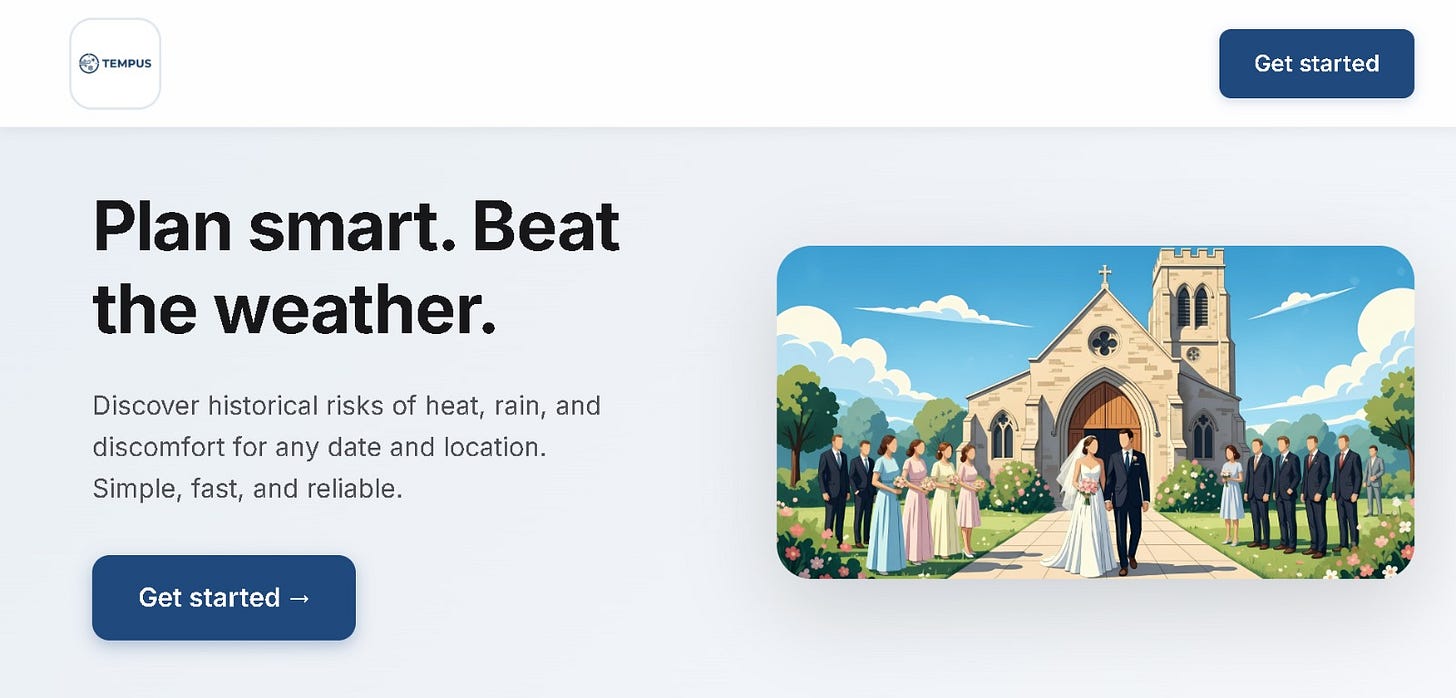
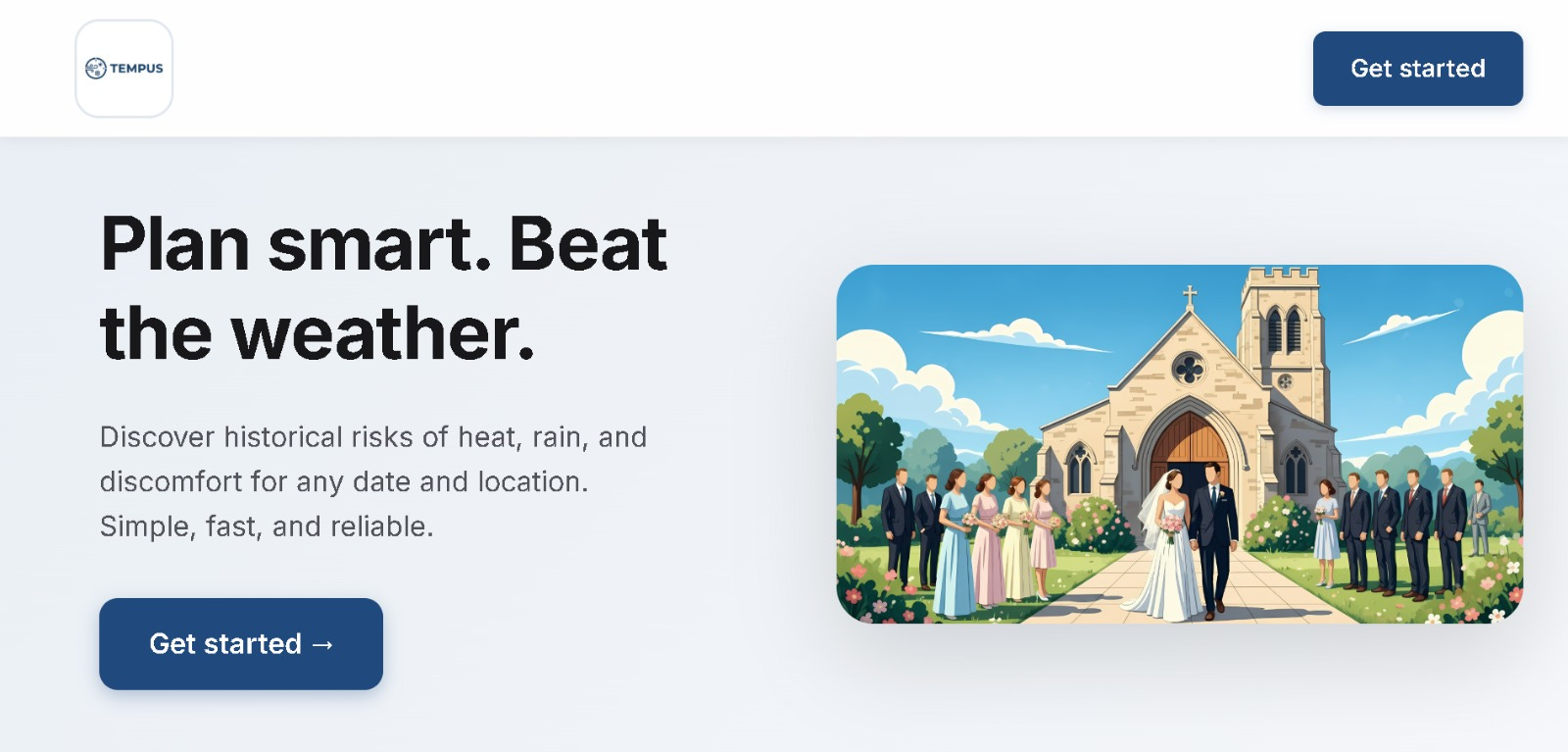
Screenshot of the Tempus homepage
Renato had been interested in participating in a hackathon for a while. So he had been watching for hackathons in the area. Unfortunately, we can’t afford to travel even to Recife, so we had to pass on a few possibilities earlier in the year. He discovered this NASA challenge, and found that it had a virtual option. It was only a few weeks out. We weren’t sure if we would be ready in time. He quickly put a team together. He and his friends have been working in software development in different areas so they make a very well-rounded team.
Your support helps us serve our rural community! Paid subscriptions support our work.
I was amazed out how much we were able to accomplish. We even delivered a fully functioning product. This was no small feat considering these NASA datasets and climate prediction was new to everyone on the team.
The team plans to continue working on the Tempus project. I am going to start integrating some of the weather planning ideas into my missionary trip preparedness coaching.
We are researching ideas for expanding this to more than event planning. For example, farm or disaster relief planning so that we can provide support to farmers in our area. The team really wanted to work this path originally, but we had to remain on task for the specific requirements of the challenge.
I have been creating several documents and videos to help guide Renato through talking to businesses. I am putting much of the research I have been doing over the past several years into some guides and training to help missionaries guide their communities through the technology shifts that are occurring.
AI and the shift to a knowledge economy creates opportunities for rural communities. Below is an except from one of the guide books for developing skills for the future in rural communities. These skills are highly mobile and can be done from anywhere.
4. You Won’t Just Use Technology; You’ll Need a ‘Translator’ for It.
As technology becomes more powerful, its inner workings often become more opaque. The decisions made by complex AI can feel like they come from a “black box,” leaving us to wonder how or why a conclusion was reached. This opacity creates a critical trust and accountability gap, which is where a new class of human translators becomes essential.
These are not the people who build the technology, but those who interpret and mediate it. The ‘100 Jobs of the Future’ report identifies roles like the Algorithm Interpreter, who is tasked with explaining AI decisions “in plain language,” and the Automation Anomaly Analyst, who investigates when an AI produces results that are “counter-intuitive, wrong, unethical, or just plain weird.” This represents a whole new category of future work focused not just on building technology, but on ensuring it serves human needs fairly, ethically, and effectively.
5. Creativity Is the New Professional Literacy.
If the 20th century was defined by professional skills like typing or spreadsheet management, the 21st will be defined by creativity. Once considered a “soft skill” or a niche talent, creativity is rapidly becoming a core competency for professional survival and success.
Skills like originality and creativity are, by their very nature, non-routine and highly resistant to automation. The data backs this up: one analysis found that in just a few years, the demand for creativity in job ads increased by 65%, while demand for critical thinking shot up by 158%. As David Ramadge, Senior Director at eBay Australia, powerfully advises for future-proofing a career:
Learn how to code, and learn how to paint.
In the work landscape of tomorrow, the ability to generate novel and valuable ideas will be as fundamental as the ability to read and write is today. It’s not just for designers and artists anymore; it’s the new professional literacy for everyone.
But we aren’t talking just about remote work. These shifts will bring new opportunities right in the community. That is what my research has been about. Finding ways to put some of the newer job and technology skill to use right in the community.
I will be launching a community for people working with remote communities. Many of the communities I work with are in Brazil, so we will be offering communities in both English and Portuguese.
Here are some of the training programs and resources I have been working on for the past several months.
Knowledge technology for missionaries
Understanding the knowledge economy
Guiding communities through the challenges
Exploring the Opportunities - future job and community outlook
Missionary role and ethics
Future technology jobs important for rural communities and projects to start building skills. In everything, my focus is skills that can be developed and used locally.
Project guides
Ideas for developing skills addressing local needs
Guides for documenting the life and history of your community.
Building a knowledge base to support local initiatives.
Expanding the Arts in STEAM through filmography and journalism.
Guides specifically designed for the communities that are just starting to come online.
I have been hinting at this for most of the year, but finally getting things organized. Looking back over some of my research I see I have been down more than a few rabbit holes, but I think I am finally resurfacing.
Your financial support helps me and my team as we continue to support our local community.
If you don’t want to give monthly, you can also give any amount through my PayPal link.

Comments
Nothing yet. Say the first thing.
Sign in to join the conversation.