
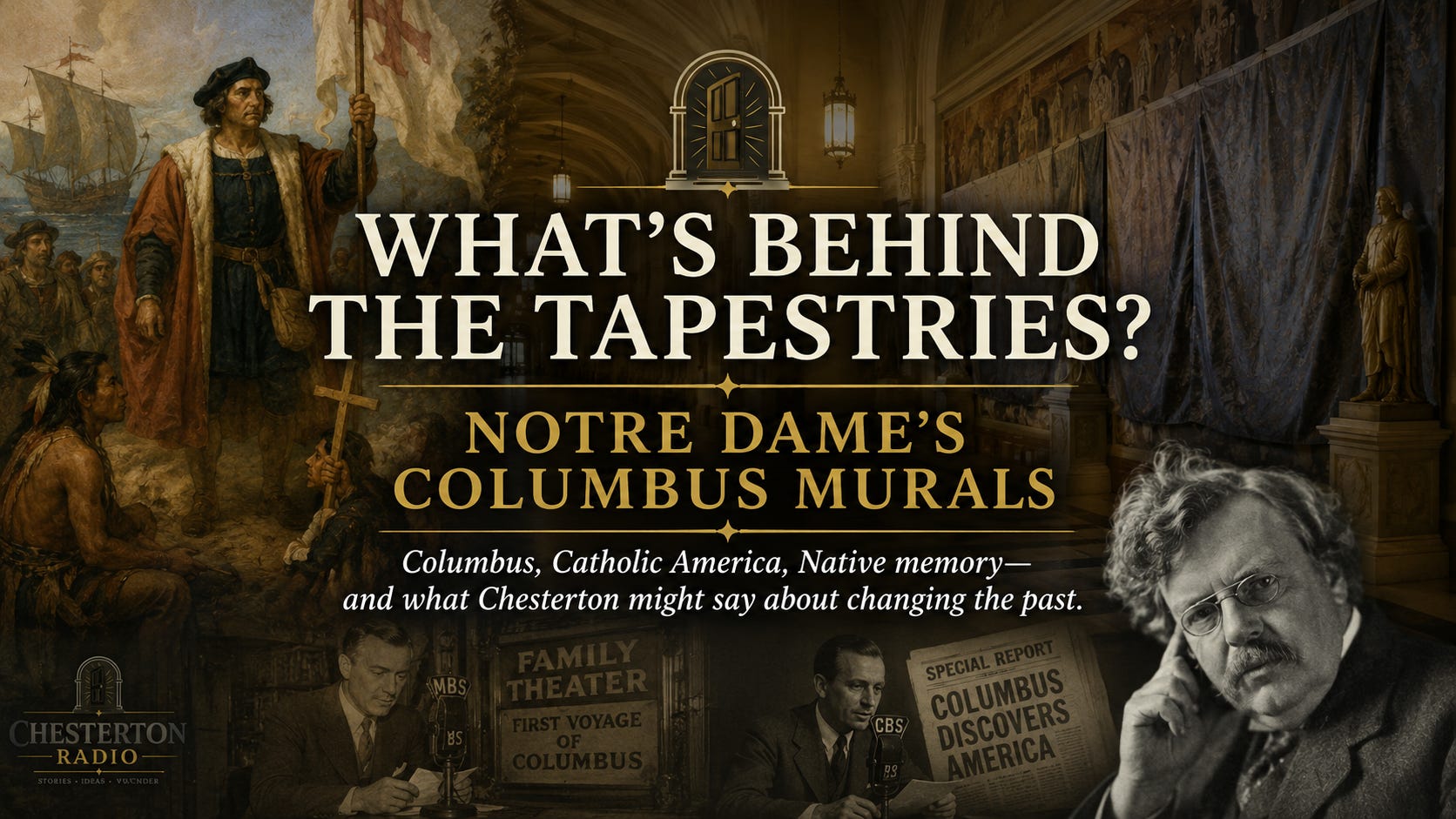
Twelve paintings have stood inside Notre Dame’s Main Building since the 1880s. Today, they are hidden behind tapestries.
Why?
This Common Room Deep Dive goes back to Father Edward Sorin and Luigi Gregori, when Christopher Columbus carried a particular meaning for Catholics trying to find their place in American life. We then follow the story through old-time radio’s heroic Columbus, the perspective of the Pokagon Potawatomi, and Father John Jenkins’s decision to cover—but preserve—the murals.
Along the way, we ask a distinctly Chestertonian question: When our understanding of the past changes, should we hide what earlier generations left us—or understand it more deeply?
Chesterton spoke of tradition as the “democracy of the dead,” giving our ancestors a voice alongside our own. But that raises another question: whose voices were missing from the old story?
Perhaps the answer to incomplete history isn’t less history.
Perhaps it is more history.
No culture-war shouting. No predetermined verdict. Just two friends in the Common Room looking behind the tapestries and asking what these remarkable paintings can tell us about Notre Dame, Catholic America, Native America—and ourselves.
The paintings haven’t changed. We have.
Comments
Nothing yet. Say the first thing.
Sign in to join the conversation.