
Hello friends!
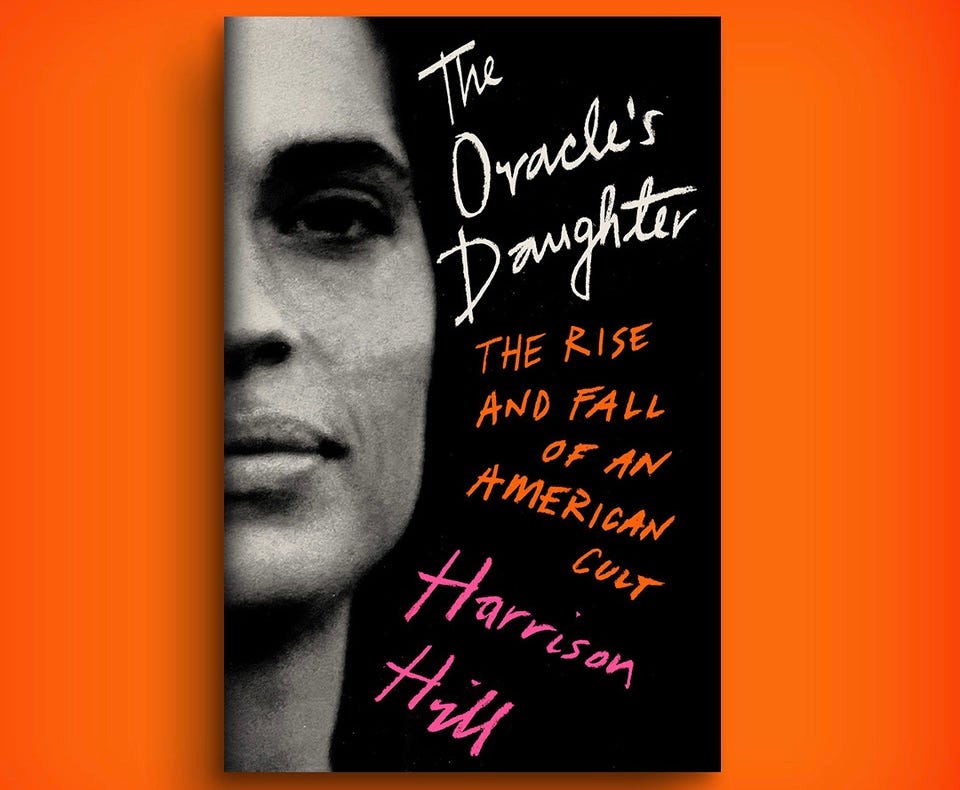
It’s time for another installment of my occasional Tells Us series, in which I ask an author to tell us about five things. Today, I’m taking a bit of extra delight in featuring the wonderful Harrison Hill, whose riveting debut book, The Oracle’s Daughter is being published today. I met Harrison in 2015, when he (and his fabulous mom!) attended a workshop I co-led with my husband Brian and our friends Rachel and Zayd on the Greek island of Patmos. Among a sparkling group of exceptionally talented, wise, good people, Harrison sparkled extra bright. From our very first conversation, he struck me as what they call the real deal in the lit world. Like writing is what he had to do in order to be true to himself.
Done that, he has—and, so very powerfully. His book is an astonishing, revelatory, un-put-downable chronicle of a cult called the Aggressive Christianity Mission Training Corps. Beautifully written, meticulously researched, heartbreaking and humane, in The Oracle’s Daughter, Harrison has written an unforgettable work of narrative nonfiction.
He’s also written so many wise and insightful things in response to my questions here that if he ever taught a workshop on Greek island, I’d be the first to sign up. I hope you enjoy the interview.
Happy pub day, Harrison! From this day forward, nothing will ever be the same again.
xCheryl
Maybe a year into writing my book, I got stuck. I couldn’t find my way into the scenes. The characters felt flat. I would sit at my desk and ram my head at the sentences, forcing them to life, word by unpleasant word. It wasn’t as if I was about to give up on the project. I just resented it.
Then one day an idea occurred to me. What if I just wrote the version of the chapter that brought me the most pleasure? I could skip the parts that annoyed me and linger on the parts I enjoyed.
I assumed I was writing in a provisional kind of way, that in a week or so I’d go back and write the “real” version. But of course the version that brought me the most pleasure was the best version: the version that, I hope, brings the reader the most pleasure, too. It was like looking at a table covered with organic superfoods and thinking, actually, I’m just going to have the lemon squares, thank you very much.
Writing a book wasn’t exactly like eating lemon squares, no matter how assuredly I stuck to my new principle in the weeks and months that followed. It was labor; it was commitment; it was the fortitude to keep my head down when the slightest glance upward could flatten me with the knowledge of all there remained to do.
But I came to believe we do a disservice to creative work if we think of it merely in heavy, noble, or even violent terms (“vomit draft,” anyone?). As I continued to work on the book, ruthlessly committed to writing the version of every chapter that gave me the most pleasure, I found myself adopting a new kind of artistic hedonism. Give me lemon squares, yes, but also give me pizza, and wine, and Lucky Charms with extra marshmallows. Give me sentences that fill me with pleasure as I watch them curl across my notebook. Give me the liberty to speed up where I want to speed up, or to slow down where I want to slow down. Give adverbs when I want to use adverbs!
In the midst of all this I came across a Virginia Woolf quote. I recognized the quote and immediately realized it had been the source of my original revelation – that Woolf had been working on me, even if I hadn’t realized it at the time.
She writes, “As nobody can possibly tell me whether one’s writing is bad or good, the only certain value is one’s own pleasure. I am sure of that.”
I was sure of it now, too. By “pleasure” I didn’t just mean “fun” or “entertainment.” I meant something richer, something spikier – the feeling you get when you’re really present, your senses alive to what is happening, even something sad or uncomfortable. I meant the feeling of keeping your focus trained on things that things that vibrate with life. (It's not just Woolf, either: The writers Jia Tolentino and Ezra Klein have spoken beautifully about these ideas, too.)
The events in my book can be quite dark. But I still took a tremendous pleasure in giving them narrative shape, in articulating them with precisely the voice and emphasis and sense of meaning I thought best suited them.
This one involves you, Cheryl!
Back in 2015, I was working as a copywriter at an advertising agency in New York City. The agency represented Broadway shows, which meant I wrote taglines, TV spots, and radio commercials for plays and musicals. I spent opening nights holed away with nervous producers, combing through reviews for quotes we could put on billboards and buses. I loved the people, and the work was interesting. It was a great job.
At the same time, I knew I wanted to write more than advertising copy. I wanted to write essays and books that made you collapse onto the couch. Books and essays that had style and swagger; that made you choke on your own breath.
Books, frankly, like Wild, which I read in 2012 and then again two years later. Same thing for Tiny Beautiful Things. All of which is to say, I was a real fan of yours, Cheryl, and like any good fan in the 2010s, I followed you on Facebook. One day in late 2014 you posted about a writing workshop you were leading with three other instructors on a faraway island in Greece. At Christmas, I offhandedly mentioned the workshop to my mom, who’d also read and loved Wild. “We should go,” she said. And so we did.
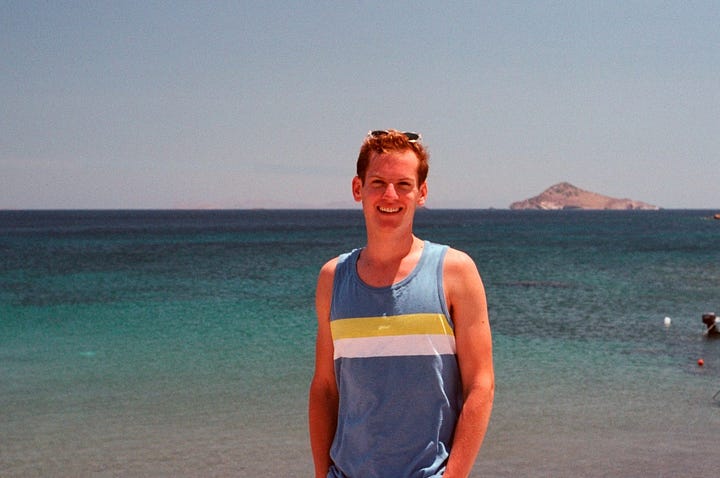
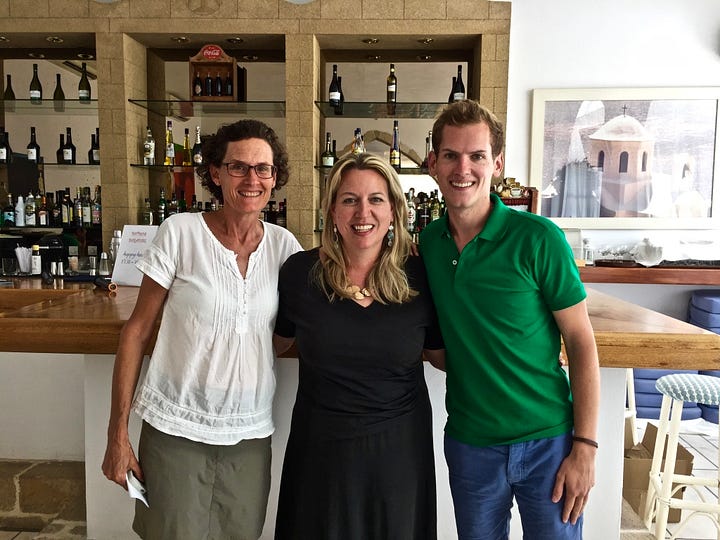
Patmos is an overnight ferry ride from Athens, a quiet, chalky-white island where the smell of saganaki practically hangs in the air. The first evening there, everyone gathered with the instructors at a beach taverna for wine and introductions. When you spoke, Cheryl, you said that after the workshop, “nothing will ever be the same again.”
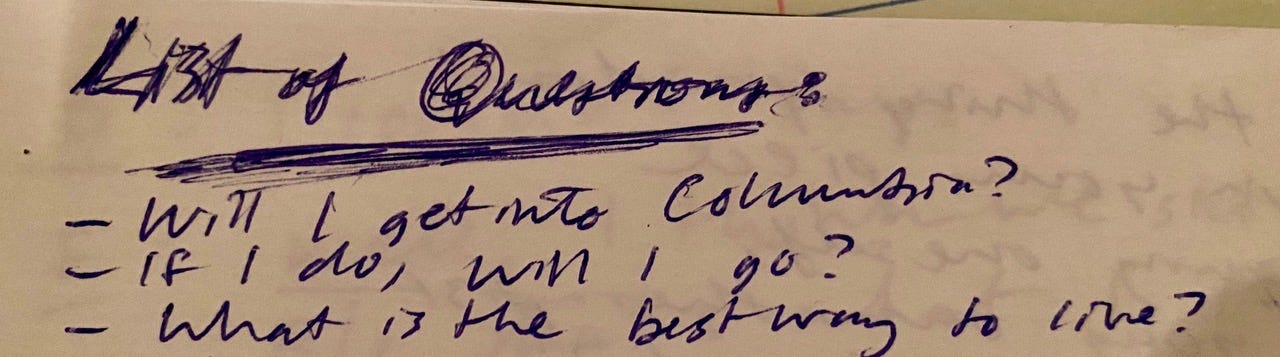
Bold words! And yet for me they were true. Writing had always been central to my life, but mostly in a private way, confined to the stacks of journals hidden in my apartment back home. Here in Patmos, however, something about the place and the people and the workshops made it feel like a kind of public, shared experience. Being around real authors, too, suggested that writing professionally might actually be doable. So when Rachel DeWoskin, another one of the brilliant instructors, told me there were graduate programs where you could study nonfiction, I decided on the spot to apply.
On my first day back at work in New York, I arrived in Times Square about half an hour before I was due at the office. It was a bright, not-too-warm July morning. I walked to Bryant Park, where I sat at a small circular lunch table in the shadow of the New York Public Library. I took out my phone, opened my calendar app, and flicked forward a year, to that precise date a year later. I typed, “must have quit job or have a plan to quit job by today.” There was so much about my current professional life that I enjoyed. But coming out of Patmos, the imperative to try my luck at writing essays or even books felt inarguable.
In the months that followed I applied to and got into grad school. I quit my job and started writing more seriously than I ever had before. I graduated and started writing for magazines and went back to my old agency, this time as a freelancer. All of which led me here, to this book.
There are so few moments in life when you can say: there, right there, that was the moment everything changed. But Patmos really was that for me. You were right, Cheryl. Nothing ever was the same again.
The Oracle’s Daughter is the true story of a cult called the Aggressive Christianity Missions Training Corps. At the center of the book is a woman named Sarah Green whose parents founded the cult in Sacramento in the early 1980s, when Sarah was still a child. Sarah’s mother was the brains of the operation, prophesying, conducting exorcisms, and ultimately leading her followers to a remote corner of the New Mexico high desert. The book follows the growth of the cult; Sarah’s escape from it at the age of 26; and the subsequent collapse of the group and the trial that followed. The book also explores questions about cults — who joins? why? — and situates the Aggressive Christianity Missions Training Corps within the broader context of American religious history.
I came to the story without any meaningful pre-existing knowledge about cults. At the time, I wasn’t even particularly interested in cults. But when my younger brother introduced me to Sarah, who was his neighbor in Brooklyn, I was immediately fascinated. We had our first interview in late 2019, and from the beginning I was convinced: I had to write about her. I didn’t think about the as a “cult” story, per se, as strange as that might sound. I thought of it as a story about family, and inheritance, and the ways we’re shaped by the places where we grow up. I thought of it as a story about faith, and belonging, and the things we do for love and community.
The idea was to look at human beings in some of the most extreme circumstances imaginable, and in so doing to shine a light on similar forces that animate all our lives — even and especially those of us who’ve never joined a cult.
I regret not being more of a mess in my early twenties. I was too ready to go home at the end of the night, too comfortable doing things on my own. I don’t mean to suggest I was some kind of shut-in. I just thought of myself as more fully formed than I actually was at the time, content not to try things simply because they didn’t comport with my idea of myself. I think I believed, on some subconscious level, that to graduate from college was to be delivered into an unchanging identity that would carry me through adulthood.
But of course things are always in flux; we remain who we are in the deepest parts of ourselves, but we also adjust, try things out, date around, move to different cities, quit our jobs. I was too much of a “good little boy” in these years, perhaps now also, and if this paid off in some ways (I learned how to focus, how to work hard, how to show up for people), it also came with its costs. Perhaps I projected something slightly closed-off at the bar. Perhaps I didn’t risk getting in trouble.
When I was 22, I remember being on a walk with my then-boyfriend and passing a construction site. The signs plastered everywhere were unambiguous: DO NOT ENTER. And yet my boyfriend insisted we go inside, not so much because he wanted to see what was going on, as to “cultivate the habit of disobedience,” as he put it to me with a kind of sweet formality. I was so uncomfortable following him through the loose gate and the hanging sheets of clear plastic that I can remember the feeling to this day.
I think now that I should have followed the boyfriend more easily. I should have snuck onto more construction sites.
In July 2024, I went to London to see some plays. After leaving a truly horrendous afternoon performance of Romeo and Juliet, I wandered through the tourist scrum of Covent Garden, happy and loose and aglow the uncharacteristically lovely weather. Then, suddenly, an idea occurred to me. What if I moved to London for several months in the fall to finish my book?
It wasn’t really a question, though. My decision had been made the moment the though first passed through my mind.
By October I was dragging my two suitcases up a flight of carpeted stairs to my flat near Clapham Junction, a major commuter train station just outside the central zone of the city. I lived there for the next four months. Every morning I woke up, put on what felt like 17 sweaters, got a flat white from the Australian barista at the local coffee stand (hi, Nikki!), and took the train into the city, to the silent bowels of the British Library, where I made may final exhausted sprint to the end of the book.
What is there to say? These were four of the very best months of my life. After work each night I walked to “my” pub to have a beer and to watch darts. I went on dates with a geography teacher and an Anglican priest who’d once been a pilot. I watched foxes scurry down the street as I headed back to my flat, Guiness and Haribo gummies sloshing happily in my stomach.
There were hard parts, too. Sometimes I was cripplingly lonely, though I made far more friends that’d I’d expected. Sometimes I wondered how long it would take for anyone to discover if I had died. Two days? A week? And I couldn’t believe how expensive everything was: far more expensive than in New York, as far as I was concerned.
But I was also happy. Happy: a word so blunt and uncomplicated as to be practically useless – or so I’d once believed.
I should mention here that my decision to go to London wasn’t made purely out of excitement and curiosity. One of the main reasons I’d been able to abandon my life in New York was that I wasn’t encumbered by a spouse or kids. This was a source of great sorrow in my life: I wanted to be so encumbered. In this sense, there was an element of spite at play to go abroad. If I couldn’t have that life, at least not yet, well then I was going to have this life, the fates be damned.
As the weeks and then months went by, and my happiness settled into habit, I tried to parse it out. It wasn’t just that I loved English culture. And it wasn’t just that London was somewhere new, though novelty certainly played a part in all of it.
Eventually I figured it out. I was happy because I was grateful. The sheer randomness and unlikelihood of the experience make me keenly aware of how fortunate I was to be here. It so easily could not have happened. And yet it had.
In New York I often fixated on what I didn’t have; and though I remained aware of those absences in London, the awareness of what I did have far outweighed the awareness of what I didn’t. I had a friend (from Patmos!) who invited me to her family’s house in a thatched-roof village for Christmas. I had the St Pancras Station, its red-and-white façade a dependable greeting every morning as I approached the library. I had my morning chats with Nikki, and the yellow lockers in the pit of the library.
I was so profoundly grateful for it all — and in this gratitude, I realized, burned the quiet candle of happiness. I knew I had to leave in March. Rather than crushing me, however, this awareness was in many ways liberating. I had to be grateful, because all this was going to go away. And because I was grateful, I was happy.
So that’s my advice, if a statement of fact can count as advice. Gratitude is happiness; happiness is gratitude. They are, for me, so similar as to be interchangeable. Which is to say — find something to be grateful for. And in that gratitude, perhaps you, too, may the quiet burning candle of happiness that I have felt.
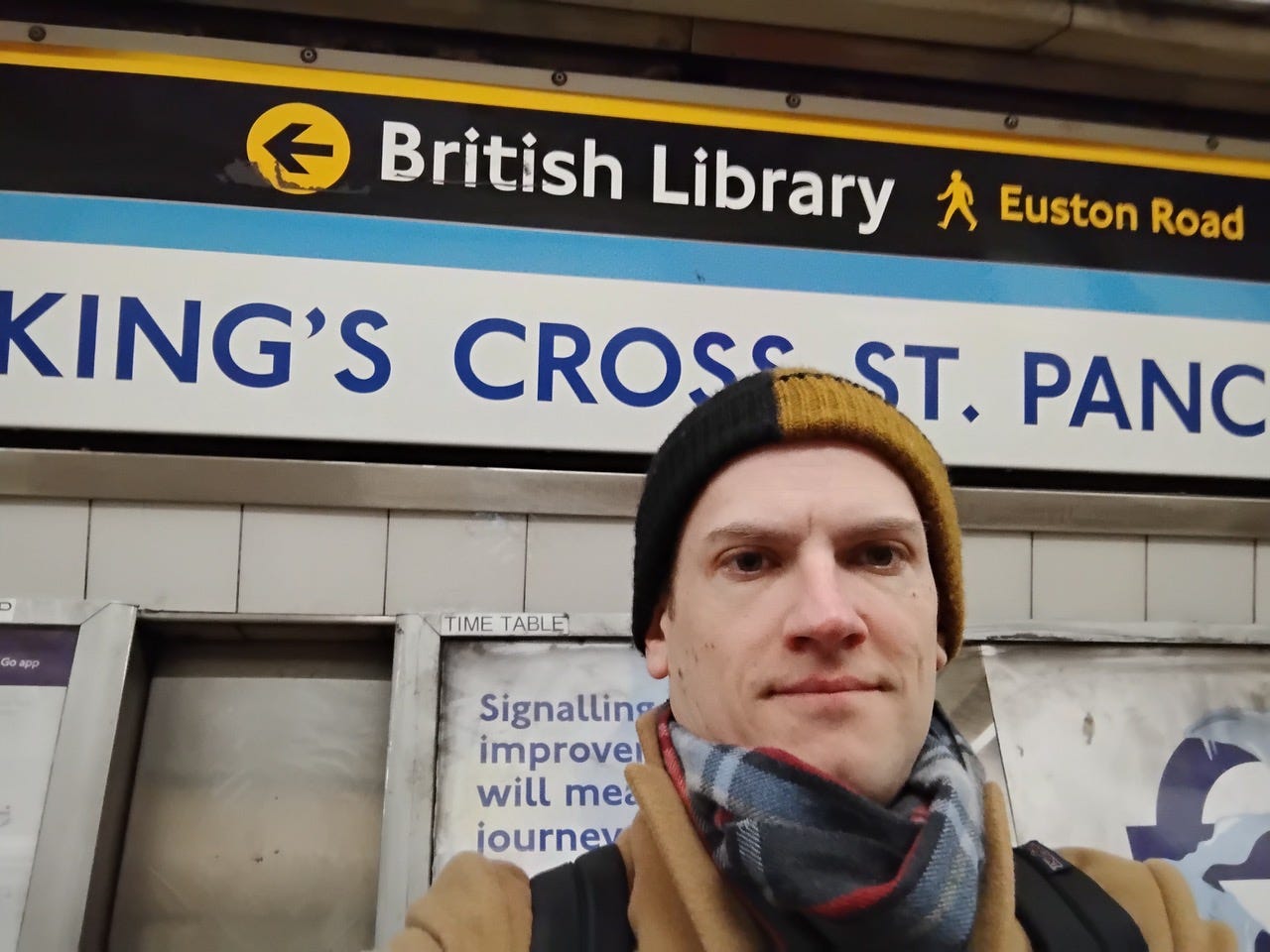
Harrison Hill grew up in Charlottesville, Virginia and lives in Brooklyn, New York. He received his MFA in nonfiction from Columbia University, where he also taught undergraduate writing. His journalism and essays have appeared in The Cut, GQ, Vogue, Travel + Leisure, AFAR, The Guardian, and The Threepenny Review. The Oracle’s Daughter is his first book.
No posts
Comments
Nothing yet. Say the first thing.
Sign in to join the conversation.