
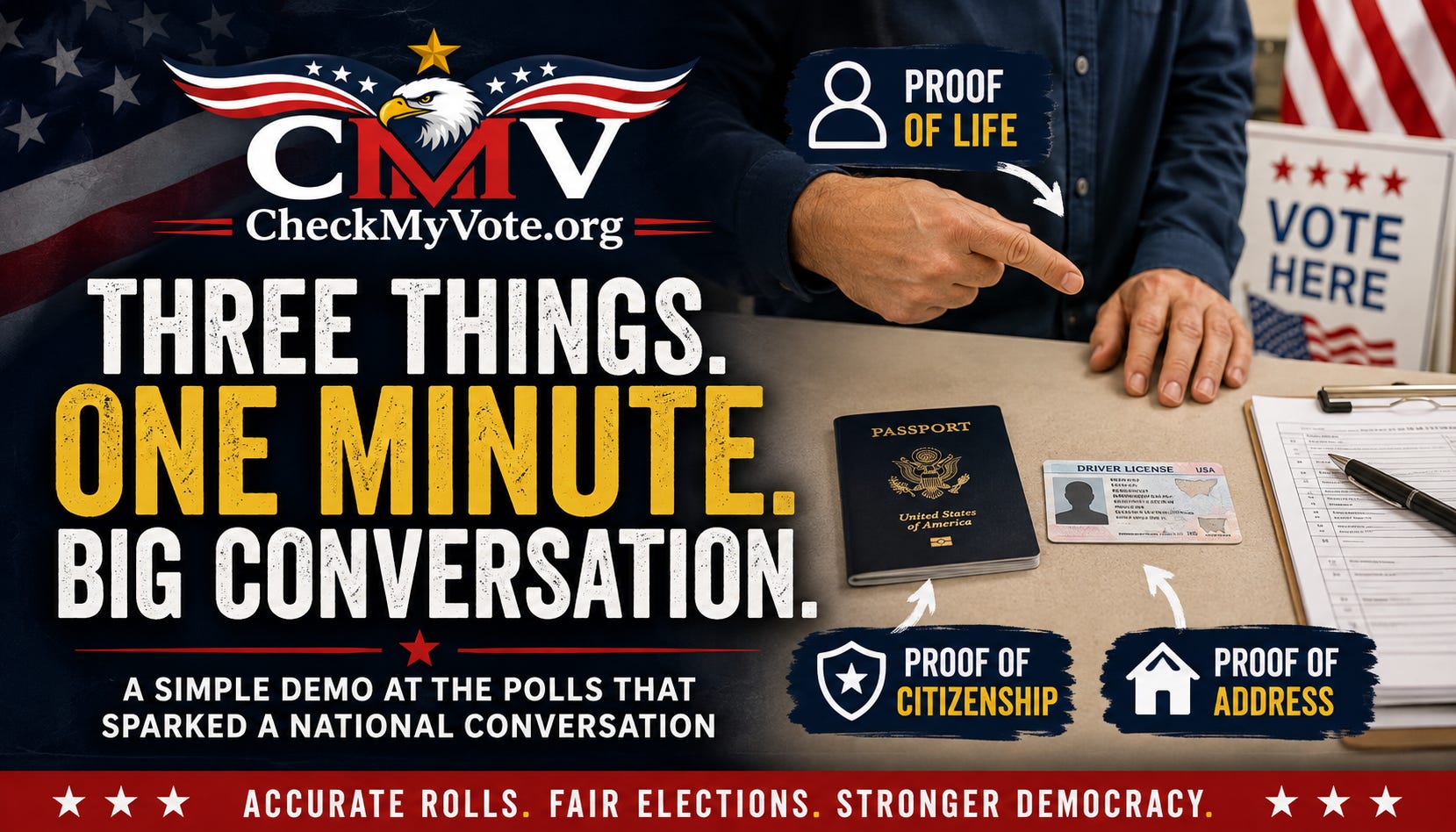
Recently, CheckMyVote founder Phani shared a brief story from a visit to a voting center that quickly resonated with many people involved in election administration and election integrity discussions. Rather than making a speech or delivering a presentation, he used three everyday items to illustrate a point that has become part of a broader national conversation about voter registration and election verification.
According to Phani, he placed his U.S. passport on the table and said, “Proof of citizenship.”
He then placed his driver’s license beside it and said, “Proof of address.”
Finally, pointing to himself, he added, “Proof of life.”
He recalled that the poll workers appreciated the simplicity of the demonstration, and the exchange led to a friendly conversation about voter verification and the various ways states seek to maintain accurate voter registration records.

Phani M@DeluxePsypher
I took my US passport to the voting center today. I laid it on the table and said “proof of citizenship”. I then laid my drivers license on the table and said “proof of address”. And then pointed to myself and said “proof of life”. The poll workers there agreed with me on the
12:11 AM · Aug 5, 2026 · 17.6K Views
11 Replies · 77 Reposts · 633 Likes
Although the interaction lasted only a few moments, it touched on three separate concepts that are frequently discussed in election administration.
Proof of citizenship relates to whether an individual meets the legal qualifications to register to vote. Proof of address helps determine the correct jurisdiction, precinct, and ballot style assigned to a voter. Proof of life, while not a legal election term, was Phani’s way of emphasizing that voter registration records should correspond to real, current individuals.
His demonstration was not presented as an official election procedure. Rather, it was a simple illustration intended to highlight the different categories of information that are often discussed when people talk about voter registration systems and election administration.
Phani’s story has been shared by a number of election integrity-focused accounts on social media, where many commenters viewed it as an easy-to-understand illustration of broader discussions surrounding voter registration verification.
Among those who commented publicly was True the Vote, which wrote:
“Citizenship. Address. Proof of life.
Three things every voter roll is supposed to confirm — and he confirmed all three himself, in under a minute, without being asked.
If a voter can do it that easily, so can a state.”
The anecdote has become part of a wider online conversation about election administration, voter registration procedures, and the methods states use to verify eligibility.

True the Vote@TrueTheVote
Citizenship. Address. Proof of life. Three things every voter roll is supposed to confirm — and he confirmed all three himself, in under a minute, without being asked. If a voter can do it that easily, so can a state. Well done, Phani.

Phani M @DeluxePsypher
I took my US passport to the voting center today. I laid it on the table and said “proof of citizenship”. I then laid my drivers license on the table and said “proof of address”. And then pointed to myself and said “proof of life”. The poll workers there agreed with me on the
8:51 PM · Aug 5, 2026 · 2.67K Views
1 Reply · 16 Reposts · 48 Likes
At CheckMyVote, our work centers on voter roll transparency through the analysis of publicly available voter registration data. Our volunteers review records, identify information that may warrant further review, and provide data-driven findings to election officials through established legal processes.
Maintaining accurate voter registration records is an ongoing administrative responsibility. People move, change names, become newly eligible to vote, or otherwise update their records over time. Careful review of voter registration data can help identify records that may require verification or correction, contributing to the overall accuracy of voter rolls.
Stories like the one Phani shared remind us that public conversations about elections often begin with straightforward questions about how voter registration systems work and how they are maintained. Whether those conversations take place at a polling location, in a legislative hearing, or around a kitchen table, they reflect continued public interest in understanding the election process.
At CheckMyVote, we remain committed to helping citizens better understand voter registration records, election administration, and the importance of accurate public data.
If you’re interested in learning more about voter roll transparency, exploring publicly available voter data, or following developments related to election administration, subscribe to our newsletter for future updates.
The CheckMyVote Address Monitoring Alert System allows you to track voter registration activity tied to your address using official state voter roll data. Most Americans have no visibility into who is registered at their home, when changes occur, or whether voter records are accurate.
Because every address matters. Every record counts. Every voter matters.
No posts
Comments
Nothing yet. Say the first thing.
Sign in to join the conversation.