
It recently occurred to me that you could tell when a venture capitalist was almost fully deployed with a fund when they managed to maintain a steady habit of writing and publishing.
And rightfully so, the deployment phase being one where you’re heads down investing ; and as you move on to the next fund raise, you need to sharpen your ideas and showcase your thoughts to LPs.
I am no exception, and I intend to take advantage of the long summer break my fatherhood in France induces to do the same as we’re reaching the end of deploying fund I at OPRTRS and moving towards the next step.
And what’s a better way to do this than to indulge in a bit of navel-gazing and write about the VC industry.
Fair warning: I have lots of ground I want to cover so this will be long even by my own standards, which is why I’m dividing the endeavour in a 10-article series rather than a single essay.
Another thing to note, I’m adding the constraint to not use AI beyond light grammar or language edits, neither in the production nor in the reflection. Not that I’m particularly opposed to AI - quite the contrary actually, my portfolio has a strong AI bias - but I’m convinced that the opinions you develop by doing the actual research, the thinking and the writing are harder-earned, and thus better-held. Sorry pal, there won’t be any “load-bearing”, “it’s this, not that” or “this is where it breaks” in here.
Without further ado, let’s dive in!
“Know thyself”
Plato
I couldn’t possibly begin a thought exploration of Venture Capital without tracing it back to its roots, the known and lesser known ones.
Unexpectedly to you perhaps and to some I’m sure, we won’t start in Silicon Valley but on the exact opposite end of the United States, in New England.
“Call me Ishmael. Some years ago - never mind how long precisely - having little or no money in my purse, and nothing particular to interest me on shore, I thought I would sail about a little and see the watery part of the world.”
Moby Dick - Herman Melville
When I was teaching classes about Venture Capital at SciencesPo or HEC Paris, I would systematically open the syllabus with a session on everything modern finance owes to the human aspiration to explore the sea.
Sending ships halfway across the world posed immense challenges that were successively solved by financial engineering - private banking, letters of credit, stock markets, insurance, all find their roots back to some form of ship-powered international trade. (1)
Venture Capital is no different. And the first form of Venture Capital can be observed in New Bedford, Massachusetts.
In this small town of New England, a whaling conglomerate - Gideon Allen & Sons - made returns in excess of 60% a year during much of the 19th century by financing whale hunting expeditions. Before fossil fuel was made widely available, whale oil was extremely sought after and made the overall whaling industry of New Bedford reach annual average returns of 14% a year throughout the Victorian era.
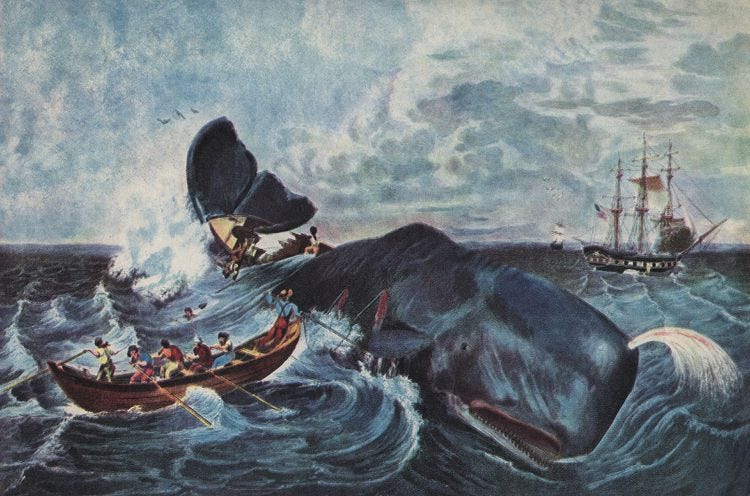
Mind you, boarding a ship as a crew member to go hunt a whale was an endeavour with disastrous perspectives: seven or more years at sea, high risk of not finding a whale, and even if you did, the chance that you’d be able to kill it and drag it back were slim. Factor in the risk of illness, starvation, sinking or being lost at sea, and it’s just a no brainer, literally.
So why would anyone in their right mind do it, how did the New Bedford whalers succeed and what does that all have to do with Venture Capital?
Well, it was not that the New Bedford whalers had invented new types of ships or discovered new routes to go hunting where more whales were to be found. It was that they invented a new type of organization and business model that was efficient at pooling capital to finance the risky business of going at sea after the mighty cetacean.
This article from the Economist, one of my favorites ever about VC, shares the whole details, but in short: pooling capital together to finance expeditions, sending multiple ships at once to increase chances of success, paying yourself back and generating returns on the few ships that actually successfully came back … the very structure of Venture Capital was there.
Oh and one more fun fact: the crew’s incentive. The reason why the captain and crewmates were willing to risk losing their lives at sea was because there were promises of riches if they came back successfully. Indeed, the investors only redeemed half to two-thirds of the expedition’s profit. The rest was divided among the crew, with the captain getting a larger piece and all crew members down to the youngest sailor getting theirs too. This incentive, or interest, that they got on the expedition was carried by them in the form of actual whale meat and oil on the hold and deck of their boats. Carried. Interest. This is literally where the expression comes from. (2)
Now, although I love to unearth this little known story as an anecdote about VC - yes, I’m fun at parties - what’s the point here?
The one thing I wanted to highlight was that the bones of Venture Capital were born out of the need to find a business model that could sustain taking the riskiest of risks in order to turn a profit. Discard what you may - reasonably - think about hunting animals, or worse venturing a crew’s life for it ; but the organization that emerged was one where a couple of “hits” would more than make up for the other aggregate losses, the infamous power-law returns.
At its very origin, VC was a model that made it sustainable to fund journeys with little odds of success.
“California knows how to party”
Roger Troutman - California Love (ft. Tupac & Dr. Dre)
I grew up fascinated by California. My teenage self was constantly feeding off the sunny type of gangsta rap music that is local to the West Coast (known as G-Funk), and from my bedroom in the suburbs of Lyon, France, I dreamt of Los Angeles more than I care to admit.
Little did I know that the Californian sting would come back years later, with founders and investors alike (me being no exception) now rushing to breathe in the fresh air of San Francisco for inspiration - as if entrepreneurship was a game that could only be played in the few square miles around Mission District.
Whether or not I believe this is the case is a question for a much later essay in this series.
What is of interest to us now is that the San Francisco Bay Area is indeed the cradle of the Venture Capital industry as we know it. Let’s head to a moment in time where “Silicon Valley” wasn’t known as such (rather, it was the Santa Clara Valley), because silicon chips wouldn’t really be in fashion before many more years - and the VC industry was being born at the other end of the country.
I’ll spare you the long route tracing back the history of Silicon Valley to World War II. Steve Blank has a wonderful talk about it if you’re interested. In short, the US military needed to reverse-engineer the German radar-based air defense capabilities and to do so set up a secret lab (the Harvard Radio Research Lab), headed by Frederick Terman. Frederick Terman was a Stanford professor and became known as ‘the Father of Silicon Valley’, having pushed many students (including William Hewlett and David Packard) to start their companies and to seek out customers where they were (at that time, the Army).
But ours is not the story of Silicon Valley per se, it’s the story of Risk Financing and how it travelled from the East Coast to settle in the West Coast (3), where the silicon and computing revolution was happening.
In the 1930s to 1950s, heirs to families that made fortune in the US in the 19th century - the Rockefellers, Bessemers, Whitneys - started to invest family money in risky ventures, realizing that technology spun off WWII research facilities could be used to build profitable commercial companies. At the time, banks would rarely fund new companies - preferably financing the expansion of existing ones, and entrepreneurs seeking out corporate funding would get acquired rather than funded.
Out of available resources (family money), opportunity (turn military R&D into profitable companies), and constraint (no funding ecosystem) were created the first “private adventure capital” efforts: J.H.Whitney Co, Rockefeller Brothers (nka Venrock) in 1946. Bessemer Securities was already afloat since 1911 (following the sale of Carnegie Steel to J.P.Morgan) but borrowed the same path around the same time. In 1946, Benno C. Schmidt, the first Director at J.H. Whitney Co also shortened the “private adventure capital” to ‘Venture Capital’ and coined the term we now use.
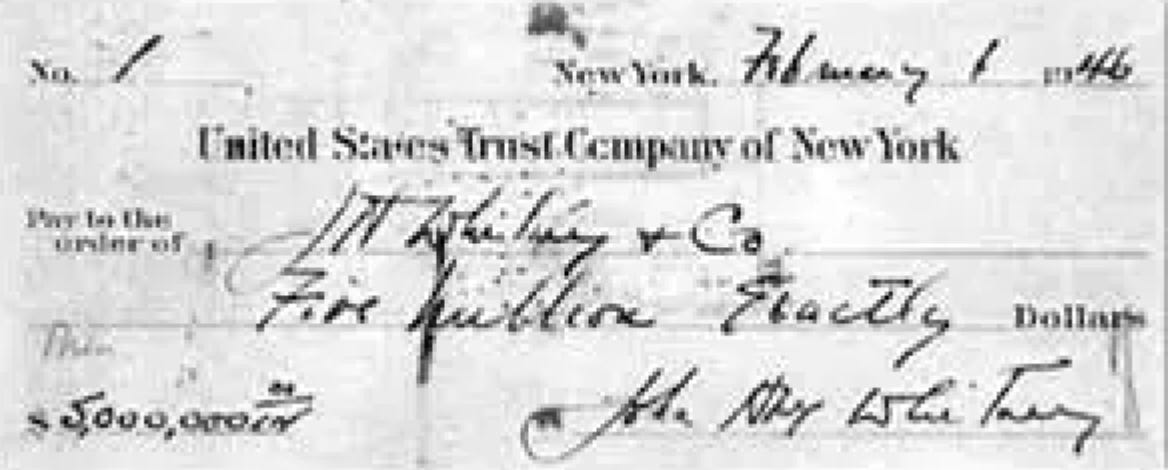
The interesting thing to note here is that financing risk had to be done outside of traditional capital conduits. Those were rich individuals using private wealth to finance risk - investing where others feared.
The first actual “venture capital firm” was set up in 1946 - what a year for VC - by George Doriot, a Harvard Business School professor that some dub ‘the Frederick Terman of the East Coast’.
He built American Research & Development (ARD), to fund startups out of MIT and Harvard with capital that was not private wealth. The pickle is that Doriot decided to set up ARD as a publicly traded firm, making it an SEC-regulated close-ended mutual fund, which later proved to be the wrong wrapper for VC. This did not prevent ARD from making successful investments, such as the $70k check into Digital Equipment Corporation (DEC) in 1957 for 77% of the company (sic). By the time DEC went public in 1968, the stake was worth millions.
This was proof, even with the wrong type of financial vehicle, that institutional investors too had appetite for the novel asset class that Venture Capital was, that financing risk could have an appeal beyond private capital dabbling in risky investments.
It’s another relationship of Doriot - Arthur Rock, one of his students at Harvard - that helps us carry the history of Venture Capital westwards.
Rock began his career in investment banking and focused on helping small high-technology companies raise capital. In 1957, he had word that eight top employees of Shockley Semiconductor Labs (the infamous ‘traitorous eight’) were leaving to build a new company. It was he who convinced Sherman Fairchild to fund them and start Fairchild Semiconductors in Palo Alto.
In 1961, Arthur Rock moved to California and formed the San Francisco-based capital firm Davis & Rock, whose founder went on to fund some startups you may have heard of, such as Intel and Apple.
As I’m writing those lines, Arthur Rock is still alive and should be turning 100 years old in 33 days. Cheers to that!
The first venture capital company in the West was Draper, Gaither & Anderson. The firm helped pioneer venture investing at a time when the land around Menlo Park, Palo Alto or Mountain View “were still mainly fruit orchards and ranches”. (4)
The big story here isn’t the firm’s legacy (5): it was financed by Rockefeller and Lazard Frères, but after some dispute the financing was pulled by Rockefeller and the firm was dissolved after the first fund.
Rather, the thing to highlight is that this was the first venture capital firm to take the form of a limited partnership. This is the moment where the entire structure we know formalized: a 10-year clock, GP/LP alignment and formalization of the carried interest (whoop, and back to whaling we are).
The limited partnership structure proved efficient in the perspective of financing risk:
7-10 years time horizons with investments made in the first 3 years gave reasonable “exit” windows. At the time, successful companies would go public in under 10 years.
For the first time in history, venture investors - not just their financiers - would have a strong performance incentive, aligning the interests. Partners would only make meaningful money if they selected the right companies, therefore increasing their risk assessment and judgement.
By the 1970s, the limited partnership would become the default organizational form for venture capital firms.
And before that in the 1960s, a handful of venture firms now headquartered around San Francisco had “risk capital” ready to deploy at a time when the semiconductor economy was booming in the region and lacked alternative financing options. Silicon Valley was born.
That part of the story is a little more known to those of you who know their Silicon Valley history.
In the span of a few decades, a number of individuals and firms - Don Valentine (founder of Sequoia Capital), Eugene Kleiner & Tom Perkins (founders of KPCB), John Doerr, Michael Moritz, Vinod Khosla, all the way to Marc Andreessen - funded generations of successful entrepreneurs (Intel, Apple, Sun Microsystems, Microsoft, Netscape, Google, Amazon, Facebook) that brought about revolutionary technologies into our lives: personal computing, internet, mobile, social media, and now AI.
However, what’s of interest to us is not who founded Sequoia or Kleiner Perkins and what legendary companies they founded.
In the 1970s, new money arrived to Venture Capital, unlocking a structural shift. Two regulatory moves at the end of the decade - the 1978 capital gains cut (reducing capital gains tax to an effective 28%) and, above all, the 1979 clarification of ERISA’s “prudent man” rule allowing pension funds to allocate to venture - turned VC from an amateur industry raising a few hundred millions a year into an asset class raising billions within five years.
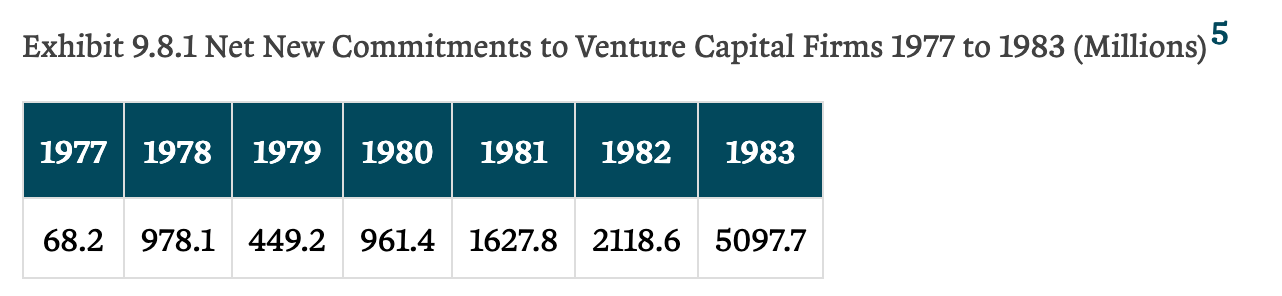
Pension money went from marginal to the dominant LP base in under a decade.
Somehow, in this context, Sequoia and Kleiner, both founded in 1972, matter more as the firms that were standing there ready when the capital fuel line of pension funds was wired in than as the firms with this legendary partner and that legendary investor.
But wait a minute, there’s something we overlooked here. The ERISA of 1979 allowed pension funds to consider venture capital a ‘prudent’ investment. Where did our risk financing go?
That is the point I took the long road to come to (sorry, I hope the detour was enjoyable though).
Risk itself has kept travelling down the social ladder and the surface of risk bearing has expanded in profile.
In New Bedford, Massachusetts, a bunch of local merchants built a conglomerate to aggregate the profits and losses of their ships sailing away.
In the 1930s, young and adventurous heirs toyed around with family money to finance promising R&D that could be turned into profitable companies.
In the 1940s, ARD proved that there was also some institutional appetite for Venture Capital in a publicly traded wrapper.
At the turn of the 1960s, DGA and Davis & Rock refined the structure to build the limited partnership as we know it. A disparate aggregate of family offices, corporations and investment banks started funding VC firms.
Finally, in the 1970s, pension funds were allowed to the party and unlocked the retirement savings of ordinary Americans. The riskiest asset class became a normal item to hold in the most conservative portfolios.
To this day, 130 odd years after the whaling industry went bust, Venture Capital remains a model that makes it sustainable to fund journeys with little odds of success. What’s changed through decades of financial engineering is who bears the risk.
“Put all your eggs in one basket – and then watch that basket!”
Mark Twain, Pudd’nhead Wilson
I like that Twain excerpt, because it sounds like an inversion of common wisdom: you’re usually told to not put your eggs in a single basket.
And when it comes to VC, common wisdom is the same: diversify your risk within a portfolio because of power law returns: a single hit will make up in value for a large volume of losses. So why quote Twain?
Well, there is indeed an inversion of the common VC wisdom that’s increasingly resurfacing these days with deal-by-deal SPVs, but this is a topic for a later essay in the series.
What I want to focus on right now is another layer of risk: not at the asset level (financing one deal vs financing many deals), but at the risk typology level (what type of risk are you underwriting).
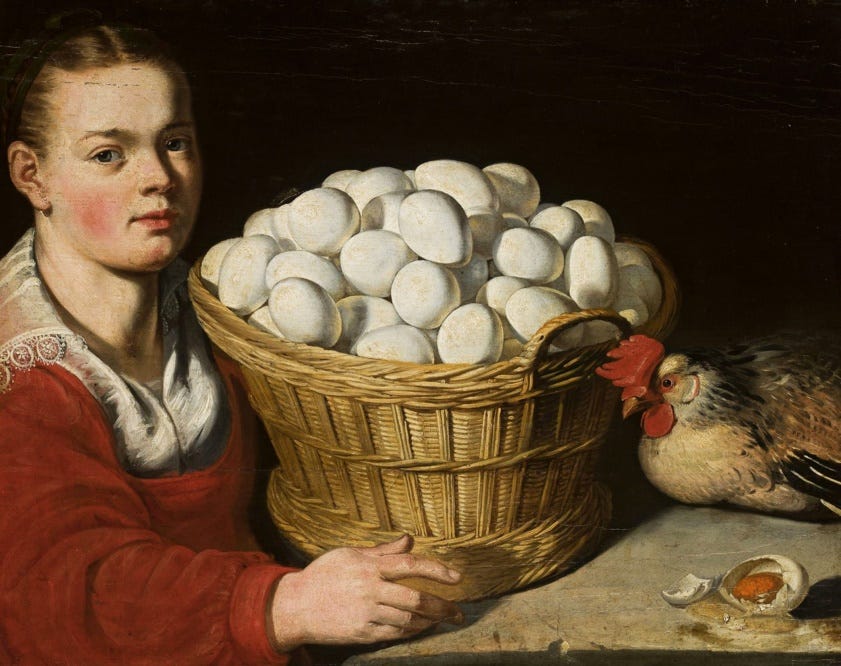
What we’ve seen through history so far explains how venture capital made failure economically tolerable: pool enough capital, spread it across enough expeditions and let a few exceptional outcomes repay the rest. But making failure tolerable does not make every uncertainty financeable. The model still needs each investment to rest on a sufficiently legible bet.
My contrarian take (not sure why but VCs love to drop the word ‘contrarian’ everywhere, and I thought it fit nicely here) is that at its core, Venture Capital is structurally risk-averse, because it can bear a large amount of risk, but it struggles to bear several independent risks multiplied together. The industry’s secret to funding journeys with low odds of success is to know precisely what type of odds it’s gambling with. This is the apparent paradox at the heart of Venture Capital. At portfolio level, it is built to absorb an extraordinary rate of failure. At company level, it tries to concentrate that failure around one decisive uncertainty. The portfolio is diversified across companies, the individual bet is simplified around a core risk.
What do I mean by that?
Let’s say you want to launch the AirBnb for jetskis. Even ten years ago, that wouldn’t have been much of a challenge to actually put the website and database together - but nowadays you can just prompt it out of Lovable or Claude Code while you swipe through a couple of reels. The real challenge with this idea is to actually find supply, clients and distribution channels that make for a profitable operation. Said differently: you carry a lot of market risk, not a lot of technological risk.
On the other hand, let’s say you want to cure cancer. If you succeed, there is no question whether the market will fall into place: demand is inelastic, and third-party providers (insurance or national health agencies) will pay for it. The real risk lies in the “if”, whether or not you’re able to research your way out of curing cancer, even a single type. Said differently: you carry a lot of technological risk, not a lot of market risk.
I guess you got the point. Most tech companies carry near-zero technology risk at inception (internet, open source, cloud - the stack is a commodity), so VC finances pure market risk. Biotech is the exact inverse: demand is obvious, products are third-party-paid, so market risk is near-zero and VC finances pure research risk (6).
Software and biotech are the clearest expressions of this pattern because they sit near opposite ends of the spectrum. In conventional software, the underlying technology is usually available and the core bet concerns adoption, distribution or market formation. In biotech, demand for an effective treatment is comparatively legible and the core bet concerns scientific feasibility. Venture capital has also succeeded elsewhere (7), but usually where the investment can still be reduced to one dominant uncertainty - or where another actor, often the state, removes one of the major risks.
All of this leads me to a sort of mental rule: for VC to work out, what matters is not the sector but whether one category of risks dominates the investment case (8) - either market or technology - and having huge enough payoffs at portfolio scale to cover it.
This isn’t an idea that is new to me, in fact it was a key doctrine at my first firm - The Family - as developed by my former colleague Nicolas Colin, who himself expanded it from Bill Janeway, and I have held it for a very long time.
A couple of recent readings made me question it though:
Kyle Harrison’s ‘What do you have to believe’ expands on Marc Andreessen’s Onion Theory of Risk: “Building a company is a massive multivariable calculation of risk-adjusted outcomes. Think about all the checklists you’ve ever seen where investors tick through the aspects they look for in a potential investment. Marc Andreessen calls this the “onion theory of risk”. Each aspect of a business is another layer: founder risk, market risk, competition risk, timing risk, financing risk, marketing risk, distribution risk, technology risk, product risk, hiring risk.”
In my opinion, the theory expands neatly the surface of the risk categories but does not fundamentally remove the need of VC to minimize the categories of risk it takes: you cannot go full risk on all aspects. Additionally, founder risk, hiring risk or timing risk are risk layers that you diligence-or-stage away as you invest ; but underneath the investment sits one belief the whole deal hangs on, and I’m convinced that belief is either a market belief or a technology belief. So the onion has many layers but one core, and the core remains a technology v. market dichotomy.
The excellent Howard Marks’ Is it a Bubble? which questions from an investor standpoint whether the current level of investments in Artificial Intelligence are akin to a bubble. This was of interest to me because if you think about our technology v. market risk dichotomy, AI investments - in Anthropic or Mistral, say - carry both. It’s a hard technological challenge, and it’s also a very uncertain market - perhaps not in aggregate but at each company’s level.
The way Marks sees it, in aggregate AI investments are infrastructure, like rail or web, and need bubbles to draw capital to fund them. But if you look deeper, the dichotomy remains: an AI vertical app is pure market-and-distribution risk, the model stack is becoming a commodity. The infrastructure layer (data centers, chips, etc.) carries immense risk, but has steady cash flows computable against hard assets held in a balance sheet: it’s more project financing than it is Venture Capital.
The one category that’s really puzzling is frontier labs, which really do carry both risks at once. They must continue advancing the technology while simultaneously discovering durable markets, business models and competitive positions. The two risks are also capital-intensive and mutually dependent: technological progress requires enormous financing, while financing depends on expectations about eventual demand. But looking at it, they are mostly not financed by VC funds: corporate balance sheets, sovereign megafunds, vendor financing, circular deals (Nvidia invests $100bn in OpenAI who buys Nvidia chips …), off-balance sheet financing … This peculiar type of asset breaks the neat VC dichotomy, and the market mutated to build other wrappers and financial products around it. The risk profile didn’t fit. If the risk profile doesn’t fit, you must ah-quit.
And then there’s AGI. The AGI thesis converts investing into a frontier lab into a technological risk leap of faith: if you can build a machine that does everything, and build it first - then demand is obvious and potentially infinite. Market risk evaporates. Whether or not this contradicts our dichotomy is an important question, but one for a later essay.
I had planned to also write in this first essay about how risk financing passported - more or less efficiently - to other regions that had the poor taste of not being Unitedstatesian, e.g my beloved Europe ; but I’ll shift it to another later in the series since this one has already gone overtime.
So, where does our exploration land us? To me, there are many interesting things to note alongside this rather historical approach of VC - like the way the capital wrappers or ultimate financial risk carriers evolved over time, or how the government acts as risk-absorber for risks that sit outside the model and/or when it needs to be kickstarted - but I would say the primary one is this:
Venture Capital is a model meant to make it sustainable to fund ventures with low odds of success, but the investment must have one dominant uncertainty - usually technological feasibility or market adoption: either whether something can be built or whether, once built, it will be adopted - whose resolution unlocks most of the remaining value.
When several fundamental uncertainties must be financed at once, like we are living now with AI, the market recomposes itself and engineers new financial solutions - (two-or-three-layered) SPVs, circular deals - or calls in other types of risk carriers because VC alone cannot bear the risk. It is not how it was built as a financial product, nor the mandate that the LPs have given venture capitalists.
And incidentally, our second essay in the series will explore VC as an Asset Class and Financial Product, and thus the relationship dynamics between LPs and GPs.
Stay tuned!
(1) To my knowledge, there is no comprehensive body of work focusing solely on the parallel history of financial innovation and maritime trade, but I’d recommend Peter L. Bernstein’s Against the Gods: The Remarkable Story of Risk and Lincoln Paine’s The Sea & Civilization: A Maritime History of the World to approach both aspects if this is of interest.
(2) Admittedly, the origin of the term is more in 16th-century maritime commerce rather than whaling specifically, but this is an instance of it that overlaps neatly with the modern VC model.
(3) Interestingly, in the traditional chain of events cited as the birth of the silicon chip industry in California - William Shockley leaving Bell Labs after inventing the transistor, and then eight top engineers leaving Shockley to open up Fairchild Semiconductors in Palo Alto in 1959 - the key firms were financed by corporate money, not Venture Capital. Shockley by Beckman Instruments, and Fairchild by Fairchild Camera & Instruments. The Valley’s first startups needed no venture capital because the state was the customer. Government demand was the original risk absorber; equity risk capital only became necessary when startups had to find markets instead of receiving them.
(4) William H. Draper III, The Masters of Private Equity and Venture Capital, 2009
(5) DGA was founded by William H. Draper, Jr. It’s his son - William H. Draper III who built Draper Richards L.P and his grandson Tim Draper who now runs the famous fund DFJ.
(6) Reality is rarely this clean. Nvidia, for instance, began with both an uncertain market for accelerated graphics and an uncertain technical architecture. Its first product made the wrong architectural bet, but once industry standards settled, the company’s problem became more legibly technological. This was long before GPUs were used for LLMs. The useful distinction is therefore not whether other risks exist, but whether one eventually becomes the dominant bottleneck.
(7) SpaceX or Anduril do sit outside of those sectors, but once again the state was the buyer and absorber of demand - leading us all the way back to the same mechanism that made the origins of Silicon Valley: Frederick Terman and building what the government needed at the time.
(8) Whether or not you can do both types of risk within a single portfolio is an interesting question, but also one for later.
No posts
Comments
Nothing yet. Say the first thing.
Sign in to join the conversation.