
AI is eating the world, it needs datacenters to be trained and to operate, and so demand for datacenters is projected to increase at a fast pace. Right now, there is a supply shortage.
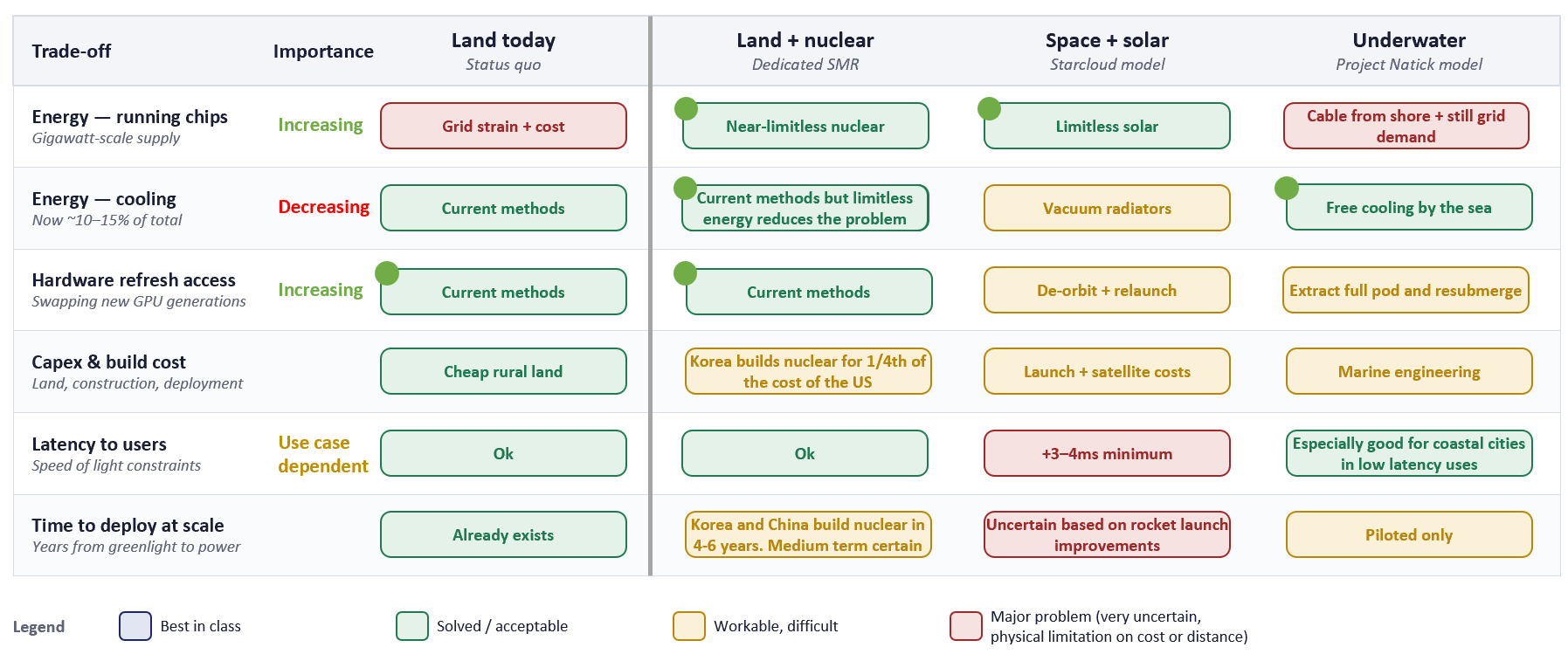
These are some of the key items that a data center needs to operate: Energy for running the chips, energy for cooling (10-40% of total energy but declining as a % of total energy use), access to the datacenter to repair/upgrade chips, and some datacenters need to be close to populations for low-latency use-cases.
Datacenters now are mostly warehouses in the middle of the countryside or in the suburbs, powered by the traditional electricity grid. The main constraint now is the cost of energy. The solutions I have read about to improve upon the traditional datacenters are:
Renewable energy (solar+wind) + battery storage. I consider this an incremental improvement on ‘today’s method’
Datacenters in space
Build nuclear to power datacenters
Datacenters underwater
The space option
Solve energy, but increase other operational costs and latency.
A startup called Starcloud raised $170 million last month, to build datacenters in space, powered by limitless solar energy. With the cost of launch to space falling, this increasingly can be possible.
Starcloud would use solar energy with 4km panels, in orbits that receive constant sun, solving a big part of the energy problem.
In space it is harder to cool down chips, but this is solvable with enormous radiator panels.
Hardware refresh is also solvable, in a fashion. You don’t repair a satellite; you launch a new one and de-orbit the old one. Expensive today, plausible at scale once Starship reduces launch costs to the projected $500 per kilogram in the late 2020s.
An item that is probably under-spoken about is that datacenters in space can be beneficial for national security reasons. In a war, space gives redundancy if land datacenters are attacked.
Latency remains an issue for earth-based tasks where latency matters, but becomes better for space-based tasks such as satellite image processing.
So I actually buy Starcloud feasibility, the national security benefit, and the latency superiority for space based tasks. But if you can solve the energy problem on earth, it would be cheaper to set up and operate for most AI training and inference (which I think nuclear could solve)
Underwater
Solve cooling (declining problem), but leave most of the energy problem unsolved.
Microsoft’s Project Natick sank a sealed pod containing servers onto the Scottish seabed in 2018 and ran it for two years with zero human intervention. It reduced energy consumption for cooling very significantly, but energy delivery and hardware accessibility became harder. Power must be delivered via expensive undersea cables from shore, with maintenance costs that scale poorly. And when a chip fails or a new GPU generation arrives, you cannot easily send a technician.
The ocean does have one genuine advantage no other model can match: proximity to coastal populations. An offshore pod five kilometres from Lagos or Jakarta could deliver latency to the coast faster than inland facilities. This can be important for certain low-latency use cases.
The nuclear option:
Solves constant energy on land, doesn’t add repair complications or latency, but it adds the problems that come with nuclear: risk of radiation disaster, nuclear waste, and complex to build. But once I studied a bit deeper, the nuclear problems are largely being solved.
Safety: Chernobyl left a scar of existential risk on the world. But new methods of building nuclear are quite failsafe, and shut down without nuclear intervention in case of disaster.
Reminder: there are submarines and boats from militaries that are powered by small nuclear reactors. So nuclear energy is still around us.
Waste: The nuclear waste can be dangerously radioactive for hundreds of years. But there are solutions. Finland’s Onkalo repository is the proof of concept. It’s carved into 1.9 billion year old bedrock — some of the most geologically stable rock on Earth — at around 400-500 metres depth. The design life is 100,000 years (nuclear waste would be significantly less radioactive in 1,000 years). Construction began in 2004, it received its operating licence in 2023, and it will start accepting spent fuel around 2025-2026. Reminder that there isn't ‘that much’ nuclear waste, all of the nuclear waste ever produced would fit in a large warehouse.
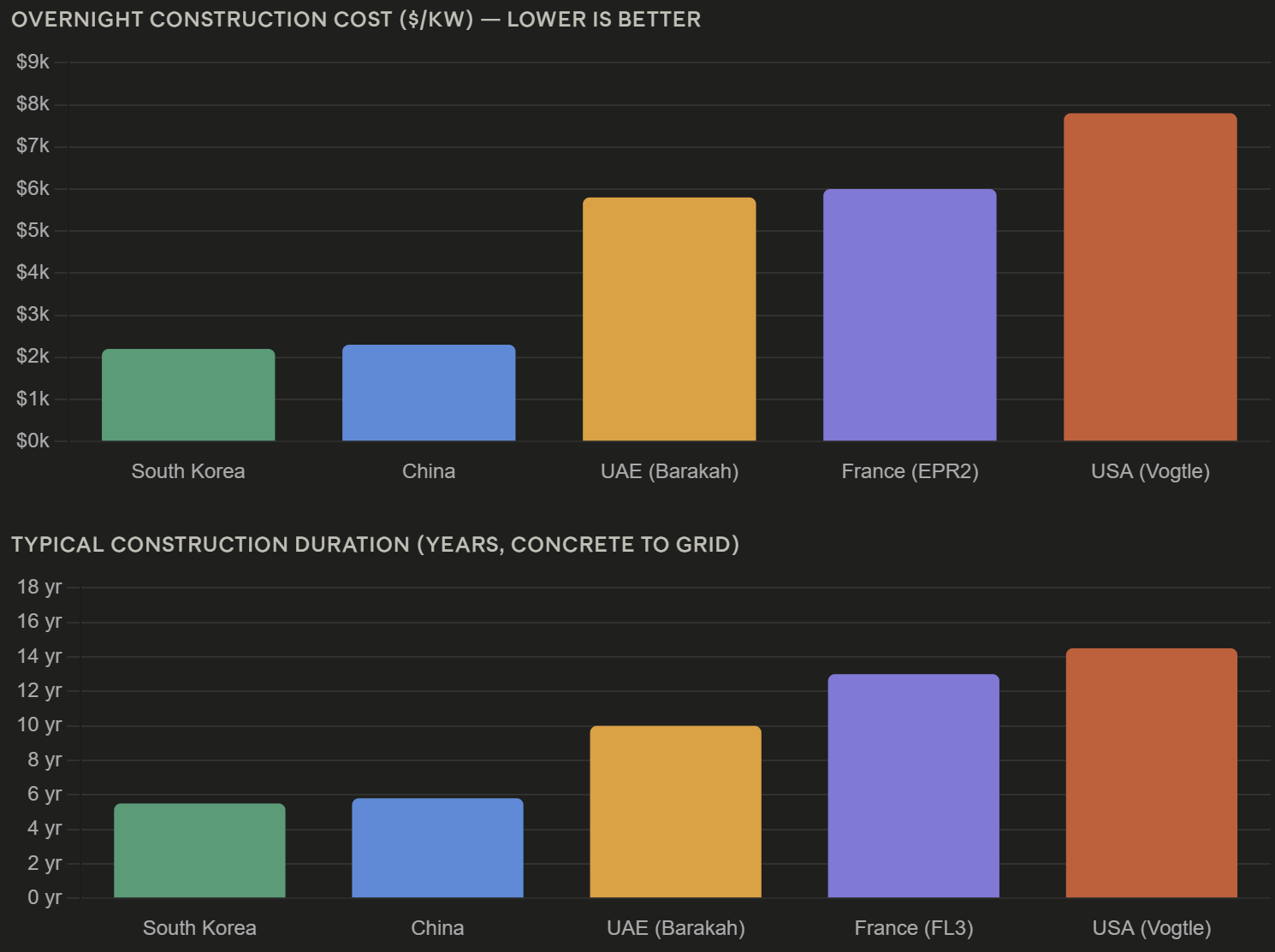
Time to build (which is the biggest factor to over-runs in construction cost): the west has forgotten how to build nuclear and made regulation very slow. Between the 70s and the 90s France could build a nuclear power plant in 4-5years; now it is taking >15years to build its latest one because it is a new type of design. But this speed can change with stable + efficient regulatory processes and once a company gets experience in building. In China they built 37 nuclear reactors between 2015 and 2024, and they built the fastest in 4 years and within budget. China and South Korea build 4x faster for 1/4th of the cost.
Another problem with nuclear is that it produces a constant output - it's very hard to ramp output up or down. In countries with a lot of nuclear like France, this creates sometimes a ‘surplus’ of energy in the grid - and this energy needs to go somewhere to avoid a shutdown. This leads to electricity prices sometimes being negative. But Datacenters can match the energy supply with a constant demand: datacenters can run close to full constant capacity if you queue training runs in times of low inference demand (e.g. at night).
And these points are for nuclear fission, if nuclear fusion is solved in the next decades, it could produce energy without safety or waste concerns. Nuclear fusion reactors cannot melt down, fission can produce runaway reactions but fusion physically can’t, and the waste from the reaction is Helium which is a high abundant element.
CONCLUSION
I am just following my curiosity on a Sunday. But is it reasonable to think that nuclear power with land-based datacenters could be the best long term option to power infinite AI?
The hyperscalers are taking steps to build more nuclear energy and small localized reactors. It seems like a good area of focus.
Beyond nuclear, space is a great alternative for workloads that already run in space (e.g. space imagery processing), and underwater localized data-centers could serve niche low-latency uses in coastal cities with high land costs.
No posts
Comments
Nothing yet. Say the first thing.
Sign in to join the conversation.