
Over the past quarter, we’ve steadily built a position in this under-the-radar coffee company—drawn by a compelling mix of valuation, alignment, and untapped potential.
Overview
Coffee Holding Co. (NASDAQ: JVA) is a micro-cap company that might not be on every investor's radar, but its recent performance and strategic moves suggest it deserves a closer look. With a market capitalization of approximately $19.47 million and a stock price of $3.22, JVA operates in the wholesale coffee sector, offering a range of products from green coffee beans to private label and branded roasted coffees.
Business Model
Founded in 1971 and headquartered in Staten Island, New York, JVA is one of the few remaining independent coffee wholesalers in the U.S. The company's operations span three primary segments:
Wholesale Green Coffee: Supplying unroasted beans to roasters and coffee shops.
Private Label: Roasting and packaging for major chains and retailers under their own brands.
Branded Coffee: Marketing seven proprietary brands across various price points.
JVA offers over 90 specialty coffee products and maintains long-standing customer relationships. Its operations are vertically integrated, covering the entire value chain from sourcing to packaging, with facilities in Colorado and Ohio.
📊 Recent Financial Performance: TTM Snapshot
As of May 2025, Coffee Holding Co. (NASDAQ: JVA) has demonstrated notable financial metrics over the trailing twelve months (TTM):
Revenue: $80.33 million, reflecting a 15.77% year-over-year increase.
Net Income: $3.02 million, indicating a positive turnaround from previous periods.
Earnings Per Share (EPS): $0.53, showcasing improved profitability.
Gross Profit: $5.73 million in Q1 FY2025, up from $3.48 million in the same quarter the previous year, with gross margin improving to 26.9% from 17.8%.
Operating Income: $1.59 million in Q1 FY2025, a significant increase from $616,911 in Q1 FY2024.
Operating Cash Flow: Negative $401,898 in Q1 FY2025, compared to +$4.59 million for all of FY2024, primarily due to increased operating expenses and acquisition-related costs.
Net Profit Margin: 3.76%, aligning with industry standards for the beverage sector.
Return on Assets (ROA): 6.44%, indicating efficient utilization of assets to generate earnings.
Return on Equity (ROE): 11.75%, reflecting effective management in generating returns on shareholder investments.
These figures suggest that JVA has achieved solid financial performance over the past year. However, it's important to consider the context behind these numbers. The significant increase in gross profit and operating income can be attributed to improved inventory management and favorable green coffee prices. The acquisition of Empire Coffee Company, while promising for future growth, has temporarily impacted operating cash flow due to associated costs.
For investors, these metrics indicate a company that is navigating industry challenges effectively, leveraging strategic acquisitions, and maintaining profitability. Nonetheless, the negative operating cash flow warrants attention, as sustained cash outflows could impact long-term financial stability.
Strategic Acquisition
In November 2024, JVA acquired the assets of Empire Coffee Company for $825,000. This acquisition included a fully operational manufacturing facility, additional roasting capacity, and a customer list. Management described the deal as purchasing assets at approximately $0.60 on the dollar. While the acquisition temporarily reduced quarterly earnings by $0.05 per share, it is expected to enhance JVA's private label operations and create cost-saving opportunities.
Hedging Strategy
JVA employs futures and options to hedge against volatility in green coffee prices, a practice not commonly seen in micro-cap companies. In Q1 FY2025, the company reported $1.8 million in hedging gains. This strategy helps protect margins and ensures inventory security, especially during periods of rising coffee prices.
Balance Sheet and Valuation
As of January 31, 2025:
Total Current Assets: $33.98 million.
Total Liabilities: $11.55 million.
Net Current Asset Value (NCAV): $22.43 million.
Shares Outstanding: Approximately 5.7 million.
NCAV per Share: $3.93.
Current Share Price: $3.22.
This indicates that JVA is trading at a discount to its NCAV, a metric often used by value investors to identify undervalued stocks.
🥊 Competitor Benchmarking
To better contextualize JVA’s valuation and performance, here’s a basic comparison with two publicly traded coffee peers:
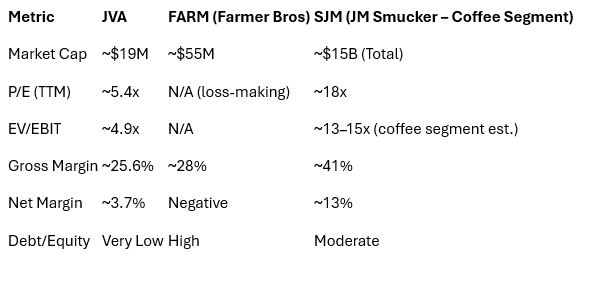
While JVA is smaller, it has better profitability and cleaner financials than its direct peer Farmer Bros, and trades at a significant discount to the broader beverage/CPG space. The current valuation implies little to no growth, despite improving fundamentals and a clean balance sheet.
Debt and Growth Capacity
JVA maintains a very modest debt profile, which offers considerable optionality. As of FY2024, the company had paid down $9.6 million in debt and carried just a $2.2 million credit facility. With a nearly unlevered balance sheet and over $22 million in net current assets, JVA retains substantial flexibility to expand its capital structure.
This context helps clarify the rationale behind the $30 million shelf registration filed in early 2025. While it initially spooked some investors fearing dilution, management made it clear that this was a precautionary measure—designed to give them the flexibility to move quickly if a strategic acquisition or expansion opportunity materializes.
Given the bankruptcy of multiple local coffee competitors and the Empire Coffee acquisition already under its belt, JVA appears poised to play offense. With a clean balance sheet and a shelf registration in place, the company is setting the stage for potential roll-up strategies or operational expansions that could significantly scale revenue.
For a business already operating with vertical integration and rising margins, this latent growth optionality—enabled by prudent financial positioning—may turn out to be one of the more underrated elements of the investment thesis.
Ownership and Insider Activity
The Gordon family, who have led the company for over 30 years, continue to hold a significant stake in JVA. According to the most recent filings, Andrew and David Gordon collectively own over 12% of the company’s outstanding shares, giving them meaningful skin in the game.
Their compensation packages, while not insignificant, appear aligned with shareholder interests. In the most recent fiscal year, Andrew Gordon earned $344,432 and David Gordon earned $352,684. These figures represent roughly 10% of net income, which could raise eyebrows in companies where owners have little equity exposure. However, the Gordon brothers’ substantial ownership means their net worth is directly tied to the stock price and the long-term success of the business.
This alignment reduces the risk of short-term decision-making driven by salary incentives alone. On June 27, 2024, CEO Andrew Gordon purchased 25,000 shares at an average price of $2.18, totaling roughly $54,388. That same day, EVP David Gordon acquired 6,856 shares at $2.09, worth about $14,329. Together, the Gordon brothers bought 31,856 shares for a combined investment of $68,717—at prices near where the stock trades today.
This type of open-market insider buying—especially at levels where retail sentiment was lukewarm—sends a strong signal of conviction. To date, there have been no insider sales reported since.
Additionally, institutions like Renaissance Technologies (6.6% stake) and Goldman Sachs (27,408 shares) have taken positions, which is notable for a company of this size. It adds a layer of validation and suggests that quantitative models and large institutions have identified something fundamentally attractive in JVA's setup.
Trading Volume and Liquidity
As of May 2025, JVA trades an average of approximately 250,000 shares per day over the past 20 trading sessions—an impressive figure for a company with a sub-$20 million market cap. While this level of liquidity may fluctuate daily, it offers considerably more flexibility than most micro-caps.
For example, on May 1, 2025, the trading volume was around 66,000 shares, well below the average. Such variability is typical in thinly-traded names, and investors looking to accumulate or exit larger positions should be mindful of slippage and bid-ask spreads.
Nevertheless, the relative liquidity in JVA stock suggests a healthy level of interest and a market that’s more accommodative than many peers in the micro-cap universe. For value-focused investors who are used to navigating illiquid names, this volume profile is a welcomed advantage.
Risks and Considerations
While JVA presents an intriguing investment opportunity, potential investors should consider the following risks:
Commodity Price Volatility: Fluctuations in coffee prices can impact margins, despite hedging strategies.
Hedging Risks: While hedging can protect against price swings, it also introduces complexity and potential losses if not managed effectively.
Customer Concentration: The loss of a major customer could significantly impact revenues.
Market Position: As a small player in a competitive industry, JVA may face challenges in scaling operations and competing with larger firms.
Recent Price Action: A Market Overreaction?
On March 7, 2025, Coffee Holding Co. shares surged to a 52-week high of $9.93, driven by investor excitement over the Empire Coffee acquisition and strong FY2024 results. The company’s positive commentary about margin improvements and growth opportunities helped fuel optimism.
However, in the days following, the stock saw a steep decline—dropping more than 30% by March 10. The selloff appears to have been driven primarily by two catalysts:
A $30 million shelf registration filing: This filing, while normal for public companies, allows JVA to issue securities at a later date. It caused some concern among investors about potential dilution. However, management was quick to clarify that there are no immediate plans to raise capital. The shelf was filed as a precaution, not as a fundraising strategy.
A delayed 10-Q filing: JVA filed a Form NT 10-Q indicating they needed additional time to complete their quarterly report due to logistical challenges in gathering certain information. While not ideal, such delays are not uncommon for smaller firms, especially following a significant acquisition like Empire. Importantly, there were no indications of accounting irregularities or financial distress. The report was later filed without any restatements or red flags.
These two events appear to have spooked short-term holders and created an exaggerated reaction. For long-term investors, this type of volatility—especially when disconnected from underlying business performance—can present a compelling entry point.
As of this writing, shares have settled back to the $3.20–$3.30 range, wiping out the entire rally from earlier in the year. Yet the fundamentals of the business have only improved.
Conclusion
Coffee Holding Co. (JVA) exhibits characteristics that may appeal to value investors: a strong balance sheet, strategic acquisitions, effective hedging practices, and insider ownership. While not without risks, the company's current valuation and recent performance suggest it could be a worthwhile addition to a diversified investment portfolio. At a valuation below liquidation value, with earnings power, insider alignment, and optionality to grow through disciplined acquisitions, JVA may represent a rare mispriced micro-cap with real upside.
Note: This analysis is for informational purposes only and does not constitute investment advice. Investors should conduct their own research before making investment decisions.
No posts
Comments
Nothing yet. Say the first thing.
Sign in to join the conversation.