


Jack Welch is often mentioned as one of the most well-known CEOs in modern business history. Over two decades at General Electric, the company generated a 20.9% compound annual return, turning $1,000 into $45,000. He was a public figure, regularly in the media, and became widely known in the business world.
Henry Singleton, who ran Teledyne during roughly the same era, is less of a household name but quietly delivered even stronger results. Singleton, the former CEO of Teledyne, led the company through nearly three decades of compounding at 20.4% annually, turning $1,000 into approximately $180,000. Over the same period, a similar investment in the S&P 500 would have grown to around $15,000, and a diversified group of comparable companies would have produced roughly $27,000.
Singleton didn’t spend much time in the spotlight. He focused on capital allocation—buying cash-generating businesses, repurchasing shares when they were undervalued, and avoiding dilution or dividends unless they made sense strategically.
Warren Buffett once referred to Singleton as “the greatest capital allocator of all time”
The Typical Approach
A lot of money managers and business owners tend to follow a traditional playbook: focus on growing revenue, making acquisitions that add to the top line, issuing new shares when needed, and paying regular dividends. That’s a common approach, and it tends to line up with what many shareholders and investors expect. It’s also a familiar theme in private equity.
But over time, this strategy can sometimes work against long-term compounding. When companies chase growth by buying other businesses—especially ones that don’t generate returns as strong as the core operation—the value created for existing stakeholders can shrink. This is even more true when those deals involve issuing more equity or taking on debt.
On the surface, it may look like progress. Revenue goes up, the business gets bigger. But if the returns on capital drop or ownership gets diluted, the long-term picture isn’t always as strong as it appears. As McKinsey wrote, “the net value creation to the buyer is usually a small fraction of the deal’s value and therefore easy to wipe out with indifferent execution or ill-informed economic assumptions.” Even modest missteps—overpaying, overestimating synergies, or underestimating cultural friction—can erode shareholder value more quickly than anticipated.
This kind of strategy became more common among companies in the 1990s. While Henry Singleton was quietly buying back Teledyne’s stock at a discount, many other companies were taking the opposite route—issuing new shares to fund a series of acquisitions. Over time, a lot of those deals didn’t hold up and were eventually written down or sold off. The long-term results reflected that. On average, those companies earned about 11% returns, while Teledyne significantly outperformed the broader market.
The main takeaway is that growth by itself isn’t always enough. Without a clear and disciplined approach to how capital is used, even well-run businesses can struggle to create lasting value. The principle behind the buyback—putting capital to work where it earns the highest return—applies just as much to private businesses.
What Capital Allocation Means
Capital allocation just comes down to how a company puts its cash to work. The main choices are usually some mix of:
Reinvesting in current operations
Acquiring other businesses
Paying dividends
Reducing debt
Repurchasing stock
They also decide how to fund those investments: through internal cash flow, new equity, or debt.
Henry Singleton at Teledyne took a different approach than most. He didn’t pay dividends, but he did buy back a lot of stock when it was cheap. He didn’t take on much debt and didn’t rush into acquisitions. It was a steady, measured approach that ended up working out well over the long haul.
His story doesn’t mean there’s one right way to do it. But it does show that being intentional and consistent with capital decisions—without chasing trends or trying to force growth—can make a big difference over time.
Five Key Areas When Allocating Capital
A useful way to evaluate capital allocation decisions—by anyone from CEOs to money managers to investors—is by breaking them into a few core areas:
1. Risk
One of the main things to look at in any capital allocation decision is risk—not just how much risk there is, but what kind of risk. It’s not about volatility or day-to-day swings. The real concern when underwriting deals is the potential for permanent loss of capital. “Rule No. 1: Never lose money. Rule No. 2: Never forget Rule No. 1.” – Warren Buffett
The goal isn’t to eliminate risk altogether, but to make sure the risk being taken is understood and makes sense in context. That includes thinking through worst-case scenarios, spotting any hidden leverage, and asking whether the business or investment could hold up across a range of outcomes. Another quote. “Risk comes from not knowing what you’re doing.” – Warren Buffett
Henry Singleton seemed to take that kind of approach—he weighed trade-offs, challenged assumptions, and didn’t make moves unless there was a clear margin of safety. Most thoughtful allocators tend to look for that same dynamic: situations where the downside is relatively limited and the potential upside is meaningfully better.
It’s less about chasing big returns and more about staying away from outcomes that are hard to come back from.
2. Return
Return tends to be the most visible number people look at, but it’s not always the most clearly understood. It’s not just about growing revenue or earnings—it’s about how efficiently capital turns into lasting value for shareholders. Return on invested capital, especially on a per-share basis, tells more of the story once things like dilution, reinvestment risk, and opportunity cost are taken into account. Good capital allocators think in terms of return relative to alternatives—not just absolute numbers.
It’s also worth noting that return on capital without context can be misleading. It needs to be viewed alongside the reinvestment rate and capital structure to get a full picture of the value being created—or not.
Henry Singleton focused on decisions that quietly improved per-share value, even if they didn’t look like big growth plays. He didn’t just improve returns—he controlled the denominator. Fewer shares, more value per share. Buying back undervalued shares, when done carefully, can steadily increase value over time. High returns don’t always come from big moves— a lot of times they come from consistent, incremental decisions that compound over time.
Private companies can’t buy back shares the same way public companies can, but the general idea is the same. Thoughtful dilution avoidance plays a similar role—protecting the ownership base while compounding value. Owners who are disciplined about when to raise capital, how they reinvest cash flow, and how they weigh outside capital against the opportunity cost are applying the same kind of long-term thinking in a different form.
3. Liquidity
Liquidity is less about having cash in the bank and more about keeping flexibility. Some capital allocation decisions tie up resources for a long time, while others leave room to adjust. Having liquidity makes it easier to handle surprises or move quickly when something worthwhile comes along.
At Teledyne, Singleton set things up to generate steady free cash flow and avoided locking up capital without a good reason. His decentralized approach gave operating units room to run, while still keeping financial flexibility at the top.
Liquidity doesn’t have to mean sitting on idle cash. It can be a form of optionality—the ability to act when the timing is right instead of being forced to sit still or stretch. Holding 20% in cash while waiting on a 15% return opportunity can be more valuable over time than staying fully deployed in 8% returns, especially if those higher-return opportunities come around occasionally but have a big impact when they do.
In certain environments, staying liquid can lead to better long-term results than always being fully invested. As Howard Marks put it: “You can’t predict. You can prepare.” Liquidity is part of the preparation.
4. Tax-Efficiency
Returns are only meaningful after taxes. A capital allocation decision that looks strong on a pre-tax basis can look very different once tax implications are factored in. Whether it’s choosing between dividends and share repurchases, structuring real estate investments to benefit from depreciation, or deferring gains through careful transaction planning, tax awareness can materially impact long-term outcomes.
Buffett’s Deferred Tax Strategy: Warren Buffett has described deferred tax obligations as a kind of interest-free loan from the government. Berkshire Hathaway holds tens of billions in unrealized capital gains, creating a large deferred tax liability that may not need to be paid for many years. By holding appreciated assets instead of selling them, the company effectively retains capital that can continue to compound. Buffett once referred to this dynamic as “an interest-free, no-expiration, non-callable loan” from the U.S. Treasury. While not often discussed, this kind of tax deferral can play a meaningful role in long-term capital allocation—allowing companies to keep more capital working over extended periods of time.
5. Timing
Markets don’t tend to present opportunities on a set schedule. Capital allocation often requires a mix of patience and readiness, the willingness to hold back when prices are high and the clarity to act when conditions change.
Singleton was comfortable holding cash when valuations didn’t make sense and just as comfortable deploying it when they did. His decisions weren’t dictated by external pressure or short-term expectations, but by a long-term view of value.
Why It Matters
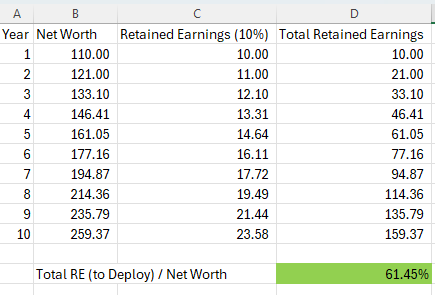
Over a ten-year period, a CEO who retains just 10% of the company’s net worth each year will end up allocating over 60% of the business’s capital. (*See visual below). That means even with similar operating results, two money managers can produce very different outcomes for shareholders—just based on how they deploy capital.
This isn’t always obvious in the short term, but over time, the impact can add up. It’s typically not just about what a business earns—it becomes about what gets done with those earnings. Capital decisions often end up shaping the long-term results more than people realize at the time.
* Visual Example: 10% Annual Capital Allocation (No Growth Assumed)
No posts
Comments
Nothing yet. Say the first thing.
Sign in to join the conversation.