
As I write this, I am on my way to meet with the head of the Greek Orthodox Church in North America. The theological nerd inside me is geek'n out.
No, I am not converting. I am learning.
For the last two years, scores of young men have been running toward Greek Orthodoxy. I want to understand why. What are they finding there that they believe is missing elsewhere? Why does its weight, tradition, brotherhood, discipline, and sense of transcendence seem to resonate so deeply with young men?
Yesterday, I was teaching at another Southern Baptist state convention. There were nearly 70+ equipping sessions. Most focused on children and students. Many devoted to women. Some devoted to discipleship in general.
One was devoted to men. I’m that guy. The one tucked in the corner of the program: Winning the Church Back to Men w/Dr. Chris Harper
My colleague and I were in a small room, ironically in the children’s wing. The room was hot, crowded, and quickly ran out of seats. Pastors and men’s leaders kept pouring in. Grown men squeezed into toddler chairs, lined the walls, and stood in the doorway.
They were not there for inspiration. They were not there because men need another breakfast, hunting trip, or workout program. They were there because they are desperate for help.
They wanted to know how to equip the men they have and reach the men they don’t.
The room told the story. The need is not small. The interest is not absent. The men are not unreachable. The problem is that we keep placing the discipleship of men in the back room, and then act surprised when men look somewhere else for answers.
I love my denomination, but not with a blind love.
I am not a fanatic. A fanatic refuses to see fault. He becomes so enamored with an ideology, a political party, or an institution that he defends everything and questions nothing. Loyalty becomes denial.
Real love is not blind. As G. K. Chesterton wrote, "Love is not blind; that is the last thing that it is. Love is bound; and the more it is bound the less it is blind."
I am bound to the Southern Baptist Convention.
I am not writing as an outsider throwing stones. I am a Southern Baptist, and I chose to be one. I was not 'born' into this denomination. I was drawn to it. I was trained in its seminaries, encouraged by its leaders, shaped by its churches, and entrusted with opportunities to serve within it. The SBC did not merely become part of my story; in many ways, it formed me. I am a lifer.
I have spoken at our annual convention. I have taught at state conventions, associational gatherings, and Southern Baptist churches across the country. I have seen firsthand the enormous good Southern Baptists are doing around the world. Our commitment to missions, theological education, church planting, cooperation, and the authority of Scripture remains one of the great strengths of our denomination.
I love my denomination. And because real love is secure, it is free to tell the truth. I need to say something truthfully and plainly: We have forgotten the men.
We have not given the discipleship of men the attention, energy, or investment it deserves.
We love our women’s ministries, and we should.
We love our children’s and student ministries, and we should.
We have built conferences, curriculum, leadership pipelines, training programs, and entire ministry ecosystems to serve women and children. Praise God for every one of those investments. This is not a criticism of what we have built for women and children. It is a lament over what we have failed to build for men.
Visit many of our churches and ask about their strategy for discipling women. They can tell you.
Ask about their strategy for discipling children or teenagers. They have leaders, curriculum, budgets, events, and a plan.
Ask about the men…. Nothing outside a quarterly breakfast, an occasional retreat, or a Bible study attended by the same six faithful men.
That is not a strategy. It’s an event calendar.
LifeWay, our publishing arm, still produces a few resources for men. I am grateful for them. But we do not have anything resembling the sustained investment, visibility, and coordinated ecosystem found in other areas of ministry. LifeWay’s own research has acknowledged that men’s discipleship continues to lag behind women’s discipleship. And they are being polite. Beth Moore [who ironically defected], Priscilla Shirer, and now Jen Wilkin dominate the shelves of LifeWay. And have for 30+ years. Few helpful resources for men are being produced.
Our seminaries train men to preach, teach, counsel families, and defend sound doctrine. All of that matters deeply. But a man can graduate with a robust theological education and receive very little training in how to reach, engage, and disciple the men in his congregation and community. Given enough time, any pastor/leader will lean on his strongest demographic. Women have been carrying the weight of prayer, serving, bible reading, attendance, and [now] giving for decades. Is it any wonder our church programs, music, aesthetics, and language cater to women [and their children]?
The church has learned to operate around the absence of men rather than confront it. We have adjusted to disengaged men. We have lowered our expectations for passive men. We have built ministry models that can continue functioning without responsible, spiritually mature men. And we wonder why men are, at best, quiet, at worst gone.
Most pastors today have little idea how to reach men who will never attend a traditional Bible study. They have not been taught how to move men from passive attendance to active obedience. They often lack the relational influence needed to call men out of isolation and into brotherhood. They have not been equipped to help a man understand what God has called him to be as a disciple, husband, father, worker, churchman, and neighbor.
And, in many cases, these pastors are uncertain about those things themselves. Too many pastors have been left to figure out the discipleship of men on their own. They are expected to pass on what no one intentionally gave them; to build in other men what was never fully built in them.
It was not always this way.
Our Baptist forefathers understood that reaching men was paramount and required intentionality. In 1907, Southern Baptist laymen organized the Laymen’s Missionary Movement under leaders such as Joshua Levering and former Georgia governor W. J. Northen. It eventually became the Baptist Brotherhood and then the Brotherhood Commission. Its stated purpose was to "bring men to God through Jesus Christ and involve men and boys in the missionary work of the church."
The Brotherhood Commission developed Baptist Men. We trained boys through Royal Ambassadors, organized national gatherings, promoted lay renewal, and helped pioneer Southern Baptist disaster relief. Brotherhood Men did not simply sit in a classroom and talk about missions. They showed up, served their neighbors, rebuilt communities, shared the gospel, and brought their sons with them.
They understood something we have forgotten: Men do not drift toward spiritual maturity. They must be intentionally reached, challenged, equipped, and called into the mission of God.
In 1997, the Brotherhood Commission was dissolved through denominational restructuring, and many of its responsibilities were moved elsewhere.
Structures change. Organizations come and go. I am not arguing that we recreate an old agency simply because it once existed. But when the structure disappeared, our denomination never replaced it with a compelling, coordinated vision for reaching and discipling men.
The result is the largest unreached people group in the world: men.
We have churches filled with women praying that their husbands will one day lead spiritually.
We have boys growing up without godly men showing them what biblical manhood looks like.
We have pastors carrying enormous burdens without a band of godly men beside them.
We have millions of men outside our churches who assume Christianity has little to say about their deepest questions.
And the world speaks where the church is silent. The world is discipling these men. Algorithms are discipling them. Politics is discipling them. Pornography is discipling them. Influencers are discipling them. Anger, isolation, ambition, and entertainment are discipling them.
The only question is whether the church will.
Southern Baptists, we can do better.
Our seminaries should equip future pastors not merely to preach to men but to disciple them. Our state conventions should help churches develop sustainable strategies for reaching and forming men. LifeWay should make men’s discipleship a visible and substantial priority, investing in biblical resources that move men from information to transformation.
Our churches should build more than events for men. We need clear pathways that move men from the crowd into community, from community into discipleship, and from discipleship into mission.
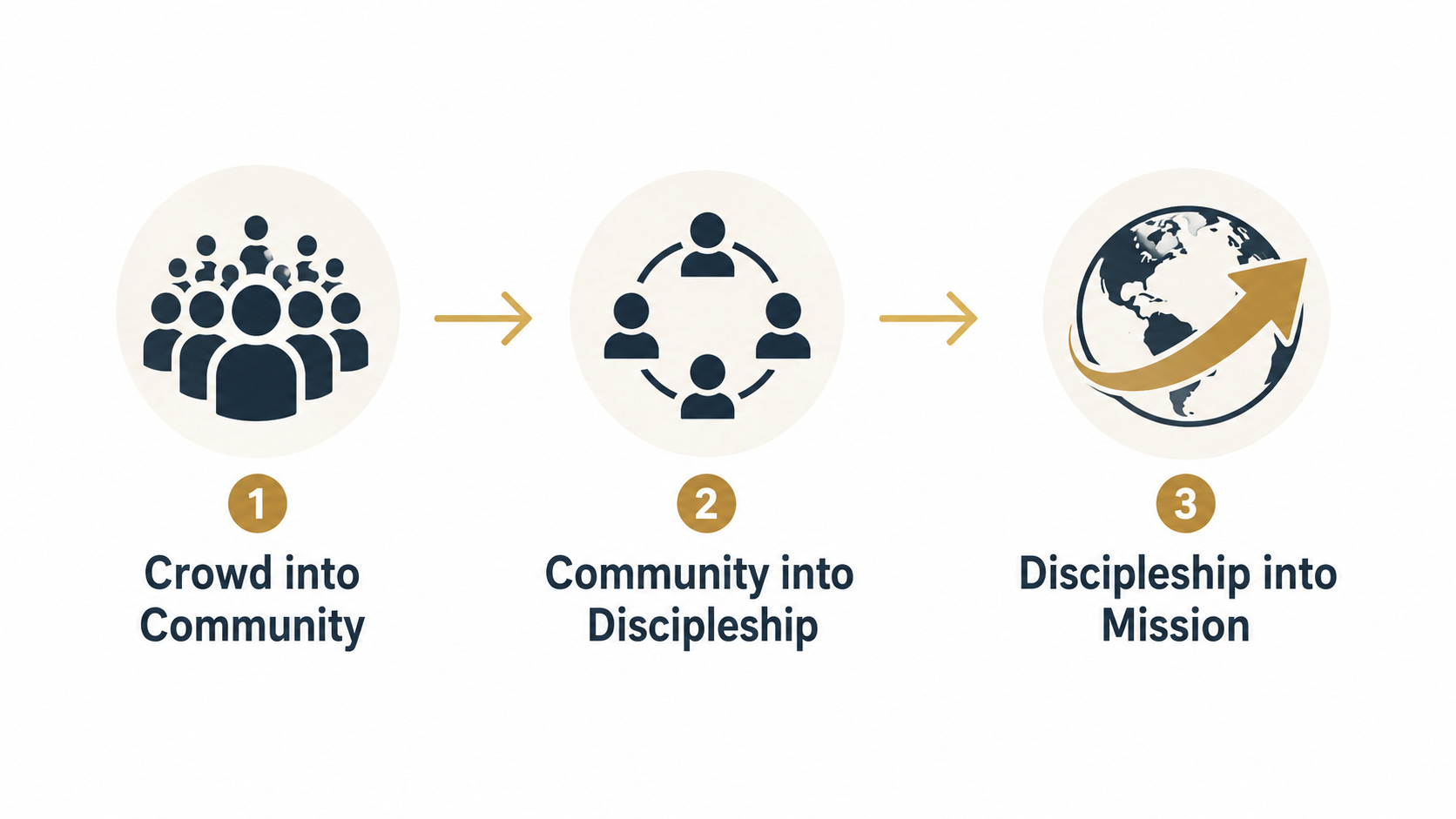
Our denomination must stop treating ministry to men as optional. This is not about creating another demographic program. It is about fulfilling the Great Commission among half the population.
We do not need less ministry to women. We do not need less investment in children. We need to recover a vision for calling men to repentance, responsibility, sacrifice, brotherhood, and mission under the lordship of King Jesus.
We need to recover the 'ancient paths,' a 1907 vision, the idea that men are the high tide that raises all ships. When a man is transformed by the gospel, he never changes alone.
His marriage feels it. His children see it. His church is strengthened by it. His workplace is influenced by it. His community benefits from it.
For decades, Southern Baptists have declared that we want to reach the nations. Amen. But the nations are filled with men, and most of those men are absent from our churches, disengaged from our mission, and unclear about God’s calling upon their lives.
We have built churches, but we have forgotten the men sitting in them and the men nowhere near them.
I love the Southern Baptist Convention. I believe in our churches. I believe in our pastors. I believe our best days are not behind us. But it is time to remember the men.
It is time to reach them. It is time to disciple them. It is time to call them to become the men God created them to be.
And for Christ's sake… invest in some bigger chairs.
For the King,
— Harp
No posts
Comments
Nothing yet. Say the first thing.
Sign in to join the conversation.