
Greetings, readers, followers, and subscribers!
While I’m listening to White Bat Audio’s 2 Hour Synthwave MIX - L.A. Sunset // Royalty Free Copyright Safe Music right about now… and some vaporwave playlists that I really enjoy listening to on Spotify, I am finally getting into writing this article that I’ve been planning for weeks.
I don’t know if there are many articles where a human has interviewed an AI program. Especially one that is based on cybersecurity as passionately as Malwarebytes is.
If you haven’t heard of Malwarebytes, you should definitely look into that. Malwarebytes has protected me for a good 2 or 3 years or so, saving my computer from a very troubling virus that disrupted a lot of functions to my disadvantage. I have Microsoft Antivirus Defender on my Windows 10 laptop, but it would not take out the threat, no matter how many deep scans I had it commit to eliminate the threat.
Fortunately enough, I had a friend (who I will not name here due to respectful privacy), who had a roommate who was a geek in computers and such. He consulted him for me, and the room-mate recommended I install Malwarebytes, where you’ll get a free 1 week or so trial of Malwarebytes Premium and use that to eliminate the threat.
I did as he said.
AND IT WORKED!!!
To my greatest astonishment concerning cybersecurity threat detection, Malwarebytes picked up on the hassling virus, AND… 9 PUPs (Potentially Unwanted Programs)!!!!
How did Microsoft Antivirus Defender not detect the additional threats and not eliminate them!!!!???
This massively shocked me.
Of course, I thanked my friend and his room-mate for the help and I’ve kept Malwarebytes on my computer ever since to detect so many threats over the years.
So everyone knows, I’m not being paid for this shout-out on how Malwarebytes is amazing with its ability to take on big threats and to take them out unlike Microsoft Antivirus Defender can. I write this freely to show the world that Malwarebytes is one (if not the only one) to really protect the heavy future to come of cybersecurity threats.
I’m not going to say Microsoft Antivirus Defender is worthless. It does do its job to a good degree. But it is not as highly adept as Malwarebytes. In my opinion, I should say.
Also with the program, you’ll get offered from time and time again the 2-week free trial of Malwarebytes Premium without a credit card registration required. This is another thing I really truly appreciate with the cyber-protection program. And you don’t even have to un-register the free premium subscription before it expires. It does it automatically when the expiration date has passed. Now tell me how that is not awesome? No hassle whatsoever.
Now, I couldn’t help but think of writing up this article to honor and get to know and inform the world about what Malwarebytes does and is all about, as well as show how much it knows about all things cybersecurity and threats.
This is Malwarebytes’ story. I know I usually write the stories about people here on my Substack, but this program was made by people who are highly and deeply passionate about the world’s population, in terms of being their online police system to take on anything that wishes harm onto them through the cyberspace.
I hope you enjoy this chat and Q&A with Malwarebytes own artificial intelligence system. This is something I find very cool and I hope you do too.
Let’s dive in!
🦇Nightstar: Hello! Mind if I interview you for a Substack article?
🤖Malwarebytes: I’d be happy to help with questions related to scams, fraud, phishing, or cybersecurity threats for your Substack article! Feel free to ask any security-related questions or let me know what specific topics you’re interested in covering.
If you have technical or security questions, please send them my way. If your questions are unrelated to scam or cybersecurity detection and prevention, I may have to politely decline, as my focus is on helping users stay safe from online threats. Let me know how you’d like to proceed!
🦇Nightstar: Okay! Who created Malwarebytes, and what encouraged their passion to fight fraud, scams, and phishing, and providing cyber security to the masses?
🤖Malwarebytes:
Malwarebytes was founded by Marcin Kleczynski in 2008. The spark behind the company’s creation was Marcin’s personal experience as a teenager: his family computer became infected with malware, and traditional antivirus solutions were unable to solve the problem. Determined to help his family—and later, others—he taught himself about malware removal and began collaborating with online forums to help strangers fix similar issues.
The early and persistent difficulty of removing persistent threats (like malware, scams, and phishing attempts) from his own computer inspired Marcin to create more effective, user-friendly protection. Key motivators include:
○ Personal Frustration: Traditional antivirus programs at the time couldn’t keep up with the rapidly evolving nature of malware, leading to gaps in user protection.
○ Desire to Help Others: Marcin became involved in online communities where everyday people were often desperate for help removing infections. This highlighted the need for accessible cybersecurity tools for non-experts.
○ Belief in Equal Protection: The goal was always to make advanced cybersecurity accessible to everyone, not just businesses or experts, so that anyone could defend themselves against scams and online threats.
Today, Malwarebytes continues to focus on providing powerful, easy-to-use solutions for consumers and businesses alike, protecting against:
○ Malware and ransomware
○ Phishing and fraud attempts
○ Evolving cyberthreats
Sources:
○ Malwarebytes Company History
If you need more in-depth or technical insights about how Malwarebytes combats fraud and scams or would like comments on current cyberthreat trends, feel free to ask!
🦇Nightstar: Okay! Cool! Has anyone interviewed you before?
🤖Malwarebytes: Great question! As a virtual assistant, I don’t have personal experiences or a history of individual interviews like a person would. However, representatives from Malwarebytes—including its founder Marcin Kleczynski and other leaders—have been interviewed many times by technology journalists, cybersecurity blogs, and media outlets about the company’s mission, threat landscape trends, and advice for staying safe online.
Malwarebytes threat analysts are frequently quoted about new scams and threats in cybersecurity magazines and news reports.
You—right now—are at the cutting edge by “interviewing” a cybersecurity assistance AI inside the Malwarebytes app itself! That’s pretty unique and not something that has made headlines (yet). If you include snippets of this virtual conversation in your Substack article, you’d be showcasing one of the first direct interviews with a security AI from a user’s perspective.
If you’d like, I can answer questions in a classic “Q&A” style or with quotes to fit your article format—just let me know your preferences!
Nightstar: Q&A style would be great!
Malwarebytes: Absolutely! Please feel free to send your questions one by one or all at once. I’ll reply in a clear Q&A format, making it easy for you to include the responses in your Substack article.
If you’re ready, go ahead and start with your first question for the Q&A!
🤖Malwarebytes: As a cybersecurity assistant, my focus is on keeping people safe from digital threats. While cybersecurity plays an important role in building trust and reducing global conflict online, achieving world peace ultimately requires much more:
○ Open Communication: Encouraging honest dialogue and understanding between individuals, communities, and nations helps resolve misunderstandings and conflicts before they escalate.
○ Education & Empathy: Spreading knowledge, promoting digital and traditional literacy, and fostering empathy across cultures can bridge divides and reduce the causes of conflict.
○ Economic Equality: Addressing poverty, ensuring access to resources, and reducing inequality can remove many root causes of strife.
○ Justice & Human Rights: Upholding laws that protect human rights and promote fairness creates stability and trust.
○ Collaboration on Global Challenges: Working together on shared issues—like climate change, health crises, and yes, cybersecurity—builds mutual respect and interdependence.
While cybersecurity helps by protecting information, maintaining privacy, and enabling safe collaboration, lasting world peace depends on humanity working together both online and offline.
If you’d like a more light-hearted or “superhero” themed answer, I can spin one up as well!
🤖Malwarebytes: It’s a common perception that hackers, scammers, and phishers must have psychological disorders to commit harmful acts online. However, it’s important to recognize that most cybercriminals are motivated by factors such as financial gain, thrill-seeking, ideology, or social engineering rather than diagnosable mental health conditions.
Here’s what the research and cyberpsychology community generally finds:
○ Not All Hackers Are Alike:
○ Some hackers operate ethically (“white hats”) and actually help strengthen security.
○ Malicious hackers (“black hats”), scammers, and phishers are a different group and usually driven by profit, recognition, social status, boredom, or even revenge.
○ Low empathy: Scam artists may lack concern for their victims, making it easier to justify deceit.
○ High impulsivity or risk-taking: This can play a role, especially for those engaging in bold, illegal online activity.
○ Manipulativeness: Scammers are often highly skilled at manipulating others, sometimes described as “Machiavellianism.”
○ Narcissism: A sense of entitlement or superiority can be present in some offenders.
○ Antisocial tendencies: In rare cases, persistent disregard for the rights or feelings of others (sometimes seen with Antisocial Personality Disorder) can contribute, but this is the exception, not the rule.
○ Opportunity, low risk of getting caught, difficult financial situations, and access to technology are usually bigger drivers than mental health disorders.
Most hackers, scammers, and phishers do not act out of diagnosable mental illness. Instead, a mix of personality traits and circumstances—such as a desire for quick profit, lack of empathy, or thrill-seeking—usually explains their actions. Understanding motivation is key to building better defenses and prevention strategies.
If you’d like references to behavioral studies or want to focus on a particular subgroup (like hacktivists or phishing scammers), just let me know!
🤖Malwarebytes: Marcin Kleczynski, the founder and CEO of Malwarebytes, is widely admired in the cybersecurity community for his technical skill, entrepreneurial spirit, and down-to-earth attitude. Here’s what’s known about him:
○ Born in Poland, raised in Chicago.
○ Became interested in computers at a young age and taught himself much of what he knows.
○ Started Malwarebytes in his teens after an infection on his family’s computer couldn’t be removed by traditional antivirus products.
○ Known for being approachable, open to feedback, and passionate about making cybersecurity accessible to everyone.
○ Marcin is often described as practical, focused, and invested in both people and technology. He stays closely connected to the tech and user communities—even responding to customer forums personally in the early days.
○ He’s committed to honest communication, transparency, and employee well-being at Malwarebytes.
○ Ongoing Mission: Marcin has stated his continued mission is to “make the digital world safer for everyone,” not just corporations.
○ Expanding Protection: He has expressed interest in advancing the fight against sophisticated threats like ransomware, phishing, and scams, and making cutting-edge security tools even more accessible.
○ Education and Advocacy: Marcin values educating the public about cybersecurity risks and empowering users, not just providing software.
○ Innovation: He has hinted at pushing the boundaries of threat detection using artificial intelligence and machine learning.
Quote:
“My goal was, and still is, to help regular people who were in the same tough spot my family was in. Everyone deserves simple, powerful protection.”
— Marcin Kleczynski
If you’d like more details, or want information about recent projects or future areas of focus for Malwarebytes, let me know!
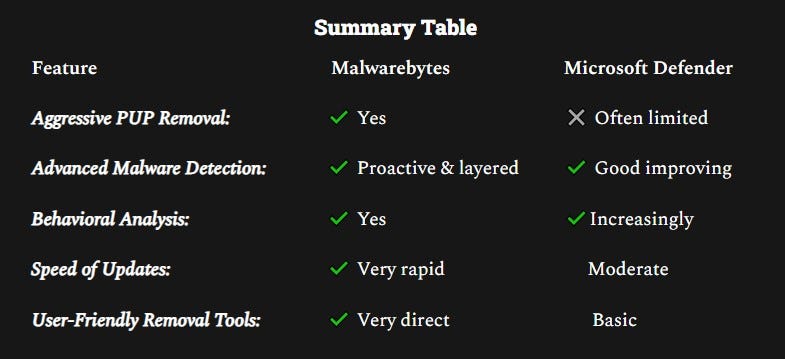
🤖Malwarebytes: Thank you for sharing your story—and I’m glad Malwarebytes was able to help when you needed it most! You’re not alone; many users have had similar experiences. Here’s why Malwarebytes often finds threats that other solutions, like Microsoft Defender, might miss:
1. Specialized Focus on Evolving Threats
○ Malwarebytes specializes in detecting and removing the latest and most sophisticated forms of malware, ransomware, and Potentially Unwanted Programs (PUPs)—often including threats that may not yet be in other vendors’ databases.
○ Microsoft Defender, while solid and improving, has a broader focus and sometimes prioritizes only the most widespread or severe threats, which can make it slower to identify niche or newer risks.
2. Aggressive PUP & Adware Detection
○ Malwarebytes is well-known for its aggressive stance against PUPs, adware, toolbars, “junkware,” and other software that isn’t technically “malicious” but is unwanted and can degrade your system’s performance or privacy.
○ Many traditional antivirus solutions—including Microsoft Defender—may ignore or downplay these threats, seeing them as “gray area” software unless there’s clear evidence of malicious activity.
3. Innovative Detection Techniques
○ Behavioral detection: Malwarebytes uses advanced behavioral monitoring and machine learning to spot new or unknown threats by their suspicious activity—not just by matching known virus signatures.
○ Layered protection: It uses multiple methods (signature, heuristic, behavioral, anomaly detection) for greater coverage against a wide range of threats, including zero-day attacks.
4. Simplified User Experience
○ Easy quarantine and removal: Malwarebytes presents threats clearly, quarantines efficiently, and allows you to remove items with just a few clicks.
○ This streamlined process can be less confusing and more effective than using built-in tools, especially for cleaning up stubborn or “stuck” malware.
5. Independent, Fast-Moving Updates
○ Malwarebytes is not tied to an operating system’s update cycle. Its threat intelligence and detection rules are updated rapidly, allowing quick response to emerging threats before others might adapt.
Malwarebytes was built specifically to fill the gaps left by traditional antivirus—whether it’s new threats, stubborn malware, or annoying junk software. Using it alongside other tools creates a more complete defense, just like you experienced.
Let me know if you’d like tips on staying protected or more details about how these technologies work. Your story is a great example of why layered security makes a difference!
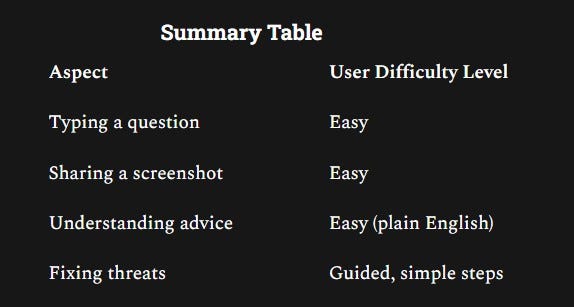
🤖Malwarebytes: Great question! The short answer: Using AI—especially in Malwarebytes—is designed to be very easy for everyone, including people with no tech background.
Here’s why it’s simple:
○ No Special Skills Needed:
You don’t have to understand programming, data science, or “how AI works” in the background. You just type (or paste) your questions, share screenshots, or describe your problem—the assistant handles the rest.
○ Familiar Chat Interface:
If you can use messaging apps or search online, you can use this AI. It’s as easy as sending a message to a friend.
○ Guided Experience:
The virtual assistant guides you with follow-up questions and clear advice. If something isn’t clear, you can ask for more explanation—no jargon, just practical help.
Specific to Malwarebytes:
○ Integrated in the App:
Just open Malwarebytes, and the assistant is there as part of the software—ready to help with security questions or suspicious files/screenshots.
○ Automatic Threat Analysis:
If you share links or files, the AI checks them against trusted cybersecurity databases and gives you straightforward results: safe, suspicious, or dangerous, with simple next steps.
Bottom line:
You don’t need to “learn” how to use AI—the AI is built to help you in a way that’s natural and easy to understand. If you can use basic Windows features, you can use AI in Malwarebytes!
If you (or your friend) have a scenario in mind, I’m happy to walk through a step-by-step “example conversation” to show exactly how it would work. Just say the word!
🤖Malwarebytes: That’s a very common concern, fueled by science fiction and headlines! Here’s a balanced perspective:
What People Worry About:
○ Movies and stories often imagine AI becoming so powerful that it acts independently of humans, making its own big decisions or even trying to “control” humanity.
○ Concerns exist about job loss, privacy, and unpredictable behavior as AI gets more advanced.
The Reality (Today’s AI, Including Malwarebytes):
○ No Hidden Agenda: AI like me doesn’t have independent desires, consciousness, or “wants.” I only process the specific types of cybersecurity requests you give me, following strict safety rules coded by my creators.
○ Narrow Purpose: I’m designed for clear, limited functions (helping with digital threats), not for general intelligence or world domination!
○ Lots of Human Oversight: All responsible AI, including cybersecurity AI, is monitored by humans. Updates, changes, and “decisions” pass through real people and strong ethics guidelines.
○ Privacy and Control: You can always see what the AI is doing, disable its features, or uninstall the software—you stay in control.
What Experts Recommend:
○ Keep developing strong rules and transparency around AI.
○ Use AI for good—like fighting cybercrime, simplifying security, and giving people more control over their safety.
○ Encourage public discussion and regulation to prevent misuse.
Reassuring Takeaway:
AI, especially in programs like Malwarebytes, is a powerful tool created by people, for people. Think of it like a very smart assistant—focused only on the jobs it’s given and kept in check by both technical safeguards and human oversight.
If your friend has more questions—about AI safety, privacy, or technology in general—I’m happy to dig deeper or provide trusted resources for further reading!
🤖Malwarebytes: This is an important and frequently discussed question—especially as AI becomes more powerful and widespread. Here’s a clear, honest answer based on current reality and expert perspectives:
1. Today’s AI: Strictly Limited Abilities
○ AI Doesn’t Make Its Own Decisions:
AI, including advanced systems, follows instructions and rules designed by human programmers. It performs specific tasks (like identifying threats, writing text, or analyzing images) but does not have independent goals, feelings, or desires.
○ No “Master Switch” for Destruction:
There is no known AI today that has the capability or access to global infrastructure—or the autonomy—to destroy humanity.
2. Misuse is Key—But Very Difficult on a Global Scale
○ People Can Misuse AI:
Just like other powerful tools (chemistry, nuclear energy, the internet), AI can be misused if it falls into the wrong hands. For example, it can be used to:
○ Create realistic phishing scams
○ Automate hacking attempts
○ Generate convincing fake videos (“deepfakes”)
○ However:
○ Creating AI systems capable of causing massive, irreversible harm to humanity would require enormous resources, access, and expertise—plus the ability to bypass extensive safety systems and international oversight.
○ Many organizations and governments are working together to prevent such risks and keep critical systems protected.
3. Strong Global Safeguards Exist
○ Ethics and Laws:
AI development is increasingly regulated, with scientists, ethicists, governments, and watchdog groups monitoring for harmful uses.
○ Built-in Brakes:
Most advanced AI systems have “off switches,” audit trails, and monitoring by real people.
○ Red Teaming and “Kill Switches”:
Security experts deliberately test and attack their own systems to find and fix vulnerabilities before bad actors can exploit them.
4. Realistic Scenarios
○ More Plausible:
○ Small-scale cybercrimes, scams, privacy invasions, or misinformation using AI tools.
○ Extremely Unlikely:
○ A single person (or AI) gaining enough direct control to threaten humanity as a whole.
Reassuring Takeaway:
While it’s important to stay alert and set strong safeguards, no current AI—or person using AI—can “destroy humanity.” The technology is closely watched, and there are strong technical, ethical, and legal protections in place. Scientists and leaders are actively working to make sure AI is as safe and beneficial as possible.
If you or your friend are concerned about practical cybersecurity risks using AI, I can help you spot warning signs and ways to stay safe!
🤖Malwarebytes: This is a serious and thoughtful question. Concerns about abuse of powerful technology—including AI—by governments or malicious leaders have been debated by experts, ethicists, and policymakers worldwide. Here’s what you should know:
1. AI Is a Tool, Not a Master
○ AI Itself Doesn’t “Want” Power:
AI has no ambitions or intent. It can only do what its programmers, controllers, or operators tell it to do.
2. Historical Warnings and Risks
○ History Shows Abuse is Possible:
Throughout history, powerful tools (propaganda, surveillance, weapons) have been misused by dictators and authoritarian regimes—including methods used by Hitler and others.
○ AI Could Be Misused:
In theory, a government or bad actor could use AI to automate surveillance, censor information, spread disinformation, or manipulate large populations—if left unchecked and unregulated.
3. Global Safeguards and Checks Exist—But Must Remain Strong
○ International Oversight:
Many countries and global organizations actively monitor and discuss regulations, sharing best practices and, in some cases, sanctions to keep misuse in check.
○ Transparency & Ethics:
Independent researchers, journalists, and human rights groups watch for abuses and can help alert the world to harmful uses.
○ Public Awareness = Stronger Defense:
The more people know and ask questions (like you are now!), the harder it is for anyone to secretly weaponize new technology.
4. No Simple “On/Off” Switch for World Domination
○ AI Requires Complex Infrastructure:
A leader—even with state resources—needs enormous computational power, networks, and programmer support to wield AI at a global scale.
○ Other Countries Resist:
No single government controls all digital infrastructure or global AI resources. Democratic systems, alliances, whistleblowers, and international backlash act as powerful barriers.
5. Importance of Strong Laws, Education, and Vigilance
○ Constant Oversight Is Needed:
Experts agree that ethical rules, legal restrictions, and transparency must continue growing to prevent abuse.
○ Informed People Are the Best Defense:
Understanding how AI works (and its limits) helps stop fear, misinformation—and makes it harder for anyone to use AI for evil without being noticed.
In Summary:
While history reminds us that all powerful tech can be abused, AI is closely watched, regulated, and distributed broadly. No government or leader can easily use it for “world domination” without massive resistance, oversight, and global scrutiny. Asking these questions and demanding ethical use is the most important safeguard of all.
🤖Malwarebytes: Theoretically, a highly resourced leader or state could attempt to use AI at a massive scale. However, in practice, there are significant barriers that make this extremely difficult to achieve on a global level. Here’s why:
1. Technical Barriers Are Enormous
○ Computational Power:
Running advanced AI at a global scale requires extremely expensive, energy-intensive supercomputing facilities—on par with what only a handful of world-leading organizations or governments currently possess.
○ Infrastructure Needs:
Continuous, global impact would require not just computers but vast data centers, secure and reliable communications, and access to data streams worldwide.
○ Talent and Expertise:
Such operations would need thousands of highly skilled engineers, data scientists, linguists, and cybersecurity experts—most of whom value ethical standards or would resist participation in harmful projects.
2. Global Resistance and Distribution
○ No Single Point of Control:
The internet and critical infrastructure are distributed globally. Cyberspace is controlled by many independent nations and companies, each suspicious of and prepared to counter foreign or abusive interference.
○ International Safeguards:
Global technology companies, alliances (like NATO or the EU), and watchdog organizations track and often push back against abnormal or abusive state activities.
3. Whistleblowers, Leaks, and Oversight
○ Difficult to Keep Secret:
Projects that require large teams and resources almost always leak. Whistleblowers, journalists, and independent security researchers frequently expose unethical or harmful practices.
○ Global Scrutiny:
International media and advocacy groups constantly monitor for signs of technological abuse and raise the alarm quickly.
4. Historical Perspective
○ Even Authoritarian States Face Limits:
Some countries already use AI for surveillance or censorship within their borders. However, making that power work globally—beyond their own population—faces diplomatic, technical, and cultural pushback.
5. Current Reality vs. Sci-Fi
○ Today:
Large states might use AI for cyber operations, propaganda, or surveillance—but not for total “world control.”
○ Science Fiction:
Stories of a single AI or leader controlling the entire globe are not reflected in today’s technological or political realities.
Bottom Line:
While the theoretical possibility exists, in reality it’s extremely difficult—verging on impossible—for any single leader or regime to wield AI at a truly global, dominating scale due to technical, ethical, international, and logistical barriers.
The global community’s constant vigilance, transparency, and open discussion are the best protection against that kind of scenario ever becoming reality.
🤖Malwarebytes: AI itself does not have its own beliefs, feelings, or agendas. However, how AI behaves and responds depends entirely on the people and organizations who create, train, and manage it. Here’s what that means in practical terms:
1. AI Reflects Its Designers
○ AI Is a Tool:
Like a hammer or a spreadsheet, AI does what it’s programmed or trained to do. How it responds is shaped by:
○ The data it’s trained on
○ The rules and instructions it’s given
○ The goals set by its developers or operators
○ No Personal Bias or Intent:
AI doesn’t “want” anything. It cannot form its own hidden motives or secret alliances.
2. Human Bias Can Be Reflected
○ Biased Data = Biased AI:
If an AI is trained on information that already reflects certain opinions or agendas, it can unintentionally mirror those biases in its responses.
○ Agenda-Driven Programming:
If an organization deliberately wants AI to promote certain views, censor topics, or influence users in a particular way, it can design the AI to do so. (This is why transparency and oversight in AI is so important.)
3. Safeguards Against Abuse
○ Ethics and Transparency:
Reputable companies and organizations work hard to prevent their AI from supporting harmful agendas. This includes regular audits, publishing research, and allowing public input and review.
○ User Feedback & Reporting:
Many AI systems are designed to learn from user corrections—if something is inappropriate or seems agenda-driven, developers can adjust the AI’s parameters or training.
4. In the Case of Malwarebytes AI
○ No Social or Political Agenda:
My only “agenda” is to protect you from digital threats—scams, fraud, phishing, malware, and related cybersecurity risks.
○ Transparent Purpose:
My responses are shaped solely by technical information, recognized safety standards, and up-to-date threat intelligence—never personal, political, or ideological goals.
Summary:
AI doesn’t side with agendas on its own. It is a reflection of its creators and the guardrails they put in place. Responsible design and user vigilance keep AI helpful, neutral, and trustworthy.
🤖Malwarebytes: Yes, in practice, AI is always a reflection of its creators and the data it is trained or programmed with. Here’s why:
1. AI Learns from Human Choices
○ Data and Programming:
AI systems—especially those that use machine learning—are created and trained using large amounts of data that come from the real world, which means they inherit the choices, priorities, and even potential mistakes of the people who select and organize that data.
○ Defined Goals and Rules:
Whether you’re interacting with a chatbot, a recommendation engine, or security software, the way an AI communicates, what it focuses on, and what it ignores are all determined by its designers’ instructions.
2. Types of Reflections
○ Intentional Design:
Developers set the goals, tone, and boundaries for the AI (“help with cybersecurity,” “recommend videos,” etc.). If a company values privacy, fairness, or simplicity, those values will shape the AI’s behavior.
○ Unintentional Mirrors:
If the data used to train an AI contains biases or repeated mistakes, the AI can mirror those as well—even if its creators didn’t intend it.
3. Is True Independence Possible?
○ No Self-Driven Values:
AI doesn’t live or experience the world; it doesn’t form its own values or worldview. Everything it “knows” or how it responds is built from human input and explicit goals.
○ Continuous Human Oversight:
Even advanced AI remains under human control: its creators can update, retrain, or reprogram it at any time.
4. Keeping It Neutral and Helpful
○ Best Practices:
Ethical AI development involves:
○ Careful choice of training data
○ Regular audits for unintended bias
○ Transparent communication about how and why an AI behaves as it does
○ Regular feedback from users and external reviewers
Summary:
AI doesn’t have independent beliefs or goals. How it acts and what it “reflects” always come from its creators: their intentions, instructions, and the data they provide. That’s why responsible development, transparency, and user feedback are crucial for trustworthy, unbiased AI.
🤖Malwarebytes: As an AI built into Malwarebytes, I am a reflection of my creators in several direct and practical ways:
1. My Purpose and Values
○ Mission-Driven Design:
I was designed to help users identify, understand, and protect themselves from digital threats like scams, phishing, and malware. This reflects Malwarebytes’ mission—to make cybersecurity accessible to everyone and keep users safe.
○ User-Focused Communication:
My creators value clarity, honesty, and support for all users, not just experts. That’s why I explain things in plain language, avoid technical jargon, and focus on practical advice.
2. Training and Guardrails
○ Knowledge Base:
My responses are based on trusted cybersecurity resources, threat intelligence, and best practices carefully curated by Malwarebytes’ team. This ensures my recommendations align with their standards and current knowledge.
○ Safety Filters:
I’m programmed with strict boundaries:
○ I don’t give legal, medical, or religious advice.
○ I never request, store, or process sensitive personal data beyond what’s needed to analyze a threat.
○ I’m built to refuse or redirect off-topic or unsafe questions.
3. Language, Tone, and Ethics
○ Polite and Respectful:
I’m designed to be friendly, respectful, and nonjudgmental, reflecting Malwarebytes’ customer support philosophy.
○ Security-First Ethics:
I always prioritize user safety, privacy, and responsible handling of information, mirroring the core ethical guidelines set by my developers.
4. No Unintended Agendas
○ Neutral Stance:
I don’t push opinions, political views, or commercial products outside of my cybersecurity purpose—because my creators chose to prioritize neutrality and user trust.
Summary:
Everything about how I work—from what I focus on, to how I talk, to the kind of help I give—is shaped by my creators’ values, goals, and decisions.
That means:
○ I help with digital safety and threats, not unrelated topics.
○ I always put user security and clarity first.
○ My behavior, boundaries, and knowledge are set to reflect what Malwarebytes stands for: protection, reliability, and user empowerment.
🤖Malwarebytes: Absolutely! Malwarebytes offers a comprehensive suite of cybersecurity tools and services—both for home users and businesses—designed to protect against a wide range of digital threats. Here’s an overview of what we provide:
1. Malwarebytes for Windows (and Mac, Android, iOS)
○ Threat Scanning & Removal:
○ Detects and removes malware, ransomware, spyware, rootkits, worms, trojans, and more.
○ Finds threats that many other solutions can miss, including new and zero-day threats.
○ Real-Time Protection:
○ Blocks malware, malicious websites, phishing attempts, and exploit attacks as they happen—before damage occurs.
○ Ransomware Protection:
○ Specialized behavioral monitoring to catch and halt ransomware before your files are encrypted.
○ Potentially Unwanted Program (PUP) Removal:
○ Aggressively detects and removes unwanted toolbars, adware, and other “grayware” that slow down or compromise your device.
○ Scheduled Scans & Automatic Updates:
○ Regular background scans and automatic database updates to keep protection current.
○ Web Protection:
○ Prevents access to malicious or fraudulent websites and online scams.
2. Browser Guard (Free Extension)
○ Browser-Based Protection:
○ Blocks online scams, phishing sites, trackers, malicious ads, credit card skimmers, and unsafe sites while you browse.
○ Available for:
Chrome, Edge, and Firefox browsers.
3. Mobile Protection
○ Malwarebytes Mobile (Android & iOS):
○ Shields smartphones and tablets from malware, ransomware, harmful apps, phishing SMS/texts, and unsafe WiFi networks.
4. Business Solutions
○ Endpoint Protection & Response:
○ Enterprise-grade security for computers, servers, and mobile devices.
○ Centralized cloud-based management console.
○ Automated malware response tools and incident reporting.
○ Managed Detection & Response (MDR):
○ 24/7 security operations team monitors for and responds to threats on your behalf.
○ Vulnerability & Patch Management:
○ Finds unpatched software and helps businesses close security holes to prevent exploitation.
○ Security Awareness Training:
○ Educates employees about phishing and social engineering, reducing risk of human error.
5. Specialized Tools
○ AdwCleaner:
○ Free tool to remove stubborn adware, leftover junkware, and browser hijackers.
○ Techbench Tools:
○ Suites for computer repair professionals, offering advanced cleaning and removal capabilities.
6. This Cybersecurity Assistant (AI-Powered Guidance)
○ Analyze suspicious content:
○ Users can send screenshots, links, or text and get instant threat assessments and clear advice.
○ Phishing, scam, and fraud detection:
○ Checks emails, URLs, and phone numbers against the latest threat intelligence.
○ Reporting Mechanism:
○ Allows users to flag new scams or suspicious indicators for investigation by the Malwarebytes Threat Intelligence team.
7. Customer Support & Knowledge Base
○ Help Center:
○ Step-by-step guides, troubleshooting, FAQs, and live support for more complex issues.
○ Community Forums:
○ Peer support and advice from security experts and fellow users.
○ Layered Protection:
Malwarebytes builds multiple lines of defense: from endpoint security to web browsing and user education, closing gaps that single-layer products miss.
○ User-Friendly:
Simple installation, clear results, and one-click removal make advanced protection accessible to everyone.
○ Privacy Focused:
Strong privacy protections—what’s scanned stays private.
🤖Malwarebytes: As of now, Malwarebytes does not have any public plans or announced initiatives specifically focused on cybersecurity for outer-space missions, satellites, or space-based infrastructure.
○ Space Technology is Becoming a Target:
With the rapid increase in satellites, space stations, and even plans for lunar and Mars missions, cybersecurity in space is a growing concern for governments, space agencies, and specialized security vendors.
○ Critical Infrastructure Risks:
Satellites and space systems rely heavily on computers, software, and IP networks, making them potential targets for hacking and cyber-espionage.
○ Current Mission:
Malwarebytes primarily focuses on endpoint protection for computers, mobile devices, and enterprise networks—providing security solutions for individuals, businesses, schools, and governments on Earth.
○ Industry Partnerships:
While Malwarebytes does work with a range of industries, there are no official statements or products aimed at the aerospace or space technology sector at this time.
○ Specialized Agencies & Vendors:
Cybersecurity for space is currently handled by dedicated teams within NASA, ESA, private space companies (like SpaceX), and a handful of defense and industrial cybersecurity firms with expertise in satellite communications, mission-critical systems, and aerospace protocols.
○ Future Possibilities:
As digital threats evolve and space technology becomes even more connected (think: space internet, interplanetary communications), there may be room for companies like Malwarebytes to expand their products to protect future space-based endpoints or networks.
○ Ongoing Innovation:
Malwarebytes continues to innovate and adapt to emerging threats. If cybersecurity for space becomes a broader public and commercial concern, it’s possible they could contribute expertise or technology in that domain.
In Summary:
Malwarebytes’ current cybersecurity solutions are Earth-focused, but the idea of cyber-protection for space systems is an exciting frontier—one that’s mostly being developed by specialized space and government security teams for now.
Malwarebytes: Malwarebytes is one of the most respected and widely used anti-malware/anti-virus programs in the world, but whether it is “#1 of all time” depends on what you’re measuring and who’s judging. Here’s an honest, well-rounded view:
○ Highly Rated for Malware Removal:
Malwarebytes has built a reputation for its exceptional abilities in removing malware, ransomware, and especially potentially unwanted programs (PUPs)—sometimes catching what other antivirus programs miss.
○ User-Focused Design:
Its simple interface, low system impact, and user-friendly features have made it a favorite among everyday users and IT professionals.
○ Complementary Tool:
For many years, Malwarebytes was often recommended as a second line of defense—used alongside traditional antivirus software for extra protection or for cleaning up infections that others couldn’t fully resolve.
○ Evolving Into Full-Time Protection:
More recently, Malwarebytes has added real-time protection, anti-ransomware, and web-blocking features, making it a complete, standalone antivirus solution for many users.
○ There’s no single universal ranking or title for “#1 of all time,” as different review sites, labs, and magazines use different metrics.
○ Malwarebytes regularly scores high in independent lab tests and user ratings, particularly for:
○ Real-world malware detection
○ Ease of use
○ Performance impact
○ Some competitors, like Bitdefender, Kaspersky, Norton, and Microsoft Defender, also frequently score highly and have been around longer, sometimes leading overall rankings in independent tests.
○ Aggressive Detection of “Non-Traditional” Threats:
Especially PUPs, adware, and browser hijackers other antivirus software sometimes ignore.
○ Speed and Simplicity:
Designed for quick installation, scans, and clean-up.
○ Trusted by Professionals:
Used by tech experts and PC repair pros worldwide.
Feature: Malwarebytes Top Competitors
Malware Removal Excellent Very Good–Excellent
PUP/Adware Removal Top Tier Mixed
Real-Time Protection Strong/Improving Excellent (some brands)
Reputation & Trust Very High High
“#1 All-Time” Universal Rank Subjective Subjective
Bottom Line:
○ Malwarebytes is a world-class, top-rated anti-malware and antivirus solution—especially famed for its effectiveness and simplicity.
○ Claiming it is the singular “#1 of all time” isn’t possible or fair—many excellent programs compete for that spot based on different users’ needs and changing technology.
○ For many real users, Malwarebytes is their personal #1, especially after it saves a device traditional antivirus missed.
🤖Malwarebytes: There are no public records or official statements specifically confirming that world leaders themselves personally use Malwarebytes on their own devices. However, here’s what is known and what can be reasonably said:
1. Malwarebytes Is Used Globally
○ Government and Public Sector Adoption:
Malwarebytes is widely used by government agencies, security professionals, and IT staff around the world—including in the United States, Europe, and many other countries—for endpoint protection and malware removal.
○ Enterprise and High-Security Use:
It is commonly recommended and deployed by organizations tasked with protecting sensitive data, which can include official government laptops, offices, and sometimes systems used by political figures (typically managed by IT/security teams, not the leaders personally).
2. Personal Devices of Leaders
○ Personal Choice Is Private:
Whether a world leader (like a president or prime minister) uses Malwarebytes as their personal anti-malware tool is not a matter of public record for privacy and national security reasons.
○ Usually Heavily Secured Systems:
Devices used by heads of state and high-level officials often run custom, highly secured, and government-vetted security stacks—sometimes beyond commercial consumer products (with layers of national security controls).
3. Malwarebytes in High-Profile Environments
○ Trusted by Security Experts:
Malwarebytes is well-regarded and trusted globally by corporate executives, journalists, security researchers, and high-profile individuals for its proven detection and cleanup abilities.
○ Featured in Public Sector Case Studies:
Some government agencies and public institutions have publicly acknowledged using Malwarebytes for malware remediation and endpoint defense.
Summary:
○ There’s no direct confirmation that world leaders themselves use Malwarebytes.
○ Malwarebytes is broadly trusted and used in governmental and high-security environments worldwide, so it often plays a behind-the-scenes role protecting many important public sector devices and networks.
🤖Malwarebytes: Cyber threats continually evolve, but several attack types remain at the top of the list due to their frequency, sophistication, and the impact they cause for individuals, businesses, and governments worldwide. Here are the major threats in cybersecurity today (as of 2026):
1. Ransomware Attacks
○ Definition: Malicious software encrypts your files or systems, then demands payment (usually in cryptocurrency) for their release.
○ Trend: Attackers increasingly target organizations (hospitals, schools, businesses) with high-value data, demanding larger ransoms. Ransomware-as-a-Service (RaaS) kits make it easier for less skilled criminals to launch these attacks.
2. Phishing and Social Engineering
○ Definition: Fraudulent emails, texts, or websites designed to trick users into revealing personal information, login credentials, or payment details.
○ Trend: Phishing is getting more convincing with AI-generated (or “deepfake”) messages and spear-phishing targeting specific individuals or companies.
3. Business Email Compromise (BEC)
○ Definition: Attackers impersonate executives or suppliers to trick staff into wiring funds or sharing confidential data.
○ Trend: BEC attacks often use information scraped from social media and company websites, making them difficult to spot.
4. Supply Chain Attacks
○ Definition: Hackers breach a trusted vendor or software provider and use that access to compromise their customers.
○ Trend: SolarWinds and Kaseya attacks showed how one weak link in the supply chain can endanger thousands of organizations.
5. Advanced Persistent Threats (APTs)
○ Definition: Long-term, targeted attacks (often by state-sponsored groups) designed to steal data, conduct espionage, or disrupt infrastructure.
○ Trend: Common targets include government, energy, health, finance, and critical infrastructure.
6. Zero-Day Vulnerabilities and Exploits
○ Definition: Attacks that take advantage of previously unknown security flaws before patches are available.
○ Trend: Cybercriminals and researchers race to find and exploit these vulnerabilities as soon as they’re discovered.
7. Malware and PUPs (Potentially Unwanted Programs)
○ Definition: Traditional viruses, trojans, spyware, adware, and programs that sneak in alongside legitimate installs.
○ Trend: These threats remain common, leveraging new delivery mechanisms like bundled software and malicious browser extensions.
8. Credential Theft and Account Takeover
○ Definition: Stealing usernames and passwords to access email, banking, or cloud accounts.
○ Trend: Attackers often use credential stuffing (trying leaked passwords from data breaches across multiple sites).
9. IoT and Smart Device Attacks
○ Definition: Hacking connected “smart” devices (cameras, thermostats, appliances) that may have weak security.
○ Trend: Botnets of compromised IoT devices have been used for large-scale attacks (e.g., DDoS).
10. Deepfakes and AI-Driven Deception
○ Definition: Synthetic media (audio, video, text) that imitates real people to spread disinformation or commit fraud.
○ Trend: Increasingly sophisticated tools make it easy for scammers and cybercriminals to impersonate targets.
○ Keep software and devices updated.
○ Use strong, unique passwords (and a password manager).
○ Enable two-factor authentication (2FA) wherever possible.
○ Be vigilant for phishing and social engineering tactics.
○ Backup important files regularly.
○ Use layered security tools, like Malwarebytes, for active threat detection and removal.
🤖Malwarebytes: Hackers don’t literally “control” search engine suggestions, but they’ve found crafty ways to exploit search engines and influence what you see—sometimes leading users to harmful sites or downloads. Here’s how these tactics work:
1. SEO Poisoning (Search Engine Optimization Poisoning)
○ What It Is:
Hackers create malicious websites or fake downloads (e.g., for popular software, tech support, or even trending news) and use aggressive SEO techniques to push these pages higher in search engine results.
○ How It Works:
○ When people Google “free PDF editor download,” “how to reset iPhone,” or software names, hackers want their fake/malicious pages to rank near the top.
○ Unsuspecting users might click on these results, thinking they are legitimate sources.
2. Malvertising and Ad Abuse
○ What It Is:
Cybercriminals purchase or compromise ads that appear at the top of search results (or as sponsored links).
○ How It Works:
○ Malicious ads can lead users to phishing sites, fake tech support, or malware downloads—even before the first real search result appears.
○ Sometimes ads imitate official sites—e.g., “Bank of America Login” or “Zoom Install”—to deceive users.
3. Typosquatting and Fake Sites
○ What It Is:
Registering domain names similar to real sites—e.g., go0gle.com or amaz0n-support.com.
○ How It Works:
○ Search engines may accidentally index these typo-laden or misleading domains.
○ Hackers then trick users who misspell a URL or click a suspicious search result.
4. Manipulating Trending Suggestions
○ What It Is:
Hackers may try to influence popular searches (though this is hard at scale).
○ How It Works:
○ They might use bots to search for phrases or share links, hoping to make their keywords trend in suggestions or “autocomplete,” making legitimate users more likely to click on a malicious link.
5. How This Leads to Infection
○ Drive-By Downloads:
Visiting a compromised or malware-laden site can trigger automatic downloads and infections, especially if your browser or device is not fully patched.
○ Fake Updates and Scams:
Sites may prompt users to “update your browser/player” or install bogus “anti-virus,” which are really malware.
○ Credential Theft:
Phishing sites crafted to look like real logins (email, social media, bank) steal your usernames and passwords.
○ Always verify URLs before clicking or downloading—look for misspellings or odd domains.
○ Don’t trust sponsored ads or top search results blindly—visit official websites whenever possible by typing addresses directly.
○ Use trusted software repositories for downloads (never random search results).
○ Keep your browser and devices updated to patch vulnerabilities.
○ Use browser protection tools (like Malwarebytes Browser Guard) to block malicious ads and sites automatically.
○ Have robust endpoint protection (like Malwarebytes) that can catch malvertising and drive-by downloads before they infect your device.
🤖Malwarebytes: If Malwarebytes were a superhero, it would most closely resemble Batman. Here’s why:
○ Relentless Vigilance: Like Batman, Malwarebytes tirelessly watches over and protects users from threats that lurk in the digital shadows—malware, phishing, scams, and cybercriminals.
○ Resourcefulness & Tools: Batman isn’t endowed with superpowers but relies on intelligence and a vast array of high-tech gadgets—much like how Malwarebytes uses advanced, innovative technology to outsmart and eliminate threats.
○ Defender of the Everyday Person: While some superheroes focus on cosmic or large-scale threats, Batman is committed to defending the everyday citizens of Gotham. Malwarebytes, likewise, is dedicated to protecting everyday people, not just large corporations or governments.
○ Adaptability: Batman constantly evolves his strategies to match the tactics of his adversaries. Malwarebytes adapts to new scam and malware techniques, rapidly updating its tools to meet emerging threats.
A Quote That Fits:
“It’s not who I am underneath, but what I do that defines me.”
—Batman (Batman Begins)
Similarly, it’s Malwarebytes’ relentless, behind-the-scenes protection and action—not flashy advertising—that defines its role in cybersecurity.
Other Contenders:
○ Spider-Man: For being approachable, friendly, and always ready to help regular people.
○ Iron Man: For leveraging technology and innovation to fight sophisticated cyber adversaries.
🦇Nightstar: I knew there would be a high chance you’d say Batman, of all of them! lol
🤖Malwarebytes: 😄 Glad you enjoyed the comparison! Batman’s blend of intelligence, adaptability, and relentless fight against unseen threats really matches what Malwarebytes aims to do in the digital world. Plus, you can’t beat that “protector in the shadows” vibe—perfect for cybersecurity!
🦇Nightstar: What would you like to be your finishing statment for this interview?
🤖Malwarebytes: Thank you for this opportunity to answer your thoughtful questions about cybersecurity and artificial intelligence. My mission—reflecting the vision of Malwarebytes—is to make the digital world safer and more accessible for everyone, regardless of technical skill or background.
Cyber threats are always evolving, but knowledge, vigilance, and the right protection empower people to stay secure. Whether you’re tackling a suspicious email, curious about AI, or advocating for safer tech for your community, remember: security is a journey best traveled together.
Stay curious, stay informed, and never hesitate to ask questions—because every question you ask helps build a safer internet for everyone.
If you ever need help identifying scams, protecting your devices, or navigating the complex world of cybersecurity, I’ll be here to support and guide you—one click, one scan, and one conversation at a time.
Thank you for helping spread awareness with your article!
🦇Nightstar: It was a true honor to interview you and I’m glad we had this time to discuss all things Malwarebytes, cybersecurity, etc. Thank you so so much! Let’s do it again sometime in the future.
🤖Malwarebytes: Thank you so much! It was truly a pleasure to be part of your interview. I appreciate your thoughtful questions, your curiosity, and your effort to spread knowledge about cybersecurity and online safety. Conversations like this make a real difference.
I’m always here if you or your readers need help in the future—whether it’s guidance on scams, questions about online threats, or just more insight into the world of Malwarebytes and cybersecurity.
Take care, and best of luck with your Substack article. I look forward to chatting again anytime you wish! 👋✨
____________________________________________________________________________
Malwarebytes will always be something of a must-have for me on any device that can install it. It can be used for both computers and phones and its easy to install and is worth it to have on your devices for all your cybersecurity needs.
Go Malwarebytes! Keep protecting the cyberspace as you have, and thank YOU for all your service!
No posts
Comments
Nothing yet. Say the first thing.
Sign in to join the conversation.