
‘What’s that crackle?’ I wondered, and turned my head to look. ‘I can smell smoke’, said Yash as we caught sight of a ring of fire below the path. Without thinking, we ran full tilt down the slope and attempted to stamp the flames out but the fire was strong and the land like a tinder box. Within minutes, it had leapt onto the heather, and was advancing toward the trees. Yash rang the fire brigade, I ran across the heath to alert the reserve wardens. The conflagration of Dunwich Heath had begun.
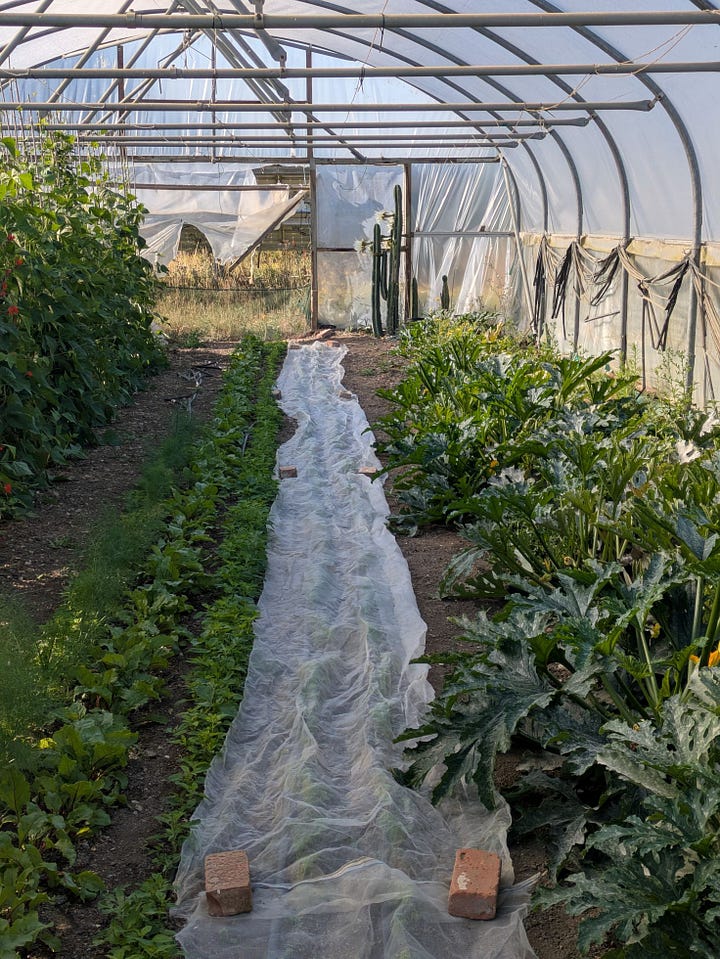
Our day did not start in flames, but beneath the fragrant flowers of the San Pedro cactus.in Malcolm and Eileen’s nearby polytunnel. As we were sitting there a bee flew out of one of the flowers and landed on my forehead, showering something feathery into my lap. ‘What is that? I asked. ‘It’s pollen!’ laughed Yash. ‘You have a golden mark between your eyes.’
So, on this fire festival of Lughnasadh, I felt I had to republish this ‘radical flower’ chapter about bees and the ling (heather) they love, set on the Suffolk heath where the small fragrant bushes once flowered in this month of August. It’s for the ling, for all the creatures that perished there this week, the moths and the nightjar, the antlions and the adder, warblers, gorse and Scot’s pine, and for all the human hearts broken by the loss of a much-loved wild place. And it’s for a path that wound through the woods, across the heath and down to the sea, that has wound its way about our practices, our teachings, these Substack pages, into all our lives. May it return again one day. may all of us recover.
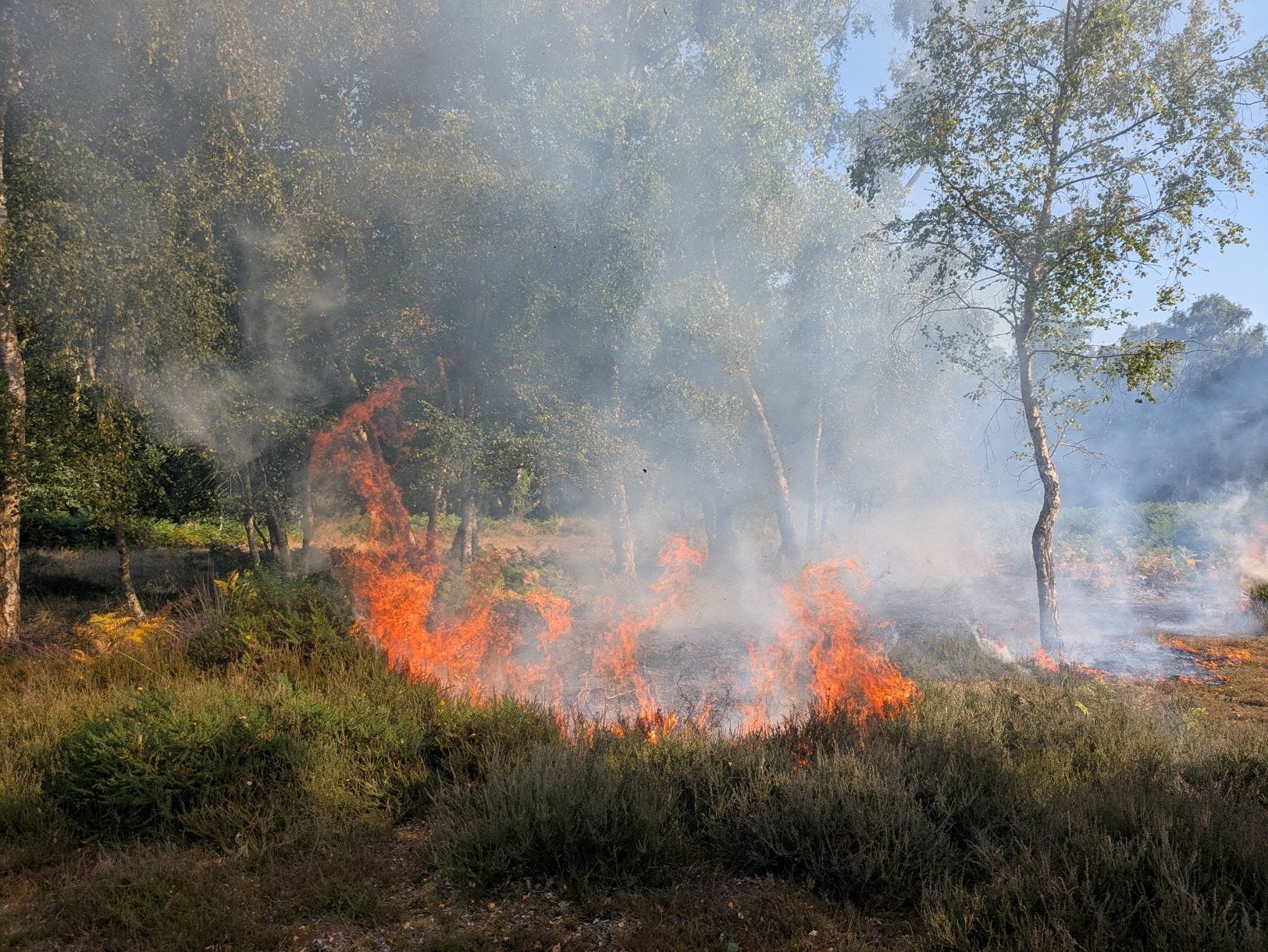
Dunwich Heath, Suffolk 2006
At the turning point, halfway through a conventional life, you realise that a deep integral part of yourself has always walked in another direction. And though you may have wandered far away from this core self, become lost in alien lands, that part is always calling you home.
When I was eight years old I took a journey each day across the city of London. It began in Newton Road, Bayswater, then went to St Saviour’s hall in Knightsbridge and back again. Wearing small boots of sheepskin I set out alone in the snow and fog of winter and came back in the bright afternoons of summer with a boater swinging down my back. This return journey to and from school belonged entirely to me. Boarding the number 52 bus, I sailed aloft on the upper deck through the tops of the Hyde Park trees, through cherry blossom and plane leaves, through conkers and chestnut candles and, on disembarking at Scotch Corner, plunged into the teeming streets of Knightsbridge. In this riverine flow I took no notice of the men in coats and women in smart dresses. My eyes noticed other things – the sweet kiosks that loomed full of coloured lights in the dusk, the grape-sellers from Spain at the street corners, the onion-sellers from Brittany cycling by. I heard the sounds of the rag-and-bone man calling out, and the organ-grinder. All these things delighted me.
But sometimes I stood in my tracks and was disturbed by what crossed my path – the old matchseller with shaky hands, the naked woman who stood screaming at the window, the female tramp asleep on the bench beside the Victoria and Albert Museum, her coat thick with newspapers. Who were these people? Where did they come from? What did their suffering mean?
One afternoon, walking to the bus stop, I saw some large women in long skirts darting in among the crowd that flowed past Harrods. The people they approached shrank away from them, or scuffled alarmed in their purses. I stood intrigued, wondering who they were.
Then one of the women loomed up in front of me. I was excited and nervous at the same time. She bent her large frame down and put something in my hands. ‘There you are my darling, for luck.’ I looked down. In my hands, wrapped up in a piece of silver foil, was a sprig of purple heather.
In the Celtic tree alphabet, heather forms the O of midsummer, the vowel of the solstice ohn, and like the golden gorse of spring equinox it is associated with bees. It is the queen bee of all the alphabet.
Bees visit a myriad wild flowers, but some they seek out more than others – rosebay willowherb, sycamore, bramble, crab apple, dandelion. Heather is one of their most coveted flowers and the honey made from its deep purple bloom is particular and commands the highest price in the marketplace. Its jelly-like thickness requires it to be pressed out of the comb, giving it a signature bubbled appearance in the jar. Its high protein content often makes it ferment and taste alcoholic. Most honeys are light and amber-coloured, easy on the tongue – those made from the abundant nectar of white clover and limeflowers, for example – but heather honey is dark, full of pollen, its taste not to everyone’s liking. When you open the lid, its fragrance exudes far into the room.
In 1924 the philosopher and seer Rudolph Steiner gave six lectures on honeybees. He told his audience of beekeepers that the bee colony indicates the most highly developed organisation known to man – a collective in perfect tune and synchronicity with the solar system. The queen bee, he asserted, is a creature of the sun and emanates the full force of love through the high vibration of the planet Venus. It is to keep connected to this solar power that her workers (all female) return loyally to her colony with all the sweetness from the flower realms of the earth. The male attendants, grounded in the vibration of the earth, keep the sound; the female workers, intermediaries between sun and earth, the dance. Inside the vibrant, warm, fragrant hive the queen produces the future generations, thousands upon thousands of embryo bees. She dwells in the core of the hive like the sun in the solar system, like the heart in our human bodies. In the centre of this universe she radiates an immense rainbow-coloured light which only bees and human seers, like Steiner, can see. It is the light that illuminates all the world.
Sometimes on a September day you can see this light as you stand among the purple haze of ling on the Suffolk coast and watch the waves running to the shore: it fills your head and intoxicates you. In this light the bees go out and collect the nectar from the heather and bring it back to store in the hive’s hexagonal cells. As they return they dance the position of the flowers and pass this map on to their fellow workers, orienting their figure of eight with the path of the sun.
All the sweetness of the summer months is stored this way. Honey is one of the most extraordinary substances in nature, and until hives were constructed (by the Egyptian empire), great stealth and skill was required from human beings to obtain it in the wild.
Steiner was concerned about the future of the honey bee. He had seen that the increased interference by beekeepers in the life of the hive to try to increase honey production was destabilising its equilibrium, and that honeybee populations would suffer. And by extension, ourselves. The fate of the honey bee, one of the earth’s great pollinators, was intrinsically tied up with the fate of human beings.
In the modern mechanised world, Steiner observed, the organisation of the human body was often weak and cold. Honey affected our constitutions by bringing warmth to cold places and strength to the weak. Steiner recommended a spoonful of honey each day as a cure, just as (Manuka) honey is now taken, principally for arthritis and stomach ulcers. But these were simple physical remedies. What brought us towards our higher development was the activation of our ‘Venusian’ consciousness, our own honey song and dance.
Inspired by these lectures, Joseph Beuys, the radical German artist and performer, made an installation in 1977 in the art show ‘Documenta 6’ in the industrial town of Kassel. It was called Honey Pump in the Workplace. Two ships’ engines pumped fat and honey through a network of clear tubing that circulated around the large exhibition hall like arteries and veins around a human body. In the centre of this network was a space in which a programme of discussions took place.
These seminars, lectures and demonstrations, he explained, were ‘an expression of the principle of the free intelligence university working in the bloodstream of society.’
During the war, as a Luftwaffe pilot, Beuys had crashed into the snow-bound steppes of the Crimea and said he had been rescued by Tartar nomads. He had been wrapped in fat and felt to keep him alive. It was an encounter that informed all his work. Many of his installations juxtaposed the vibrant dynamics of nature with an industrialised culture that produced cold-blooded human beings, incapable of empathy or mystery. The warmth and movement of natural substances(in this case fat and honey) that related to the warmth and movement of our blood, activated the higher centres of our consciousness: thought became imagination, feeling became inspiration, will, intuition. In short, the alchemical presence of honey provided the warmth and vibrancy in which our materialistically hardened thoughts softened, and heart-felt communication could take place.
Warmth of feeling, as well as the unimpeded movement of the mind and will, were necessary for the ‘free intelligence university’ to work. Many of Beuys’ actions were followed by group conversations to discuss their meaning, and in Honey Pump these discussions were expanded over the whole period of ‘Documenta 6’. They were seen as key steps towards creating a social organisation as a work of art, a collective that would be oriented, like the beehive, to the sun. He was, like all creators, laying down a map for the future development of human beings. It was a vision he maintained to the end of his life.
*
When I was eight years old I sometimes went through the doors of the great department store where my grandmother worked, to visit her for tea. I had a passion for the lime and raspberry milkshakes in the Fountain Room. Like all children, my desire for sweet things was giant. But below the Fountain Room with its artificial syrups, its fluted glasses and twirling straws, lay something I treasured more deeply and secretly. Among the opulent shelves of the Food Hall there lay a small box. In it were six jars containing the Honeys of the World – eucalyptus from Australia, orange blossom from Mexico, clover from New Zealand. I would hold that box and long in my heart to taste the nectar of their flowers.
The sweetest honey comes from the dry lands. When I am grown I will taste the honeys of those countries I only dreamed about as a child: the treacly honey of the desert acacia, the sharp flavour of lavender from the Provençal garrigue, the thyme honey of the Greek island. But already, at eight, I know that nothing quite captures that dryness, that utter reckless wildness of the moor and the mountain as heather, the greatest honey of the British Isles.
Nothing quite captures that dryness, that utter reckless wildness of the moor and the mountain as heather, the greatest honey of the British Isles.
There are three native heathers that grow on the heaths of Suffolk: the bell, the cross-leaved and the ling. The first two bloom in summer and are the heathers of the summer solstice. But it is the third that is the best known, that is treasured by bees and their keepers as it spreads its purple coat all over the wild lands of Britain, over the hills of Scotland and Wales, across the moorlands of the north, and here along the East Anglian seaboard in August. In some places, you can see the surname Ling carved on the ancient gravestones of coastal Suffolk. The word comes from Anglo-Saxon, meaning ‘fire’.
In some places, you can see the surname Ling carved on the ancient gravestones of coastal Suffolk. The word comes from Anglo-Saxon, meaning ‘fire’.
Before enclosure, ling was a vital plant in the life of commoners on these heaths. The flowers of the heather not only provided honey and ale, but its branches were used for thatch, baskets, brooms, ropes and bedding, its roots for nails. It grew alongside the bracken and gorse that provided litter and fuel, the oaks that gave acorns for pigs, and the grasses for geese, cattle and sheep. In the seventeenth century a quarter of England was ‘waste’: that is, wild land that was collectively used by the people, rather than the property of individuals. Today this is now less than one third of one per cent.
When I come to Suffolk I start to walk the cinder tracks that crossed these ancient heaths – across Dunwich, Tunstall, Blaxhall, across the heathy commons of Leiston, Westleton and Walberswick. These territories are quite different, I discover, from any other of Suffolk’s coastal woods, fens, meadows. Even though they are managed by councils and the National Trust, their relationship is still with the people.
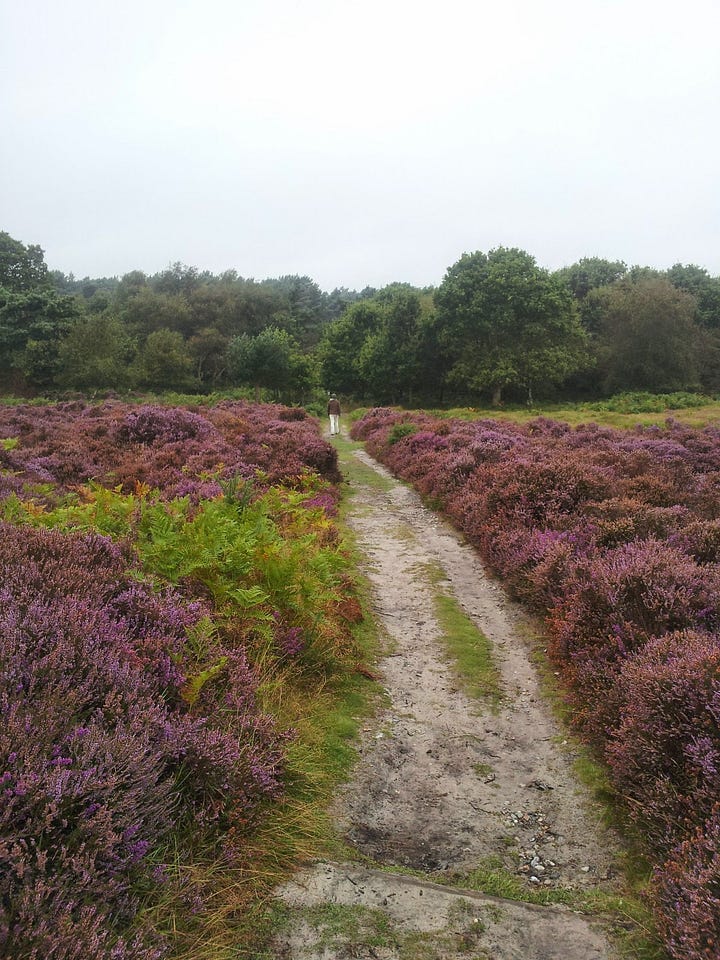
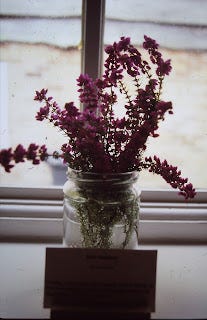
In a weekly wild flower exhibition I coordinate during one summer, a sprig of heather sits in a jam jar on the windowsills of the Southwold Museum and I find myself uncharacterisitically veering away from botany:
‘In 1624 Sir Robert Brooke, landowner, set up a boarding house for men and dogs to drive out commoners’ cattle from Walberswick common, in order that the land could be enclosed for his own use. A terrible fight took place in which four men lost their lives and the place was named Bloody Marsh. These men were resisting an enclosure of land by force which began with the arrival of Norman kings who claimed the wild forests, and was completed by Parliament who claimed the rest of the wild land for agriculture.
All civilisations have to raid and enclose for the benefit of their rulers. That is the ‘nature’ of all parasitic systems. What suffers under its cruel and contemptuous rule are the natural host systems – the wildlands and the hearts of the people. The pauperism suffered by the dwellers of the Suffolk Sanderlings a result of enclosure was the worst in all England. They suffered the kind of poverty and despair found among all relocated native peoples in Australia, Africa, Indonesia and the Americas today, all the lands that the heirs of the Norman conquerors went on to raid – and still do in their present corporate form, in every rainforest, every last marsh and mountain of the world.
As I crossed the commons, heaths and warrens, I found myself walking a time-line that stretched across the world. Through the golden yellow of the gorse and the purple ling, past the history of the rabbit (also a legacy of the Normans) and the blackfaced sheep who keep the heaths from reverting into forest, I walked a time-line that mapped the struggle for human liberty. The commons were the meeting places of the people – resisting medieval peasants, the East Anglian bread riots, Chartists. I watched activists gathering at the nuclear power station of Sizewell, heard the guns of the landowners all around me.
I followed the sheep tracks through bracken and birch and entered the kingdom of the adder, the lizard, the linnet and the glow worm. There I lay among the bright green moss and the tiny toadstools, ate blackberries under a rowan tree, waited until dusk for the whirring of the nightjar as the moon rose and lit the seashell track all the way down to the singing sea, toward a different heritage we share under the starlit sky.
The whirring of the nightjar as the moon rose and lit the seashell track all the way down to the singing sea, toward a different heritage we share under the starlit sky.
When I walk across Dunwich Heath in 2006, I take a different route. I walk from Eastbridge across the marshes, with dykes full of marshmallow, the broom bushes rattling their pods, and approach the heath from the dunes. It is early September and the ling is at its height. As I turn onto the main track I suddenly feel intensely irritated.
Mean thoughts enter my mind. I start looking most suspiciously at the two people coming towards me. For goodness sake, Charlotte! I say to myself. You are here to see the heather! But somehow I can’t concentrate on the heather, as I feel overwhelmed with negative thinking. The people walking by don’t look any more agreeable than I do. We are all scowling like mad, wishing we had the path to ourselves. What a crew! I think to myself, and avert my gaze to the ground. Oh, it’s the track! I realise, and immediately I step off it and plunge into the unmapped heather. As soon as I do, all the fury inside me disappears.
Released from my inner turmoil, the heath opens its arms. Everywhere there are purple flowers and sky. I head towards Minsmere making my own path, high-stepping through the bushes, following the line of fire-breaks. No one is in view. The ling is dotted with bristly low gorse and young Scots pine, the sky full of racing clouds. I feel intensely free. The sun pours down on us all. As I climb the hill red deer appear as if from nowhere. Their heads emerge from the heather one by one, until the whole herd stands and watches me as I stumble by, off-track, lost but at home.
Home is a place the heather leads you. Sometimes without realising, I go through the heather and get lost. Even when I know the track, I lose my sense of direction and find myself somewhere else. Or I come across someone who asks me the way, or who has lost their dog. Dreaming of heather I find myself at a crossroads, watching people going down paths across the common. All of the paths are dead ends. Are you alive? I ask one woman, but she is dead. Another appears and tells me: We have saved the Romany girl! She is found! But this evangelist is no more alive than anyone else.
In 1998 another German visionary walks across Dunwich Heath and gets lost. He is walking a time-line that goes in the opposite direction to a radical future.
In 1998 another German visionary walks across Dunwich Heath and gets lost. He is walking a time-line that goes in the opposite direction to a radical future. His name is WG Sebald and he is on his way to visit the translator of his first work. Michael Hamburger, who lives in the village of Middleton on the other side of the heath.
Sebald is collecting material for a book that will make his name. It is called The Rings of Saturn. The book is about a walk, a particular walk in time in which, if you do not follow the clues, you will find yourself walking into a trap.
History is doomed to repeat itself. It is like the rings of Saturn, an exploded moon whose form fascinates everyone who gazes at its coloured detritus which whirls endlessly round and round. Out of this meaninglessness, at certain points in time, appear writers and philosophers who have walked along this Suffolk coast. Some of them are aristocrats, eccentrics who break the mould. Sebald recounts their stories as their houses and their histories are washed away by the ceaseless waves of the North Sea, which he calls the German Ocean.
Sebald becomes confused on Dunwich Heath, oppressed by its lack of signposts, finds the purple ling dingy and oppressive. He is walking in the dog days of August, when everything is dying down and becomes stagnant, a time when even the birds have ceased to sing.
Afterwards he dreams of the heath as the figures of myth and history enact their meaningless dramas of horror on the shore. The heath in his dream becomes a labyrinth. In many ways the book itself is a labyrinth: one in which the readers are given a thread woven by the silk weavers of Norwich, cultured by the peasants of China; a thread that leads us not out of its convoluted passages, but towards the Minotaur, the beast who will one day feed upon us as Saturn once ate his own children. In this, Sebald is no Ariadne. He is writing from the position of Daedelus, the mythical constructor of prisons.
The labyrinth of Crete, created by Daedelus, was a remnant of the Minoan culture that was washed away by a great tidal wave caused by the eruption of Santorini in the Aegean. At the centre of this culture was the goddess of the honeybee, known as the mistress of the house. Ceremonial dances were performed in her honour by women dressed in skirts shaped like beehives, while men cavorted and leapt over wild bulls.
Of all nectar-loving insects, including wild bees, the honeybee is particular. Instead of flitting from one type of flower to another, it works one flower at a time. When bees return to the hive they dance on the floor of the hexagonal honeycomb, making a ‘map’ of how to return to these flowers. The Minoan dances, orientated to the sun, were a map that showed how to reach this place within and return, and thus keep our relationship with the earth in harmony. The arena of these intricate dances was once known as Ariadne’s dancing floor.
When this female-based culture disappeared, the heroic male culture of Greece turned its labyrinthine dance into a fortress. In its centre they kept the demonised bull, the Minotaur, totem of the star Venus, and turned the mistress of the house (later their bull-slaying hero’s accomplice) into a spider. The world constructed in their wake was a prison.
Labyrinths are seen everywhere in Europe and the Middle East. They live on the rocky shores of the northern lands of Finland and Norway. They appear, like spiderwebs, on desert rocks and baskets in Arizona and Nevada. On the floors of medieval French churches, in the ancient Celtic dances of the summer solstice. Some of them are traps, a way of holding spirits, but some lead towards the sun in the centre of all things. Some of them take you home.
The heather takes you off the path when you are going down the wrong track, along the lines of Empire.
The heather takes you off the path when you are going down the wrong track, along the lines of Empire. The Minoan labyrinth was a prison, but beneath this labyrinth is a map. The rings of Saturn go meaninglessly round and round. You get confused. You find yourself in a maze, overwhelmed by choices, stuck in your mind. But the map leads you to the centre, towards the heart. In the centre of the hive sits the queen bee. At the zenith of the solar year she presides over the harvest months of July and August, season of all heathers, beloved food plant of the bee. In the centre of her being is the sun, organising everything in our lives for our highest development.
When you lose track of history among the heather, that’s when you find her dancing floor.
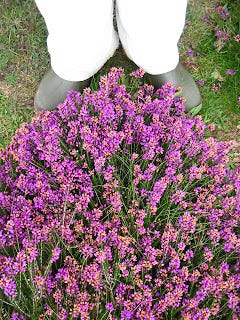
There is a patch of heather at my feet, a smell of honey in the air, warmth on my face. Dragonflies rest on the stems of the small bushes, their folded azure wings glint in the sunlight. One lands on me, swivelling its eyes, and polishes its pincers. Its forelegs sink down, in three precise jerks. We sit there in the small windless patch. Over our heads the clouds race and scud.
‘You see that patch of sky,’ said my grandmother in the English garden of yew hedges. ‘It’s enough to make a pair of sailor’s trousers. Soon the sky will be all blue.’
‘You see the hole in the clouds,’ said Karen in the Andean valley of immortality. ‘That’s the whole. So long as we pay it attention.’
You see that patch of heather in this last corner of wilderness in the world? That’s enough to remember your wildness. When you go there, when you find the honey, you will know you have found your way home.
It’s our last stand. Our last rebellion.
*
Why are the flowers radical, why is the honey-scented heather radical? Because when you speak with the queen bee who is yourself, you stand in the centre of the universe. When you bring harmony to bear at the centre of your being, you become the lady of the house. You have gone out to visit the flowers, and at the turning point you have come back to the core. This dance of the self, aligned with the sun, is the dance the old order does not want to happen. For when we begin this dance, the prison will collapse and their rule will end. We will have come home to ourselves. And once you are home no one can persuade you to leave.
Something within us knows this, even though we are born into places quite opposite to our natures. No matter how much our house has told us we should have such and such manners and our school that we should think in such and such way, always we take a path that is uniquely our own. I lived in a road named after the cold-blooded scientist whose mechanistic rules still dominate our consciousness and attended a school in a church hall whose autocratic, cold-blooded god still lays claim to our souls, and yet my dance took place outside these labyrinths. Because I was born with the taste of honey on my tongue.
I have long since forgotten the lessons I learned in these places, but of the times I boarded the number 52 bus and sailed through the tops of the trees, when I considered the fate of the matchman, tasted the sweet grapes of Spain and a large woman put a small bunch of gypsy heather in my hand, I remember everything. For that is the path my life took: the path that led to quite different conclusions about the world than the one described by my parents and teachers.
Your own path is always radical, because it leads away from the mind and walks towards the heart. It returns to its place of origin, like the salmon, against all odds. It’s radical because it puts you in the centre and commands that you create a warmth and a vibrancy so that all in your house can speak in harmony; a position that can coordinate the flight paths of 50,000 bees pollinating a million flowers that become seeds and fruit for all living beings and keep the whole world turning. No institution, no school or god or family, can teach you to take up that position. Only the heart will lead you there. Only the heart will lead you home, your own foolish and fiery child’s heart.
It has to be that way, because it is a path of love.
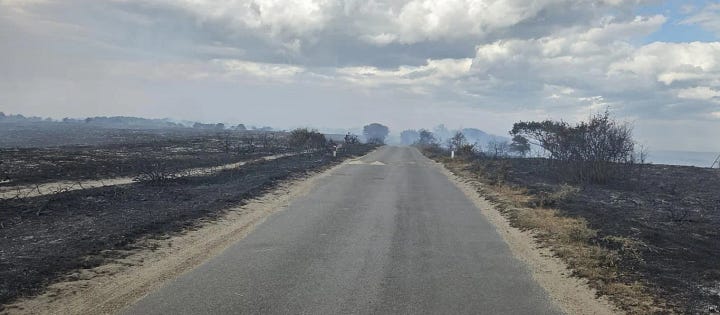
You can donate to help the recovery of Dunwich Heath via the National Trust here
Thanks for reading everyone. The Red Tent will be back in September, after a short break. Wishing you all a good August and happy Lughnasadh.
Comments
Nothing yet. Say the first thing.
Sign in to join the conversation.