
Hello everyone - This is a piece I wrote for the new Dark Mountain issue out this week, a modern bestiary for collapsing times. It’s a collection that, unusually, I have had no hand in producing, so it’s a novel experience opening its uncharted pages (although after packing hundreds of books in the warehouse this week for our subscribers, I know the shape of it very well!). I’ll be reading an extract at the online launch this coming Wednesday 22nd April. Do join us!
It is a story that emerges out of the dreaming practice Mark and I began in Australia in 1997. Animals were the first messengers that came to us, as they have to human beings through time. But of the hundreds of creatures that presented themselves in those years, I never dreamed of a bear until I finished this piece: when I ‘woke up’ one night, and found a giant polar bear in my bedroom…
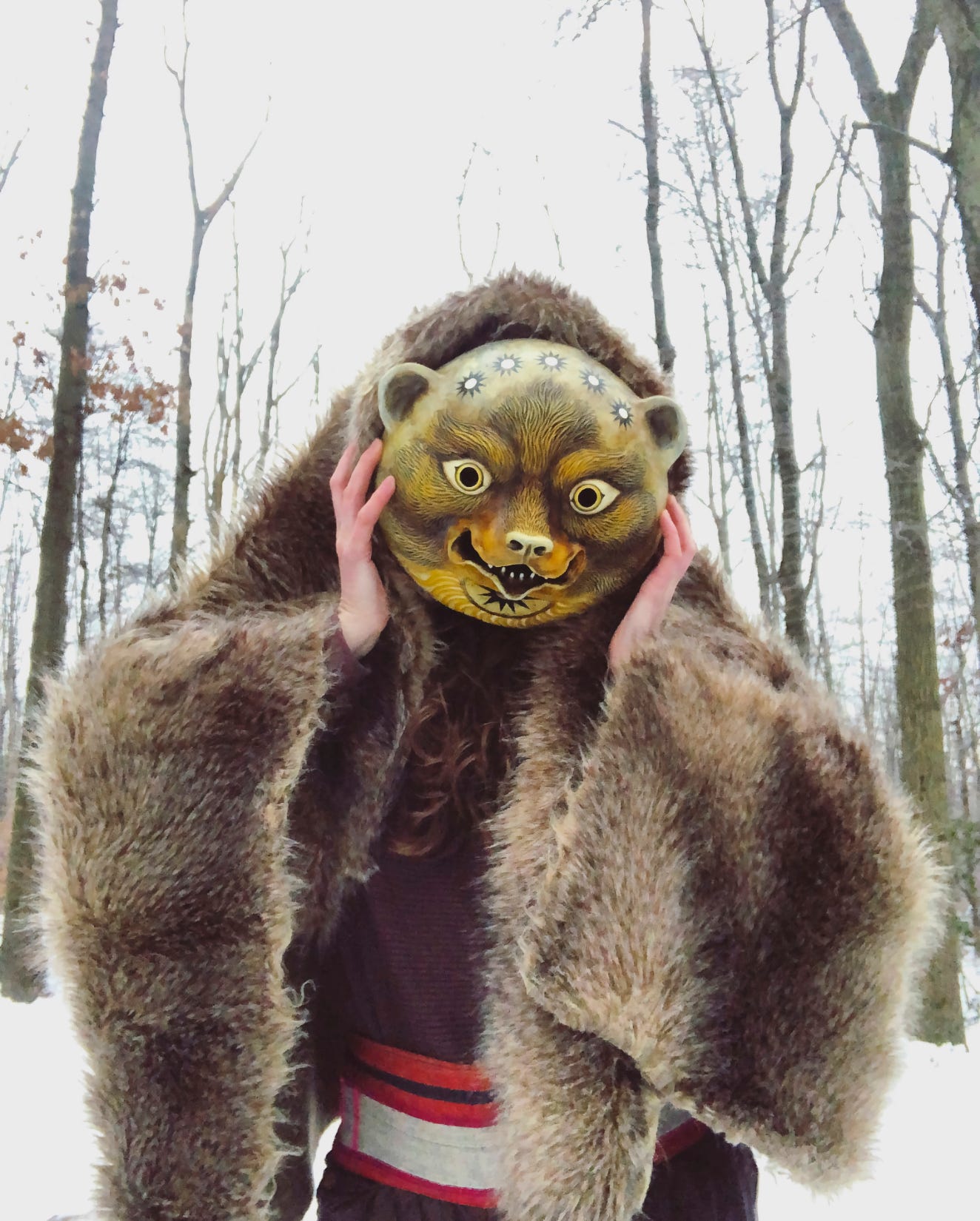
ONCE UPON A TIME there was a princess who lived in a castle where she lacked for nothing. But one night she had a dream. She dreamed of a golden wreath so beautiful that when she woke, she longed for it more than anything her heart had ever desired. She stood in the tower that overlooked the dark forest and pined for it. Her father the king summoned all the goldsmiths in the land, to reproduce the wreath for his youngest and favourite daughter. But none had been able to match it.
One morning, as she gazed out, she saw in the clearing a white bear, playing with something shiny between his paws. It was the wreath! She ran down the stairs and rode out to meet him. ‘What will you take in exchange for your lovely wreath?’ she asked.
‘There is no price,’ said the bear.
‘My father is the king of these lands,’ she told him, ‘You can have anything you want.’
‘I do not wish for anything,’ he replied. ‘This wreath is not for sale. You can only have it in exchange for yourself.’
And so it was that the following week, the bear returned for the princess. Her father first tried to replace her with her two elder sisters (mean as they always are), but the bear asked them questions as they each rode on his back.
‘Have you ever sat on anything more soft or comfortable?’
‘Yes,’ the sisters both replied. ‘When I sat upon my mother’s lap.’
‘Have you ever seen more clearly?’
‘Yes. I see more clearly from my father’s turret.’
‘Then you are not the right ones,’ said the bear and returned to fetch the youngest princess.
‘Have you ever sat on anything more soft or comfortable?’ asked the bear as they entered the forest.
‘No,’ she replied. ‘I have never sat on anything more soft or comfortable than your fur.’
‘Have you ever seen more clearly?’
‘No. I have never seen more clearly than I have with you.’
This tale is a long one, in the manner of northern fairy tales. The bear, whose name is Valemon, is kept under a spell. The princess, deceived by her sisters (jealous as they always are), disobeys his instruction, and is forced to go on a long search for him to break the enchantment. The story I want to tell now does not have space for it all, but this you need you know: when we went on our travels away from the city into the forests and mountains of this world, I had never felt more at home, and for all that time, I never saw so clearly, as when I was with you.
In a dark nursery he lay beside me, a golden bear. He was always there. He was my protector, confidante, friend. And then returning to England on the ferry one summer’s day, I left him for a moment on deck and when I went back he was gone. Someone had stolen him.
Years later in a dark city, a man with a bear hug and golden smile appeared and stood by my side for 35 years. His name was Mark. He was always there, until I lost him too.
In your presence, it always felt that things would be OK. You taught people how to stay long enough in the company of a plant or tree to connect with the intelligence of the living, breathing world.
‘I don’t do much’, you would say of your teaching. ‘But you are there,’ I would reply. ‘You are like the bear in the forest, a bull in the field. When the bull is there, everything about the herd is different. He is not doing much, just eating grass like the cows. But you walk through that field, through that forest where the bear lives, differently. And this place, this time, feels different with you in it.’
You taught everyone to perceive the Earth with our hearts, with our animal abilities to sense, feel, attune, be alert, to have a relationship with the wild things, to live alongside them as kin as once all human beings did.
When we thought the door was shut, you showed us we can always open it again.
When we thought the door was shut, you showed us we can always open it again.
When I was young I shook a toy rabbit like a rattle and told stories out loud about animals who went on all kinds of adventures. When I went away to school, I left my childish storytelling behind. I entered the world of humans and began a life of writing about grown-up things.
And then one day, the animals came back.
In Australia during our travels, we begin a dreaming practice. All kinds of animals and birds, snakes and fish and crocodiles are coming into our dreams. They are not symbols or totems, or representations of human qualities, they come as themselves, as creatures in their own right, to communicate their presence, how they interact within the dreaming fabric of this Earth.
They appear from the places we are living and travelling through: the emu from the Australian bush, the deer out of a rainbow-coloured peyote in Mexico, the rats from their cages in the Oxford University laboratories. A hare waits quietly underneath the apple tree. The horned toad sits under a desert stone. All manner of cats joyfully greet us, small cats, large cats, leopards, lions. I stroke the fur of coyotes and foxes, swim with otters and killer whales. In one dream bees cover my entire head. I hold a butterfly in my hand that roars. A bull puts his face to mine and I can feel his great heat and my own heart thumping. A bald eagle flies so closely past my window I can hear the beat of his wings. All manner of birds show me their feathers, their dance, take me in flight, hold me to their breasts: swan, duck, wild turkey, black grouse, goldfinch, peacock. A hummingbird drills my third eye awake, a falcon sits on my head and imparts knowledge.
The creatures are fierce, powerful, gentle, mysterious, but sometimes snared cruelly in the human world: tigers that are trapped, turtles that are sick, rabbits that are dying, horses in an abattoir. Before our return to England I dream there is a parade of disembowelled cows in the void. So much has been taken away from them that they are hollow. Everything has been taken away but there is a golden light inside them. Human children coming out of them with golden hair.
In a small house in a karri forest outside Perth, I dream an Aboriginal man puts his hand through the window to shake mine: ‘We are the action,’ he says.
The dreaming bears live in caves and teach us to remember the way of our ancestors. The ivory bears, carved from the tusk of a rhinoceros, show us how to hold fast in hibernation. The dancing bears, made of straw, are burned to banish winter in the mountain towns. The medicine bears are the sweet-tasting roots of a mountain plant; in the darkness of the temescal and kiva, they connect us, across dimensions, to the dreamtime of the Earth and ourselves.
When Carl Gustav Jung was unsure whether his work on dreams and archetypes was correct, his mother would challenge him in a manner quite unlike her normal nurturing self. Her prophetic utterances made him aware something of significance was happening. He called it her ‘second voice’, and it frightened him, like unexpectedly coming across a bear in a cave.
The oracular voice belongs to the bear, companion of Artemis, the fierce virgin goddess of the wild things, the hunt, and protector of children. When two small girls played with the bear in her sacred grove at Brauron, their brothers came and killed it. In her wrath the goddess brought down a plague on the city of Athens. The oracle declared she would only end it if every girl in the city thereafter should come and ‘play the bear’ for her and undergo a time of ritual ‘wildness’ before puberty. The little bears, known as arktoi, wore bear masks and saffron-coloured robes and for one year they performed ritual duties including processions, dances and foot races in honour of the goddess.
Gazing out of our lonely towers, we long for kinship without knowing we long for kinship: with the beasts, with our ancestor self, with our own creaturehood, our voice
Gazing out of our lonely towers, we long for kinship without knowing we long for kinship: with the beasts, with our ancestor self, with our own creaturehood, our voice; with a world where as small girls we carried garlands and a basket of figs for the Great-She-Bear.
Some part of us knows we cannot get back to the forest without her.
The bears in English children’s books are whimsical. They eat marmalade and wear hats. But the armoured bears, or panserbjørne, in Philip Pullman’s His Dark Materials trilogy are giant polar bears, warriors and blacksmiths.
Their exiled king-to-be, Iorek Byrnison, possesses all the mythic qualities real bears, their fierceness, their strength, their integrity. He comes to protect the children when dark forces threaten to steal and separate themfrom their dæmons, their animal soul companions. Without their daemons, the children die, or become like zombies. They are left soulless and without an ability to find meaning in their lives.
When your soul companion vanishes, it is not only the physical presence that goes, but the dynamic you once created between you, a creative sphere that allowed the oracular to be voiced, where we could shapeshift into a bird, jaguar, or whale; walk into each other’s dreams, show each other the language of plants and the planets. For a long while after you had gone, I held your memory close, how you appeared in places we visited: the cliff, the river, the tumulus, beside the trees and sea. I honoured you as best I could, wrote down our Earth dreaming practices, made a book of your teachings, planted your sunflower seeds and wild tobacco. I hung your coloured shirts in your room and sometimes heard you call my name in a dream.
When I look at your empty chair now by the fire, I realise how impossible it is to contact that capacity to see, to be comfortable without you, and I am at a loss what to do.
I am on top of a red hill in Arizona. We have just arrived from California insearch of a home for our collaborative project, the Earth Dreaming Bank.
For a week I have felt silently scrutinised by the thorny desert plants, as ifthey were testing me. Is she worth talking to? Is she for real? And now I was being addressed in a very forthright manner.
I look around. There in front of me is a strong-armed, handsome bush with sculpted red-brown branches, small leathery leaves and tassels of dark berries. It is a manzanita, known throughout the world as bearberry, Arctostaphylos uva-ursi.
What are you going to do about the American Dream?
These are lands where bears still chew these berries high up among the peaks of the sky islands. The resonance of the great beasts is held in these bushes, reminding us of the mysterious art of being fully alive.
Archaic body. Bear body.
I had not considered the American Dream, or that our presence here mattered. The Earth Dreaming Bank has emerged out of the practice, founded on the premise that paying attention to our dreams, communicating with the kingdoms of nature, has an effect within the complex fabric of planetary life. All our small actions go recorded. This increased attention works to make the dream of the Earth stronger than the industrial trance that holds us all to ransom. The American Dream is the illusion of consumer freedom. In this dream everything is for sale: you can live in a world where you can be who you want to be, where your past does not matter and your actions have no consequence. It is a dream that runs entirely contrary to the ancestral dream of the Earth and has turned into a nightmare for the whole of the planet.
Across the Northern Hemisphere, the bearberry leaves, named after the animal who chews them for medicine, are smoked as a protection against destructive forces, to bring peace, and connect with the ancestors and the dreaming of the Earth. It is a chieftain bush and speaks directly to our shared imaginations.
What is the ancestral dream of America? What am I doing here, climbing towards the bear’s red-armed bushes on this fierce hot day?
The Okanagan word for human being means land dreaming capacity. The people of the north-western coast recognise the human ability to dream with the land as our primary gift. Our language, our vision, the way we speak, dance, make music ritual and art, is the land speaking to itself, how the Earth and sun and all beings communicate. This knowledge is held within all peoples’ ancestral form, what Aboriginal academic TysonYunkaporta calls our function as a custodial species. Not as commanders or stewards of a territory but as mycelial connectors and pattern seers, among different species and elements, between the worlds of sky (mind and spirit) and earth (land, relationship, activity), which Indigenous peoples have always practised.
Where is your allegiance?
‘It’s a London plane,’ I say. ‘A hybrid of a Greek and an American plane.’
Years later, shortly after Mark left, I am standing next to the writer Derrick Jensen, lover and fierce defender of bears, salmon, and the Northern Californian forest where trees talk with him and remind him of the predator-prey bargain: if you consume the flesh of another, you take responsibility for the continuity of the other’s community.
It’s a clear spring evening, a blackbird singing high in the canopy of this signature London tree, by whose roots I once shared my childhood stories about animals: rabbit, donkey, koala, bear.
A grey squirrel runs up the trunk. ‘Invader species from North America!’ I laugh, and tell him about the reintroduction of pine martens in former red squirrel strongholds. The native squirrels are light, so can run to the ends of branches to escape predation, the grey ones are too heavy and fall.
We have been speaking about breaking the spell of consumer illusion, about writing as a ‘sacred obligation’, about feeding bears (the subject of his next book) but mostly about communicating with the land. When people ask him, frequently, what they should do when faced with ecological collapse, he tells them to go to their landbase and ask what is needed.
‘All my work is to participate in the community of wild nature and to protect it, in the way you would defend anyone you love.’ (Derrick Jensen)
‘All of nature is starving, for food, for love, for attention. The act of feeding each other is fundamental to communal relationships. to courtship, to the predator-prey relationship. I realise that feeding the particular forest where I live does nothing but it is my offering to the world. This is what I can give. All my work is to participate in the community of wild nature and to protect it, in the way you would defend anyone you love.’
‘When I wrote Endgame I wanted to know what it was to write from the perspective of a river, which is not static and runs beneath and beyond its banks. Eventually I went down to the stream and asked: what is it like for you? Then the thoughts came, and as I went back to the house to write them down, the trees called out: ask what it is like for me!
‘I see myself as a filter-feeder. If thoughts jump into my head and a bear walks by, then that is the story.’
When he stopped some people cutting trees in the forest after he first arrived there, a bird came and brushed its wing feathers against his chest. You could, he said, dismiss this kind of encounter with your ordinary attention,but if you look at it, as you would a dream, in a ‘blaze of reality’, as Claude Levi-Strauss once wrote, you might ask: what was the significance of that?
‘You can’t live in a world full of significance in every moment, but if you never do it, you’re not really alive.’
Now months later, when I look back at that spring evening in Red Lion Square, I see that I had not come to ‘interview’ Derrick Jensen in the way Dark Mountain did in its early volumes, as a deep-green defender of the wild against the onslaught of civilisation; but rather to connect as fellow landspeakers, those who go down to the river to ask: what is it like for you? A writer whose house bears come to visit to show him their cubs.
As we sat in that small pub courtyard, we leaned towards my old ’80stape recorder as the babble of customers rose about us. I realised it was not so much what we were saying to one another but the allegiance we are both holding out for.
This midwinter day I go down to the sea, wearing your bearcoat. The sea is roaring with a wild north-easterly, and I crouch by the seakales, feeling their roots holding fast to the shingle shore, an invisible chain of command running along the edge of this blighted land. Out towards the horizon, a circlet of sunlight shines on the dark water, like a golden wreath.
When I asked Derrick Jensen what we should do as writers as the house falls about our ears, he told me he loved that line by Barry Lopez: we are holding hands through time.
‘I learned so much from him, from Aldo Leopold, Susan Griffin… and my job is just to continue their work. It makes me so happy when someone takes what I have been writing about and takes it further.
You write to remember, to hold fast in your creature heart, to keep the warmth going and the light. You write to keep watch, to give back, in an act of allegiance. Because years ago you made an exchange with the bear. Your hands reach out to those who have gone before you and those who are yet to come, a small beacon on this dark beach. At night you trace the lines of the stars in alignment above you. The constellations of the lion, the bull and the hunter; the Great Bear and the Seven Sisters.
You are alone but you are not alone. We are the action.
You hold the line.
Dark Mountain: Issue 29 (£19.99)
Our Spring 2025 issue is devoted entirely to animals. Order from our website or take out a subscription to issues of Dark Mountain and get Issue 29 for only £14.99.
Comments
Nothing yet. Say the first thing.
Sign in to join the conversation.