
At half past two in the morning, Tokyo time, the phones rang on the currency desks of Tokyo’s big banks. The caller was American, and the caller was official.
In Washington it was still Wednesday afternoon, July 29. The Federal Reserve had just finished a meeting at which it did nothing at all. Someone at the United States Treasury wanted to know where the yen was trading.
In this business that is called a rate check. It is not a question. Every trader alive knows what it means.
In the session that opened a few hours later, Japan’s Ministry of Finance spent roughly eight and a half trillion yen, about fifty-three billion dollars, buying its own currency. The largest single day in the country’s history.
The next day it spent five trillion more, and this time the United States Treasury joined in, selling euros to buy yen through two American banks.
Call it eighty-eight billion dollars in forty-eight hours.
The route, so you know the room before you walk it. First the friendship and the reason it is not the explanation, then the arithmetic that cornered Tokyo, then why the safe half of your money is the exposed half.
The Threshold falls there, at the end of Act One. Behind it, the smallest number in the building, where the money actually came from, the euro trick, three public clocks, and a bet you can grade by December 31.
Here is the part that will confuse everyone who follows this story through photographs.
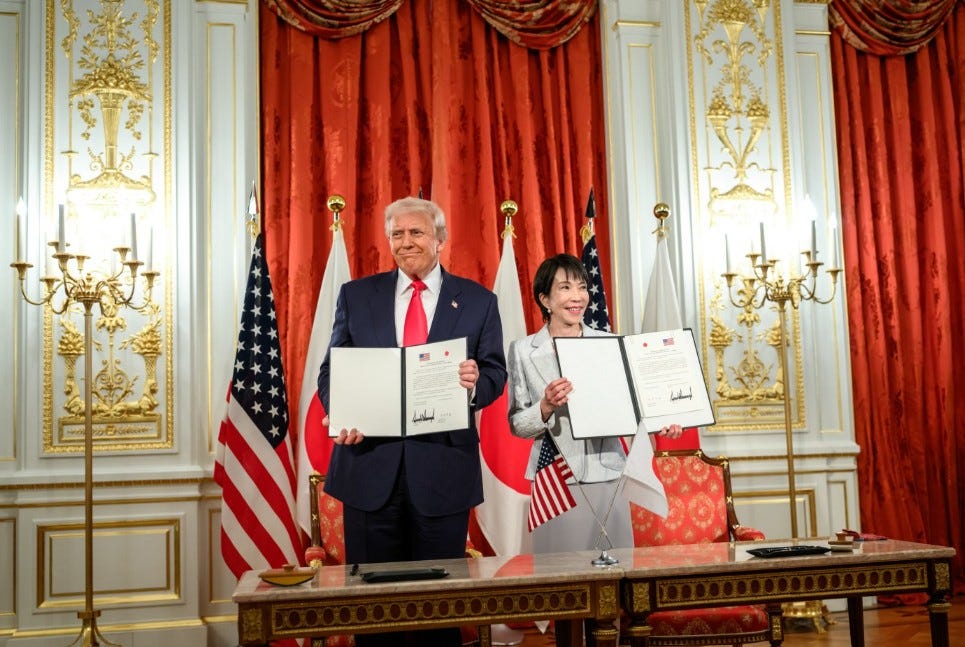
The two governments have never been closer at the top. Sanae Takaichi became Japan’s first female prime minister on October 21. Six days later Trump was in Tokyo, standing next to her on the deck of an American aircraft carrier at Yokosuka, signing a one-page declaration of a golden age for the alliance, plus a critical minerals pact. She promised Washington 250 cherry trees for the country’s 250th birthday.
Since then, the cadence of a genuine friendship.
A November call in which he told her that, as a close friend, she could phone him anytime. A New Year call on January 2. In March, ninety minutes in the Oval Office and dinner after.
In May he called her from Air Force One flying home from seeing Xi, before the wheels touched. They met again on the sidelines of the G7 in France in June.
Three summits and at least three published calls in her first eight months. Abe’s protegee inherited Abe’s playbook and ran it faster.
And the weak yen underneath this whole story is her cost of living crisis, the thing chewing on her approval ratings at home.
Asked about the operation aboard Air Force One, Trump cited the good relationship and said, “They wanted a little bit of help, and we’re always there for Japan.”
He is right about the relationship. He is wrong about the reason.
When the largest operation in the alliance’s year actually ran, it ran a level below the leaders. Ministry to ministry, Bessent to Katayama, no summit call, no readout, no photograph. The friendship is the picture at the top of this letter.
The plumbing is the policy.
Washington did not do this out of friendship. Friendship gets you cherry trees. This got a wire transfer.
The ordinary way for Japan to buy yen is to sell American government bonds. Japan owns about $1.14 trillion of them.
The American bond market can no longer absorb a seller that size without the price of every bond in it falling, and the price of every bond in it falling is your problem, because the part of your retirement account labeled safe is stuffed with exactly that paper.
So the United States spent its own money to prevent a sale, the way a landlord pays the tenant’s rent to keep the appraiser off the block.
Some of the coverage called it the first joint intervention since 2011. That has the direction backwards. In 2011 Washington sold yen to weaken it after the tsunami. The last time America bought yen to save it, the year was 1998 and Robert Rubin was Treasury secretary.
I have been writing about this for two weeks and I want to be precise about what I got right and what I did not.
On the morning of July 29, hours before any of this happened, I argued in MarketWatch that Wall Street was watching the wrong central bank and that the number funding America was going to get set in Tokyo before the week was out.
That was correct about the pressure and wrong about the institution. I told readers to watch the Bank of Japan. The answer came from the Ministry of Finance.
On the night of Sunday, August 2, I wrote to my Founding Members that this was not a currency rescue at all. It was a Treasury market protection operation wearing a currency costume, and I gave them the three tells and the one report to watch.
The Financial Times reached the same conclusion two days later.
I also made them a bet with a date on it, and I want to state the terms plainly so you can grade me rather than take my word for it.
On Thursday, July 30, one dollar bought 163.73 yen. That is the most a dollar has bought since 1986. It printed intraday, which is how forty-year records get set and how I will grade this.
That Sunday night I told my Founding Members the water would not touch that mark again before the middle of August.
I put the date on the inflation report, Wednesday, August 12, because that report is the only thing on the calendar that can change the flow.
As I write, the pair sits at 157.80, parked almost exactly on its own 200-day average, the market’s coin flip line.
To beat me, the dollar has to climb back nearly six yen, close to four percent, in three trading days, through a ministry that has promised to shoot again.
It is not settled and I am not claiming it yet.
Nobody has covered the next two paragraphs.
On July 31, while this was underway, Japan’s Ministry of Finance published its monthly intervention report for the window that ended July 29. The official figure was zero. Not one yen. Every dollar in this story was spent in the two days after that form went to the printer.
And there is one more number, published quietly by the Federal Reserve every Thursday at 4:30, that tells you what this actually was.
I pulled it. It is the smallest number in this letter and it is the only one that matters.
The Federal Reserve met on Wednesday, July 29. Kevin Warsh said about as little as a man can say into a microphone and still be described as having spoken.
Then the phones rang in Tokyo.
Tokyo’s Thursday session opens Wednesday evening in New York, which is how the largest currency operation in Japanese history managed to happen on two different dates depending on which clock you were watching.
Thursday, July 30, was the eight and a half trillion. Friday, July 31, was the five more and the American assist.
Those figures are estimates drawn from Bank of Japan accounts. Tokyo publishes the official number at the end of this month, and I will use theirs when it arrives.
One detail tells you how little the interest rate had to do with any of it. The Bank of Japan met on those same two days. It held, eight to one, with the lone dissenter wanting a hike, and trimmed its inflation forecast only because government energy subsidies do the trimming.
The central bank sat still on rates while its own trading desk, acting as the finance ministry’s agent, emptied the vault. Same building. Same two days. Different masters.
The reason is arithmetic, not preference. Japan raised its policy rate to one percent in June, the highest since 1995, and the yen fell anyway to its weakest against the dollar since 1986. A rate hike is supposed to lift a currency. When reality stops following the textbook, the textbook left out a chapter.
The missing chapter is the interest bill. Debt service reached roughly thirty-one trillion yen this fiscal year, about a quarter of everything the Japanese government spends. A Ministry of Finance memo reported by Reuters projects it reaching a third of outlays within three years.
And Japan’s own ten-year already trades above the models that produced that projection.
Raise rates to defend the currency and the interest bill eats the government. So the currency becomes the pressure valve. A pressure valve is the part designed to fail first so the rest of the machine can call itself safe.
Tokyo is not choosing to debase the yen. It is being evicted by arithmetic, the way an underwater homeowner does not so much decide to sell as sign where the bank is pointing.
The Bank of Japan owns just under half of every Japanese government bond in existence, below fifty percent this spring for the first time in three and a half years. It has now decided to slow that reduction rather than let yields rise in a scramble.
Read that twice. The central bank that owns half the bond market is slowing its exit because it cannot afford the price discovery.
Now the part that concerns you. The ordinary route to yen still runs through selling that $1.14 trillion pile.
Washington’s answer was to point at a pawn shop. There is a Federal Reserve facility that lets foreign central banks borrow dollars against their Treasury holdings instead of selling them. It has existed since 2020, was made permanent in 2021, and is capped at sixty billion dollars per counterparty.
Scott Bessent spent a Sunday publicly asking the Fed to raise that ceiling. Tokyo said it plans to use the window.
When the borrower builds plumbing so the lender never has to sell the collateral, the borrower has told you exactly what he is afraid of.
Bessent’s fuller explanation, when it arrived, was about Asia. A sinking yen drags the won and the region’s currencies down with it, and on the very Thursday Tokyo fired, South Korea was in the market defending the won. An echo of 1997.
Perhaps. When the fuller reason for an eighty-eight billion dollar operation turns out to be about a different continent, the first reason usually has the better claim.
If someone on your feed is still narrating this story from the photograph, restack this and hand him the plumbing. It travels in one tap.
Going into the intervention, the American ten-year traded at 4.75 percent and the thirty-year at 5.28. Days after Washington sold euros, the dollar index sat at a seven-week low.
That combination is not supposed to happen. Higher yields are supposed to attract money the way an open bar attracts a convention, and the crowd is what lifts the currency. Washington is financing a two trillion dollar budget deficit this fiscal year, so the yield is not cosmetic. It is the asking price on the next trillion.
And all of this happened during the Hormuz crisis, when frightened money is supposed to run toward the dollar the way a crowd runs toward the exit sign. The money read the sign and kept walking.
When a country’s borrowing costs rise and its currency falls at the same time, in a crisis that ought to be sending money toward it, that country is no longer being treated as the safe one. The demotion is never announced. It is priced.
You do not own Japanese bonds. You own American ones, almost certainly, sitting in the part of your retirement account your statement describes as the conservative allocation.
When the largest foreign buyer of those bonds steps back while Washington borrows more than ever, you get an auction where the lots keep doubling and the paddles thin out. Long rates rise. And when rates rise, the price of the bonds you already own falls.
This is not theoretical. It happened in 2022, when stocks and bonds fell together, some long Treasury funds shed close to a third of their value, and the classic sixty-forty portfolio stopped working in the exact week it was needed. The airbag became the crash.
The word that matters is duration. It is the length of the lever the market swings at your account when rates move, and it is printed in documents you already own. A long Treasury fund and a short one take the same rate move like a heavyweight and a folding chair.
If you are near retirement and your safe money sits at the long end, that is worth knowing before the move, because after it the knowledge converts to regret at par.
The Federal Reserve published its weekly balance sheet on Thursday, August 6, covering the week that ended August 5. Anyone can read it. Almost nobody does.
There is one line on it that answers the question every strategist in New York spent last week guessing at, on television, for money.
I pulled it, and it means that most of what has been written about this operation has the mechanism wrong.
They put the tripwire in a footnote, folks. A footnote. They know you will not read the footnote. They are counting on you not reading the footnote, that is not an accident, that is the business model. So I turned the footnote into a picture. Now nobody has an excuse, including you.
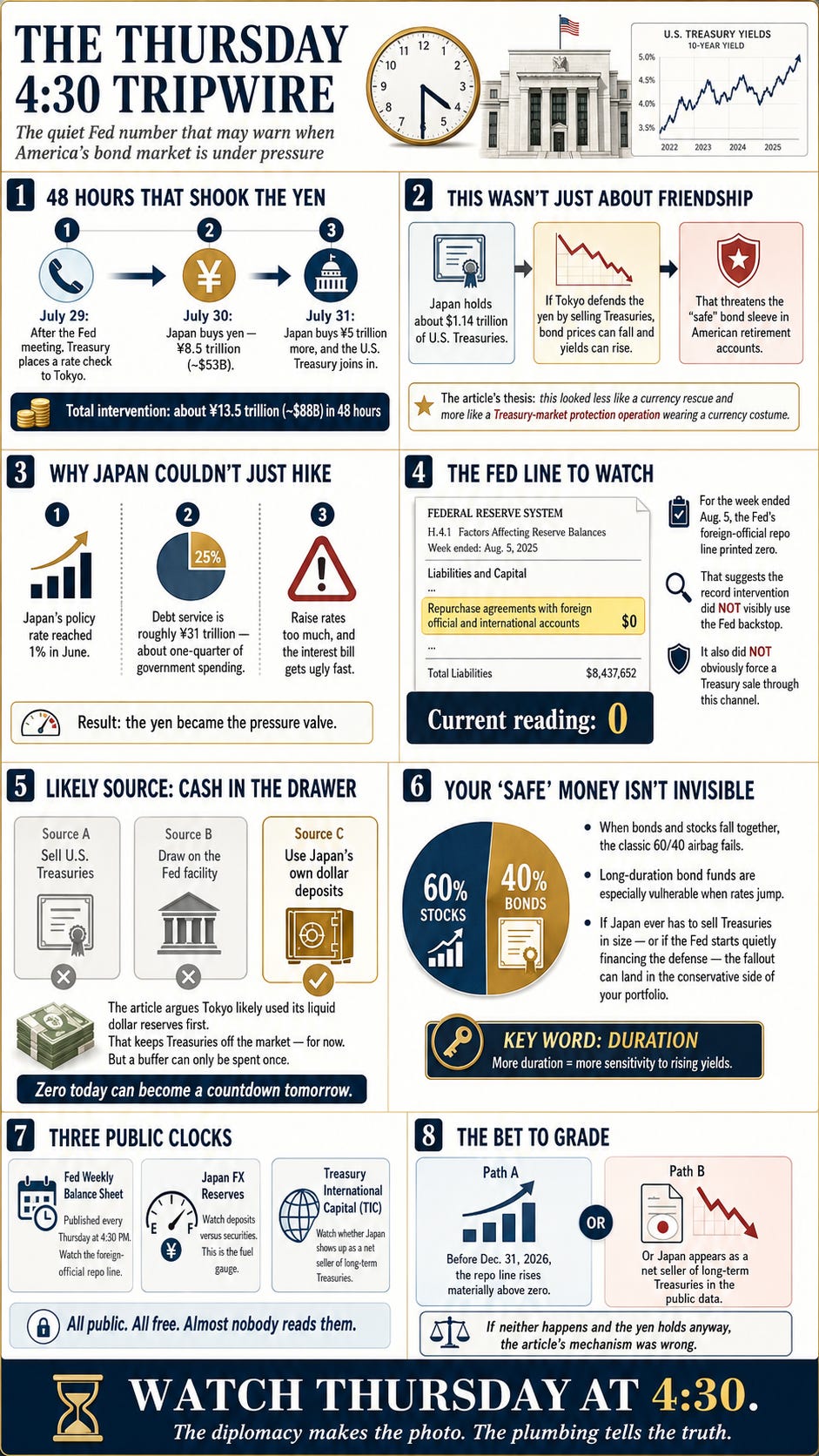
Past the Threshold, in order: the line’s exact name on the Fed’s own ledger, what it printed every day of the week ended August 5, the custody cross-check, the one place the money could have come from, the euro arithmetic nobody ran, three public clocks with dates attached, a prediction that expires December 31, and every position I hold, tickers included, plus the one that argues with the rest.
And one more thing. I own exactly one Japanese stock and the same weak yen that is coming for your bond fund is the thing that pays it. Inside I name it, I price it, and I show you why it argues with everything else I own.
I spent a career, some of it for presidents, reading documents governments publish and hope nobody opens. This is one of the weeks the habit pays.
The verdict on my bet lands Wednesday, August 12, with the inflation report. The next tripwire print lands Thursday at 4:30. You can meet both with the mechanism in hand, or meet them in headlines that have it wrong.
Being wrong about this gets billed to the sleeve your statement calls conservative. Being a subscriber costs less than being wrong. Come inside.
Comments
Nothing yet. Say the first thing.
Sign in to join the conversation.