
Today, I offer you an excerpt from my book Children of the Broken Treaty: Canada’s Lost Promise and One Girl’s Dream.
It is the story of Shannen Koostachin, a 13-year-old girl from an impoverished First Nation community who launched the largest youth-driven children’s rights movement in Canadian history.
Over my career, I have met many leaders, committed activists and brilliant artists. But none of them shook me up the way Shannen did.
Shannen didn’t want to be an activist. She didn’t want to take on the government of Canada; she just wanted to go to school. A real school. What she called a “comfy” school. One with proper desks, books, and lockers.
Instead, kids in her community were being educated in broken-down portables on a toxic site where children as young as five breathed in cancer-causing chemicals on a daily basis. In a region where the temperatures regularly dipped below -50, they wore winter coats and toques in the classroom.
Shannen made me see injustice through a child’s eyes. She understood something that adults too often forget: that children have only one childhood and once it is gone, it is gone forever.
In December 2007, the Conservative government of Stephen Harper walked away from the latest in a long series of promises to finally build a school. Shannen announced to her classmates that they were going to force the government to keep their promise.
That’s when she came on my radar.
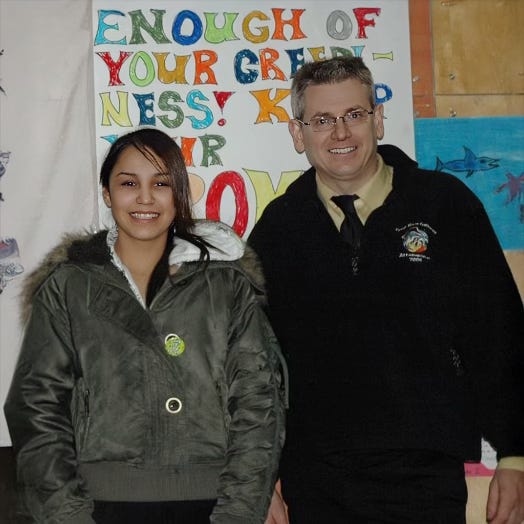
I will never forget the impression Shannen made on me as she stood on a frozen field with a group of young kids holding homemade cardboard protest signs. The nearest journalist was hundreds of kilometres away. Nobody outside of the community knew of their protest.
But Shannen wasn’t daunted. She looked me straight in the eye and declared,
“The younger brothers and sisters are going to get a school.”
Cree youth tend to be shy with strangers. Not Shannen. She was outraged that adults were failing to protect the kids she loved.
Since the government refused to act, Shannen and her classmates set out to use fledgling tools on the internet to reach out to children across Canada. In those early days of Facebook and YouTube, that was a daunting task.
But the campaign took off like wildfire.
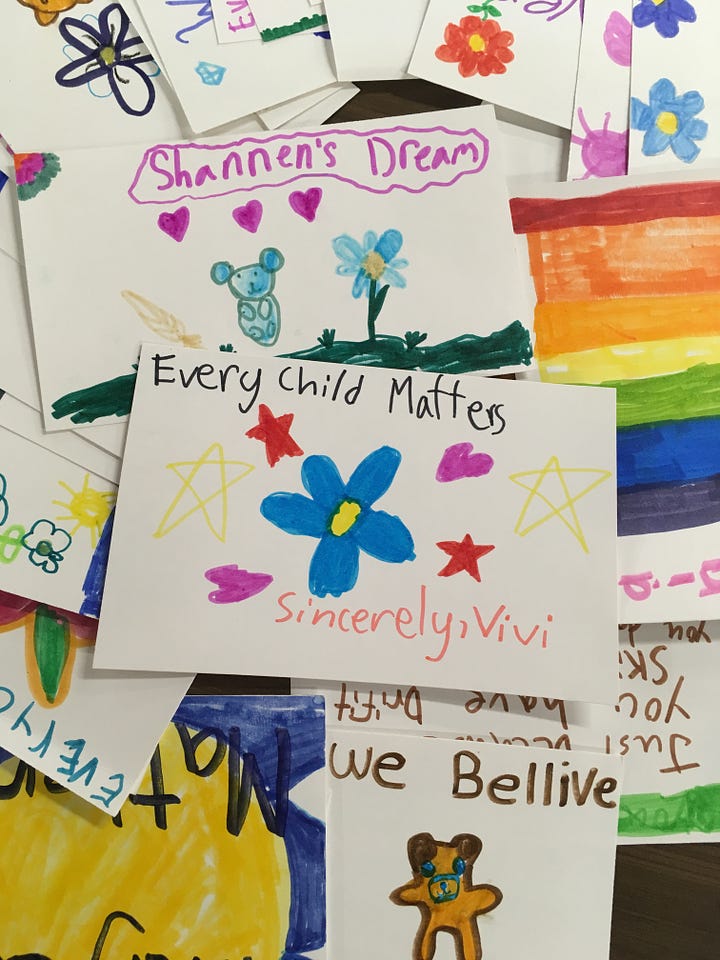
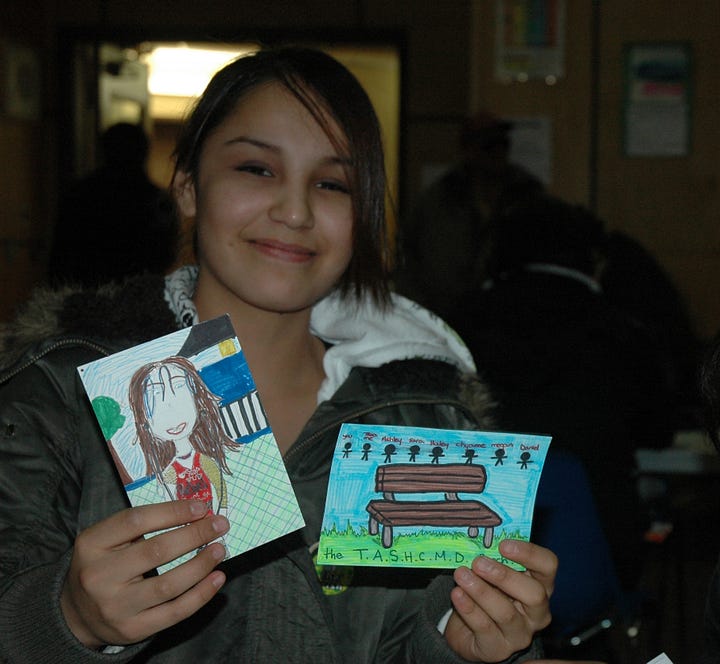
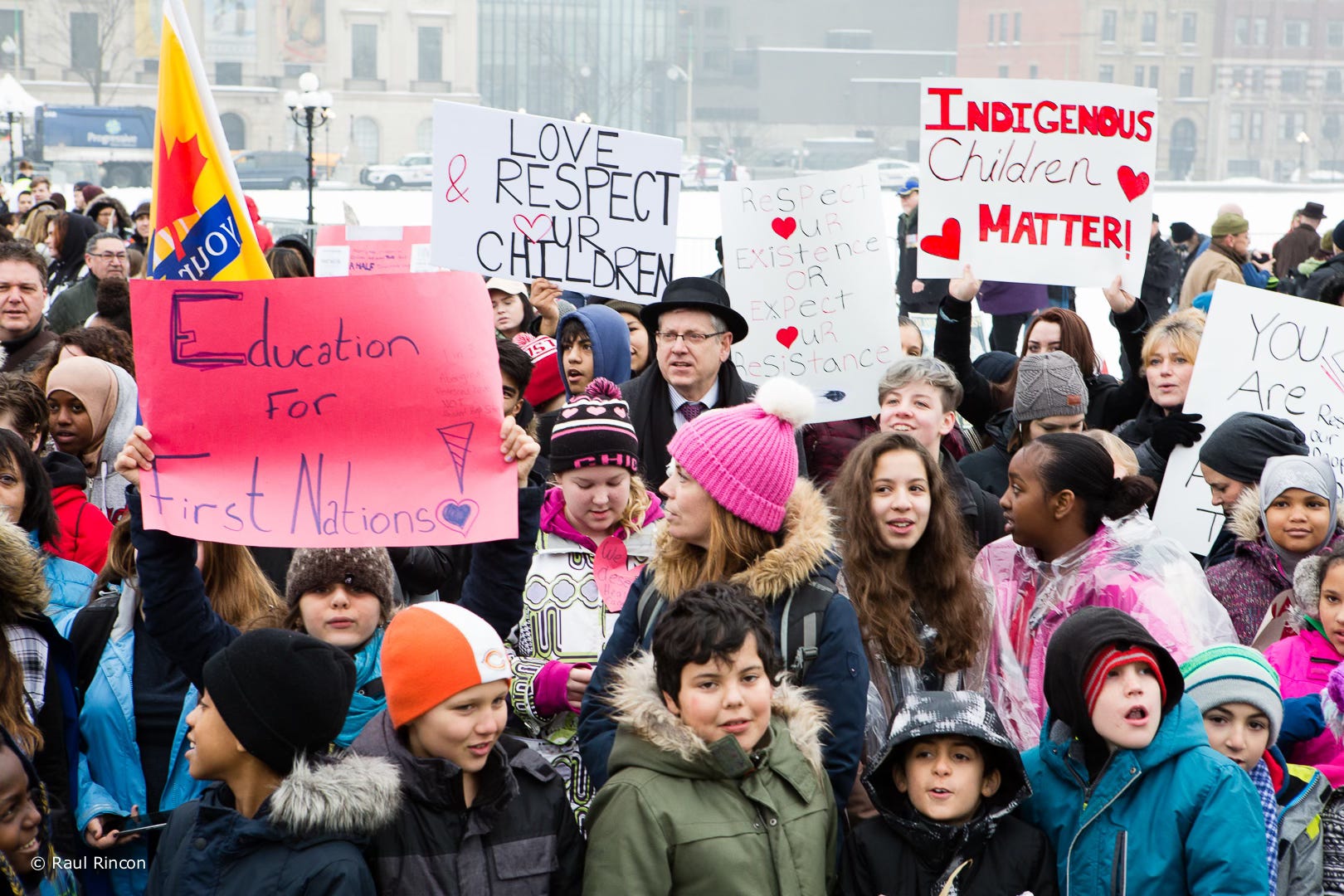
Students from coast to coast to coast responded to the call to inundate the government with letters. They wrote handwritten letters and crayon-drawn postcards. Students held solidarity protests and marched in their communities.
The children of Attawapiskat were overwhelmed with the hand-drawn postcards from communities all across Canada. These children who had been made to feel forgotten were suddenly hearing from thousands of kids who were telling them: We see you and we are with you.
The Attawapiskat school campaign was soon being taught in classrooms; it was the subject of the National Film Board documentary Hi-Ho Mistahey! and eventually reached the United Nations.
My book is an account of a struggle that is historical, political and deeply personal.
Shannen and her sister Serena lived with my family for a year when they had to leave their community to attend high school. So this is not just a story I witnessed; it’s a story that became a fundamental part of my life.
The excerpt I am sharing this morning captures the first showdown between Shannen and the government of Canada. The result of that first meeting was heartbreaking at first, but it galvanized people across Canada to push even harder.
In a way, this is where the story began.
The Grade 8 class from Attawapiskat arrived in the nation’s capital in May 2008. It was on the eve of one of a large Indigenous protest rally against the policies of the Stephen Harper government.
A meeting with Indigenous Affairs Minister Chuck Strahl was set for the morning.
The plan was for the 13-year-old youth leaders — Chris Kataquapit, Solomon Rae, and Shannen Koostachin — to speak to the minister and his officials about the conditions that they faced, and then Grand Chief Stan Louttit would lay out options for getting the school project back on track.
Louttit spoke with the three youth to prepare them for what was to come.
“Speak from the heart, and speak the truth, and you will be fine,” he said to them.
The delegation was then ushered into a large, plush room with rich cornice mouldings. To break the ice, Strahl pointed to the surroundings and asked, “What do you think of my office?”
Shannen didn’t miss a beat. She said she dreamed of having a classroom as nice as the room where he worked everyday.
As they sat down, Strahl pre-empted the discussion by telling them bluntly that the school wouldn’t be built. It simply wasn’t on the government’s list of priorities.
The delegation was stunned. What was the purpose of the meeting if the government refused to discuss options?
“We invite you to come to our community to understand our living situation,” Chris Kataquapit offered.
But the answer was no.
The elders began to cry. Shannen didn’t want to cry in front of the government, so she stormed out. Grand Chief Louttit went out into the hall to find her.
“This is not how the meeting ends. You need to go back in there and be a leader.”
Shannen wasn’t just sad she was furious. Nonetheless, she listened to him. As she stepped back into the room, Strahl was telling the delegation the meeting was over.
And this is how she later retold the story to media and supporters:
“He told me he couldn’t stay for more of the meeting because he had other things to do. We were very upset. The elders who were with us had tears in their eyes . . . But when he was about to leave, I looked at him straight in the eyes and said,
‘Oh, we’re not going to quit, we’re not going to give up!’”
The delegation came out of the meeting into a bank of media cameras. They were whisked into taxis to meet the rest of their classmates who were joining the protest march assembling nearby on Victoria Island.
There was a fairgrounds atmosphere as thousands of people prepared for the big protest march. But as soon as the rest of the Attawapiskat students saw the delegation, they knew that something was wrong.
The leaders looked tense, and the youth representatives were clearly stressed. Around them, marchers bustled and shouted excitedly for the rally to begin, but the students of Attawapiskat stood in the midst of the crowd, bereft and desolate.
Carinna Pellatt, a teacher from Attawapiskat, said that the students were determined not to cry in public:
“We stood in that circle, and the elders were crying. I cried. But the students were so stoic. I always wondered why the minister agreed to meet them if he was just going to turn them down.”
As the Attawapiskat students tried to come to terms with what had just happened, a large group of students from a Catholic school in Brampton, Ont., who had come in support, formed a protective circle around them.
Pellatt said that their presence had a profound effect on the Attawapiskat youth:
“When the students from St. Edmund Campion came to be with them, it really meant a lot. Both groups of students were shy, but words aren’t necessary with the Cree. Just to know that students came to be there with them meant so much.”
Strahl later told the media that he had simply been honest with the youth.
“I could have strung them along. But they have been strung along before.”
Walking up to Parliament Hill, the leaders were troubled by how things had turned out. These were still early days for the new Conservative government, but they seemed willing to ride out the bad publicity of being perceived as so hard-hearted toward First Nations children.
The Harper government had been pushed on the issue, and they pushed back hard. The government was now likely to dig in on the school campaign, and the momentum of the entire movement appeared to be in jeopardy.
The question we asked ourselves was what effect would this rejection have on the students? Was it fair to bring children down from James Bay only to have their hearts broken?
As we approached Parliament Hill, the rally organizers informed us that they would allow one of the young people from the delegation to speak. This was a moment to try to salvage something from what had been a very heartbreaking day.
It was decided that Shannen would be the one to tell what had happened in the meeting with the minister. When she was informed that she would be the voice for the community, she seemed panic-stricken.
“I don’t have my speech with me. I lost my notes. I don’t know what to say.”
“Shannen,” I said, “this is the moment where you need to be heard. Just speak from the heart. You’ll know what to say.”
She stood with her classmates as one national political leader after another denounced the government. Shannen had her hair pulled back in a ponytail and seemed so small and young as she stood beside these national leaders.
She was shaking with nervous energy.
She and her classmates were just kids from an isolated reserve who were now standing in the midst of a complex political struggle that stretched back generations.
One of the teachers whispered to me, “Do you think she will be okay? What do you think she’s going to do?”
“I have no idea,” I replied, “but we’re about to find out.”
When the time came, the rally organizers announced that the youth activists from Attawapiskat were on Parliament Hill, and a huge cheer went through the crowd. Shannen stepped forward to the microphone, and immediately the nervous, frightened girl who had never given a speech before or held a microphone became very poised.
“Hello, everybody, my name is Shannen Koostachin, and I am from the Attawapiskat First Nation. Today I am sad because Mr. Chuck Strahl said he didn’t have the money to build our school.”
She paused and then added,
“But I didn’t believe him.”
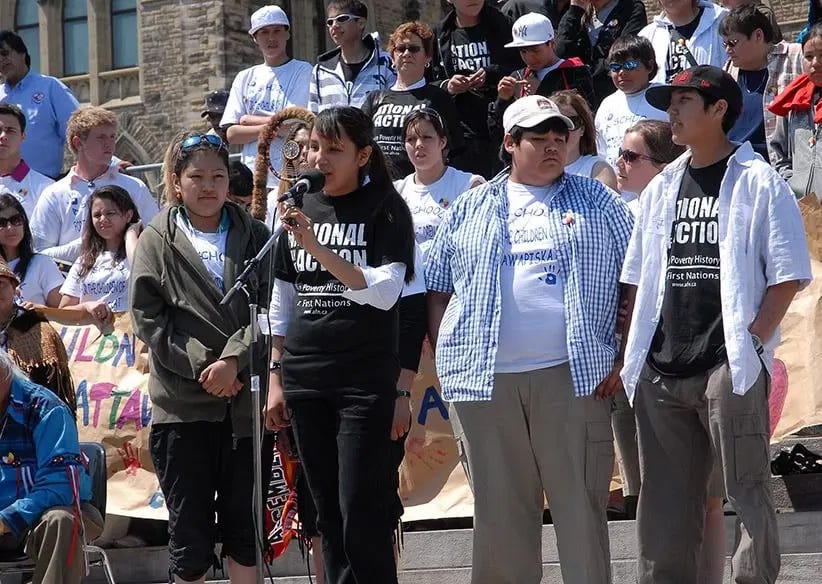
The crowd lit up. Shannen became more confident. She related the story of looking him in the eye and telling him that the children were not going away.
“And,” she said, “I could tell he was nervous.”
The crowd roared their approval.
It was a simple speech, but her heartfelt determination genuinely touched people.
The news coverage across Canada became the story of the 13-year-old girl who had never seen a real school and had stood up to the minister of Indian Affairs. Speaking to the media afterward, she related the daily humiliations of being educated in substandard conditions.
“I told [Strahl] that we will not quit until every First Nation child has a school that they are proud of, that they can call their own.”
In terms of the political impact, Shannen hit it out of the ballpark.
The day had been a hard one for the students. But there were those present who saw Shannen’s two-minute speech on the Hill as a defining moment.
In what would be a nasty and long-term fight with an entrenched government, the Attawapiskat School campaign immediately became symbolic of the much larger failure of Canada to live up to its obligations for First Nation communities.
The 13-year-old girl who had just graduated Grade 8 was now the face and voice of a new civil rights movement.
Shannen Koostachin was killed in a car accident, in 2010, before her 16th birthday while attending school hundreds of kilometres from her home.
The campaign for Indigenous education, renamed Shannen’s Dream, continued. It forced changes in Canada’s parliament and resulted in a special delegation to the United Nations.
Eventually, Ottawa agreed to fund a new elementary school in Attawapiskat. It opened on September 8, 2014.
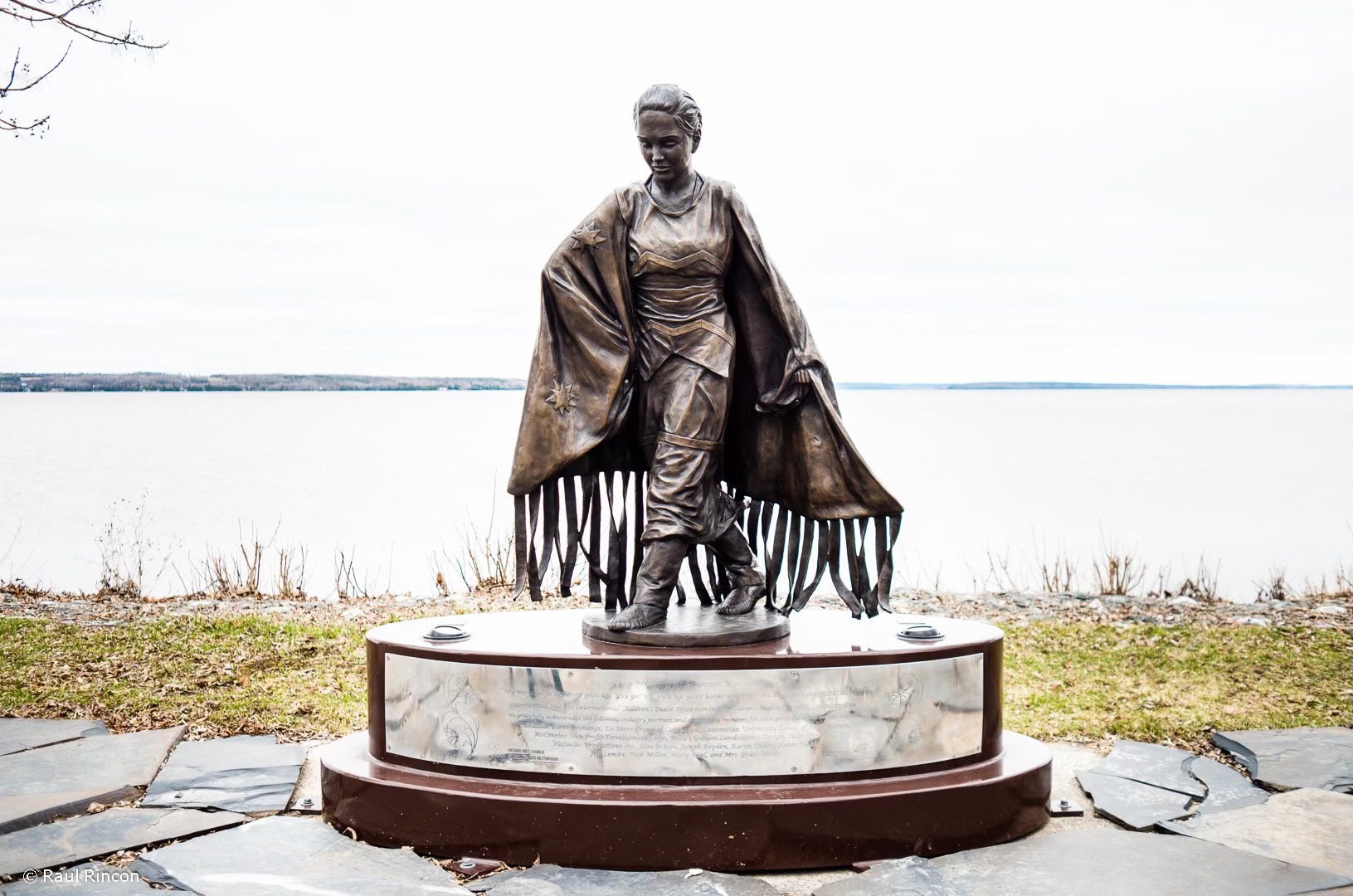
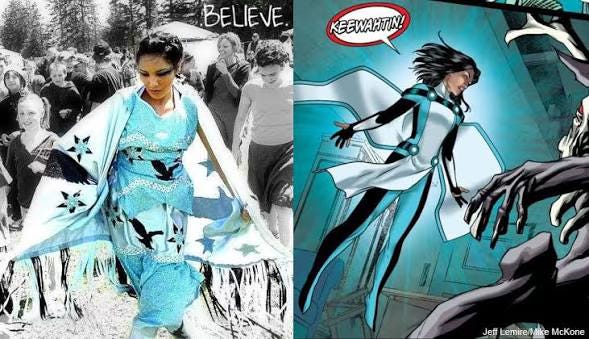
Shannen has been celebrated as one of the 150 most important women in Canadian history and in 2014 was made a superhero in a DC comic book.
If any photos or images on this site are under copyright, please let us know and we will provide appropriate credit. This content is used in accordance with applicable copyright laws, including “fair dealing” under Canadian law and “fair use” under Section 107 of the U.S. Copyright Act, for purposes such as criticism, comment, and news reporting.
This post is public — feel free to share it.
Comments
Nothing yet. Say the first thing.
Sign in to join the conversation.