

They are from two different generations, but they are both born of local newsrooms and came of age on the cutting edge of a kind of investigative reporting that is defining this moment in American history.
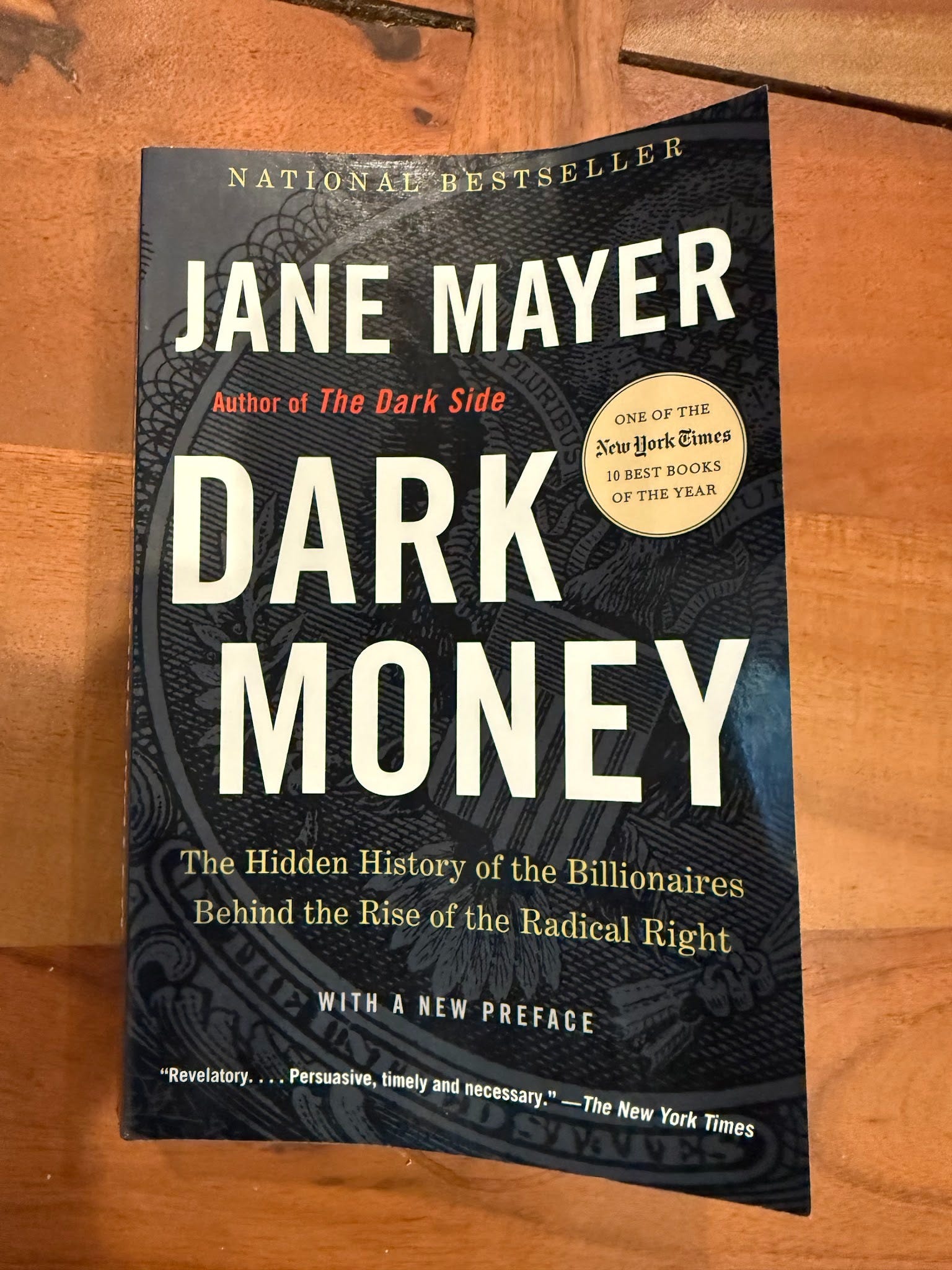
The New Yorker’s Jane Mayer, whose career was fueled by the Watergate era in 1973, was just starting in her first job at a tiny weekly newspaper in Vermont when Nixon was president but would soon be consumed by scandal and resign in disgrace. Mayer, now 71, would plunge into an illustrious career as an investigative reporter covering national politics and go on to write a searing bestseller in 2016 titled “Dark Money: The Hidden History of the Billionaires Behind the Rise of the Radical Right.”
Nathaniel Horwitz, the CEO and co-founder of the pioneering investigative news organization Hunterbrook, graduated from high school on the Island of Martha’s Vineyard and had his first reporting job in 2014 at the small newsroom of The Martha’s Vineyard Times where I serve as the publisher. Horwitz, now 30, spent eight months as a local reporter and continued on and off as an intern for a few years after that. He wrote about the gender-bending sexual exploits of the venerable horseshoe crab during a full-moon survey of the species which fishermen chop up into bait and which the biotech industry covets as an unusually reliable test for bacteria in injections. Horwitz also managed to talk his way into the White House press pool covering a speech by President Barack Obama on issues ranging from the war in Iraq to racial tensions in Ferguson, Missouri when the president was vacationing on the Island.
I was fortunate to host both Mayer and Horwitz this month at a local literary gathering hosted by The Times titled Islanders Write, where we bring together authors, poets, playwrights and journalists from all genres who share a connection to the Island and a passion for the craft and the business of writing. Mayer is a long-time summer resident who has recently bought a home on Martha’s Vineyard. Horwitz grew up on the Island and is the son of two acclaimed writers and foreign correspondents, Geraldine Brooks and the late Tony Horwitz, and he is today a renowned entrepreneur who has put together a successful hedge fund with a team of investigative reporters who trade on the same information they unearth and thereby create the funding they need to sustain their work.
On a July 14 panel discussion, titled “Writing on the Edge: New Models for Reporting and the Current State of Journalism,” Horwitz and Mayer shared their deep concern about the future of journalism, offered some hope that impactful work is still being done and laid out contrasting views on the business models that will sustain in-depth work.
(Become a paid GroundTruth subscriber at $5/month to get access to the full audio from the panel.)
Mayer started the panel by setting a bleak stage for First Amendment rights in the Trump era and a culture of fear that seems to be pervasive among the sources she relies on in Washington to reveal the subterranean forces behind political power in America. She argued that the Trump administration had recently “crossed a new line.”
“We’ve never seen in this country people more afraid of talking to reporters. People are so intimidated. Sources are drying up. There’s a sense of fear and kind of malice in the air that is something I’ve never seen in this country. I did cover at some point a few other countries where I’ve seen sort of this kind of atmosphere, but never never before here in this country.”
Mayer pointed to the July 10 subpoenas issued by Trump’s Justice Department demanding New York Times reporters to testify and to provide phone records connected to an investigative story on the extraordinarily high costs of retrofitting a plane that was gifted to Trump by Qatar and converted to an Air Force One jet. A week after the panel, a federal judge forced the Justice Department to drop the subpoenas after sharp questioning by the judge who challenged almost every facet of the government’s approach.
The Justice Department had insisted that it was acting solely in the interest of national security. It filed subpoenas on July 10, just two days after the Times published the first of two stories about concerns that led to the U.S. Secret Service interceding to prevent President Trump from flying home from Turkey on the new Air Force One jet. As NPR reported, “The case highlighted the Trump administration’s ongoing assault on press rights and the free flow of information to the public. It also provided another glimpse of the White House’s eagerness to assert an expansive definition of executive authority, as prosecutors argued the U.S. attorney general has the power to set aside legal protections for journalists when he deems necessary.”
For now, journalism and the right to a free press seem to have at least one federal judge on its side, but it is clear that Trump has set out for a war of attrition against the press, and Mayer believes we should all be very worried. She commented on the extraordinary effort to quash the Times’ reporting and how it fit in with a litany of other lawsuits and legal tactics aimed at punishing journalism and news organizations perceived as less than loyal to Trump.
“It’s going directly at reporters, and it’s basically saying you may have committed a crime for telling the truth to the country. The others were slightly different. I think they’re also tremendously important. Those were shakedowns of major legacy media companies in this country, who, in essence, decided to pay off Trump in order to continue to be able to operate, and of course it raises questions. The word that the lawyers use is chilling. It’s incredibly chilling to news organizations who are seeing that they may wind up having to pay millions and millions of dollars, or face a grand jury investigation,” she said.
Horwitz said that his investigative reporting at Hunterbrook is also about pushing back against the forces of the government and he cited a recent example in their reporting on a series titled “Poisoned USA.” Horwitz said that the administration has in recent years been hollowing out regulatory agencies that have been either destroyed or captured by the industries that they’re meant to impose guardrails around. An example he cited was the EPA, which has been weakened at a time when major industry continues to contaminate natural habitats and poison communities.
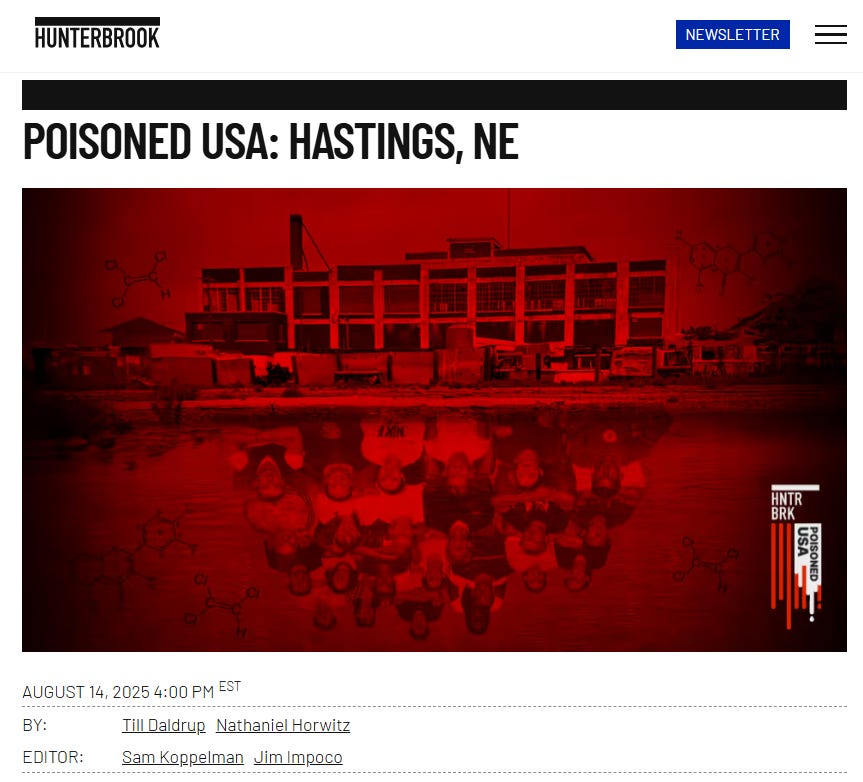
“This has already been a substantial source of illness and degradation across the country, but it’s worsened dramatically under an EPA that is controlled by former executives of the industries that it’s meant to put those buffers around,” said Horwitz, adding, “So our Poisoned USA series aims to bring together nationwide datasets on contamination and on the incidence of various diseases, with on-the-ground local news reporting across the country in the communities that are in these hotspots, where there’s an overlap between high contamination rates and high rates of various diseases.”
What is perhaps most pioneering about Horwitz's model is that it takes this time-honored tradition of muckraking and public-interest journalism, and it is building an arm of the business that then uses the information to seek compensation for those hurt by environmental damage caused by corporations and goes further to leverage the information through stock trades to garner profit that can in turn sustain the reporting. It is a controversial and complex model that is not without its critics, but it appears to be an approach that is carefully considered and gaining traction.
Horwitz explained, “It used to be very ad hoc. You might have a couple of journalists at ProPublica who might spend six months talking about a very specific community, a very specific set of people who were harmed. We found a way to financially support doing this much more systematically across the country. And the way that works is that so often the people who are sources for a story like that are also natural plaintiffs in a case against the company that’s responsible, and what’s powerful about that in what I hate to say feels often like a post-shame society is that it gives journalism real teeth because you’re not just exposing wrongdoers who can put their head down and wait for a news cycle to pass, and then not have to worry about this months of investigative reporting. But you’re arming it with the litigation, such that those wrongdoers then have to show up in court, and those people who otherwise would have just had their name and their sort of sympathetic photograph and an investigative report actually have a chance to take on that major corporation.”

He added, “While our legal system has all kinds of flaws, one of the beauties of it is that it enables a regular person to go toe to toe with a corporate giant and sometimes win, and sometimes deter that type of action. And sometimes get restitution. If you’re familiar with the movie Erin Brockovich, we think that that model is a really powerful way, both to fund the reporting as well as to really have people made whole if they’ve been harmed.”
That very important idea, that journalism should be designed to hold power accountable and to advocate for those hurt by abuses of power is really what our craft is all about. Both Mayer and Horwitz embody this idea, and there are lots of reporters working within venerated institutions like the New Yorker and innovative new models like Hunterbrook who are out there finding ways to meet this moment and do the good work of holding power accountable. In the famous words coined by humorist Finley Peter Dunne in 1902 via his fictional bartender alter-ego, “Mr. Dooley,” the job of a news organization should always be to “comfort the afflicted and afflict the comfortable.”
We can all raise a glass to that!
The Uses of ‘Treason’ | Jem Bartholomew, Columbia Journalism Review
Most Americans Lack Local News Coverage on Essential Issues | Dan McCue, The Well News
A human wrote this – believe me | Marina Adami, Reuters Institute for the Study of Journalism
‘I Promised People I Would Do Something’ | Grace Benninghoff, Columbia Journalism Review
How 8 Latin American newsrooms mapped misinformation campaigns targeting environmental defenders | César López Linares, LatAm Journalism Review
Comments
Nothing yet. Say the first thing.
Sign in to join the conversation.